The idea of rebuilding and relying on a supply of necessities near to where you live is called relocalization and is often promoted as a wise response by people aware of the simplification/collapse that will be soon be forced on us by fossil energy depletion.
The Post Carbon Institute defines relocalization as “A strategy to build societies based on the local production of food, energy and goods, and the local development of currency, governance and culture. The main goals of relocalization are to increase community energy security, to strengthen local economies, and to improve environmental conditions and social equity.”
It is common to observe cognitive dissonance, which is caused by our genetic tendency to deny unpleasant realities, in discussions about relocalization.
Un-Denial regular Kira pointed out some cognitive dissonance in a recent essay by the excellent overshoot writer ‘B’ The Honest Sorcerer. This resulted in an insightful exchange with another un-Denial regular Hideaway that I thought deserved more visibility so I have copied their comments with minor edits here as a post.
Kira:
I wonder what to make of B’s latest article? Looks like he’s beginning to struggle with a bit of cognitive dissonance. I wonder how many of his ideas are actually feasible taking into account all the feedback loops?
While it’s true that large and heavy, individually owned vehicles (and their manufacturers) are slowly going the way of the Dodo, ultra-small, ultra-light vehicles are not. Just think about it: how efficient it is to move an 80kg (or 176 pound) person in a one and a half ton vehicle? The monsters most people drive today not only take a ton of resources and energy to make, but also burn untold gallons of fuel (or kWs of electricity) to move around. I mean, there is demand for a lot of things, like traveling deep into space, but since neither the energy, nor the resources are available to do that, it simply does not happen. As soon as the penny drops that this energy crisis is here to stay, auto-makers will come out with smaller and cheaper to maintain automobiles (in both gasoline and electric versions). Many Chinese manufacturers are already well ahead of this curve producing tiny two-person cars or even miniature utility vehicles, taking up much less resources and utilizing a range of “primitive” but time-tested and dirt-cheap technologies. It’s a different question, of course, whether renown car makers can swallow their pride and come out with tiny boxes on wheels. (Or how about being spotted in one…?)
Another, even more low-cost / low-tech mode of transport to revert to in a world of much less fossil fuel energy is the plain old bicycle. Cheap, easy to maintain (at least the older models) and requires no fuel to run. And as for carrying stuff around just take a look at cargo-bikes — which is already a big thing in Europe, especially in the Netherlands. By fitting an electric motor and a small battery pack on them, these clever inventions can be cheaply upgraded into a veritable work-mule, able to carry a hundred sixty pounds of just about anything.
Hideaway:
Most overshoot aware people like B assume the collapse will only impact the vulnerable portions of our economy and not everything.
There is a lack of understanding about how a 6 continent supply chain actually works! Minerals and parts come from all over the world to make anything in our modern world. Visit any manufacturer and you will see that whatever they are ‘making’ is constructed from parts that were manufactured elsewhere. The ‘manufacturer’ might make the box that all the separate pieces fit in, or the circuit board that chips made elsewhere are soldered to.
When the economy starts to fail due to reductions in oil supply year after year, businesses around the world will go bankrupt, and production and transportation of the materials and components needed by every manufacturer to make any product will be impossible to organise in a fashion that suits the way modern industry operates.
No company makes all of the parts needed to manufacture a ‘car’, and attempts to do so will be impossible in a world of falling energy availability and businesses going broke everywhere.
To make anything, you need industrial machines that can forge, stamp, put plastic coatings on bits of metal, or coat ‘wire’ with plastic to make electrical wire, etc., etc., and all require someone else to make the machines, and they need parts and raw materials to make the machines.
Once contraction of the oil supply really gets going, 5Mbbl/d down, then 6Mbbl/d down, year after year, and economies are collapsing, governments will do things they hope will help there own people, but that harm the global supply chain and ability to manufacture anything, such as banning some exports, placing tariffs on some imports, and restricting certain activities.
With food production falling and insufficient food getting to cities, the last thing governments will be worried about is helping new businesses and industries to get started. The collapse will happen faster than governments can cope with, with failures in sector after sector across the country and everyone pleading for help.
It takes time and capital and coordination for a business to set up new production. In a crumbling world we’ll be lucky to have any old existing manufacturers operating, let alone new manufacturers.
The expectations of many overshoot aware people like Dr. Tim Morgan and B are that an economic contraction will only impact discretionary things on the periphery of civilization. This may be true at the beginning, but when oil (and therefore all energy) is in an accelerating decline, each year there will be less of everything, because energy is needed to produce everything, including for example oil drill pipe and oil rig replacement parts, which will accelerate the collapse via many feedback loops.
This chaotic collapse means that by the time we reach ‘bottom’ it will be a world without oil, without mining, most agriculture gone, billions dead, making a Mad Max world look like a party.
Kira:
It’s the year on year decline that is difficult for people to wrap their heads around because for the last 200 years all that we have experienced is an increase in energy supply. The positive feedbacks upon feedbacks pushed us at warp speed from horse drawn carts to stepping on the moon in little more than a century, which is almost akin to sorcery. This magic happened only because we shrank the world with oil to access multi-continent resources.
The cobalt of DRC and lithium of Chile are right next to a battery factory in China thanks to massive diesel powered cargo ships and diesel mining machines. When oil starts to decline the resources will move farther away each year, eventually being permanently out of reach. Even within a continent distances will increase, for instance, China’s western provinces are rich in minerals but transporting them to the eastern manufacturing area will become increasingly difficult.
It appears as though oil has altered the concept of distances for us modern humans. When people like B talk about relocalization they are not specific about the distance. Is it a radius of 10km, 100km or a 1000km? If it is 10km or 100km you may not have any easily accessible minerals or energy to make even a bicycle. If it is 1000km then it brings us more or less back to where we are today.
A microchip requires about 60 elements from the periodic table. How many of these 60 would be available within a radius of even 1000km? Without accessing six continents of resources, dense energy deposits, and thousands of global feedback loops in manufacturing, we never would have gone from Shockley’s transistor to a microprocessor. This applies to everything from a bicycle to an airplane engine.
I also think we should move on from EROEI as it may no longer be relevant in a world where all types of energy liquids are lumped together to show an increasing ‘oil’ supply. We have surely come a long way from 10 years ago when EROEI was pretty fringe, to today when governments like China’s have special committees to review EROEI before sanctioning any large energy project like CTL.
We need a new metric DRODI (Diesel Return on Diesel Invested) as this measures what is most important to modern civilization. Diesel powers everything we need to survive including tractors, combines, mining machines, trucks, trains, and ships.
Shale oil, for instance, may be DRODI negative as it produces little diesel but consumes a lot of diesel. A negative DRODI is ok in a world with surplus diesel the US can import, but without any diesel imports can the US continue any shale extraction? Seems unlikely to me.
When the diesel supply falls our ability to shrink and reshape the world to our liking goes away.
Hideaway, I want to add that observing your debates with Dennis Coyne at Peak Oil Barrel has taught me that a good way to evaluate any proposition is to deconstruct all the components and then apply the circumstances of no diesel and very low ore concentration to it. I have been training myself to do this. With this insight we can see that the only way you can make even a bicycle is if your community is within a 50km radius of a mine with accessible coal, and an iron ore mine with float ores, with access to machines like lathes, and people with expertise to do everything required. This might be possible today or even at the beginning of the energy downslope, but impossible near the end.
Hideaway:
Thanks Kira, you seem to understand the problems caused by energy depletion that multiply on top of each other. Localization is not an alternative for 8+ billion people. We rely on massive economies of scale that result from cities and a 6 continent supply chain. Sourcing everything from the ‘local area’, as in walking distance of a day or less, means a massive simplification of everything.
No one lives within a day’s walk of a coal mine, and an iron ore source, and a smelter that can operate without a source of electricity, plus food. The old smelters didn’t use electricity to drive the huge motors moving heavy hot metal and slag around. The first smelters were close to coal and iron ore sources, but we used them up, they no longer exist close to each other.
In the year 1500 we had a world population of around 450 million and grew massively over the next 250 years to the start of the industrial revolution by increasingly using the resources of the ‘new world’. We’ve been on an upward trajectory ever since, especially since around 1800 when fossil energy came into use.
People just don’t understand our extreme (and still growing) overpopulation problem given the imminent decline of oil, and especially diesel. Assuming “we’ll downsize this” or “relocalize that” ignores the fact that once oil supply shifts to contraction, the declines will be permanent year after year, and with diesel shortages the ability to build anything new all but disappears.
It will be a sad sight with suffering everywhere and increasing year after year. Survivors will have to be hard people, protecting and providing for their own, at the exclusion of others.
Everyone should look around their home and imagine it without the oil used to produce and deliver everything in it, because that’s the world of the future, with old decaying cold buildings and no food in cities.
Kira:
To be fair to people who advocate for simplification, as I also often do, the complete picture of our predicament only becomes visible by looking at both the supply and demand side. If you only consider supply the mindset of resource substitution can creep in. Tim Watkins recently wrote an excellent article that explains the supply and demand squeeze that is causing the “Death Spiral” of industries. He chose as examples the communication and airline industries but the idea applies to all industries.
Watkins defines “critical mass” as the minimum number of people needed as customers to maintain the complexity and economy of scale of any industry.
As I understand it, money is a lien on energy. When we pay Apple for an iPhone that lien is then given to Apple. Apple then uses it for direct energy purchase or passes it further down the chain till it reaches the bottom of the chain which is a mining company in Africa, South America, Australia, or Asia. The larger the critical mass, the more collective lien there is to increase complexity, or reduce cost, or both.
This is how solar panels, which were originally affordable to only NASA, are now affordable to even rural villages in Africa, as the critical mass and therefore the total energy lien of NASA has been far exceeded by a large number of customers using their discretionary income (lien) to buy solar panels. The complexity and efficiency has remained more or less the same but the cost has gone down.
When this process reverses and critical mass decreases, the profits of companies will decrease until they are losing money and need government bailouts. But governments cannot afford to bail out every company and will prioritize sectors critical for survival like agriculture and defense.
Soon every industry will enter the dreaded Death Spiral.
Rob here on 17-Sep-2024 adding a follow-up by Hideaway and Kira.
Hideaway:
‘B’ The Honest Sorcerer has a new post up with a lot of content that we understand and discuss here.
https://thehonestsorcerer.medium.com/the-end-of-the-great-stagnation-45473b60d243
Although GDP figures suggest otherwise, people of western (OECD) economies are in fact trapped in a great stagnation lasting for fifty years now. During these decades real wages struggled to keep up with inflation as neoliberal economics and globalization ruled supreme. Meanwhile, the wealth of the top 10% — and especially that of the top 1% — has kept rising exponentially, together with debt levels and the chances of a major financial meltdown coming sooner, rather than later. But could it really happened otherwise? Are the lucky few really behind the steering wheel when it comes to economic growth, or are they just that: the lucky, greedy, clueless few who are just riding the top of the wave while it lasts?
One aspect that B and many others in the peak oil/end of growth/collapse world miss, which guarantees our situation is much worse than most assume, is scale and complexity. We require economies of scale with our huge population to build the millions of complex parts that support modernity. When we lose scale or complexity it will take more energy and materials to keep the system running.
Localization doesn’t work, and can’t work, with the complexity of the modern world, because we have exceeded the scale for making ‘widgets’. If you require 500 ‘local’ factories to make widgets, that used to be produced by 10 factories around the world, it will take a lot more buildings, machinery, energy, and workers to produce the same number of ‘widgets’ for the world.
Multiply this by a million for all the different ‘widgets’ modernity uses, and consider that we can’t discard 80-90% of the ‘widgets’ because most are required to run modernity.
A lower population creates similar problems. Our cities still require maintenance, but with a lower population the taxation to pay for it becomes too high for an individual to afford. The number of people available to work in factories falls below that required, and the number of customers falls causing businesses making widgets to go bust.
The more I research how our civilization works, the more confident I become that civilization’s collapse has been certain from the beginning. There never was a way out once our species decided to live in a ‘civilized’ world instead of the natural world.
Every conquered culture around the world, when given a taste of modernity, grab it with both hands. A few people, especially the elderly, lament what’s been lost, but they too make use of modern appliances and conveniences. We no longer have the wild animals that people could hunt like their ancestors to survive. I shake my head in disbelief when I see native peoples trying to return to their ancestral hunting lifestyles by replacing their wood canoes and spears with aluminium boats with outboard motors and rifles.
A HUNTER has hit back at calls to ban dugong hunting, saying there’s no proof the animal is an endangered species despite its global classification as ‘vulnerable’.
Using all available resources to expand its population is what every species that’s ever existed has always done until some limit is reached. Consider at a mouse plague, enabled by human agricultural practices, with its huge population until the next frost or the grain is eaten, then a massive die off in a short time.
Whenever we read someone calling for more recycling, more repairable gadgets, more solar, more wind, more batteries, more recycling plants, more localization, etc., we instantly know the person doesn’t yet understand the big picture. They are in denial, still searching for answers.
People in cities will not be able to ‘grow’ their own food. In Melbourne, my nearest large city, all the old backyards were subdivided off and townhouses built where people use to grow some vegetables. Now there is just no room. We would need more tools, more land, more seeds… Oh, there’s that little nasty expression “we need more”, which simply wont happen.
“It won’t happen” also applies to the many other things we would need more of to relocalize our world.
We should live and enjoy every day, and not feel guilty, because there never was anything any of us could have done to change what’s happening now or will happen in the future.
One of these days the power will be off and the internet will be down which will signal the end, because our leaders knew there was no future and decided to end it all quickly.
Kira:
Good points Hideaway. I want to add that people underestimate the difficulty of growing food since most of them have never had to do it and assume a few urban community food gardens in vacant parking lots or backyards will suffice when fossil fuels are gone.
There are articles on how Cuba managed to move food production away from oil dependence after the Soviet collapse that reinforce this false narrative. I believed it myself for a few years but none of it is true. Cuba’s per capita fuel consumption is on par with Eastern European countries, always has been, yet still imports a lot of food, especially grains. Here is Cuba’s yearly oil consumption:
Cuba’s population has plateaued for decades so the decrease in consumption can probably be explained by an increase in efficiency.
Without potash, phosphate and nitrogen there is no feeding even a billion people.
Another topic commonly ignored is security. Even if you could somehow grow your own food, protecting it from raiders will be a massive challenge. A hallmark of modern states is its monopoly on violence and the umbrella of safety it provides. When states lose their ability to impose their will (which is certain once fossil fuels become scarce) and the threat of consequences disappear, the safety we take for granted will also disappear.
There is a good movie called The Survivalist released in 2015 that nicely captures this tension. Unless you join a sizable community of people you fully trust that is capable of defense there is no point in trying to grow food.
The certainty of collapse, knowing that this is how it was always going to be, knowing that the horrors we inflict everyday on the biosphere and on our siblings in it in the pursuit of being “civilized” will come to an end, and knowing that our arrogance of having conquered mother nature using the gifts she provided will also end, is very comforting.
Rob here on 24-Sep-2024 adding another interesting exchange between Kira and Hideaway from the comments below.
Kira:
I think B’s article was pretty good today cutting out all the noise of simplification and going straight for the core of the issue.
https://thehonestsorcerer.medium.com/2030-our-runaway-train-falls-off-the-seneca-cliff-cd51db4e7dfb
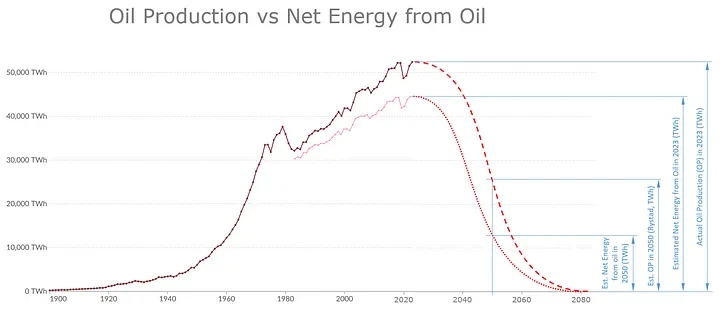
I had a few questions about this graph. I have seen this before and it has been mentioned on this site as well. This is the study but is it accurate?
https://www.sciencedirect.com/science/article/abs/pii/S0306261921011673
If our destination in 2050 is 1/3rd the amount of energy from oil that we get today, what happens on our way there especially with the economy?
Hideaway:
Hi Kira, have a close look at the graph and notice the exponential rise from around 1950 to the early 70’s. Hubbert showed that the rise and fall of world oil production should have followed a normal distribution curve, like individual oil fields tend to do.
When OPEC raised prices and the world realised oil was a finite resource there was a huge change and we implemented many efficiency improvements and substitutions (mostly gas) for oil use. The growth in oil production changed from exponential to linear, and instead of rolling over as predicted by Hubbert, has continued to rise.
We have been dragging future use of oil into the present for the last 25 years, while still growing overall oil extraction, as reserves deplete. Think about oil producers around the world. They have older wells still producing at EROEIs of 20-30:1 or more, plus newer wells in harder to reach places with much more expensive infrastructure and processing. The older wells that paid off their capital costs decades ago are easily the most profitable. They generate the most cash to keep the system going, however it’s the newer wells like shale oil, tar sands, deep water, etc. that help keep the overall price of oil lower.
Which are depleting faster? The old profitable wells, because the trade of goods and services runs on dollars and profit, so oil producers need lots of dollars coming in. Whenever the Saudi’s turn down production, it will be the expensive oil they reduce, not the cheap easy stuff, unless they desperately need to rest fields to protect future extraction.
What this leads to in our world of capitalism economics, is all the high EROEI wells depleting around the same time, just as the cost of maintaining production rises rapidly, because the wells are so much more expensive relative to the oil produced.
Complexity also enters the picture because the extraction processes for newer oils are highly complex operations. For example, horizontal drilling relies on sensors and computing power to keep the drill in exactly the correct strata, 10,000 feet below the surface. The oil sands extraction process uses large modern machines with the latest computers and sensors to maintain optimum efficiency.
Once the easy high EROEI oil is depleted, the remainder becomes much harder to extract because supply lines of equipment and spare parts become less reliable due to reduced economic activity, making everything required to support the complex processes harder to obtain and much more expensive.
Rapid loss of oil production quickly leads to higher oil prices and shortages, with businesses closing as people reduce spending, as happens in every recession, however the declining oil supply will accelerate as other high EROEI wells also reach total depletion, exacerbating the overall problem, with newer oil sources not keeping up with the declines. Deep recession leads to businesses shutting and restricted trade as countries can no longer afford imports, which causes more businesses to go bust.
Factories that earn 10% of their revenue from making essential ‘widgets’ for the oil sector go bust because the other 90% of their business starts operating at a loss, and it is impossible to restart the manufacturing because critical machinery was sold off for scrap in a clearing sale.
Thousands of factories stop making parts critical for a complex system. Without parts, oil rigs and refineries can’t operate, which brings down the entire system.
For us here at Un-Denial, it’s pretty obvious what happens next as the problems will mount and cascade affecting many businesses unexpectedly, thus triggering a self-reinforcing decline.
Most importantly, although demand for oil will fall with recession, oil will not become cheap because supply will also quickly fall. There will not be investment capital available to extract new marginal oil, especially in the Middle East where populations will be suffering from the high price of imported grains and other food, that will become difficult to purchase on the open market. Food exporters will struggle due to high diesel and fertilizer costs and will be forced to reduce production.
Then the next year oil supplies will fall another 5 Mbbls/d, and again the year after, and soon it’s over and most people will be left wondering how those in power let it happen or couldn’t see it coming…
Kira:
Thanks for the explanation.
I hadn’t considered at all that even within countries like Saudi Arabia and Kuwait you will have different EROEI fields. It makes economic sense to keep running the high EROEI wells to get most for your barrel of oil. After reading your explanation I was curious to see the status of old oil fields, the giants and super giants which are collectively responsible for the majority of our crude oil, but most importantly as you pointed out, high EROEI oil. This is the list from wiki:
https://en.m.wikipedia.org/wiki/List_of_oil_fields
Most supergiants were discovered more than 60 years ago. Taking the top two as example Ghawar and Burgan. They both started production nearly at the same time and apparently peaked at the same time (2005) although Saudis don’t confirm it. Ghawar seems to be declining at 2.5% annually and will be down to 2.5 million barrels from a peak of 5 million by 2030. I am sure Saudis are doing everything possible to slow the decline now which will make future decline worse.
It appears as though oil fields like Ghawar are subsidising the extraction of the low EROEI oil like shale and tar sands. The energy comes from the old ones and the volume comes from the new ones, keeping price low and maintaining the illusion of abundance. It’s quite deceptive when you think about it. The net energy keeps depleting while the volume remains same or even increases for a while.
Companies that make generators for offshore oil rigs are a great example of economy of scale tumbling. They probably make generators for hundreds of clients who are not oil companies, when these clients can no longer afford their product the critical mass is lost and they go out of business. Oil companies cannot keep them in business single handedly. This can be applied to other things like pipes as well. This is what the death spiral of the oil industry will probably look like.
Hideaway:
I was thinking when reading your post Kira, yes, yes, yes, yes, yes. I certainly couldn’t have written it better.
On the oilprice.com webpage, there is this article….
https://oilprice.com/Energy/Crude-Oil/Arab-Gulf-Producers-Are-in-Need-of-Much-Higher-Oil-Prices.html
After enjoying a rare budget surplus in 2022, most Gulf Cooperation Council (GCC) economies are seeing their budget deficits widen with current oil prices still well below what they require to balance their budgets. According to the IMF, Saudi Arabia, the GCC’s biggest economy, needs an oil price of $96.20 per barrel to balance its books, thanks in large part to MBS’ ambitious Vision 2030. The situation is not helped by the fact that over the past few years, the oil-rich nation has borne the lion’s share of OPEC+ production cuts after agreeing to cut 1 million barrels per day or nearly half of the group’s 2.2 mb/d in pledged cuts. In effect, Saudi Arabia has been selling less oil at lower prices, thus compounding the revenue shortfall.
Imagine how they cut back, will it be the most profitable oil wells or least profitable ones, when they are so desperate for revenue? Obviously the least profitable ones get reduced while the cheap easy to get oil gets depleted quickly.
What could possibly go wrong when all the cheap high EROEI oil extraction starts declining rapidly just as shale oil uses up its tier 1 and 2 locations…
Perhaps we should have been called Homo dumbass, because we are definitely not ‘wise’.
Rob here on 15-Oct-2024 adding some fresh calculations by Hideaway on the expected speed of collapse, and a response from Kira.
Hideaway:
An aspect of our situation I’ve been thinking of putting down in writing with numbers, so that people can get a better understanding of the collapse ahead…
In regard to oil, we are mining around 100Mbbl/d which will roll over at some point in the near future..
According to some paper I read recently, we currently use around 15.5% of oil to obtain oil and this will rise to 50% of the energy by 2050.. From this paper…
https://www.sciencedirect.com/science/article/abs/pii/S0306261921011673

At the same time as this is meant to be happening, we will be mining a bucket load more metals and minerals for the transition.
What people find so difficult to do is to put several aspects together, to see if it can work, so I’ve decided to try below.
Assuming the increase is 1Mbbl/d/yr in the energy used to gain oil, which is easily possible as we’ve mined all the easy to get oil and only have the harder, more distant supply left, plus allowing for oil production to roll over to a decline in production we get the following…
I’ve used a fall of oil production of 1Mbbls/d for years 2,3 and 4, then 2Mbbls/d for yr 5, and 6, then 3Mbbls/d, for year 7, 4Mbbls/d for yr 8, 5Mbbls/d for yr 9, then a maximum of 6Mbbls/d for years 10, 11, and 12. At no time does the depletion rate go over 10, in these 12 years…
Year 1 …production 100Mbbls input energy 15.5Mbbls … Left for society 84.5Mbbls
Year 2 99M ………………………….. 16.5M ………………. 82.5M
Year 3 98M…………………………… 17.5M ………………..80.5M
Year 4 97M ………………………….. 18.5M ………………..78.5M
Year5 95M ………………………….. 19.5M ………………..75.5M
Year 6 93M ………………………….. 20.5M …………………72.5M
Year 7 90M ………………………….. 21.5M …………………68.5M
Year 8 86M ………………………….. 22.5M ………………….63.5M
Year 9 81M ………………………….. 23.5M …………………..57.5M
Year 10 75M ………………………….. 24.5M ……………………50.5M
Year 11 69M …………………………… 25.5M …………………….43.5M
Year 12 63M …………………………… 26.5M ……………………. 36.5M
Because of the combination of more energy cost of energy (a la Tim Morgan), plus just plain slow decline, the available oil for the rest of society has gone from 84.5Mbbls/d in Year 1 to 36.5Mbbls/d by year 12..
But wait there’s more.. Assuming mining uses 10% of all energy, while in oil’s case makes it around 10Mbbls/d, we know that mining has to increase greatly for the ‘transition’. With the massive increase required, just assuming a 10% increase per year would be conservative, as we are talking a magnitude more copper, Aluminium, Nickel etc, plus all the steel in wind towers and solar farm foundations being built in the TW scale every year etc.
Mining’s use at just 10% growth rate goes from 10Mbbls/d in year 1 to 31.4Mbbls/d in year 12..
When we add this into our calculations of oil available for everything else, we go from 75Mbbls/d in year 1 (100 – 15.5 – 10 = 75Mbbls/d) to 5.1Mbbls/d (63Mbbls – 26.5Mbbls – 31.4Mbbls= 5.1Mbbls/d) for everything else other than oil production and mining..
The above assumptions are very conservative assuming oil doesn’t decline by more than 10% in any one year, that oil used to gain access to more oil goes up by only rises by 6.5%/yr at most, then the growth rate declines (unlikely), plus the 10%/yr increase in oil going to mining wouldn’t get us close to climate/transition/renewable expected growth rates…
Even with those very conservative assumptions, we go from 75Mbbls/d for “everything else” to 5.1Mbbls/d for “everything else” in just 12 years after reaching maximum possible oil production. It clearly can’t and wont happen that way!!
We’ve been dragging future oil use into the present for the last 40-50 years, as shown by the linear increase in oil production since then, whereas we had an exponential rise in production before then.
The above is just putting together 3 aspect of our modern world, instead of concentrating on one and assuming everything else stays constant as just about every ‘model’ does that I come across from ‘experts’ in various fields..
The big question is what happens instead of the above??
Do we cut back oil spending on gaining oil, so that the depletion of existing oil happens much faster than 10%/yr?
Do we cut back on mining so that the transition dies a lot earlier?
Do we assume we will find a magic energy solution to all our problems?
Do we just assume oil production will never decline quickly… because….. just because we don’t want it to???
I didn’t realise how bad the numbers were until I just did the simple calculations and put it down in writing. To me it means we collapse well before the 12 years are up after reaching peak oil production because of many feedback loops creating chaotic disruptions on the way down. Every year we remain close to the peak of oil production, means we are dragging more future oil to the present, meaning the decline when it starts to accelerate will likely be much faster than the sequence above…
Kira:
Excellent analysis!! I just want to mention that the oil that goes into getting oil is mostly in the form of diesel yet only about 75 million barrels that we extract today is the kind of crude that can be refined into diesel. The rest of oil is either shale, NGL, Biofuels among other things which have their uses but not as diesel.
There was also a video that was posted here about a gentleman who mostly agreed with what we discuss here about the irreplaceable nature of fossil fuels and the shortcomings of so called renewables but believed that there is so much oil out there that we will never run out, that we can have shale revolution after shale revolution. There are many who subscribe to this school of thought and think we can extract shale oil and gas from formations in Argentina, Russia, China and many other such places. Art Berman (who has expertise in this area) on Nate Hagen’s podcast has stressed several times that the geology of American shale is very unique and the shale revolution cannot be repeated anywhere else.
If one needs any proof of this please look at China. Despite the CCP pushing the state oil companies hard to extract shale deposits for years gas out has reached only about 30bcm per year which is less than 3% of American output. Part of the reason is the remote location of the deposits in the northern part of the country but we are talking about a country that can create entire cities from scratch within a few years. This is a matter of National security for the Chinese but the geology is the problem and has been unyielding so most efforts have been fruitless and abandoned.
As far as depletion goes even if we take super optimistic figures given by Rystad which predicts that oil production will be down to 50 million bpd by 2050 then the oil available by energy would be worth only about 25 million barrels. This is just a slightly stretched out version of numbers given by you.
It is interesting excersize to speculate on how things will play out on the downslope.
At the beginning of this downslope the airline industry will be the first casualty. Consuming about 8 million barrels of oil and mostly middle distillates at that, this shutdown will provide a much needed relief to the energy constrained world. Of course the commercial airplane manufacturers namely Boeing and Airbus will also go out of business. It is unlikely that governments will have any interest in bailing them out even if they had the ability which they won’t. The tourism industry which depends on air travel will also collapse, as will countries entirely dependent on revenues from it. Depletion will soon catch up and the gutting of industries will start again but this time it won’t be something discretionary and superfluous like air travel. This time industries that touch all our lives will start competing for the remaining share of energy.
Rob here on 7-Nov-2024 adding Hideaway’s answer to a question by ABC on whether Dr. Simon Michaux’s proposed solution of Thorium reactors and iron powder will work.
My take on why this type of future can’t happen is because Simon Michaux misses complexity and scale in the argument we can go to this type of future…
Let me explain, we can only have the complexity of nuclear power and running everything off electricity with an enormous scale of the overall human enterprise we call modern civilization. The scale of this complexity would require much larger markets than we currently have as the number of ‘widgets’ needed to be made for all the complex machinery would be greater than today.
We only have the complexity of today due to the total scale of everything we do. The highly specialised nature of building the best computer chips as an example happens in one place Taiwan with TMSC. The facilities they have built to make these computer chips can only be as sophisticated as it is because of the global scale of it’s customers. To build and operate 50 such facilities around the world would not be possible, they would all go broke. The scale of the facilities built needs the scale of the market size.
To build cheap thorium reactors or any SMR, the “modular” being the important point, would require a massive market as the factories involved, down to the smallest widget all have to be working in co-operation so everything fits together perfectly, so the market needs to be massive so everyone in the chain can make a profit. It also means all the suppliers of parts have to be operating smoothly and at large scale to supply all the inputed metals and minerals.
This all requires the existing system to be maintained while we get the growth in scale of the industry which relies upon the growing demand for the new products from the markets.
Notice how there is growth at every stage to make it all happen!! So if we had a spare planet or 2 of resources to use to accommodate all this growth, then we might get to a more advanced technological civilization, however running into limits of everything we currently use, because of growing energy cost from energy access itself to everything else mined, means we can’t get that advanced.
Also note that to get to where we are today in regards to the totality of civilization has taken growing energy use of all types for over 250 years. It’s been oil that has allowed for the increases of coal and gas use over the last 100 years. All the renewables plus nuclear and even modern hydroelectricity all rely upon oil themselves, and upon oil for the cheap coal and gas used in their production.
If we didn’t care about the environment at all and had another 2 earths worth of oil on this planet, then sure we might get to thorium reactors everywhere, but it will still all rely upon oil.
As oil production starts to rapidly decline, sometime in the near future, I have no idea exactly when, then the ability to keep our modern complexity will quickly unwind. We are getting a ‘sniff’ of this at present by all the countries that want to relocalise so much production, which isn’t possible as we lose the economies of scale of the current globalised system, unless there is an accompanying simplification as well. However no-one is planning for a simplification, the actual plan is to make aspects of the modern world at home. All these plans will quickly realise that they rely on imports of most/all the parts and the relocalisation is not very economic because of smaller market size.
Of course all the duplication everywhere is more inefficient using both more energy and materials to build and taking more people to operate and maintain. We lose some of the existing efficiency in the huge scale of many operations by trying to relocalise them.
What it means by even trying the relocalisation is that the population as a whole gets poorer because of inefficient use of energy and materials (unless we had spare planets worth of all these on this planet!!), due to lack of scale and overall the complexity has to fall to match the energy we have.
Please also note we have no shortage of any material on this planet, just a shortage of energy to access lower grades, and all the processing involved in making them useful goods. It all comes back to existing energy availability within the scale of complexity of what we have as current civilization and we can only build a lot more of any one aspect, while the entire system operates normally. Normally being in growth mode, providing the capital, goods and services required in the usual orderly manner to open new mines. Which means the population needs to be well fed and educated, with abundant services continuing to operate throughout.
We can’t take energy and materials away from one sector to go to another as the odds are they use different aspects of modernity and it’s not a simple swap, with whatever being constrained having feedback loops that are unexpected.
Anyway back to thorium reactors. The industry needs to grow and develop naturally in a world of increasing demand for this product, so it can develop naturally, which takes the rest of the system growing normally. Eventually factories that could build SMR would develop, providing the capital and operating costs were a huge advantage over the existing forms of energy. This can only happen in the background of our system operating ‘normally’, ie growing economies. It can’t be forced, as any developments of forced, as in uneconomic simply don’t last as industries when times turn tough.
When we get a real recession/depression brought on by oil getting more expensive for every other industry, all the expenditures on solar, wind, nuclear and batteries will probably start falling fairly quickly, as these expensive subsidised builds lose market share, as they are too expensive, even for a product (electricity) that is only one aspect of our energy use.
All heavy industry needs a constant cheap energy supply, often in different forms at the same time to produce the raw materials that feed our modern consumption. Without coke, coal, gas and plastics many of the items of modern civilization simply wouldn’t exist at all, so build a huge array of thorium reactors with say the last of the fossil fuel energy available, solves no problems. We wouldn’t be able to make the products we use today with just electricity.
If we were to build fancy new recycling facilities that somehow made use of all existing plastics for re-use in original forms, the whole enterprise would suffer the same entropy and dissipation as everything else and winds down fairly quickly, plus requires a rapidly growing system of modern civilization working normally in the background while it’s built to the scale and complexity required.
Every argument of how we can power a new civilization with solar, wind, batteries, nuclear, thorium or whatever form of electrical energy in the future, argues for a smaller supply of energy needed than now because fossil fuels are inefficient, we only use 25-50% of the energy (depending on the machine). It’s a terrible argument as the increase in the modern civilization growth to get to that point, would mean a much higher energy use than at present, just because of the growth in scale and complexity of everything to just build this future.
Someone should ask Simon Michaux or any other expert about the clean green future whether from renewables normal nuclear or thorium, about how much of it can be built without using fossil fuels at all, including down to the plastic insulation on all wires. The usual answer is it can’t be done yet, but improvements in technology and increased use of renewables/nuclear and how cheap they all become will allow it to produce synthetic fuel for these types of purposes.
I usually counter, with how none of it’s being done now, yet renewables and nuclear are already claimed to be cheaper, so all new factories would already be going to the cheaper ways if it was true, but no-one is doing it, so something is very wrong with the narrative. The argument usually flows to climate reasons why we have to move away from fossil fuels, which is unfortunately a different argument, because the energy required to then mine all the minerals to build this fantastic green future simply doesn’t exist without the use of fossil fuels.
We are in a total and utter catch 22 where we require cheap fossil fuels to build everything and maintain the current modern civilization, which collapses without their use leaving 8 billion cold, angry starving people looking to survive. Using another 2 planets worth of fossil fuels to build the entire renewable/nuclear/thorium future with electricity used for everything, including making plastics and synthetic fuels, will leave the climate and environment in ruins, then collapse anyway, when we turn off fossil fuel use, as that is a sudden energy loss when we continue to require more minerals and metals from the environment, due to those lost from entropy and dissipation, and the increase energy use from all the movement of materials for recycling..
I didn’t even get around to mentioning that a world of recycling everything as much as possible, uses fossil fuels for all the processes anyway, but that’s another story. It’s an incredibly complex situation we are in and any ‘easy’ sounding solution will simply not work as the proponent forgets we spend 97-98% of all our existing energy and materials on just maintenance of the existing system with only the other 2-3% going on ‘growth’ of everything.
Any one new major investment into a great sounding idea on a world wide scale, can simply not work by spending less than 1% of energy and materials use on it, unless the entire system of energy and materials grows massively. As the entire system has to grow, the number we start from in the future will be much higher energy and material use than it is today. The scale and complexity has to also grow to allow for more efficiencies in the system. the starting base of energy use in 30 years time will be double of what it is today..
If we don’t ‘grow’, then we can’t maintain existing subsystems within our civilization, as we need an increasing quantity of energy just for maintenance of material availability. The system can’t work ‘normally’ without the increase in energy, even without growth in the overall system. If we shrink the market size, then we can’t maintain the complexity of the current system either, as the affordability of the complexity goes down, so the system simplifies, which makes gaining access to lower grades of everything much more energy intensive as less complex equipment will mean lower recoveries in mining, lower food volumes from a given area of land etc.
Oops, sorry for excessively long answer. Our civilization is highly complex and so is the reason why none of the bright green ideas can work, and neither can a shrinkage of population while maintaining modernity, but hte attempt to do so, will lead to collapse of it all.
Rob here on 14-Nov-2024. Hideaway and ABC had an opportunity to ask some questions to a couple important leaders in the overshoot awareness community, John Michael Greer and Simon Michaux. Following are the questions and answers plus follow-on commentary from Hideaway.
A.) How can we have modernity without the scale of market size that we currently have to enable the mining, processing, distribution then manufacturing of the huge range of parts that go into making every aspect of modernity?
We can’t. It really is as simple as that. Modernity, as Dr. Richard Duncan used to say, was a transient pulse waveform a one-time, self-terminating affair.
B.) How do we make the machines that make the final product machines in a scale down world?
That asks the question the wrong way around. The right way around is “what kind of final products can we afford to have, given all the constraints on producing them in a deindustrializing world?”
The answer won’t be clear for several centuries, but it’s unlikely that any technology invented since 1900 or so will be included.
C.) How is it possible to maintain complexity, such as a thorium reactor and all the machines it powers on only a small scale?
I’m not a specialist in this technology, of course.
I’m open to the possibility that it can be done, but I want to see an affordable example first.
As we’ve seen over and over again, every nuclear technology is cheap, clean, and safe until somebody actually builds it…
D.) Where do the materials come from after many cycles where entropy and dissipation have worked their magic over many cycles of recycling?
Oh, in the long run say, another 10,000 years we’ll have to go to entirely renewable resources, and that will involve sweeping changes in everything; for example, some future society may cultivate chemosynthetic iron-fixing bacteria (the kind that currently produce bog iron) to keep it supplied with iron. Our immediate descendants won’t have to worry about that, though. Given the scale of population contraction we can expect (around 95% worldwide) and the gargantuan supplies of metal and other materials that have been hauled up from deep within the earth and stored in what will soon be urban ruins, our descendants for the next thousand years or so will have all the metal they can dream of using.
A.) How can we have modernity without the scale of market size that we currently have to enable the mining, processing, distribution then manufacturing of the huge range of parts that go into making every aspect of modernity?
I don’t think we can. It was all dependent on oil as a fuel. We have no replacement for this.
B.) How do we make the machines that make the final product machines in a scale down world?
We have to change our thinking in what we need all this stuff for. Do we need it? Can we do it in a more simplified form? Then ask how we can get there. If we can simplify how the tools are made using more abundant resources (iron vs. lithium for example) then use those machines differently, using modern knowledge.
What have we actually learned over the last 200 year?
The last 20 years in particular?
Can we take a backyard workshop, make a small foundry, have a blacksmith forge, run a basic lathe, drill press and welder, power it with a wind turbine on a lead acid battery?
Strip out useful products from all the places around us that no longer are in operation (cars in a carpark that have been abandoned).
Make an electric motor and a lead acid battery.
Can we shred rubber tyres and make gaskets?
Can we run a furnace to recycle ceramics and building waste into geo polymers
Then you have tech like 3D printers.
Can these be reinvented where we can make our own feedstock and make our own printer unit?
And so on.
C.) How is it possible to maintain complexity, such as a thorium reactor and all the machines it powers on only a small scale?
A Th MSR unit is about 12 m long, about the size of a shipping container and delivers 40 MW of electricity, or 100 MW of heat at 560 deg C.
They are made mostly from steel, nickel and a small number of exotic metals and alloys.
They have a working life of 50 years.
Complexity to run it is about that of running a modern medial isotope lab.
Their production is much simpler than most other devices.
I think it can be done in some cases.
The problem is getting permission to use them.
D.) Where do the materials come from after many cycles where entropy and dissipation have worked their magic over many cycles of recycling?
Contract our material needs per capita.
Simplify what we need to resources that are more abundant.
Most of the purple transition needs iron, which we have lots of.
Copper will be the limiting metal.
Industrial systems have to come into line with food production limitations.
Once we get to the point where recycling and mining can no longer deliver, then society has to work out a way of living without these things or go extinct.
Hideaway’s commentary:
Thanks ABC great work and answers by JMG. He gets the big picture of what’s going to happen, but appears to miss all the feedback loops that will accelerate everything to the downside. We have over 8 billion humans on the planet and 99.99% of them have no idea modernity is going to end abruptly, and when it does so will destroy the plans of the other 0.01% (or less!! ), that did see it coming and tried to prepare in some way.
Lots of people use Cuba as an example of what can happen with building vegetable gardens etc., except forget to mention that it’s in the tropics with fast growth and plenty of water, compared to say the UK which is 2.4 times the size and 6 times the population, plus Cuba today imports around 70%-80% of their food.
Where JMG says it’s asking the question the wrong way around, is incorrect. We are not planning anything about contraction as a species, every machine is becoming more complex allowing for more automation and hence cheaper costs. Once we go down there will not be the investment capital, energy nor materials, nor co-ordination to build any new machines to make anything.
He has once again used how we have done things on the way up, as in using more energy, materials and larger expanding markets; to think that some similar type of planning will occur during the collapse phase. It’s wishful thinking not close to reality.
Realistically, when food is not arriving in cities, who is going to be sitting around talking about what machines they are going to build and what level they can acquire, when there is no energy, nor materials in the appropriate form to do any of it??
One aspect JMG gets completely correct is about thorium reactors….. “As we’ve seen over and over again, every nuclear technology is cheap, clean, and safe until somebody actually builds it…”
There is a very good reason for the cost of all nuclear, of which thorium reactors will be no different, complexity. Every aspect of it is a highly complex specialty. It wont be made from ordinary stainless steel, it will be highly specialised stainless steel, probably with a high quantity of minor elements like molybdenum to allow for the highly corrosive environment of molten salt. “Salt” as in sodium chloride does not play well with most stainless steel, as the chloride is the one thing highly corrosive to stainless steel.
In the huge new refinery in Texas built by the Saudi’s a decade or so ago, upon commissioning someone turned on the wrong valve that sent hot seawater through the piping, causing something like $1.5B dollars in damage and delaying the opening by a long time. Interesting they now call it “caustic” released as it pitted all the stainless steel pipes. If seawater can do that, imaging what 600-800 degree molten salt will do to any weakness of the piping.
Scavenging materials, finding a smelter that can separate all the scavenged materials into the original metal forms, then recombined into the correct quality stainless steel to withstand high temperature molten salt, is a highly complex process by itself, involving a lot of coking coal for the heat. We don’t currently do this for new highest grade materials, we use newly mined purity, for the combination specialist metals, recycled metals doesn’t provide the purity required at this level of specialty. There is no way Simon’s thorium reactor can be rebuilt in a small community, as we would still need the mining of all the separate metals, including his one word reply of ‘exotics’.
What seems to happen is that we get answers about the future that all sound very plausible and comforting, until some person with a bit of knowledge of the intricacies of some part of it comes along to spoil the party.
It’s the highly technical nature of the materials that go into machines, that are then forged into specialized minor, often tiny, sometimes huge parts, with all the connections working in harmony, to make any modern kit, that will be impossible when people are desperate to find food and survive that’s the problem which is overlooked. They always assume some type of normality in the future, just with a much smaller group, forgetting that normality has been a growing human enterprise, with always more energy and materials to make stuff with for generations, and that normality is going to leave us in the near future.
Rob here on 5-Dec-2024 adding an interesting thought experiment by Kira on the energy and material savings benefits of economies of scale and our multi-continent supply chain. With follow-up comments by Hideaway and Kira.
Kira:
I have been trying to think about the benefits that economies of scale and multi continent supply chain provide in terms of energy and material savings and decided to try a simple thought experiment to try to visualize it.
Lets take a simple rudimentary motorbike as an example of the product that we intend to produce at scale. The raw materials will be the metals and alloys needed to make the parts and everything else will be done in house without depending on any external supply chain. The basic parts for a bike are as shown.
If we decide to make everything everything under a single roof (which is what localisation implies) we would have to dedicate seperate machining and fabrication units for each part along with the people with expertise in each of those departments all of which are massive upfront investments and would make the factory a mammoth operation on the scale and size of a gigafactory.
So what are the downsides of this approach?
- It requires massive upfront investment and upkeep.
- The output would be low.
- If we have to serve a country as large as US with localisation we are looking at at least one factory per state leading to large redundancy and waste of production capacity.
Lets approach the same problem and apply a distant supply chain solution.
Since all motorbikes are more or less the same and use same parts shown above we can do the following. Three companies A,B and C may be different bike companies making different types of bikes they will only design and make the frame(chassis) and engine in house and everything else will be outsourced to an external vendor. The suspension will be made by suspension manufacturing company, brakes by a brake manufacturer and so on. So how does this benefit everyone?
- Since the company is only making the frame and engine its factory size will be a fraction of what it would have been in scenario one.
- A dip in demand for company A’s bikes would not result in wasted capacity as company B and C can absorb the common capacity for the parts.
- Less labour requirements as there is lower redundancy as there is only one plant making suspension, brakes, tyres, clutch etc. instead of three.
- Since more resources are freed up the companies can focus resources on research and innovation thereby speeding up progress.
The obvious downside of this is the loss of redundancy and a single point of failure which can halt the production of all bike companies. But the benefits to the civilization as a whole far outweighs the risk as the more complex the product is the longer the supply chain is and the more difficult it would be to make it under a single roof.
If we take microchips as an example and try to take all the processes from raw materials to a finished chip and make everything under a single roof the factory will easily be the size of a small sized city.
When I mean everything I mean everything from the lithography machines to all the other machines, starting all the way from raw materials. That means first making this incredibly complicated machine below starting from metals and alloys mined,processed and shipped to the plant then machined, fabricated and assembled into the machine shown below.
So as complexity of the object increases multi continent supply chain is not only useful but essential to making high tech products. None of this is possible without fossil fuels and high grade minerals both of which are in irreversible decline and will soon lead to the supply chain collapsing leading to a loss of complexity creating a negative feedback loop.
The lithography machine shown above is just one of a hundreds of processes in getting from silicon ingots to a microchip (albeit the most important one). Some of the processes are shown above which require equally complex machines to perform.
Hideaway:

The caption with the photo states .. “just one of the benches the engine was laid out on”.
This was from a 1965 built motor..
Thanks Kira, a brilliant breakdown of complexity, with each of the above different main parts of a motor bike having so many components themselves. A simple motorcycle can have 2,000 – 3,000 separate parts.
Our complexity of modern life is just lost on so many people, not understanding that each and every part has to be made precisely from the exactly correct materials, to work together and function as a whole ‘machine’.
The other huge misunderstanding is that we need the total complexity to gather the food, energy, and materials that make up this complexity as we have used up all the easy to get food, energy and materials.
The motorbike example is a simple machine compared to a horizontal drill rig with tens of thousands of separate parts, including many computer chips, in many separate parts of the rig, from control systems to sensors to actuators, communication systems, power systems.
Without modern horizontal drill riggs our oil production would fall rapidly by a large percentage and these machines are dependent upon lots of spare parts arriving nearly every day.
When we start to lose overall energy availability, especially oil production because of depletion, the complexity has to rapidly unwind, as there is simply not enough energy to keep it all going. Once feedback loops kick in, of lack of parts, then machines we rely on become junk very quickly, which accelerates chaotic feedback loops.
The concept of going local, means massive simplification, because we don’t have either the energy nor materials locally to do anything differently, which means we will be unable to feed the current huge populations of local areas as all the modern machines cease to function. Fertilizer becomes a thing of the past, tractors can’t get oil and grease, let alone fuel, likewise for all transport from local rural areas, to cities.
Modern humans have just forgotten how reliant we all are upon 6 continent supply chains for our very existence…
“Kleiber’s law” of power/mass use to the 3/4 power most likely applies to human civilization. Studies have shown that in nature the law is a doubling of animal or plant mass requires a 75% increase in energy use because of efficiency gains is the easy explanation.
In human settlements research, done by Prof Geoffrey West and a host of others, they have found human population centres the power law is closer to 85%, as in we are not as efficient as nature with a 4B year head start. The problem with all the work on settlement sizes is that we live in a world of one global civilization and no city is an entity to itself, which they were 500-10,000 years ago, including their surrounds.
Kira:
Actually it was your exchange with Dennis on POB that lead me to have this train of thought. I found this line by him to be quite revealing of how people like him think.
Dennis: “Society is not based on physical laws alone, it is understood using knowledge such as sociology, psychology, and economics.”
Cornucopians like him always point out how GDP is growing with less energy use ie growth is becoming less energy intense. We know this is primarily because of massive financialization of economy but when you point that out his reply is that GDP calculation are a reflection of physical and thermodynamic reality of the society. It’s funny how he tries to have it both ways whenever it is convenient.
He is wrong as usual. Let’s take three bike companies on three continents North America, Europe and Asia – Harley, Triumph and Honda respectively. Assuming that there is no contact between the continents and each company has complete monopoly over their respective continents without any alternative then they can manufacture in whatever configuration they want. They could make everything under the same roof with redundancy and inefficiency or outsource their production of components to third party and cut costs.If they are inefficient their customers end up paying more than their counterparts on other continents.
But as soon as we apply the situation of globalization and they have to compete with each other they will have no choice but to reorganise themselves in a way to reduce material and energy costs and if they don’t they go out of business. You were right in your counter that civilization is very much like an ant hill and just like how no ant has the complete blueprint, no human has the complete design of civilization. It is not intentional, it is self organizing and self assembling. Complexity increases to solve problems and with increase in complexity comes increase in material and energy cost. When this happens the system reorganizes itself to optimize resource consumption. There is no way to intervene here.
For instance Ford could probably manufacture every component of its car under the same roof 85 years ago but with today’s complexity they probably have hundreds of suppliers that they share with many other car companies. If an American president declares that every inch of a Ford vehicle must be made on American soil the company would immediately go bankrupt as if they tried to do that a car that costs 20,000 would cost 200,000.
This pattern holds even across completely different industries.


This is a ridiculously condensed and shortened version of the supply chains of Apple and BMW. All supply chains end up either at pits of mines or oil and gas rigs as everything we produce comes from earth as raw materials. The suppliers in greens are the common ones for both companies and hundreds of others including oil and gas rigs. If we fully expand the supply chains we will see countless overlaps with one another with constant reorganization happening to optimize resource consumption. The true scale of feedbacks and overlapping is so complex that it is impossible to even comprehend. But there are some interesting things we can glean from the above diagram. The critical mass of consumers for the chip industry is coming from consumer electronics meaning that the auto industry and oil industry are just beneficiaries of this. If people stop buying smartphones and PCs then oil companies and car companies go out of business. There are several such critical dependencies that may not be so obvious at first glance and may be far down the supply chain.
Of course the connective tissue connecting the supply chain is oil since without we cannot maintain the multi continent movement or power the mining machines at the end of the supply chains.
Hideaway:
Thanks, Kira, excellent work again.
Trying to get people to understand the connection between the overall size of the growing market, relative to the complexity is extremely difficult, especially when added to the overall energy and material savings to the entire super organism of the human civilization.
Because of collapsing grades of ores of all types, we need the complexity of modern machinery, modern financing and modern supply chains, to gain access to all the requirements of all materials and energy used. It’s a self feeding monster that has to grow just to gain access to the requirements.
Unwind any aspect of modern complexity and the whole lot collapses, yet keep growing and the whole lot collapses due to environmental limits anyway.
Most likely oil will be the limiting factor, that sets in motion feedback loops in reduced consumption of all the requirements used in modern complexity, and your example of discretionary spending on computer chips is the perfect example, but we can multiply this by thousands for all the unknown links that are necessary to keep modern complexity going.
The concept of localizing industries, plus using tariffs to do so, will just hasten the collapse as it uses up more energy and material resources to build all the local manufacturing plants and tool them up, let alone gain the raw materials and energy for their operation. Just the attempt to do this will likely set off other unknown feedback loops as the extra energy and materials involved in the attempt to localize puts pressure on other aspects of the system.
Of course it’s all just a duplication of what’s already happening elsewhere, supplying the world, so the energy and materials are effectively wasted giving higher costs to consumers everywhere because of the duplication. Now imagine 5-50 countries trying to do the same for their local markets.
We can’t have 50 TMSC factories around the world as there is just not the market for that number of computer chips, with the complexity it takes to produce them. That factory/foundry whatever they want to call it has to churn out millions of wafers and chips to be viable. It wont work with 50 of them, unless the super-organism of human civilization grows by enough to accommodate the increase, which means every facet of civilization has to grow including population, energy and material use.
Once oil declines because of depletion and the impossibility of an increased production, whenever that happens, then overall energy availability turns down, meaning the growing organism can’t keep growing, nor even maintain what’s built and operating as entropy guarantees we require 97-99% of all energy and materials to just keep operating ‘normally’. (All while energy use keeps growing to supply the raw materials because of lower grades).
Once energy of all types that totally rely upon oil start suffering from increased costs, as oil’s harder for any one business to obtain, the civilization that relies upon cheap energy, suffers from reductions in internal markets from those struggling, meaning less markets for computer chips, and every type of machine that relies upon them, sending businesses broke, that manufacture essential requirements of other businesses, so creating a cascade of accelerating failures across civilization itself, in producing everything required to just maintain and operate what exists.
We’ve been in extend and pretend mode for over 50 years, making up a linear increase in oil supplies, with exponential increases in coal and gas energy supplies to make up the required energy of the growing civilization, then added some nuclear, solar, wind, geothermal etc, all just electricity providers, which are not providers of the full range of products and energy supplied by fossil fuels.
The increase in coal and gas though is totally reliant upon oil, with the rest being just derivatives of fossil fuels in total.
The complexity of the entirety of the system would take multiple books to explain just the merest of details of any one component of the overall complexity of how we live. It’s beyond the comprehension of anyone, as it’s exactly as explained by Kira above, so people without thinking of the overall complexity, assume we can just increase one part of this civilization by increasing something massively, on a world wide scale, without having implications elsewhere, nor have any understanding how everything else has to keep working normally for their one aspect to increase greatly. (EVs, batteries, solar, wind, geothermal, tidal, and nuclear).
Single cell organisms, multiple cell organisms, storms, stars and all prior civilizations have grown with increasing complexity over time, yet all eventually collapse due to some type of internal energy usage decline, that collapses the overall system.
To think our modern civilization will be ‘different’ to everything else in the universe that is large and grows complexity internally, increasing energy use until collapse, is denial in it’s finest form.
 un-Denial
https://x.com/robertkennedyjr/status/1847978348204458465
LikeLiked by 2 people
https://www.icanw.org/climate_disruption_and_famine
LikeLike
Power has been out for a few days in Cuba. Causes are murky ranging from fuel shortages, lack of spare parts, and too much demand from air conditioners. Food is spoiling and people are cooking with coal and wood in the streets.
LikeLiked by 1 person
Florida’s Largest Insurer Denying Hurricane Claims Sparks Alarm
https://www.newsweek.com/florida-largest-insurer-denies-hurricane-debby-claims-1972227
LikeLiked by 1 person
I’m fascinated by denial in those in my old work space. Here’s a talk by Gaya Herrington who remodelled parts of Limits to Growth in 2021 and confirmed we’re tracking BAU. She lays out the predicament well (although I don’t think she mentions energy decline), and then the fairy dust gets sprinkled…
LikeLike
It’s only in the last couple of years that I’ve realised that the ‘Limits to Growth’ authors were painting the rosy version.
In the book they never allowed for entropy and dissipation of materials, plus lower ore grades, meaning we require an ever increasing energy supply to even meet their ‘sustainable solution’, in the longer term.
While they talk the stabilised world model in an equilibrium state, in the commentary (pg 155 in book), the computer generated graph clearly shows ‘resources’ still falling (pg 168), meaning it wouldn’t last much beyond the year 2100-2200.
To try and explain to people that ‘The Limits to Growth’, is the rosy version and unrealistic is a very hard sell when most consider that book to be a worst case scenario, which technology will solve anyway.
LikeLiked by 2 people
I actually think that Limits to Growth is the best case scenario, that is at least somewhat biophysically plausible.
LikeLiked by 1 person
That’s right, Hideaway. I put a comment on xraymike’s site (Collapse of Industrial Civilisation ) (on his “Head’s Up” essay,dated 26 Jan, 2022 ) .I’d noticed the same thing. The comment was dated March 21, 2022
David Higham
LikeLiked by 1 person
Hi David, great comment, I’ve added it here as it bears repeating….
Going back those 50 odd years, the authors probably thought that because they offered a way out it would be grabbed with both hands, yet seemed surprised at all the negative feedback they received.
They probably mulled among themselves, ‘What would have happened if we’d told the whole truth?’
LikeLiked by 2 people
I see similarities to climate change which is a serious civilization ending problem yet the “solutions” proposed by PhD climate scientists and governments will make long-term climate change and the short-term lives of citizens worse so it’s no wonder so many intelligent people assume the problem is also a lie.
Almost no one speaks the truth about climate change.
LikeLiked by 1 person
I’m always amazed by how those on the “Right” correctly get how fossil fuels are needed to power our civilization (Tickerguy) and wind/solar would not be any solution. They then pivot to the mistaken belief that global climate change must be a fraud. Just seems like “silo” thinking to me.
AJ
LikeLiked by 1 person
I sort of get it though.
I’m on day 16 of being sick. My flu has morphed into a lung infection and I resist going to get some antibiotics because covid proved to me the entire health care profession consists of unethical morons.
I know this is an exaggeration but that’s how I genuinely feel about them.
LikeLiked by 1 person
I’m probably sick with a virus that was illegally engineered in a lab and that was made worse and more prolific because of unethical idiot health care “professionals” that transfected 5 billion people with a non-sterilizing experimental gene therapy.
Not one person has been prosecuted. They are not even investigating the crime.
LikeLiked by 1 person
Take care of yourself Rob. I hope you get better soon
LikeLiked by 2 people
Rob you really should get some antibiotics. Bacteria could be busy scarring your lungs.
LikeLike
Hi Rob. I hope you’re on the improve from your flu. Since posting this comment about Gaya Herrington and LtG I’ve gone down a bit of a rabbit hole and I think she would be your absolute classic case study for denial. Her income and social status are absolutely tied to business as usual by another means masquerading as an “end of growth” frontage. Look at this from the transcript from a recent TED talk she did….
https://www.ted.com/talks/gaya_herrington_will_the_end_of_economic_growth_come_by_design_or_disaster?subtitle=en
“In a well-being economy, business activities, government policies and citizen behavior are aimed at meeting our physical, social and spiritual needs within planetary boundaries. It doesn’t mean we’re anti-growth, it just means we’re more selective about it. We differentiate between what should and should not grow, depending on whether it contributes to well-being. This implies different pathways towards a well-being economy for low- and high-income countries. At small material footprints, growth more often correlates with well-being, including through poverty reduction. So poorer countries below their share of Earth’s carrying capacity may still need green growth, economic expansion driven by clean technologies. In richer countries, what has decoupled from growth is happiness, so they can and should focus on reducing ecological footprints to sustainable levels while safeguarding everyone’s livelihood by sharing more equally.
Let me stress because I hear this misconception a lot. Decentering growth doesn’t mean shrinking the economy until it crashes. It means reducing our environmental impact to within a safe operating space for life as we know it. That’s not going back to a poorer past. That’s changing the forward direction away from a cliff. We’ll still have houses with fridges, good schools, health care, profitable businesses. We’ll go to jobs and parties. But social norms and economic dynamics will change. We’ll redefine what has value or what work we call productive.
With our needs securely met, this trade-off between social and environmental benefits, which we often take as given, dissolves. Sharing more equally means less income and wealth inequality, improving social cohesion and reducing wasteful, conspicuous consumption. Efficiency gains are used to work less instead of produce more. By not pursuing growth at all costs, we can avoid a lot of costs, like all the expenditure on health care and cleanups due to pollution. Moving to a post-growth society isn’t choosing permanent recession. It’s flexing our free will to change our notion of prosperity from ever more to better. How probable is this economic transformation? It’s feasible. That’s half the answer.”
And from her own website….
https://gayaherrington.com/about
“But as Gaya describes in her book, this is not a capitulation to grim necessity. In a wellbeing economy, people’s needs are met by design, not indirectly – fingers crossed- through growth. That is a society in which we work fewer hours, in sectors that focus on care work and ways to restore nature, while the most polluting sectors like fossil fuels have been phased out. A society with much lower income and wealth inequality than today, powered by renewable energy, with high-quality public transport and housing, and in which fresh nutritious food is available to everyone and grown in a way that is regenerating, rather than depleting, the soil.”
And she works as Vice President of ESG Research for the Schneider Electric in their Sustainability Research Centre who “Enrich your understanding of current and future energy and sustainability landscapes, trends, issues, and opportunities”…
https://www.se.com/ww/en/insights/sustainability/sustainability-research-institute/
And this one is specially for Hideaway… https://www.se.com/ww/en/insights/post/sustainability/sustainability-research-institute/copper-4-0-integrating-green-mining-practices-smart-technologies-and-value-chain-collaboration/
Cheers
LikeLiked by 2 people
Thanks Campbell. Once you see denial you can’t unsee it.
If it’s not MORT then there’s something very powerful going on that demands an explanation.
LikeLiked by 3 people
Thanks Campbell, that’s a standard green utopia report that of course glosses over all the important issues to make it sound so easy. What it fails to mention is how most of these new green methods have already been used wherever possible already.
Every time this, or any other report does the hand wave of high capital costs, it’s a metaphor for high material and energy upfront costs.
They also do the hand wave over various technologies that are useful in certain limited situations, as if they could be employed in every new mine needed. For example there is a bit about how massive savings can be made from course particle flotation …….
” For instance, coarse particle flotation allows for the recovery of valuable minerals at larger particle sizes, reducing the energy-intensive fine grinding stage. Some operations have reported energy savings of up to 20% in their flotation circuits through the implementation of such technologies”
While not bothering to mention, that this tends to work on only certain ore types, that tend to be the higher grade deposits, while all the newer mines on average are not only of lower grade, but have a much smaller grain size where finer grinding is necessary, and smaller grains are the rule. It’s a technology that would work brilliantly on all the high grade ore deposits of a century ago, that we’ve already exhausted…
I couldn’t be bothered reading past the ‘sustainable mining’ chapter as it’s all written for investors, making out the industry has future possibilities to be clean and green, whereas in reality it’s a dirty, energy intensive, environmentally destructive practice that we need to expand exponentially for the requirements of the clean green techno-future utopia.
Of course there will be so much more energy and materials to build it all, in a world of contracting energy, metals and minerals coming very soon. It’s not like there would be any competition for these declining resources from every other industry on the planet and people just trying to survive and eat….
OK enough I’m getting very sarcastic now….It actually requires a book’s worth of information to explain to people that don’t understand an industry, why so much of what’s a hand wave in this document is not useful, as industry has to already conform with govt rules and regulations, appease investors about being environmentally responsible and make a profit.
They already do everything possible and most mines are high grading the deposits anyway, as they can’t justify the higher capital and operating costs continually imposed by investors (green objectives coming from investment funds/pension funds etc) as much as anyone else.
What’s actually happening is the average grade of ore left in existing copper mines is starting to fall rapidly, and we are just not finding the new deposits needed, all while bodies like the USGS (US geological service) make statements about huge reserves available that simply don’t exist.. The giant BHP Olympic Dam mine, which is the largest Uranium mine in the world (as a by product of copper mining) and a large copper mine, is mining 2% copper grade, makes a loss on average every year, with their remaining resources averaging 0.62% and falling, as they are obviously high grading it.
LikeLiked by 4 people
by u/Used_Agent7824
LikeLiked by 3 people
u/Used_Agent7824 responded
LikeLike
US Oil Production will Peak Soon
LikeLike
Israel Is ETHNICALLY CLEANSING Northern Gaza – In Full, Shameless Public View
LikeLike
Super interesting explanation of how important the inland waterways of the US are for transportation of food and other materials, how they work, and the cost and complexity of maintaining them.
LikeLiked by 1 person
Really good big picture recap of the Ukraine situation and what a high risk mess it is.
LikeLiked by 1 person
I don’t have words for how angry I am about what our leaders did and are still doing with mRNA.
This is another big picture recap of the evidence that a lot of people need to go to prison.
And probably another case study for the power and validity of MORT.
I blew up a few family and friend relationships over covid. I have no regrets.
I detest all people that support covid policies.
LikeLiked by 1 person
We don’t see any of the vaccine pushers / pro vac people apologizing for their terrible behaviour either. Look at the failure of covid vaccines and apologize to us critics
LikeLike
The criminals are getting away with it because the 5 billion citizens who transfected themselves refuse to look at the data and demand justice.
Denial is a happier place.
LikeLiked by 1 person
Hideaway today…
LikeLiked by 4 people
Megalomania is expensive… What a splendid project to ring out the age of abundant resources.
https://www.newsweek.com/saudi-arabia-neom-line-steel-1972265
LikeLike
I actually found Brandon Young arguments very interesting.
LikeLike
Brandon’s ideas are like so many cornucopians, taking so much in isolation. If we just do this, ‘build more capacity’ in one area, everything can be great, as is his argument today, without considering the interactions of increasing one area greatly and all the ‘other’ industries that have to grow to make it happen.
He also thinks that getting food to cities without fossil fuels is not an issue, despite there now being over 4 Billion people in cities worldwide. Apparently trains will do it, but here in Australia, a large grain exporter feeding ‘other’ places, without fossil fuels we will not be exporting grains and probably wont be providing enough for people in our own cities as most grain farms are too far from any rail anyway. His answer is to build more… rail in this case..
When I’ve questioned him on exactly what we can do without, to provide the energy and materials to build more, he never gives a straight answer, it’s always cut back on our ‘consumerist economy’, but can’t name anything in particular, nor go into any details of the mechanics of it all.
I find this exact attitude in lots of people that think if we only just do A, B, C …., then we will be OK in energy and material decline, but they still never overcome the overall real problem of total overshoot on a finite planet.
The real problem is that we only have the current exploitation of energy and materials because of the complexity and scale of the human enterprise. We can only obtain low grade ores because of this complexity and scale. Take away the complexity and scale and we immediately cut our access to most energy and materials. The entirety of the system needs to operate, or it collapses because of shortages that bring cascading feedback loops of ‘less’ in every area of production of everything.
We are going to be caught very quickly because of cascading failures in every aspect of our modern lives, including with 4B plus people living in cities when food becomes rapidly unavailable, and likewise for any hope of escaping those cities in anything like an orderly manner.
Brandon answered one question of how Australia will cope in a world without fossil fuels, and his answer was “just fine providing we can keep exporting all the foods and materials we currently do”.
Australia wont be exporting anything without fossil fuel use, we wont be able to feed our own people let alone export enough grain for another 100 million and zero imports as well, so no new tools nor machinery either . The ships all rely on bunker fuel, so no more exports or imports of anything in a world without fossil fuels, but he didn’t consider that. His attitude is we’ll build hydrogen ships, we’ll build, we’ll build etc, if we just put a tax on carbon..
He doesn’t understand that by putting a tax on carbon makes all the things he wants to build much more expensive. Also he doesn’t understand money and wealth. He thinks that by redistributing the fake wealth of billionaires, we can build all the necessary bits. Money is money, not energy and materials which also seems to escape his thinking.
LikeLiked by 1 person
Sigh Hideaway.
I don’t know what to tell you. It’s quite useless talking with you, because it’s one way.
I know your arguments, ad nauseam. I get it.
I don’t understand your point.
What interests me (and always has), is not doom per say. It’s: given how things are now, given my expectations (what I wish), to find out what is feasible, what is some realistic direction (not even a path).
That’s all. No guarantees.
It’s interesting to know the limits. But, then there is still a wide range of possible.
Like Rob always says: one less child born today is one less suffering tomorrow. That’s a strategy. It’s not complete, it won’t avoid many things. But I find it of value talking about it, showing this possibility, facilitating it, implementing it to some extent, rather than other strategies (such as planning on eating your neighbour)
I don’t read Brandon’s argument as building more. I read it as doing things locally, on the small scale and eliminating all the things not necessary from the system, to buy time while population declines and life replenishes.
There is a lot of waste (from a pure survival viewpoint) in the current system: consider the medical system for instance.
He is also advocating the sponge strategy. (As you already well know) I personnally find this approach really interesting and I am happy seeing this idea slowly making progress (Brandon shared this for instance https://www.fixingthesystem.net.au/2018/07/06/boosting-natures-cooling-system/) I know you don’t believe in regenerative or syntropic: you consider them only as infeasible fads. I do not agree because our understanding of life’s dynamic has progressed compared to the beginning of the 20th century.
In a way, the end result of your attitude is exactly the same as the cornucopians: status quo.
What do you want to get from these conversations? I don’t get it…
Acknowledgement that everything is dark?
(I hope I didn’t say anything offending to you. That’s not my goal. I am just trying to express myself clearly, directly.)
We could try to put numbers and try to outline a scenario for a region of the world, but I am not sure we would even agree on the assumptions. For instance, what is the productivity (as expressed in calories/hectares) of regenerative agriculture compared to conventional one? What would be the productivity if big machinery were to be replaced by manual work?
How many people can the country side house (using existing building, or tents for instance)?
What portion of is wasted on useless (from the point of view of survival only) economic activities?
It’s a complex system.
LikeLike
Charles, I’ve been looking for answers to keep modern civilization going for the best part of 50 years. It’s why we moved to the country over 40 years ago. Given the power of information availability from the internet, I’ve been searching much harder in the last 25 years.
Every time I think I’ve found a potential answer, looking deeper and following pathways to make whatever possible, I hit dead ends of something the proponents never thought about. It’s almost always a hand wave away of something very important that was not considered.
Take the circular or doughnut economy examples promoted by many people. Entropy and dissipation are never taken into account, natural physical laws that men in the long term anything using minerals and metals becomes impossible to continue unless the quantity of energy keeps rising to replace the lost metals and minerals.
You commented about how Brandon’s ideas were ‘interesting’, I was replying to that comment, because Brandon has the same cornucopian beliefs that I’ve already seen so many times before, with hand wave solutions to so many problems, without ever defining many important aspects of his arguments.
I’ve asked him many times about what exactly is the ‘consumerism’ he intends to get rid of. There is never any examples of exactly what we should be getting rid of, nor a mechanism to actually do it, except promotion of a carbon tax, so we can build more renewables.
My wife is an artist these days, with many hours spent on painting. She purchases paints, canvasses, frames etc. Should these be banned to save materials and energy? Putting a carbon tax on them will not stop the activity, as they don’t use much.. nor will stopping this activity for everyone release the energy and materials to build ‘enough’ renewables..
The very reason why we go into collapse is because despite all the COP meetings every year, the world still allows motor racing, a huge use and waste of oil and materials. Porche are buying the synthetic fuel from the Haru Oni plant, made at huge energy and material expense, to fuel their racing cars.
Humanity as a whole, doesn’t want to change anything. We’ve known of the problems of overshoot for decades, but as a collective whole, deliberately decided to make up excuses that it will be OK if we do A, B or C in the future. It’s always in the future, never now, as doing something positive now would contract current living standards.
I’m into the reality of what’s happening, not a wish list of if we only did ………….., which is the direction Brandon is coming from. Brandon’s ideas are that modern civilization can continue with a few changes.
It can’t and more importantly, we will never try. While we have democracies, people will always vote for whoever promises ‘more’ for existing voters, never the person that will state the truth of our reality and how fast we’d have to reduce living standards and population.
We head into collapse, it’s that simple, yet most people just deny it, with schemes that will never be implemented, and do not have a chance of working anyway, as they mostly defy the laws of physics..
Life is for living, enjoying the company of people and the environment around you, while you can. At some point in the near future, it’s all over and there is nothing anyone can do to stop it happening, and it’s likely there never was anything we could have ever done, because of natural instincts (MPP) of humans as a species overall.
LikeLiked by 1 person
Hello Hideaway,
I am not sure what Brandon really believes, he did recognize (https://surplusenergyeconomics.wordpress.com/2024/10/15/291-the-coming-shock/comment-page-1/#comment-42164):
I found Brandon’s ideas interesting, not as a way to keep modern civilization, but simply as things to be doing, to experiment. Yes, humanity (as a whole, not as individuals) will not change course, before it has to. But some of the today unimportant ideas and experiments will then become valuable and replicated.
Just to be sure that I understand what you mean. When you say:
“All” means modern civilization? (the subject with which you introduced your comment)
Or do you mean something else?
Definitly yes to that:
🙂
LikeLike
Charles by “all over”, yes I mean modern civilization, followed closely by a huge percentage of the 8 billion humans and most of the mega fauna and forests. As civilization collapses, the people will mostly try to survive, by eating whatever they can and keeping warm however they can. As people flee cities, they will leave a path of destruction using every resource they find, like a plague of locusts.
Over time these waves will spread from every city and major town, consuming resources without any concern about ‘leaving’ anything for later. The battle to stay alive means consuming what’s available. As everything is consumed ‘locally’ then the waves keep moving to wherever they can find food, shelter and heat. This is especially so away from tropical areas, where winter will make people move further as they burn everything they can find, very inefficiently, to just stay warm.
LikeLike
That, I am convinced.
That, I am not. It’s one possibility. I don’t see why it would be the only possible outcome.
We will see 🙂
LikeLike
In any case, thank you for giving a precise answer. I can add this scenario to the list of possible end of the world scenarios.
If it unfolds like this in France, I am pretty sure I will experiment it. Although, frankly, I am personnally more worried about the nuclear production centers and hope the Russians plunder all our fuel sources before any major accident.
I now understand the meaning of your posting name better. I hope you are away enough. Did you estimate the distance the swarm of human will be able to reach from cities?
I imagine you consider this a problem for the swarm of human beings only. I mean, to me, necessarily, after collapse, environmental destruction on the whole will be reduced.
LikeLike
Charles, even the above answer is the short version as there are many aspects I left out. For example the current 73% reduction of animals, the climate continuing to change, the fencing off of huge tracts of land for farming and many other uses that restrains where animals and even plant communities can move given the changing climate all come into it, plus the continued pollution from plastics/endocrine disruptors etc, then nuclear meltdowns..
The one aspect I’m continuing to argue is that none of it is simple, there are many complex feedback loops to everything we do and have done.
Also because of the dynamic savings of energy and materials having 4 billion people in large urban areas and possibly over 75% considering all urban areas over 1,000 people (still way above the Dunbar number), these people, what’s left will try to use more energy and materials when they spread looking for food and fuel.
Do you think people will burn just wood when cold and away from cities or burn plastics, tyres and anything combustible when cold and no more authority of governments in action?
I use to be a believer in slow decay as people could re-organise themselves into small self sufficient local communities, which is why we bought where we did, but the more research I’ve done has drawn me to the latest conclusions of collapse being far faster and much worse that anyone can imagine, all because of the combination of all the existing damage we’ve done to the natural world, plus the immense feedback loops of shortages in a 6 continent supply chain, the energy and material savings of having people in cities, and the total reliance on modernity for everything we do in modern civilization.
LikeLike
Global public debt is set to hit an unimaginable $100 trillion this year, and is on course to top 100 percent of world gross domestic product by 2030, the IMF said last week in an advance release from its Fiscal Monitor.
https://www.politico.eu/article/imf-inflation-us-election-debt-war-russia-dc-monetary-policy/
That’s … crazy, right?
LikeLiked by 2 people
Yes, and gold agrees.
LikeLike
Chris Martenson today explains that the debt is much worse than the official numbers. The US has recently spent an additional $500 billion on something they are hiding.
LikeLike
Art Berman demolishes the credibility of the International Energy Agency (IEA).
https://www.artberman.com/blog/iea-optimism-vs-reality-the-contradictions-in-the-energy-transition/
LikeLiked by 2 people
https://www.google.com/amp/s/oilprice.com/Energy/Crude-Oil/Rystad-OPECs-Oil-Reserves-are-Much-Lower-Than-Officially-Reported.amp.html
The reserves are still holding steady at 1500 billion barrels, meaning about 50 years at current production levels. Either oil is constantly being replenished or the forecast is completely detached from reality.
Looks like Saudis are indeed squeezing high EROEI fields before considering expensive offshore fields for development. Also as Art Berman predicted shale development in Argentina is still pretty limited. The aforementioned Vaca Muerta is the largest shale deposit outside US and is producing around 100,000 bpd and with massive investments and infrastructure developments may reach 1 million bpd optimistically.
I have been thinking about the consequences that the secrecy about the oil reserves combined with denial of reality can have.
Once shale and with it global oil production starts its irreversible decline the world in general and the US in particular will look to the Saudis and OPEC to increase oil production using the spare capacity that they claim to have all the time. If they are unable to do so and claim to have no spare capacity, or that their production is in decline will anyone believe them given the tendency to deny the obvious? It’s more likely they will be blamed at least partly for the economic chaos that will follow. There may even be a possibility of a regime change.
LikeLiked by 1 person
I will bet a can of sardines that as modernity collapses we will never acknowledge peak oil as a primary cause.
LikeLike
Hi Kira, I totally agree and that’s how I see it playing out… US shale starts to decline rapidly, as it must when they run out of the areas to drill, with decline happening from the OPEC countries at the same time, pushing the price of crude up a lot, while all the cornucopians think it’s a great excuse to accelerate solar, wind and EVs, then not understanding why financial markets crash, capital for any new investment dries up, while capital and every other cost goes through the roof. Followed closely by shortages of everything starting to happen.
Then the next year, another decline in oil production, while the excuse turns to not enough, parts, drills, investment etc, but the decline re-enforces the problems in the financial markets and supply chains, while solar, wind and EV costs go through the roof and no-one can work out why, as mine production everywhere gets reduced, materials prices go through the roof and ‘inflation’ and worker demands (for pay rises to keep up with inflation) gets blamed for everything going wrong..
Like Rob stated, I also don’t think peak and rapidly declining oil will get mentioned in the public arena, everyone will point out how much oil is left, so something else will be to blame, like they say in The Big Short, it will be the poor, homeless and immigrants who get the blame, while a greater percentage of the population become poor and homeless…
LikeLike
Joe Clarkson commented.
LikeLiked by 1 person
Nice recap of our blind march towards nuclear war.
History will record that the US is 100% to blame.
Unfortunately anyone that survives won’t be reading history.
LikeLike
Again,
Larry Wilkerson, along with McGregor, Mearsheimer, Ritter, Johnson and others see us going to WWIII soon and nuclear war as a distinct probability soon thereafter. No need to worry about peak energy, over population, and overshoot & collapse we will go straight to extinction.
AJ
LikeLiked by 2 people
Article by USA Today about how they found a shitload of lithium “white gold, the new gasoline” buried deep below southern Arkansas. Has that stereotypical vibe of a junkie running low and then miraculously finding an old stash spot to keep them going.
LOL. We humans are so good at that; Making the fantasy part as loud/clickbaiting as possible and burying the reality part in the fine print.
Vast deposit of ‘white gold’ in Arkansas could be stunningly valuable
LikeLiked by 3 people
It is astonishing that we are capable of building such machines. We will miss it when its gone. What are the biggest applications of such amazing compute power? Video games, Cryptocurrency and AI.
LikeLiked by 1 person
Remember a while back when Hideaway needed to take a break from all this crap. I was worried he might be successful at pulling off a Chefurka and we’d never hear from him again. LOL, what a selfish prick I am.
Been hardcore addicted since day one with Michael Dowd. My addiction used to be somewhat productive. Typical night involved 6 hours of watching/reading about sustainable vs unsustainable cultures and spiritual stuff. There were even bouts of happiness. With tons of hopium sprinkled around.
My addiction no longer resembles that😊. A typical night lately is searching Reddit, Medium, Substack for human extinction content and then wasting time in the comments. Then watching a couple of Sam’s videos. Rest of the night is spent in front of the idiot box searching through all the garbage on netflix and amzon for something to distract me from the doomerism. I usually end up watching only the first 10-15 minutes of a movie, then stop because it sucks or just doesn’t distract me enough… and then repeat that process with five or six other shitty movies.
Here’s a good link I found last night. It’s a year old and is about “getting the hell out of the doomasphere”. But just like most of us, Sam wasn’t able to pull it off.
The video was very easy to enjoy and relate with. (if you don’t like him, skip to the 10:00 mark for the good stuff).
LikeLike
That’s not a good way to spend the balance of your life. There’s still a lot to enjoy in this world despite having awareness. Maybe find an enjoyable hobby? Or do some meaningful volunteer work?
LikeLiked by 1 person
Why not? Does it truly matter how we spend our time? Because I think it only matters if you either believe you are immortal or that there is an afterlife. Isn’t the realization that nothing truly matters one the reason why we have to deny our death?
LikeLiked by 1 person
🙂 I liked both comments. It’s a deep question, isn’t it? I find both viewpoints to be true (from different perspectives).
I have a personal response. I don’t know how if it can be any valid for anybody else. This does not play in the rational mind (which only has access to very limited fragments of reality and is unable to balance everything)
I listen. And I feel that everything, every event, every thought, every action has some effect in the “inside”, in the body (on my “inner being”). Negative or positive. And that has become my compass.
To give a concrete example: when I am angry at somebody, I now feel how it burns inside, more specifically in the chest. So I try no to anymore, simply because it hurts me as much as the person my anger is directed at. It’s a bit like the surface between my inner world and the outside world behaves like Alice’s mirror.
So to me, even if (mentally, rationally, logically), everything is meaningless, in the concrete, when embodied, everything has a flavour, a shade. So I know, what I must do (if I am being honest with my sensations).
In some situations, spending hours in front of images feel the “rightest” thing to do (because it may well be the case that there are inner processes which need to unravel and require body rest, or mental intoxication), in other situations, it’s simply is not.
So I would not know the ultimate reason, but I can know what is the proper action. For me, at that specific time. And only that.
(I feel it is important, this all plays beyond or under the realm of the mental, the world of indoctrination, ideas)
Does this speak to you? Do you feel that too?
LikeLiked by 1 person
Max Wilbert on the unfairness of overshoot.
LikeLike
Funny that he has a couple new uploads today. Last night I was on his channel complaining about the lack of videos. This dude is very good on camera and should be pumping out way more content. (but I get it, Max is busy doing actual work that matters… and not looking to entertain assholes like me😊)
Was on his substack for quite a bit last night too. This short essay was probably my favorite:
When The Lights Go Out – Biocentric with Max Wilbert
LikeLiked by 1 person
LikeLiked by 1 person
It’s started.
I remember the good old days of shock & awe when we could watch the arabs get blowed up real good on the teevee.
Now it’s just pundits with no more information than I have speculating on what’s happening.
LikeLike
It’s already looking like more theatre for home audiences.
On our ABC news… “The senior official suggested Israel had heeded international warnings to contain its retaliatory attack to military targets – limiting the risk to Iranian civilians.
But, and it’s a big but, the official said the White House was of the opinion this should be the end of direct attacks between Israel and Iran.”
I’m confident Iran will come out with some statement about not much damage and they will respond in their own time and place for retaliation..
The US govt clearly told Israel “not oil infrastructure”….
Oil futures went up a bit last night, but nothing dramatic, and you can bet your bottom dollar the oil market will respond before attack on oil infrastructure by a Western Govt (including Israel), as ‘insiders’ (the MIC) will be buying oil futures contracts for an easy profit.
LikeLike
Thanks for the good news update. There’s still time to buy more sardines.
LikeLike
Hideaway hits the bullseye.
https://peakoilbarrel.com/open-thread-non-petroleum-october-21-2024/#comment-782328
LikeLiked by 3 people
Indeed we are on the brink of what Umair Haque calls ‘minimum viable future’. He’s started a new essay series at the address below. He says I don’t like writing system-level criticisms now. I barely do it. It’s a thankless task, and a fool’s errand. Nobody wants to know about how bad the future’s going to be. Everybody wants to know how bad the future’s going to be. People beg me for optimism, and I look at them, wondering, do you think I’m being critical because I think this all we’re capable of?
The Issue’s founder is Umair Haque, ‘one of the world’s top 50 thinkers, has published several books through Harvard Business Press, been one of Harvard Business Review online’s top authors for many years, helped run gigantic corporations, reluctantly been an evil hedge fund guy and a banker, loves disco, and is an award-winning, globally recognized expert in economics, innovation, leadership, and transformation.’ according to his bio.
His ‘mission is to help you understand the Issues that matter most. We keep it real, raw, and razor-sharp. Like an expert would. We’re not here to play games. The Issues today are too big and urgent for that. Our goal is to take you one step closer to becoming you an expert—not just a passive consumer of news. Someone who understands The Issues that matter, with depth, resonance, and focus.’
https://www.theissue.io/the-futures-been-decided-for-us/?ref=the-issue-newsletter
https://www.theissue.io/the-minimum-viable-future-or-how-we-ended-up-here/
LikeLike
Very good interview. If you come across an interview with Kamala Harris being grilled by a high integrity interviewer for 3 hours please post it so we can compare.
LikeLike
I would say that after watching this interview that DT is one of the most intelligent and aware politicians in the US. Completely overshadows the diminished intellects of his rival.
This is why the US is fu ck ed no matter what. DT fully displays his self obsession and lack of understanding in practically everything that matters to survival on this planet and what the future is bringing upon the US and the rest of us.
This interview could be edited down to 10 mins and have the same content minus the me, me , me stuff.
Depressing really.
But hey it is collapse so what you gonna do?
LikeLiked by 2 people
A better use of our time.
LikeLiked by 1 person
It is very depressing that DT is the best that 300 million will support.
RFK Jr is much better (setting aside his blindness to genocide) but he had no chance of being elected. With RFK Jr joining DT’s team, maybe we’ll see some progress on health issues.
LikeLiked by 1 person
Agreed
LikeLike
Harris will only do 1 hour and won’t go to Rogan’s studio. Doesn’t look like it’s going to happen.
YouTube censored the DT interview so Rogan uploaded it to X.
https://www.zerohedge.com/political/joe-rogan-address-trump-interview-youtube-censorship-concerns-also-says-harris-interview
LikeLike
Did Native Americans Really Live in Balance with Nature?
Regardless of how you feel about that question, this excellent video is worth watching. Old World meeting up with New World is always fascinating, but this guy’s presentation gave me a lot to think about. (and absolutely hilarious every time he says the word “sustainable”)
For me it was a two-hour detailed trip into the inner workings of the most destructive species in the Milky Way. MPP was on my mind the entire time. I was positive he was in favor of humans going extinct… until that little bit of hopium at the very end. (I won’t hold it against him😊)
LikeLike
Chris Martenson today interviews Kevin McKernan on DNA contamination in covid mRNA.
It’s a super interesting deep dive into one dangerous dimension of the mRNA used to transfect billions, and the ongoing attempt to cover up what they did.
Must watch if you still care about truth and justice.
https://rumble.com/v5jvnrv-pfizer-hid-sv40-from-regulators-peak-prosperity.html
LikeLike
Nate Hagens roundtable discussion on what differences may result from who wins the election. Spoiler alert, it won’t make much difference because both will be forced to print the interest we owe, and neither is likely to be brave and weird enough to do what it would take to kick the can one more time by allowing demand to drop and juicing supply. This will probably be the last presidency with a “normal” economy.
They all seem to be in denial of what the collapse will actually look like.
LikeLiked by 1 person
Meanwhile Nicole Foss is still acting like Trump is the antichrist LOL
LikeLike
Trump derangement syndrome is a real thing. I remember Gail Zawacki lost her mind over Trump. I recently heard someone credible predict mental health problems will skyrocket if Trump wins.
LikeLiked by 1 person
It really does seem like a genuine mental problem. Like where is the same level of outrage for all the other shitty politicians?
LikeLike
Just added Kasey Chambers to my music library. I like her music.
LikeLike
I have been sick for 22 days and just successfully treated myself with Ivermectin. Here is my experience in case it helps anyone else.
This was my first illness since April 2019 when I had the flu.
The first 10 days felt like a modest flu with achiness all over. I experienced a similar flu 5 years ago and it took 12 days to recover so I was not concerned that I was still ill at day 10. Then the achiness went away and a heaviness with modest irritation settled into my lungs. It did not feel too serious and I had no fever or other major symptoms so I decided to try to recover without antibiotics and stepped up my supplements with quercetin and zinc in addition to the usual D, C, and multivitamin plus of course homemade chicken soup. After another 7 days with no change I became a little concerned and decided to try Ivermectin. Here is what I learned and did:
LikeLiked by 4 people
I hope you feel better soon.
LikeLiked by 1 person
I would recommend only getting the IVM form as Praziquantel is for treating liver fluke and is quite a strong drug. When I take it I take a 100kg dose measurement of paste though I only weigh 80kg. If sick I double that. The only side effect taking 200kg dose that I have had is eye disturbances that involve adjusting to light level changes. Goes away at lower doses.
I would recommend using IVM anytime people get a flu symptom or take prior to going to large social event.
LikeLike
Thanks for the tips.
I noticed an extra sensitivity to light for a few minutes after getting up in the morning.
When sick, how many mg IVM per 100Kg of body weight do you take?
Once per day? How many days?
LikeLike
But wait, there’s more from Hideaway.
https://peakoilbarrel.com/open-thread-non-petroleum-october-21-2024/#comment-782350
LikeLiked by 3 people
Movie recommendation: Warrior (2011). Don’t let the UFC stuff scare you away from this great film. You’ll probably even shed a tear. Especially if you have a competitive relationship with a sibling (or any family estrangement issues). Worth it just to see Nick Nolte steal every scene he’s involved in.
Here is an awesome song from the soundtrack.
LikeLike
I love that movie. I rated it a rare 10 out of 10.
LikeLiked by 1 person
https://substack.com/home/post/p-150611698
Geopolitical (Un)realities by B
Do you think that the Western Ruling class has the humility to admit defeat in Ukraine?
LikeLiked by 3 people
Good essay.
Western leaders have not admitted they were wrong on mRNA and are still harming children for no reason, so I expect the worst.
LikeLiked by 1 person
Rintrah with another DEEP dive into the implications of transfecting billions of people with a gene therapy our idiot leaders call a vaccine.
He predicts more excuses and more death.
Notice that this discussion only addresses the implications of damaged immune systems and a mutating virus. It does not discuss the many other mRNA harms including inflammation, cancer, and clots.
I see a parallel with MORT in that there are probably less than 1000 people on the planet that understand it’s significance. Ditto with our mRNA f*ckup.
I wish Rintrah was MORT aware, then he could refine his conclusion:
https://www.rintrah.nl/the-populations-antibody-response-to-sars2-is-hanging-by-a-thread/
I struggled to decided which piece of the essay to quote here because there’s so much good stuff, but I ended choosing this summary by Rintrah from the comments section.
LikeLike
Here’s an interesting dot connecting theory from a comment by Tibor.
https://www.rintrah.nl/the-populations-antibody-response-to-sars2-is-hanging-by-a-thread/#comment-17561
LikeLike
To which I responded:
LikeLiked by 1 person
If you have health problems, don’t watch this clip because it might cause sudden cardiac arrest.
Remember the idiocracy video a couple months ago of Hulk Hogan performing on stage at the RNC. Or that insane opening ceremony of the Olympics in France. Those were intelligent compared to this one.
At the start of the World Series game last night in New York, this trash was on display. So cringeworthy that I’ll bet you can’t make it through the entire 4 minute video (even if you’re young and hip😊).
Smoke and mirrors and phony superbowl halftime shows with the teeny bopping audience up front pretending they know the words to a Tom Petty song has been going on forever… But it was never obvious that “they” were intentionally dumbing us down. Glaringly obvious nowadays.
LikeLike
Skimmed it and skipped it. I hate all rap except Snap! World Power (1990) and Eminem.
It’s the end of October and winter is fast approaching. Why are people still play baseball? It’s a game for warm summer evenings. In case you can’t tell, I don’t watch sports. 🙂
LikeLiked by 1 person
Smart to not watch sports. Been weening myself off it for years. Pretty good now, but still guilty of watching playoffs for baseball and football.
I hate rap also, except for some stuff I grew up with. Was not sure who Snap was, and instantly recognized the first track “the power”. LOL, it’s still good. Probably been over 20 years since I heard that.
LikeLiked by 2 people
The movie Idiocracy gets better every year with the insanity we are living through
LikeLike
Just some random crazy thoughts running through my head:
Wetiko seems like a pretentious way to say MPP. Or maybe it’s the other way around. Either way, I’m not gonna use the word anymore.
I hung out with a friend and his dog over the weekend that I had not seen in a year. The dog is one of those that goes crazy for food and will literally eat to death if given the opportunity. During his feeding frenzy, normally I would laugh along and make a joke… but this time was different. I was quiet and just appreciating the awesome display of MPP. Could’ve easily watched it go all the way till the task was complete. (eh, maybe not😊)
MPP tells me that humans (just like germans & americans) have no choice in the matter. Even if they did, it’s still a no-brainer… willfully reducing energy consumption is the same thing as living in harmony with nature… might be possible for a tiny few, but impossible for the aggregate. So drill baby drill, lets go! Be all you can be – a Good Human.
LOL, that site is the Grim Reaper for hopium. Life is brutal, survival of the fittest, winning and losing… or… Life is beautiful. I’d like to choose the latter because remove humans and I still have that warm and fuzzy cartoonish Bambi vibe of everyone thriving together. But I know reality is more like this cool video I got from davelysak@megacancer.
Life/MPP seems to have nothing interesting to say. Just a constant rumbling of “I don’t give a fuck what happens, you’re all on your own and the only meaning or gospel your gonna find out there is… greed is god”. Oh it’s so boring. Are we really just following our programming instructions. If there was a creator/inventor of life, it would certainly be patting itself on the back right now for a job well done.
So maybe my last bit of crazy hopium is that a sick demented inventor actually created a purpose for this experiment. Some secret mystery waiting to be discovered deep in space. And the only possible way to accomplish this is by fully embracing the MPP Commandments. Stealing resources and destroying life on every planet that you come across enroute to unlocking the mystery.
Hundreds of civilizations have conquered interstellar travel. There will be thousands more. 9 out of 10 fossil fuel societies figure it out. Most never make it out of their own galaxy, and some have travelled across millions of galaxies. But so far, 13.7 billion years, nobody has come close to the finish line. Surprisingly, the famous last words for all these civilizations are “Uh-oh, we’re out of energy”. Don’t worry though, still plenty of time for someone to crack the code. About 100 trillion years left.
For the pathetic losers of the Universe that had the privilege of playing with this magic yet couldn’t even get off their own damn planet… they’re banished to an eternal mocking in Life’s Hall of Shame. Reserved strictly for the 10% of faulty civilizations that for some inexplicable reason could never quite grasp two of the easiest (yet vital) laws of the universe: 1) resources run out. 2) adding more people makes resources run out quicker.
LikeLiked by 2 people
Nice 30 min summary of our predicament.
LikeLiked by 1 person
https://phys.org/news/2024-10-bone-dry-october.html
Where has all the rain gone? Bone-dry October strikes much of US
LikeLike
I had no idea drought was a problem. Abnormal seems to be the new normal.
LikeLike
As the “atmospheric river” is hitting us both again Rob. At least the fire season is over.
AJ
LikeLiked by 1 person
The Mid-Atlantic region (Washington, D.C. / Maryland / Virginia) has had no rain for a month. Last weekend, there was a fire advisory from the National Weather Service.
LikeLiked by 1 person
have had very dry late summer/fall here. Finally got rain yesterday, 1.8 inches all in one day. The Holocene was nice while it lasted.
LikeLiked by 2 people
We are having a cold spring in New Zealand. We just had another big dump of snow, and it’s only 8 weeks away from the summer solstice.
LikeLike
Trump or Harris: the implications for U.S. immigration policy
https://overpopulation-project.com/trump-or-harris-the-implications-for-us-immigration-policy/
by Philip Cafaro
LikeLike
Russian Court Slaps Google With a $20 Decillion (2×10^34) Fine: Here’s Why
https://www.pcmag.com/news/russian-court-slaps-google-with-a-20-decillion-fine-heres-why
This shows the power of exponential growth.
LikeLiked by 1 person
https://www.ecosophia.net/the-man-with-the-moustache/
LikeLiked by 1 person
I really enjoyed this article
LikeLike
It is a very good essay.
LikeLiked by 1 person
Vance took the 3 hour Rogan slot that was offered to and declined by Harris.
Lots of VERY refreshing common sense here.
Even some modestly intelligent discussion of solar and wind energy.
The climate change discussion was pretty bad. But no worse than the bullshit solutions proposed by climate scientists.
I’m going to go way out on a limb and predict a landslide Trump/Vance win.
LikeLiked by 1 person
I think that it is fair to say that Trump is getting better and better at relating to the public.
This is the best I have seen him.
I hope you are right Rob as the Dems are now just a party of decay.
https://x.com/TrumpWarRoom/status/1851775985286344992
LikeLiked by 1 person
I don’t care about left vs. right. I care about smart vs. stupid.
Vance spoke intelligently, articulately, and with common sense for 3.5 hours without notes.
Some “left” people I really respect like Dr. Bret Weinstein and RFK Jr. have moved to the Trump team.
It feels like a tidal wave but I’ll probably be wrong like my other predictions.
LikeLiked by 1 person
I won’t participate but my mom already sent in her vote by mail. And just like your friend Gail who kind of went crazy because of Donald, so did my mom. So the fact that she voted for Trump tells me he’s gonna win in a landslide. (she still hates him, but she loves RFK)
p.s. We’ve gotten tons of voting junk mail in the last couple months. They all have a bold print line about how your vote is private, but whether you voted or not is public information. And your friends, family, and neighbors can check to see if you vote. I’ve noticed it heavily in commercials too.
I don’t remember ever seeing this scare tactic before. Not sure of the agenda other than I think it’s common knowledge (or maybe urban legend) that high voter turnout is good for blue and bad for red.
LikeLiked by 1 person
Very interesting story about your mom. That’s a big shift for someone to make.
LikeLiked by 1 person
I know, right. And it’s no influencing from me. Mainly just her infatuation with RFK.
My brother does persuade her a bit. He is addicted to unhealthy waste of time rabbit holes. He listens to angry white males (Ben Shapiro types) crying about how their country is being stolen from them.
I gave up trying to steer him towards the correct rabbit holes. Cannot discuss anything of importance with that guy. But we do get along much better now that I no longer bash white skin😊.
LikeLiked by 2 people
Same shift I made. Always voted democratic, never again. I think Trump is a narcistic ignoramus, with everything ALWAYS about him. But I voted for him.
BECAUSE He is not currently the cause of a genocide in Gaza or nuclear war brinkmanship with Russia/Iran/China. Neither is he that foolish DEI crap or Open Borders crap.
Neither major party candidate is intelligent, reasonable or cares about the populace. But, RFK, Musk, and Vance are enough to make me vote Trump. But either way the U.S. (hubris is personified in our leaders) is in collapse and this is what all empires do, they double down on Stupid. Maybe if we suffer an ignominious defeat in Ukraine and Israel is destroyed there might be a chance for a few more years on the way down, but I’m not an optimist. Luckily I’ll be dead in a few years at the most.
AJ
LikeLiked by 2 people
Well said, 100% agree.
LikeLike
How are the Dems a party of decay?
LikeLike
Now that I think about it, (referencing the Nate Hagens video below). Both parties are of decay, because they are both subservient to the superorganism. Neither party is willing to take substantive steps to address overshoot. One party pays lip service to the environment (Dems), the other has its head in the sand (GOP).
LikeLiked by 1 person
Unfortunately the USA, UK, France, and many other countries have a horrible electoral systems that prevent people from making genuine political choices. In NZ, you get a party vote that directly counts – real democracy! You can vote for your favourite party, and they might get into parliament. The smaller parties really help! I am so grateful for our system in NZ.
LikeLike
Damn I love Prof. Ted Postol.
This interview is filled with truth bombs on how the US government works and the stupidity of our leaders. Also lots on the immoral tragedies of Ukraine and Gaza.
Postol is a top-tier nuclear war expert but not too much on that in this interview.
LikeLiked by 1 person
Somebody’s Gonna Win | Frankly 75
LikeLike
Here is my comment:
I want a candidate/party who will openly talk about the issues discussed on The Great Simplification and who will take substantive steps to address them. In the US, one party pays lip service to some of the ideas (Democrats), the other party has its head in the sand for the most part (Republicans).
LikeLiked by 2 people
I did too. I’ve given up on that hope now that I understand MORT.
Today I vote on second tier issues like intelligence, ethical behavior, no war, no censorship, no mRNA.
LikeLiked by 2 people
How about not voting and simply slowly turning your back away from this masquerade. Do they deserve the brain time you grant them?
If the end of fossil energy is about switching gear from a dense energy source centrally distributed by technological devices, to the slow local harvesting of the sun, then what about participating mainly at the local level?
LikeLiked by 1 person
You are right. I should have said I “when I vote”, which I mostly don’t.
We just had a provincial election and I did vote because the green candidate was a friend and although I knew her policies would not work I thought she was an ethical leader with strong consensus building skills. She lost.
At the federal level I will probably not vote unless someone steps up and promises to prosecute the covid criminals.
LikeLiked by 1 person
🙂
That’s cool.
LikeLike
Neither Donald Trump nor J.D. Vance acknowledges climate change, which disqualifies both of them IMHO.
LikeLike
I just don’t see any difference between that (which is a stick your head in the sand attitude) and the democratic parties idea that climate change is a existential threat and that a green new deal is the solution (lots of graft and payoffs to our friends, who with us will continue to jet all around the planet to our favorite vacation spots – right next to the rethuglicans).
AJ
LikeLiked by 1 person
Who cares who wins, two cheeks of the same ass! If I was in the USA, I would vote for Trump purely for the LOLz. I used to think the Greens (internationally) could achieve something, until I learnt about pro pedo past and policies – that’s a hard no from me. Everyone sucks. Whoever crashes the economy first will do the most to stop climate change
LikeLiked by 2 people
https://www.cnn.com/2024/11/01/europe/spain-floods-horror-intl/index.html
Did anyone hear about the flooding in Spain?
LikeLike
Yes, I did. It’s every year now: fire&drought/flooding combination. Over most of Europe.
As I see it, this will keep on happening until built infrastructure is decayed and Europe is mostly covered with forests once again. (Because only perennials can go through droughts, thanks to the reserves they store during flooding, and thus regulate) We can fight it/resist, and lose. Or go with the flow.
But maybe that’s just my personal bias… https://en.wikipedia.org/wiki/List_of_floods_in_Europe
LikeLike
Wow! They got hit hard. The short video and still pics were good. Picture #2 and #25 were impressive. Cars getting whipped around like ragdolls was something I fell in love with while watching coverage of the Japan tsunami of 2011. The power of water is hypnotic.
Thanks for the link. Only way I would ever know about it. The only thing I see everywhere I look is the stupid election coverage.
LikeLike
Dr. Michaux presentations regarding BRICS
Part 1
https://m.youtube.com/watch?v=03JHWPDeJPU
Part 2
https://m.youtube.com/watch?v=FkBltBbQmuQ
Kind and warm regards,
ABC
LikeLike
This is a very good presentation by Simon, going through all the problems, especially the first half of part 2, where he has a couple of excellent diagrams of the energy and metals pyramids. He even has a new number I hadn’t heard before.
Despite all the technological and efficiency improvements in mining over the recent decades, it now takes 4.9 times as much energy to gain a tonne of metal (this would be the base metals, not iron and aluminium), than it did in 1978, because of the combination of lower ore grades, more remote mines, deeper mines, harder ore indexes and smaller grind size.
Plus the acceleration of energy use is exponential as the ore grade gets lower. In other words to double copper tonnes produced per year would probably take 4 times the energy currently used, if done today, but in 10 years time might take 8 times today’s energy use (because of all the above factors continuing to get worse).
Then Simon puts on his denial cap and offers the solution, without any numbers… The more I watch Simon give these presentations, the more I’m convinced he knows the reality but gives the hopium on purpose to keep himself employed and relevant in a world of denial.
His own arguments clearly show his solutions are not possible, but without producing some ‘solution’ no matter how ridiculous, he wont win a meal ticket without one, so offers dumb solutions..
For example using iron powder as a fuel, sounds recyclable with the pure science, but have a look at the reality of it. To grind a solid, tough heavy metal like iron, takes energy, a lot as it turns out, plus is going to be very tough on the grinding equipment, plus of course there is the likelyhood of contamination during the grinding process, which will make the burning of the fuel not as clean as the theoretical.
A kg of iron ground to a fine powder will take around 5KWh of energy, without counting any energy in the manufacture or maintenance of the grinding equipment, just the process of grinding. There is around 2.9 kg of iron powder in a litre of volume, which means realistically well over 15KWh of energy input to grind iron into a powder that gives 11.3 (or whatever the energy from burning it), then the energy to take the oxide back to the smelter for conversion back to iron (using hydrogen made elsewhere), before grinding commences.
It’s a ludicrous proposition and Simon would know it, yet people seem to eat up as a ‘possible’ future to maintain civilization!!
LikeLiked by 3 people
Yes very good. I like their explanation of geopolitical events using oil scarcity as a driver.
I’ve always said you need to view Cheney’s decision to attack Iraq using fraudulent claims of weapons of mass destruction in the light of fracking not yet being a thing.
More to view. I may add more comments.
LikeLike
A small quote from no less an insider than Alan Greenspan
“And whatever their publicized angst over Saddam Hussein’s “weapons of mass destruction” American and British authorities were also concerned about violence in an area that harbours a resource indispensable for the functioning of the world economy.
I am saddened that it is politically inconvenient to acknowledge what everybody knows: the Iraq War is largely about oil”
The Age of Turbulence.
I’m not sure how he managed to get this through but apparently he was forced to row back a bit from the obvious truth telling. The powers that be at the top level know full well what’s going on, they just can’t shout fire in the theatre. I don’t think Greenspan knows about the ELM making the destruction of non-complying oil producing countries economies essential but I wouldn’t be surprised – he’s very smart. Mentioning that would probably be a step to far.
LikeLiked by 1 person
I find it interesting that the conquest of Iraq did not increase its oil output. My understanding is that the passive aggressive resistance of Iraqi citizens doomed the efforts of western oil companies.
LikeLike
Dear Hideaway,
I hope thou are feeling well.
As always, thine well measured responses offer insightful perspectives.
Kind and warm regards,
ABC
LikeLike
Dear Hideaway,
I hope thou are feeling well.
As always, thine well measured responses offer insightful perspectives.
If Dr. Michaux could elaborate on how the iron powder is acquired, that would indeed be fascinating.
Kind and warm regards,
ABC
LikeLike
Bill Clinton’s VILE Anti-Palestinian Racist Speech.
I just lost a lot of respect for Bill Clinton. I hope he didn’t hand Michigan to Trump.
LikeLike
A number of people I read suggested that the democratic party is going through some internecine warfare. The gist of it is that Obama and Pelosi pressured Biden to withdraw from the nomination in favor of Harris (an empty vessel for Obama’s 4th term) who was the Obama’s choice. The Clintons didn’t want Biden to withdraw so they want Harris to fail (which would end Obama’s third term (Biden)). Hence, Bill saying things that hurt Harris. Seems plausible.
AJ
LikeLike
AJ, thanks for the info. Makes perfect sense.
Stellar, I give you a lot of credit for your denial control. But you’re making me look bad when you say things like you lost respect for Bill. None of these clowns should ever have your respect in the first place. Not even the almighty saint himself… JFK.
Indi has a good new short essay about this. 2024: The Least Consequential Election Of My Life — indi.ca
LikeLike
To be honest, it is just Realpolitik. Pennsylvania has more Jewish voters, while Michigan has more Arab voters.
LikeLike
https://www.artberman.com/blog/dark-matter-unseen-forces-shaping-our-climate-and-future/
Dark Matter: Unseen Forces Shaping Our Climate and Future
LikeLiked by 1 person
An overshoot blind friend sent me this link. Kind of entertaining because of how basic, desperate, and naive it is.
But the guy did have some good bits about how much resources we are dumping into A.I. data centers. Some of the bigger ones consume 5 million gallons per day. Overall, U.S. data centers consumed more than 75 billion gallons of water in 2023. And “its gonna double or triple in size in the next year”.
James Cameron was close with his Terminator story. But real life is never as sexy as the movies. Instead of a film about a final war between righteous humans vs villainous robots… It should have been about clueless morons pouring their last precious resources into Skynet just before their civilization collapsed due to depleted resources. LOL. Thats a tough sell to the studios. Ya, I see why Cameron went with his version instead😊.
LikeLiked by 1 person
Headlines news from the Wall Street Journal this morning that that capital costs of AI are higher, and the profits lower, than most expected.
I expect the bubble will pop soon.
LikeLiked by 3 people
At last! This AI fad is so dumb. The tale so detached from reality.
I agree and I have another personal indicator, predicting that the bubble will pop: they created an AI team at my workplace just last month. We are always the last adopting “new” trends and it has always turned as losses, which the more traditional, stable, reliable aspect of our activities must always finance.
In a way just like renewable at the societal level, financed by fossil fuels.
I guess, this all makes sense since we live at the end of a society which built its growth on doing things differently (innovation), and keeps on repeating the same recipe for expected success (except it’s repeatedly turning out as failure because there is simply not enough energy or resources to fuel the innovations)
LikeLiked by 3 people
Here is some evidence that either:
Here Sam Mitchell interviews an expert on ecological overshoot and focusses on the question “Why do so many smart people believe infinite growth on a finite planet is possible?”.
Mitchell once knew about MORT but does not mention it. Same thing happened with Alex Smith.
LikeLike
I’ve sometimes thought that some kind of MORT test would be a useful tool in this regard. I took the Asperger’s test developed by Simon Baron-Cohen (generally regarded as the leading expert on the subject) a few years ago, and it helped me to make sense of my entire life, as the result was that I was quite high on the scale. Such a test gives something concrete to hold on to, I think it lets people read a theory and then put that into practice. It’s perhaps both more interesting and more memorable if you can take such a test and then remember, oh yeah, I scored 95/100 on that denial test.
Aside, you might find this interesting, a Dutch minister noting that covid was a military operation: https://x.com/veen_els/status/1850525670905888792
LikeLiked by 1 person
Thanks for the insight. I’ll try to take the Asperger’s test. There are many things about myself that are not normal and that I do not understand.
The covid response was managed by the US defense department. Why?
Clues to what happened that I focus more and more on these days is why did China and US collaborate on engineering the virus at the Wuhan lab, and why did they collaborate on fomenting panic (including MAYBE deliberately spreading the virus), and why did China use a conventional vaccine technology whereas the US forced a novel untested gene therapy transfection technology on the western world?
If we can answer these questions I suspect we’ll be close to understanding what actually happened and why.
LikeLike
I’d be surprised if you’re not an Aspie, Rob, which I mean sincerely as a compliment. Takes 5 minutes, I just did this again and get 38/50: https://psychology-tools.com/test/autism-spectrum-quotient
I think covid and the gene therapy shot are both a bioweapon designed to slowly, subtly reduce population. I think there’s a spiritual, good vs. evil element involved too, and that perhaps this was all done ultimately with Gaia’s approval, such is the destruction wrought by us upon the biosphere. Knowing another’s (or indeed one’s own) intent is a hard challenge; knowing a goddess’s intent is perhaps impossible for a human mind.
LikeLike
Thanks, I’ll take the test.
Why do you think US elite have decided to increase the population with open borders if they also decided to decrease the population via an engineered virus and mRNA?
LikeLike
and why did they ‘decide’ to kill off highly skilled professions like health care workers, doctors, other professionals who signed up willingly for the jab?
In an offhanded answer to your query, because they vote a certain way. Isn’t it likely all those climate and political refugees will be forever grateful for the chance to move to El Norte?
LikeLike
You beat me. I got a 26.
Scores in the 26-32 range indicate some Autistic traits (Asperger’s Syndrome)
And I’m totally with you on the MORT test. Would love to see how I score there.
LikeLike
I tried to complete the test but gave up.
Too many poorly worded questions and the answer I frequently wanted to select “I do not know” was not available.
LikeLike
I ended up with a 33, which doesn’t surprise me at all as I’ve always been a numbers sort of person..
LikeLike
34
LikeLike