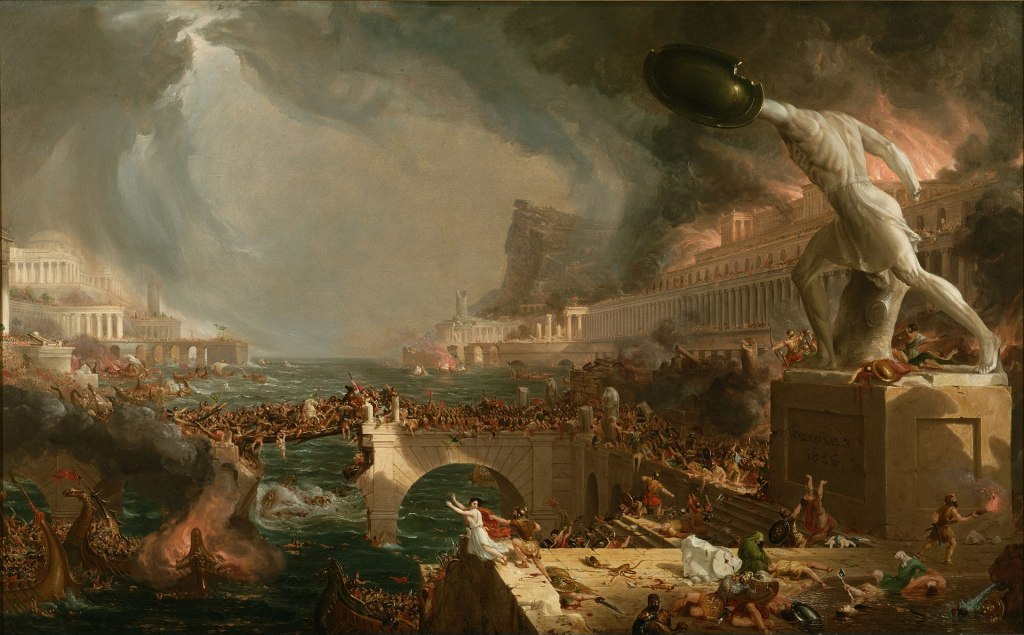
Today’s guest post by Charles is an excellent primer on the diversity of beliefs held by many of the best minds that think about our overshoot predicament. Charles wisely reminds us that no one knows what the future will bring.
Charles recounts his journey of increasing awareness that led to depression and despair, followed by an awakening of acceptance and constructive action, that has provided him with some peace and happiness.
It’s funny how I (we?) construct incorrect mental images of people we meet on the web. I imagined Charles to be an elderly retired reclusive spiritual philosopher, not a middle-aged top-tier software developer with a deep scholarly interest in human overshoot, and an impressive sustainable food growing sideline.
Charles concludes by asking readers to share their own visions of the future. If you have something to say that deserves more than a comment, please contact me about posting a guest essay.
P.S. I believe Charles now holds the doomosphere record for the most links in a single essay.
The idea for this post originates from an exchange with fellow doomer davelysak who states:
I foresee, based on various portents, an extreme human population crash in the relatively (10 – 50 years? Maybe sooner?) near future.
and later adds the precision that
I’ll be surprised if there are more than 2 billion people alive on earth in 20 years.
This made me reflect about my own anticipation for the future, even more crucially, the way I communicate it to others. Or rather as a matter of fact, don’t so much anymore. Like Cassandra, I have come to understand that I find myself psychologically between a rock and a hard place: I foresee a future of extreme hardships which I do not particularly desire. Worst, I have long felt compelled to share my projections, driven by the naive impulse to initiate collective preemptive action. However, torn apart between the pride of intellectual rigor, my ideal not to harm others and increasingly aggressive or irrational reception of the message, I have slowly learned to repress myself, not to voice my concerns and conform to the group. After all, even Cassandra brought ill fate to herself. (It turns out my strategy is no solution, as the rage is turned inside and builds up, but that could be a story for another day.)
Hopefully, our host, Rob provides a safe haven to any doomer who wishes to bravely face the crude, unadulterated nature of our predicament.
As doomers, we share a myth, the myth of collapse. In a nutshell, it unfolds, as I understand it, as follows:
- The old age of material opulence is about to end, as current trends can not continue for long.
- A world-scale crisis has been brewing for quite some time; it is about to burst.
- After it eventually recedes, once balance is somewhat restored, a new normalcy, a new age will be revealed (that part of the myth is optional).
Funnily, if we refer to Kurt Vonnegut’s shapes of stories it falls somewhere between the shapes Old Testament and New Testament.
And many false prophets shall rise
Lurking for a quarter of a century in the doomosphere has taught me visions of the future, even among doomers, may vary tremendously. The stroll through the exhibit of studies can go on for hours, ranging from loss of material affluence (Richard Duncan’s Olduvai theory) to complete life wipe-out (James Hansen’s Venus Syndrome), with population collapse (Club of Rome’s limits to growth) and near term human extinction as middle-grounds (I guess).
The fall is seen as either rapid and brutal as in Hugo Bardi’s Seneca cliff, or manageable as in John Michael Greer’s catabolic collapse. Even our preferences and values differ: some like Jack Alpert’s sustainable modern civilization of 70 million wish to preserve the current living arrangements trading population level, on the contrary, primitivists such as Derrick Jensen do not equate humans with Homo Industrialis and impatiently wait for the machine to (be) stop(ped). There are even some fringe organizations advocating voluntary human extinction and euthanasia, while most would just like to manage degrowth. (To be fair, the church of euthanasia’s ultimate goal is species awareness.)
Model after study after analysis after opinion piece paint different aspects and outcomes of the fall. Some radically scarier than others.
My personal journey through doom
What then do we really expect, fear and hope? At first I had planned to cold-heartedly present the scenarios I found most probable and then invite you to share your own prospects. But, given the heavy emotional load that the subject carries, I somewhat changed my mind: after all we are discussing the possibility of not only material losses but the widespread increase in suffering, deaths, extinction of the living world. At the very least, our cultural identity is at stake. So I’d like to add a personal twist and narrate how my understanding of the future evolved during my personal journey.
I was born in 1978 in the then extremely affluent and sophisticated country of France (WesternCiv). I was inculcated with the idealism of my time and place which originates from the Age of Enlightenment: triumph of reason, humanism, universalism, materialism, progress and atheism. Even though I had a really hard time learning the fundamental necessary last piece allowing anyone to function in an ideal world (hypocrisy), it was indeed the best of all possible worlds.
At 6, I was profoundly marked by Chernobyl. I remember the haunting masks of the liquidators, courageously shoveling the entrails of the angry machine, promised a certain death as a reward for saving our, my lives; and the helicopters hauling sand; and then the oddly reassuring claims from my country statesmen about the spread of the cloud. A first encounter with official doublespeak?
As a city boy living on the 6th floor of a modern building, I grew up a book-worm. Books offered countless windows into exciting realms out of the deprived environment of a sanitized flat. In particular, I vividly remember feeling a strong emotional bond with Hans Christian Andersen’s fairy tale Five Peas from a Pod. Was it a hint, a reverberation from a destined future of my deep yet unacknowledged nature? More were to follow. At a relatively young age, I watched the extremely violent Japanese TV series Fist of the North Star (right-minded censorship hadn’t caught up yet). A brilliant blend between the universes of Mad Max and Bruce Lee, it depicts a brutal post-apocalyptic world set in barren landscapes and desolated ruins. This time around the call of agonizing farmer Smith to plant rice seeds for tomorrow particularly resonated (captions are read from right to left).
I later read Asimov’s Foundation series and Hermann Hesse’s Siddhartha.
I was faintly aware of the environmental crisis, in particular climate change as a life changing but slow process with only distant impacts. Shortly before the new millennium I stumbled upon information which blew my comfortable world view. It was Colin Campbell explaining depletion and predicting peak oil.
At that point, I was convinced global population would have to come down during my lifetime and challenging times were ahead. I thought it would still be manageable, spanning through the coming century from the current population of 6 billion back to pre-industrial levels between roughly 1 and 2 billion (respective estimates of the population around 1800 and 1930).
I was a rational realist, not buying into modern human exceptionalism which asserts we can achieve higher agriculture yields than our predecessors with fewer resources on an environmentally degraded planet. Even though the greatest shortcoming of the human race is our inability to understand the exponential function in a Tragedy of the Commons, I had faith humanity would soon change its ways: it was just a matter of spreading the crucial piece of information about resource depletion widely enough. After all, there were already some men of good will, such as Jason Bradford, taking action. In South Korea, I had just met the love of my life, some years later we married. We were fruitful. Our daughter Rachel, as an homage to Rachel Carson, was born in 2007. Determined to carry my load in curbing population growth, I convinced my wife to stop multiplying at one.
I was to be punched in the face again. It was 2012. A somewhat egocentric professor was sternly announcing near term human extinction (this is most probably the presentation by Guy McPherson I watched at that time). The future was sealed. I was now standing on the edge of a steep final cliff. For me, it was the start of a very dark period. You know that kind of aftertaste which lingers a while after watching a documentary such as the Island of Flowers.
Except everyday, as a background of everything else. I couldn’t help but feel hopeless for my then 5 years old daughter. The key notions were feedback loops (for instance methane according to sad Nathalia Shakhova) and tipping points.
Evidence accumulated from every side. State of the ocean: apocalyptical; ice: disappearing; trees: under assault; soils: eroding. It was suddenly the 6th (or was it already the 7th) mass extinction. I quit flying (for what that is worth, there surely is, unfortunately, a substitution of demand paradox similar to Jevons?).
Having thoroughly assimilated this new data, two years later, I wrote a dense blog entry to get it off my chest. I reviewed my script: I was now expecting 1 billion humans by 2040 and extinction at the end of the century. News still got worse. Moving goalposts, shifting baselines and worse than predicted by the model were the expressions of the days.
Homo Sapiens’ response was to pretend all was safe. The manufacture of consent, merchants of doubts had it easy with a general public all too eager to keep on basking in comforting denial.
Kevin Anderson exposed the half-truths of even a supposedly rigorous official body, the IPCC, about non-existing negative emissions technologies included in their models. The remaining carbon budget was already getting slim and the task to turn this ship around incommensurable.
I took Wing Chun classes (even though I was not sparring with these ladies) and practiced like an addict would inject heroin.
Primitivism (Derrick Jensen, Deep Green Resistance, Daniel Quinn’s Ishmael) convinced me our fate was sealed a long time ago, when we forked into the original sin. Attempts to heal (Carolyn Baker, Joanna Macy, Charles Eisenstein) back into the lost Eden did not cheer me up. Resistance seemed futile (Underminers, Sea Shepherd). Everything was a lie, a fraud, and the living world was collapsing.
I felt increasingly ashamed and guilty for being part of this holocaust of a new kind (let’s not mince words, this is un-Denial after all 😉 ). Only this depressed collapsitarian on his boulder brightened me up, at least for his accent and hat. I considered taking ‘shrooms to communicate with the spirit of the Earth.
Meanwhile, unbeknownst to me, an ordinary miracle was happening on my very own balcony. For no real reason, I had installed a large clay pot and was everyday discarding some food waste. It was fun watching soil building. 7 years later I harvested 3 peaches on a small tree that had grown on its own out of a minimal daily routine. It died the next year, but had shown me a way forward.
I went back to my bookcase to dust off Fukuoka’s One-Straw Revolution. I had read it at 20, but as a conformist computer scientist did not know how to respond to the strong appeal it had on me already at that time. I bought all translated Fukuoka’s books and Larry Korn’s excellent clarifications (for a western mind that is).
Haunted by images from The Burmese Harp, I stopped Wing Chun one year just before covid struck. I lived this surreal period as a blue pill/red pill moment: do we still put our faith into an authoritative centralized science, absolved from any personal implication and effort, or do we fend for ourselves and look for other ways. Although, it was a slow grind, a long arm wrestling, I felt the price of resistance turned out surprisingly not to be very high: give up on restaurants and movies mostly. I have to admit I am proud I was able to withstand (especially for my daughter’s sake) peer pressure and the manipulative wannabee bully Emmanuel Macron we have as president, a corporate valet, if anything.
I enrolled in the local community gardens and bought a small piece of land in the country side to plant a resilient edible forest garden. I started at ground zero: the previous rectilinear poplar plantation was clear cut just before the sale (in modern mindset no profit is too small).
I don’t really worry about the future anymore. After all, if we let her be, life unveils tremendous amounts of strength and resilience. Humanity does not deserve only contempt. I’ve found many people to admire and approaches to follow.
Masanobu Fukuoka’s natural farming:
Ernst Götsch’s syntropic agriculture:
Joseph Lofthouse’s landrace gardening:
I learned acceptance of what I can not control: other people’s behavior, preferences and own internal limitations. I learned the importance of doing small things at my pace, my scale, everyday. I unlearned duality (that’s another story).
Current thoughts about the future
In the span of 25 years, my outlook on the future changed three times. Today, I am not even sure were we really stand. In Vonnegut typology, rather than the classical doomer’s narration, I now find myself in the “Which way is up” shape of story. In this section I will outline my current personal view and preferred outcome.
Although, nothing can completely be excluded, I don’t believe the planet will either go Venus nor abiotic. I do not believe the human species will be extinct by the end of the century. I do not believe we will escape to the stars onboard metallic ships. We may nuke ourselves out of existence, but it is in nobody’s interest. We may experience multiple severe nuclear power plant accidents. But maybe scarcity of nuclear fuel will compel us to progressively shut them down before. In the longer term, the human species could even survive the ongoing extinction event.
As depicted by Joseph Tainter for prior civilizations, ours chose a similar path of increased complexity. Following this strategy, it has cornered itself: in my country almost every service has been converted into an “app” or is in the process of doing so. Thus creating the biggest single point of failure: all this convenience relies on the continued operation of the grid, data centers, the network, chips, long supply chain, rare minerals, etc.
To me, a Seneca cliff scenario is unavoidable and guarantees rapid material loss. We will lose our technological gadgets and crutches. Our machines will stop, thirsty. Pollution will be reduced and assimilated by the organic world. We won’t do much about it other than pretend.
Will there be a population crash or a graceful decline? Will the planet temperature stabilize at a livable level? What will the ultimate stable population be? I don’t know.
Our current ways impact the web of life brutally. I will really be surprised if the planet sustains more than 2 billion people for long. Biomass tonnage of mammals gives an idea of the scales at play:
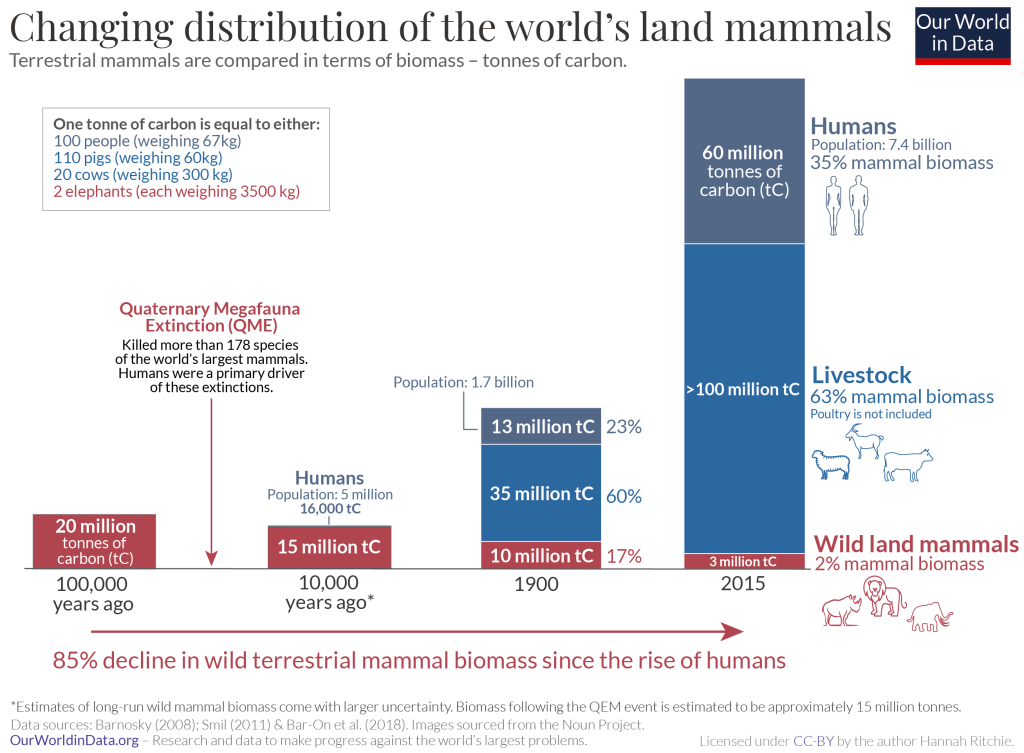
I expect a crash in the following 2 to 3 decades. Eyeballing the world population age pyramid, if we had to achieve this four-fold reduction tomorrow in a “fair” way, then all males above 30 years of age should go soylent green (females are given 5 more years). For long term survival wouldn’t this be preferable to a slow long agony? This won’t be said out-loud. So I won’t go further on that path.
A call to inaction
Fortunately, there could still be room left to maneuver. Fuel could be rationed for food usages. The population could spread out, reducing the need for transportation and providing labor for agriculture. Degraded land could be regenerated, deserts converted to forests, cereal fields hybridized into agroforestry, or converted to orchards or edible forests as once was the case in Europe.
There are some success stories (propaganda of our times, maybe) all around the world.
China:
Saudi Arabia:
India:
Africa:
New Zealand:
USA:
Agriculture from the green revolution is productive (given external fossil fuels), but soulless, dumb and destructive: the philosophy at work in every step (delineating plots, tilling, applying pesticides and herbicides, irrigating) is that of control, rendering the soil inert, blocking the natural flow of life. The idea, disconnected from reality, is to make agri-culture an industrial process so that outputs can be maximized following a known function of inputs.
Life is not inert, its potential surpasses anything we can fathom. A miracle akin to the one that happened on my balcony could be made possible on the large scale. We don’t (and I believe never will) understand the whole system.
The theory of the biotic pump gives us a glimpse into the full extent of its processes at the planetary level:
I cannot recommend this presentation by Anastassia M. Makarieva enough:
Accompanying slides:
Large forests work like a planetary air conditioning system: pumping water from the ocean and circulating it across the continent, cooling temperatures, releasing heat above the layer of greenhouse gases directly into space.
Soil could be restored while at the same time cooling the climate.
I accept this may well be sophisticated denial on my side. But why not try?
Conclusion
I agree with Guy McPherson when he states everybody in the industrialized world was born into captivity. But that’s primarily a mental prison we can break out of. So far this culture has lived by the motto divide and conquer, waging war on every side, engrossed in the illusion of control. The fire has grown to the point it has now become a matter of life and death.
Course must be changed. It is not even that hard. All it requires is some generosity: stop the aggression towards the planetary organism which shelters us all, let forests grow absolutely everywhere. Feed ourselves, heal and replenish life at the same time. Tend to be taken care of.
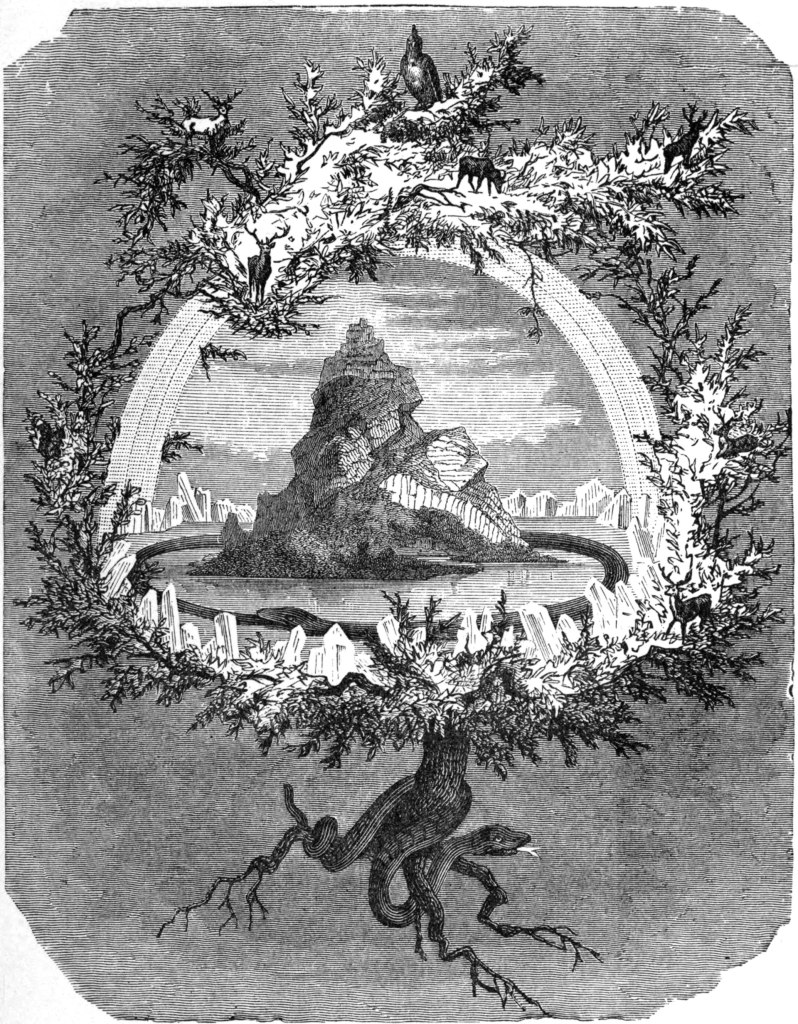
This, to me, is the concrete meaning of love: the cycle of co-dependence illustrated by Yggdrasil, the tree of life surrounded by the eternal snake Ouroboros.
In any case, this is the path I have chosen for myself, regardless of the circumstances, and my proposition for mutually assured survival.
Your turn
Thank you for reading. At least, I hope this post was somewhat entertaining. Please let me know what your own visions, hopes and propositions for the future are. I love to be surprised.
 un-Denial
I’m heading off for a week of camping without internet so I will be silent for a while. Stay well.
LikeLiked by 1 person
Wow, it sure is quiet here without Rob.
Lonely too.
AJ
LikeLiked by 2 people
Here’s a random thing for you, I find both Nates make excellent background noise while I’m working (The Great Simplification and Canadian Prepper).
LikeLike
I’m sure there are people here who follow Keith, the Canadian engineer with his permaculture forest. His videos are spot on – concise, no holds barred.
He’s also done a more detailed/elaborate one on collapse but I find the one above more concise for some reason
LikeLiked by 1 person
awesome thanks for the recommendation. I haven’t heard of him
LikeLike
Thanks! I also haven’t heard of him.
LikeLike
Thank you. That was good.
(A bit of a late answer, because I didn’t have time to check it out before).
LikeLike
I want to express my deep appreciation for sharing your profound insights and perspective. Your thoughts resonate deeply, and it’s refreshing to see someone addressing the mental captivity that often constrains us in the industrialized world. Your call for breaking free from the illusion of control and division is incredibly relevant, especially as we face urgent challenges like the growing environmental crisis.
Your vision of shifting course towards a more harmonious relationship with the planet is both inspiring and practical. The idea of fostering generosity towards our environment and allowing nature to flourish resonates with the ancient wisdom of interconnectedness. Your emphasis on co-dependence and nurturing life in all its forms is a powerful testament to the true essence of love.
It’s heartening to read about the path you’ve chosen for yourself, one that prioritizes the well-being of our planet and its inhabitants. Your proposition for mutually assured survival is a profound shift in mindset that could potentially pave the way for a more sustainable and harmonious future.
Thank you for sharing your thoughts, for inviting us to join in this important dialogue, and for encouraging us to envision a brighter tomorrow. Your words have certainly left a positive impact and sparked contemplation about our own visions, hopes, and contributions to the world. Keep embracing this journey of transformation, and may your dedication inspire more people to take meaningful steps towards positive change.
LikeLiked by 2 people
Thank you for your appreciation. I feel honoured.
Note that I have no illusion we live difficult times: we may also have to revere the gods of destruction (it may be a necessary step before renewal, purification and freedom from old ossified systems)
For me, breaking free from the modern world mental captivity (without falling into another type) took time. I hope it goes faster for the next generation. Accelerating circumstances will maybe do the trick. I myself have seen with my own eyes, during the covid episode, that apathetically and blindly listening to authority brings no good. We must get our spiritual cores back. That which make us firmly alive and not just cogs in the machine. Now that I got to feel what’s right, I have no choice, it’s simple. Before that I was numb, lost in the mental labyrinth of endless rationalization and argumentation, prey to the false promises of the system, without real purpose, unable to see the numerous rooms for possibilities to break free.
One reason I appreciate Rob’s blog, aside from the well-versed and civil commentators, is that by addressing denial, it is making the link between inner brain mechanisms, beliefs, individual behaviours, and the resulting collective impacts on the world.
In my case in particular, I have discovered at least three distinct mental stances (I apologize to some for using, yet again poetic religious language to explain this, it could totally be described more programmatically. The translation into scientific language is left as an exercise to these readers ;):
– modern myth of rationality/consumer mindset: set a goal according to some idea of what is right/desirable, apply scientifically proven recipes and expect to get there/be rewarded/be satisfied
– Bhagavad Gita privilege of action without any entitlement for the result (Chapter 2, Verse 47)
– Biblical faith (labeled fatalism by the believers of rationality) trust the higher power will provide (Matthew 6:25-33), as long as we seek righteousness (that’s where resides all the complication, at least for the mind).
I recognize the tree by its fruit: following the first mindset was hell for me. Either I would achieve my goal, but not really be satisfied for long. (A new desire sets in. Worse, I was partly running after manufactured desires which were not mine) Or I would fail and feel bound to try harder. The net result is a life of labour and constant worry for the future. (In a way fascination with collapse can turn that way too)
These days I navigate from mindset 2 to 3.
I’d like to end with a quote from chapter “Simply Serve Nature and All Is Well” of Masanobu Fukuoka’s book “The One Straw Revolution” : “The world exists in such a way that if people will set aside their human will and be guided instead by nature there is no reason to expect to starve. ” (https://archive.org/details/The-One-Straw-Revolution/page/n97/mode/2up)
That is my belief and increasingly my experience.
LikeLike
I am unusual because sometimes I don’t just read a post looking for the (often obvious) intended message. With Rob and occasionally others I will sometimes see completely unnecessary anthropomorphizing – usually I can resist the urge to post my jaded and cynical screed.
Looking at the post above – I see sentence, paragraph, vocabulary, grammar and message that all look “too clean”. So I pasted a copy into https://copyleaks.com
The results : “AI content detected”. 95% certainty.
No doubt, someone somewhere got a little Dupers-Delight. I hope they choke to death.
LikeLike
I don’t recall talking about animals. Call me out if you see it again.
LikeLike
Strictly speaking its not just animals “To ascribe human characteristics to things not human”.
Here are a couple of yours from above.
“evolution discovered denial”
“the goal of the universe”
Typically it is not important, since there is little (if any) detraction from the message and often it can indeed help convey the message.
The duping above irked me. We live in a profoundly sick society. Phising / Vishing / Duping / Conning / et al.
LikeLike
Thanks, I understand now. I anthropomorphize those 2 intentionally and am likely to continue because it’s a short way of communicating an idea that’s reasonably accurate.
LikeLike
I had a closer look at the Prateek post. It’s the first from that source and its email confirms it’s spam. Normally WordPress catches many of those every day but for some reason missed that one, as did I because I was away camping.
LikeLike
By getting through, it can serve as an example to you, Charles, Monk and others – that deception is everywhere and utterly convincing. A shorter post would have fooled me. The gushing was excessive in both duration and amplitude.
Anything more would have been “I want to have your babies”.
LikeLike
You are right. When I first read it, I thought it was an advertisement. Also, it was the first time for me seeing this poster. But then, I thought the text comment was legitimate since it was referencing my initial post in a logical, structured and gradual way. I was duped. But it is sad wasting energy interacting with machines. To me, comments on this site have value, as long as they propagate viewpoints from human to human.
Thank you very much for spotting this and telling. It helps me be more careful. Although, it’s incredible what AI can do. And the only efficient response, might be to stop network interactions.
I wonder what the purpose of this kind of automatic comments and cost/benefit ratio is.
LikeLike
Frankly, the level of (available) sophistication is now terrifying. Someone could phone a loved-one and record it. A long enough recording can be used to train a computer system to mimic the voice. Add a little social engineering (or Facebook) to determine when the loved-one is away from home (preferably on vacation) and then the “help me, I’ve been arrested / been in an accident / etc.” phone calls to mother / father / husband / wife / grand parents start.
Some people will see the dupe, some will not. The podcast Darknet Diaries has some free episodes that are both entertaining and informative – I particularly liked the mother that helped her son ‘penetration test’ a prison. She was retired, white and female and had a background in catering. She posed as a kitchen / food storage inspector, walked right in and duped everyone.
EP 67: The Big House
https://darknetdiaries.com/episode/67/
I consider myself an expert in computing and cyber security – the need for due diligence constantly goes up, the ability to do it goes down.
I equate privacy with security, so everything from Michael Bazzell (Intel Techniques / Extreme Privacy) is good. He also has podcasts.
https://inteltechniques.com/podcast.html
Joseph Tainter’s – The Collapse of Complex Societies, is here.
LikeLike
I also like Darknet Diaries.
I have listened to Steve Gibson on security for 10+ years but have never heard of Bazzell. Thanks for the tip, I added him to my podcast player.
I recently read up on the pros and cons of Signal vs. Telegram. I used Signal but the majority of security conscious people seem to prefer Telegram. Do you have a preference?
LikeLike
I use Telegram on a rooted Android, but don’t like that the phone number is the ‘price’ of admission. It was the ease of setting up automation that tipped the balance for me. Signal is equally good.
LikeLike
Thanks. Instagram has more social media features so I use it for monitoring Ukraine war channels. I use Signal for messaging.
LikeLike
New paper by Will Reese called ” The Human Ecology of Overshoot: Why a Major ‘Population Correction’ Is Inevitable”. Probably not big news to people here but it’s still great.
https://www.mdpi.com/2673-4060/4/3/32
LikeLiked by 2 people
Thank you so much Anon for sharing that link. That paper said everything there is to say (except I think Rob would add here that MORT should have been invoked) most cogently. Dr Rees laid out all the evidence and presented an airtight argument and indictment of our self-induced fate, to be enacted in full in due course. I am getting to the stage of acceptance where I almost can feel a sense of relief and consolation that the verdict is so conclusive by any and all measures of scrutiny so I can actually move on with what I can do, in the time I have remaining, including squeezing joy and gratitude from every day.
Wishing you and your family peace and comfort to see you through.
Namaste.
LikeLiked by 2 people
Gaia, you know me well. I read the paper and thought it was very good except Rees has no understanding of MORT’s central role. He does discuss denial but does not explain what we observe.
LikeLike
Very good. Only a couple of quibbles. I don’t know if I read it wrongly, but a surprising opening by Bill Rees, especially after that recent round table with Nate Hagens, Rex Wyler, et al. “Homo sapiens has evolved to reproduce exponentially, expand geographically, and consume all available resources.” No species evolves to do any of those things, though any of those things may be a consequence of the abilities they evolved. As discussed on that round table, humans are a species. There is no goal of evolution, it’s just what happens.
That opening is surprising considering that, a little later, he goes on to say:
This is further, properly, reinforced by
In terms of population, he doesn’t even hint at reducing birth rate but frequently mentions negative feedbacks which tend to limit a species’ population, which is what I think is the likely response of nature to overpopulation. The death rate will increase to rein in population numbers.
In the introduction, he implies that it’s possible for a humans “to override innate human behaviours,” but that is as close as he gets to adding the usual dose of hopium.
LikeLiked by 1 person
Steve Bull who writes well about overshoot and collapse has put together a collection of writings and presentations on our predicament from people he respects. I am pleased to see Rob’s Un-Denial Manifesto included along with articles from the likes of Bill Rees and Alice Friedemann.
https://olduvai.ca/?page_id=65433
Rob your manifesto and What would a wise society do? pages are my favourite and the ones I’ve shared in my circles most often. I wonder if you make any changes or additions to the Wise society post now given it’s a few years since you wrote it? Personally I think all the actions remain wise and relevant.
Cheers and I hope your camping trip was a memorable one.
LikeLike
Thanks for posting this Campbell.
I’m grateful that Steve included my essay in his compilation.
Your two favorite un-Denial posts are also my favorites.
I also have a fondness for the world’s longest single sentence about overshoot:
And the un-Denial decision tree that explains where MORT awareness fits into the space of possible responses to overshoot:
I re-read the “What would a wise society do?” post that I wrote 7 years ago and it seems to have held up fairly well despite me knowing a lot more now about overshoot than I did then. Nothing major jumped out at me as being wrong or missing.
The essay is an important rebuttal to anyone that claims there is nothing we can or should do about overshoot.
I’m curious if anyone can spot any errors or omissions? If you have any ideas for improving the essay let me know as I’d be pleased to incorporate them and re-issue an update.
LikeLiked by 1 person
That “wise” commentary seems great … if some kind of modern society is retrievable. I can’t see how that is possible. Wouldn’t a wise society realise that any society even vaguely resembling the one we have is not sustainable? Wouldn’t a wise society figure out was is possible and sustainable, then try to move to that? Population needs to decline, certainly, but unsustainable behaviour also needs to go. After years of thinking about this, I still can’t see how that is possible without a primitive existence.
[Gosh, the comment facility seems to have changed. This may be the first cleanly processed comment I’ve left in years. Pressing Reply now.]
LikeLike
Damn. No. Even though I was informed that I was logged in, I was still asked to log in after pressing Reply. Oh well. Back to Reader.
LikeLike
I’m not seeing any problems with Edge on Windows 10/11 and Android. I could try a little digging with WordPress support & user forums if I had more information about the problem you experience and your configuration.
For example:
– any other problems besides being logged out?
– Windows/Apple/Linux?
– browser?
– cookies enabled?
– uncommon browser settings?
– frequently changing IP?
– VPN?
– do you run a cleaning utility to wipe cookies?
LikeLike
I haven’t had many issues other than having to log in every time I press the Reply button after composing the comment, even though the comment box claims I’m logged in. Occasionally, something else has gone wrong but not consistently. I’m on Windows, using Firefox, have cookies enabled and with no odd browser settings. I do use a VPN but had the same problem before I started using it. I guess the IP might change every time I connect to the VPN but this happens multiple times. No frequent cookie cleaning.
LikeLike
Thanks. I do not know what is causing your problem. One idea. Go to the main WordPress site, logout, then login and look for an option on the login form to stay logged in (often called “remember this computer”).
LikeLike
Welcome back Rob,
Just a thought, I’ll try to express clearly.
So, we got denial of reality to balance existential anxiety stemming from our ability to build models of the world in our minds. But this combination has resulted in an imbalance with planetary equilibrium. Now we get a mass extinction.
Aren’t they only 4 possible outcomes (mixes are possible):
– the species disappears, and its capacity for fantasy with it, the planet recovers,
– the environment evolves around this new species and constrains it so that new equilibrium are regained, maybe the capacity for fantasy propagates to other species,
– partly under new evolutionary constrains (but maybe not only), the species matures and somehow reins itself in while driving planetary recovery,
– life sustaining equilibrium diverges and the planet dies.
I’d like to be play 3.
LikeLike
A deep comment Charles. Very hard to respond in a few words.
I think your understanding of MORT is still a little rough around the edges. All animals with brains build models. That’s what brains do.
Humans are the only species that evolved an extended theory of mind which means (among other things) that we can imagine what another person is thinking and that they are the same as ourselves. With this capability when we observed a tribe member die we understood or own mortality which caused reduced fitness due to depression and drove the need for denial of mortality to co-evolve with an extended theory of mind. The method evolution chose to implement denial of mortality had a side effect that we deny all forms of unpleasant realities.
The imbalance you speak of results from a super intelligent brain capable of dominating all other life, that is unable see the damage it is doing, because of genetic denial.
A few comments on your 4 scenarios:
– I think it unlikely that denial (you call it fantasy) will spread to other species. Elephants, dolphins, and corvids have been unsuccessfully bumping up against the extended theory of mind barrier for millions of years without evolving denial. It seems to be a rare event in the universe, like the eukaryotic cell.
– Your scenario where humans mature means I think that we somehow evolve away from denying unpleasant realities. Can you imagine a selection pressure that would cause this and at the same time allow us to accept our own mortality without depression?
– I too hope for #3, but is there any plausible scientific path to get there?
LikeLike
Thank you for clarifying to me the notion that existential dread requires an extended theory of mind and not just the ability to build models. It is rather tricky. Let me rephrase to see if I got it right this time:
– many species have the ability to build models of the world in their minds,
– minds in the human species got to the point where they could model the minds hidden behind the surface of other persons,
– from that came the realisation to the mind modelling, that the mind being modelled had similar properties,
– since death is witnessed for other persons, the mind is able to infer its own mortality,
– which creates anxiety, because the mind understand its mortal nature,
– denial is a protection mechanism which appeared simultaneously in order to alleviate the downside of knowing one’s own death,
– the concurrent evolution of the two traits makes it an extremely rare occurrence of evolution,
– denial is generalized to any kind of unpleasant realities,
– hence, the imbalance.
What I don’t understand is that pigs are aware they are going to die when being sent to the slaughterhouse. So why don’t they similarly suffer from existential dread? Is it because their minds are only able to fear in the imminence of death, but not during most of their existence? Or maybe, they too are subject to lesser forms of denial?
Also, why should it be necessary for a mind to be able to finely model another mind in order to understand it is of the same mortal nature? Does it have to be that sophisticated? Don’t all social animals (dolphins, wolves) at least understand the ones they are interacting with are of similar kind than themselves? Don’t many animals (dogs for instance) feel the loss of another being.
Maybe this can be explained by the fact that (background, constant) existential fear requires to reach some kind of threshold in the brain? (Isn’t this just a bias related to the way we study nature, a form of self-reinforcing human exceptionalism?)
Wouldn’t it also be possible that existential fear is not required to give rise to this situation at all? Access to denial on its own could confer a species a short time advantage over other species: individuals are able to see and understand the havoc they create when wiping out competition (it requires some kind of blindness to raze a forest and build a road, or exterminate a pack of dolphins…). A faustian bargain, if any and a somewhat grimmer theory 😦
Would it be possible that the rise of denial is not such a rare event, but rather that it doesn’t leave traces that can easily be observed by scientists? After all there are many things we can’t easily know from the past, as they simply disappear: internal mind mechanisms could be such a thing if it results in behaviour well tuned to the environment. Also since denial on its own, carries fatal downsides, how long should a species acquiring it survive so that we could acknowledge its previous existence?
Sorry, I am rambling about things which are way out of my league…
I am unsure it is unlikely for denial to spread to other species. Evolution from scratch was a rare event, but propagation may not be so much. The story of orangutan Chantek is a curious one (https://www.quora.com/Can-animals-have-an-existential-crisis).
Yes, I can imagine environmental pressure that would make our behaviour to change. But not necessarily eradicate denial from our mind. And I even think there are historical precedents. I see the rise and fall of empires as a kind of oscillating signal of increased amplitude. At one point, the strategy which consists in drawing down stocks (be it oil, trees, fishes, soils, captured slaves, trust in fiat currency…) as fast as possible to wipe out competition to the detriment of the ecosystem is not cost effective any more.
The pressure results from the fact the species reaches the physical boundaries of the whole planet. At this point, alternative strategies (which basically protect the living assets) fare better. We are already there. To give an extreme example: buying a forest to raze it down, sell the wood and convert the land to agriculture, then exhausting the land to desert only makes sense in a globalized settings as long as there are other stocks to plunder elsewhere to ensure economic value and continuation of the practice. From the desert, any regenerative technique will make more economic sense than leaving the land to its natural process (be it slowly recovering or trapped in the desert phase). There are other reasons which shift the optimal economic point towards more ecologically sound practices: lesser availability of oil, lesser availability of metal, marginal land which prevents the use of machinery, local human resistance, low value of what is left to plunder…
An historical example may be Tokugawa Japan discussed in Jared Diamond. Not necessarily a pleasant society to our modern eyes, but a relatively sustainable one, by necessity.
To go beyond existential dread, the mind could just recognize the map is not the territory. And that the notion of “mind”, or “I” (and consequently “mortality”) is a blurry approximation of reality at best, if not yet another delusion. We are too enthralled into our models and forget they are not the world (wouldn’t it take a mind the size of the universe to truly understand the universe). Once this is accepted, exit constant anxiety.
Or we can build other models, still enough consistent with reality to be of practical use, where the mind identifies with other things, such as “life”, “the whole planet”, “the universe”, “nothingness”, “consciousness”, rather than “my car”, “my manly destructive power”, “my bank asset”, “my power status”, “our progress”, “our supremacy”…
At this point, we got the software, so a genetic evolution may not even be necessary, just a cultural evolution.
This will happen, once the external constraints sufficiently favour those that do. It can be gradual, but can not occur before there are places where it makes sense from a competitive point of view (MPP, I would say). Given inertia of the system, I believe this ensures some level of collapse first.
To me, scenario 4 seems unlikely. Life is tough. This may be denial from me, but, I would give scenario 1, a relatively low probability. The human species is quite versatile. Unless there is a complete shift in the way the planet functions. Even in this case, there could still be pockets of habitability. (Tongue in cheek : I always had a part of me think Elon Musk was investigating technology to live on Mars, not to be used over there, but rather for the not so distant future Earth. The ultimate advanced version of the rich guy bunker). A mix between scenario 2 and 3 seems the most plausible to me (with more of 2 at first and 3 longer term).
LikeLike
Hello everyone, I’m back from 10 lovely days camping on northern Vancouver Island.
I used this trip to practice minimalist living. After arriving I did not use my vehicle for travel or resupply until I departed 10 days later. I ate healthy foods that did not require a cooler and only minimal use of a small butane stove. I went to bed early before 9 pm when it got dark. At home I’m a 1 am night hawk and the extra sleep made me feel great.
Books I read on this trip were:
– Donella Meadows: Thinking in Systems (a classic by an author of the 70’s Limits to Growth study) – highly recommended
– Shaman: Kim Stanley Robinson (a fictional story of life in a tribe thirty thousand years ago) – not yet finished, good so far
It’s very nice to see that this little un-Denial community stayed active while I was gone.
LikeLiked by 1 person
Welcome back, Rob! What a paragon of virtue you are! So happy to know you’ve had a wonderful time and came back so invigorated. You probably look and feel 5 years younger at least! I think you should take to the woods at least once a month even for just a couple days away.
It’s almost too cruel to start back on the doom parade after that respite for body and mind, please take a few days to settle back into things.
We have missed you for this time but can wait a bit longer!
LikeLiked by 1 person
Hi Rob,
It’s Gaia here who tried to welcome you back on behalf of all of us but did something change with this WordPress platform because it wouldn’t let me reply under Gaia gardener, now I am Anonymous, the most ubiquitous contributor of them all!
Now it tells me I can log in to leave a reply (optional) I never had to log in before and I don’t do Facebook or WordPress.
I don’t really mind being Anon for a while, you can all probably tell it’s me anyway from my loquaciousness.
LikeLiked by 1 person
Hi Gaia,
Nice to hear from you. Sorry about the WordPress problems. I’ve changed nothing.
I confirmed I have it set so that you do not require a WordPress account or to be logged in to comment.
I also had it set so that a name and email are not required to comment. Perhaps this is causing the Anonymous problem? I changed this setting to now require a name and email. The email will not be displayed publicly but if you are worried I suspect you can enter any gibberish you want for an email.
LikeLike
Hi Rob,
Thanks for retroactively unmasking my Anon to my still masked moniker!
I think I cottoned onto the new format now, we’ll see how this one posts.
I am interested to know you’re reading Kim Stanley Robinson, have you read other books by him? He is a new author to me and I was recommended his The Years of Rice and Salt which is about an alternate history if 99% of Europe’s population perished with the Black Death. It’s in the queue to be read but even though it’s high fantasy and probably an excellent escape read I am not quite sure more doom and gloom is what I need at the moment! I am getting the picture quite nicely as it is! Your manifesto and the longest overshoot sentence (remember you chided me for my run-on sentences and paragraphs!) were what I cut my doomsphere teeth on, good to have another look, and unfortunately, there’s nothing to change or add because we’re still barrelling down the same path. And thank you for introducing me to Panopticon, it’s my next daily check-in after your blog. It was all the climate news of late, especially the sea temperature readings and extant ice situation that really got me thinking our time is even more compressed than we thought.
Still, every day is a wonder and ours to live as fully as we choose. I am really glad you’ve been able to do what you love most several times this summer and hope that you will find more chances to be immersed in nature as the weather starts to cool. When you are amongst the trees and rocks and rivers you are truly declaring that you are an Earthling and honouring your being part of the biosphere. This is our privilege of bearing witness to what is unfolding and partake in both the joy and sorrows because that is our due.
Namaste, friend.
LikeLike
Shaman is the first book by Robinson I’ve read. I’m the wrong person to provide tips on good fiction books because I read so few. Perhaps someone else here can jump in with some good tips.
LOL, I thought about you when I re-read that longest sentence essay. Long paragraphs break my brain.
Panopticon and the now deceased Gail Zawacki are the two people that encouraged me to start this blog. I was going to write anonymously but they pressured me to use my real name.
Then when Panopticon started his site he used a pseudonym because he was worried about what the neighbors would think in his small community. What a hypocrit!
LikeLike
The Honest Sorcerer is new to me. Today he wrote a very good essay with a fresh spin on why we require growth and why growth is no longer possible, and concludes that overshoot collapse is inevitable.
https://thehonestsorcerer.substack.com/p/exponential-growth-forever-and-beyond
LikeLiked by 1 person
Prigozhin kills 12 while committing treason and is vaporized.
Fauci kills millions while committing treason and is rewarded with millions in royalties and a nice pension.
LikeLiked by 1 person
Thanks, Rob. But the login dialog that pops up when I reply has the stay logged in option which I always select, though it makes no difference. As I say, wordpress thinks I’m already logged in but still asks me to log in when I press the reply button after composing a comment. Oddly enough, even after I logged out, the comment box thinks I’m logged in. I’m going to delete all of the cookies for WordPress and Un-denial, to see if that helps. Here goes.
LikeLike
Woo-hoo! That worked. I ensured I was logged out on WordPress, then deleted all cookies, then logged back in on un-denial and put up the comment. It went straight through without having to log in again. Fingers crossed that that is the end of the woes. Thanks for the hints.
LikeLiked by 1 person
I went to university, worked, and lived in the Vancouver city area for 35 years. Then 10 years ago I moved to a smaller town on Vancouver Island and have rarely returned to Vancouver.
Today I spent all day walking around downtown Vancouver and observing the city with my overshoot aware eyes. I saw unaffordable prices for amusements (art gallery $30, aquarium $50) and crazy prices for food ($15 hotdog).
There are many small stores in the city and I did not see a single one that sold items that will be of use in a post-collapse world. Almost everyone sells items that are 100% discretionary with little real value like fashion, jewelry, cosmetics, and knickknacks.
The majority of people will have to find a new way of making a living.
LikeLiked by 2 people
My son is flying from Germany to Vancouver Island today for a semester abroad.
Hopefully his money will be enough (-:
LikeLike
You’re probably already used to high prices. I visited Germany once and remember everything was more expensive than here. I think I paid 1 euro for a cup of coffee!! It was about 1990 🙂 .
Tell your son he can call me if he needs help with anything.
LikeLike
Thank you, Rob, that is very kind!
LikeLiked by 1 person
In case you don’t know him, Dr. Richard Nolthenius is pretty much the only climate scientist on the planet that understands the importance of Dr. Tim Garrett’s work, which explains why I think most climate scientists are case studies for Varki’s MORT.
Nolthenius’ recent twitter post, if true, is a big deal.
LikeLiked by 1 person
Interesting. Recently I speculated that cleaning up Sulphur emissions in shipping fuel may explain the recent gear shift in weather.
There’s a new paper by James Hansen et. al. that seems to confirm this.
https://arxiv.org/abs/2212.04474
LikeLiked by 1 person
LikeLiked by 1 person
This is relevant to Donella Meadow’s book Thinking in Systems which I recently read in which she argues you need to be really careful when changing feedback loops of systems you do not understand.
Here we tried to reduce pollution from shipping and inadvertently accelerated climate change.
Perhaps DEF is having the same effect plus reducing our resiliency? We took proven reliable diesel engines, increased their complexity with DEF fueled exhaust cleaners, and now have our entire truck fleet dependent on a 2nd non-renewable substance. Urea is a key input for DEF and the top exporters are Russia and China. Oops.
https://en.wikipedia.org/wiki/Diesel_exhaust_fluid
I wonder if EV’s will bring down the grid much more quickly when the energy crisis starts to bite?
LikeLiked by 1 person
LikeLiked by 1 person
Tom Murphy debunks the latest Fusion denial.
https://dothemath.ucsd.edu/2023/08/fusion-foolery/
LikeLike
Jean Marc Jancovici is a superstar in the overshoot intellectual space – maybe number 1 in my ranking. He’s also an engineer, which I very much like.
Nate Hagens recently interviewed Jancovici:
A few points stood out for me:
* Neither was aware of the other’s work, despite huge and rare overlap.
* A soft simplification may not be possible, our entire civilization is dependent on computers that are dependent on rare metals that will be unavailable when diesel becomes scarce.
* Worst case IPCC emissions models will not happen due to energy depletion, however, the consequences of probable emissions will be MUCH worse than predicted.
* Sobriety is deciding to make do with less. Poverty is being forced to make do with less. France today is pretending that poverty is sobriety.
* Because denial prevents people from acknowledging peak oil, Jancovici is using CO2 reduction as cover for peak oil planning in France.
* Jancovici is succeeding in France doing what Hagens aspires to do in the US. I sensed envy.
* Jancovici’s keys to success have been to speak honestly and clearly, to avoid mainstream media, to ignore political leaders, and to bring change from the bottom up via citizens who push their political leaders.
* Support for nuclear energy is up by 20% to 70% in France (and Europe).
* Jancovici’s latest book is being translated to English for US release end of 2023.
* Jancovici’s advise for the overshoot aware is to avoid being alone, it’s easy to become anxious, all responses are collective.
LikeLiked by 2 people
This was a very good talk and one I enjoyed
LikeLiked by 1 person
This Planet Critical episode focused on population reduction.
I found Rachel’s guest Bill Ryerson to be an inspiring example of someone doing something useful and effective to get the population down.
Perhaps not as fast as I think we should be moving. But n-1 is better than n when the goal is to minimize suffering from overshoot collapse.
LikeLiked by 1 person
Every once in a while the BBC In Our Time podcast has a really good episode.
If you’re looking for a little pick-me-up on how amazing the human brain is for figuring our complex things, and for how amazing the universe is, this is superb. I listened to it 3 times while camping.
A handful of astronomy experts take a deep dive into what we know about stars but do so in easy to understand language.
Many people say we are made of stardust, but it’s more accurate to say we are made of nuclear waste.
Highly recommended.
https://www.bbc.co.uk/programmes/p0fy7ksn
LikeLiked by 1 person
Wow Rob, that’s a lot of catch-up homework you’ve just handed to us but this student is an eager beaver and very grateful for all the new fodder, it might take a few days to chew through though.
Regarding choosing a pseudonym instead of commenting using my legal name, at first it was because I was totally new to this and any public space but I did think long and hard about taking on Gaia gardener because that’s really what I’d like to be known as.
Interestingly, perhaps for those who have a curiosity for Chinese, part of my given Chinese name is Ga which means family or home, and that is what Gaia is for us. In traditional Chinese culture, the father chooses the name for the baby and my father who just immigrated to the States, also decided on my Western name as an afterthought because he was sure I was going to be born a boy (apparently he didn’t quite understand that a 50/50 chance is far from any guarantee!) and would have been named Tony. Apparently he didn’t even have a girl’s name in mind. I’m not sure what my mother’s opinion on this was. Funnily enough, the name he gave me turned out to be one that is equally used as a male name and in fact, the spelling he chose is the usual male version–it’s Terry. I don’t think he realised that but he obviously wanted me to be a son!
There’s a bit more to the name tale. When I was old enough to be interested in what my name meant (and it’s on the birth certificate as Terry, not a nickname for Theresa), I discovered that it meant Reaper or Harvester, so in an almost prescient way my father did choose wisely after all. All my life I have been passionate about growing plants and tending the earth, and it is still my deepest heart’s desire, now especially food plants, until the time for me to return to the soil.
Here I am very happy to continue as Gaia but I am also pleased that you know I’m called Terry. I’m sure there will be another opportunity for a surname reveal but you’ve had enough of my babble for today! I did say that even as Anon you would know I wrote it!
LikeLiked by 1 person
Nice story Terry. My mother was supposed to be born a Richard and spent her life being called Dick by friends and family despite Frances being on the birth certificate.
LikeLiked by 1 person
Welcome back Rob. Glad you had a nice holiday.
LikeLiked by 1 person
I spent another day exploring the Vancouver city area. This time I road the SkyTrain transit system to all of it’s extremes.
The sky was overcast with smoke from wildfires giving the city a dystopian gray look.
I had a tough time assessing the state of the economy. On the one hand there was a lot of high density construction underway everywhere I went suggesting the population is rising and the real estate sector is healthy. On the other hand, all of the small businesses I walked past had very few customers including food outlets at lunch time. Perhaps these observations confirm a widening wealth gap and a real estate debt bubble? I don’t know.
My most important take-away from touring the city is that there are a LOT of people in a dense area and none of the resources they depend on to survive are produced nearby. It’s hard to imagine how cities will be good places to be in the future.
LikeLiked by 1 person
I respect physicist Sabine Hossenfelder and read her book in which she argues that the discipline of physics has lost its way and is wasting time and money on research paths that will not bear fruit.
Sean Carroll is another really smart physicist and he argues in a recent podcast that Hossenfelder is wrong (without mentioning her name).
Carroll makes the case that physics has been so successful at figuring out how the majority of our universe works that it is hard to make further progress because the remaning unknowns (like dark energy, dark matter, gravity unification) require experiments that are too expensive or are too complex for our current intellects. To make his case, Carroll takes us on a sweeping tour of what we do know.
The point of this post is not to take a side in the debate (I suspect both are partially right) but rather to bring your attention to another superb example of how utterly unique the human brain is compared to all other animals.
Listen to this podcast, and although you probably won’t understand all of it, let it wash over you and marvel at what the brains of our species have achieved.
Such a shame that these accomplishments will soon be forgotten.
Audio version:
https://www.preposterousuniverse.com/podcast/2023/07/31/245-solo-the-crisis-in-physics/
LikeLiked by 1 person
Harvard2TheBigHouse sometimes offers a unique perspective on what happened, or is happening, with covid. I haven’t followed him enough to vouch for his integrity but he’s definitely intelligent and feels credible.
In a recent essay he argues that covid was caused by a live attenuated vaccine (LAV) prepared with serial passage gain of function techniques that was administered as a test to the Chinese military at the Wuhan military games, and this virus is in process of deattenuating back to it’s deadly origins, as LAVs frequently do, and will soon kill many.
The key culprits are still collaborating to hide the virus’ origin.
I don’t know if he’s right but I’m so glad there are smart people out there still trying to figure out what our idiot and/or evil leaders did.
https://harvard2thebighouse.substack.com/p/first-come-the-warnings-then-comes
LikeLike
Or, if you prefer the Dr. Geert Vanden Bossche hypothesis, this update today from Rintrah is excellent. He argues, among other things, that Australia and New Zealand (and China) can be blamed for making the coming pandemic resurgence worse.
https://www.rintrah.nl/ba-2-86-the-next-serotype/
LikeLike
A few days ago Dr. Geert Vanden Bossche published a long paper updating his view of what’s going on.
It seems Bossche is predicting a significant die-off of vaccinated people.
h/t to commenter on Rintrah’s blog
https://www.anhinternational.org/news/whats-driving-turbo-cancers-and-autoimmune-flare-ups/
LikeLike
It occurred to me that perhaps the Harvard2TheBigHouse and Bossche hypotheses are not mutually exclusive.
The former focusses on the incompetent/evil source of the virus and the latter focusses on the incompetent/evil response to the virus.
LikeLike
I finally got around to watching the movie “Don’t Look Up”.
Despite having a denial theme I procrastinated watching it because I suspected it would make me angry with producers trying to be clever, but in fact revealing their stupidity, by arguing that climate change could be easily fixed if we just stopped using oil and switched to green energy.
I’m pleased to report that was not what I interpreted the producers to be saying. They seemed to be addressing the wider problem of human overshoot and did not imply there was an easy fix.
There were lots of good chuckles poking fun at Varki’s MORT in action.
I liked the movie and will probably watch it again.
The last line of the movie by star Leonardo DiCaprio as he sat with friends and family moments before the asteroid killed them resonated with me:
https://www.imdb.com/title/tt11286314/
LikeLiked by 2 people
A new animation from Kurzgesagt explaining the complex and intense issues our leaders must weigh in the 14 minutes they have to decide whether to retaliate to a suspected nuclear attack.
LikeLike
Excellent new essay from Tom Murphy looking at the profound and diverse consequences of humans shifting to agriculture 10,000 years ago.
https://dothemath.ucsd.edu/2023/08/our-time-on-the-river/
LikeLike
Like the tunnel!
Click to access the_tunnel_by_durrenmatt.pdf
LikeLike
“What are we to do?” persisted the Chief Conductor.
“Nothing. God let us fall. And now we’ll come upon him.”
LikeLike
“Nothing,” came the merciless reply.
Merciless, yet not without a certain ghostly cheerfulness. Now, for the first time, his glasses were gone and his eyes were wide open. Greedily he sucked in the abyss through those wide-open eyes. Glass and metal splinters from the shattered control panel now studded his body. And still he refused to tear his thirsting eyes from the deadly spectacle below. As the first crack widened in the window beneath them, a current of air whistled into the cabin. It seized his two wads of cotton wool and swept them upward like arrows into the corridor shaft overhead. He watched them briefly and spoke once more.
“Nothing. God let us fall. And now we’ll come upon him.”
LikeLiked by 1 person
Another excellent essay from Tom Murphy. He’s smokin’ hot these days.
https://dothemath.ucsd.edu/2023/08/ecological-cliff-edge/
LikeLiked by 1 person
I watch a lot of Ukraine updates. I thought this one was pretty good if you want to catch up on what’s going on.
LikeLiked by 1 person
Mines are evil 😦
LikeLike
The BRICS renewal might be the most important story in world events. Nice update today from Simplicius the Thinker.
https://simplicius76.substack.com/p/sitrep-82623-wagner-denouement-and
LikeLiked by 1 person
Our idiot leaders are incapable of learning from mistakes and self-correcting.
Fortunately they’re all boosted to the max, unless you subscribe to something really dark going on, in which case they injected saline.
https://www.rintrah.nl/a-simple-explanation-how-serotype-evolution-suggests-covid-vaccination-was-a-big-mistake/
LikeLiked by 1 person
Pfizer refuses to answer how their vaccine causes myocarditis.
LikeLike
The problem is the complete corruption of all institutions by money. Perhaps that is just the end result of a capitalist system? Money is power, security and prestige and corrupts all science it touches.
AJ
LikeLiked by 2 people
If you don’t report something it is easier to deny.
LikeLiked by 1 person
that is crazy!
LikeLike
A few months ago Moderna gave $300M to CDC.
LikeLiked by 1 person
It’s understandable that citizens and the news media do not discuss mRNA since they injected it and have genetic denial.
But why the silence on the gain of function research that started this shit show? There’s no reason to deny this and lots of reason to be very angry. Yet silence.
https://www.rintrah.nl/a-tough-question-for-team-nothingburger/
LikeLike
I plan on using my horse paste (ivermectin) twice a year as a prophylactic (there is research showing that bi-yearly ivermectin shows lower cancer rates. And then use it again if I happen to get a covid variant. Never taking any “flu” shot of any kind again, maybe not any vaccinations – other than boosters for tetanus, etc.
AJ
LikeLiked by 1 person
make sure you only get the tetanus one as the stuff containing pertusis is very bad for you.
I personally am not getting any more vaccines after having researched things much further. The risk is too high.
LikeLiked by 1 person
What would you recommend for children / babies? I notice in the USA babies are recommended more vaccines than in NZ. It must be hard for skeptical parents to know what to do…
LikeLike
We have 3 major crimes here:
1) Gain of function research that released a contagious dangerous virus.
2) Aggressive blocking of several safe, effective, and inexpensive preventions and treatments for the disease that could have avoided almost all loss of life and probably terminated the initial virus.
3) Aggressive pushing of an inadequately tested mRNA substance that did not prevent people from getting sick, AND that did not stop transmission, AND that harmed many with side effects, AND that damaged immune systems, AND that has encouraged the proliferation of many variants that someday may turn deadly.
Any one of these is a candidate for the biggest crime in our lifetime.
All three together are unspeakably evil.
Yet the criminals are not only getting away with it, they got rich in the process, AND NOBODY CARES.
It makes me crazy.
LikeLiked by 1 person
LikeLiked by 1 person
The fourth major crime is the official coverup and snowjob to portray SARS-CoV-2 as a “natural” occurrence.
LikeLiked by 2 people
The criminals have killed many and enriched themselves with zero consequences.
I blame the large majority of citizens, including my friends and family, who’s denial circuits prevent them from seeing that the people they elected, and the doctors they trust, lied to them.
It’s simply too horrific to accept.
LikeLike
You know this comment describes me pretty well. It is interesting working for a large manpower company. We have had more deaths in the company in the couple of years than normal. At the moment, bereavement leave is noticeably spiking. I had an appointment with someone recently who said a a few of her clients had recently died – it was noticeably unusual for her. It’s hard to know is this a signal, or am I just being hyper sensitive?? I don’t really know what to think. Everyone in my family is vaccinated, including myself, and we all seem to be fine – healthy as ever.
LikeLike
Just perusing all the blogs I read. . .
Tom Murphy has a great post out today.
https://dothemath.ucsd.edu/2023/08/learning-to-walk-again/#more-3456
Personally I don’t know if there is somewhere out of the water for any of us. Is there dry land left? What is left of the experiment of modernity after it goes away?
I’m not sure if life without the scientific knowledge we have gained is worth continuing? Are homo sapiens without awareness of the vastness of the universe,
it’s beginning and what makes it all happen (evolution, the law of physics, etc.) worth anything? Not sure they are.
AJ
LikeLiked by 1 person
Good questions.
You and I both know how hard it is to grow enough calories to survive without any industrial inputs. And that’s before the climate went crazy.
LikeLiked by 1 person
The thought that humans could conquer space or indeed time-space seems to relieve death anxiety for some of the smart people
LikeLike
Yes, a good blog. I’ve also come to the conclusion that modernity can’t be saved. As to whether that removes the worth of living, I think all life evolved without thinking of the worth of living so we will go on, if we survive the bottleneck. We’d probably be too busy thinking about how to survive to worry about the worth of doing so.
LikeLiked by 2 people
Back to my greatest short term worry. Nuclear war started by the fools in D.C.
Andrei’s recent post after he came back from a vacation in Russia is scary again. It is interesting that he is a native Russian who chose 20+ years ago to live in Washinton state. He is one of the credible voices on all things Russian.
The second video link in his blog post is precious. It was made just prior to Russia’s entry into the Donbass in February 2022. Col. Wilkerson’s take on the U.S. and how we have screwed everything up prior to the Ukraine war is interesting. We are probably as close as every to Nuclear Winter and the end of everything. Someday VERY soon I fear we will no longer be in contact with each other. I will miss you all!!
https://smoothiex12.blogspot.com/2023/08/how-to-find-out.html
AJ
LikeLiked by 2 people
I too have a very bad feeling. Everything is trending in the wrong direction. Nothing is trending in a good direction. Escalations it seems every week.
Since this is un-Denial you would guess correctly that my biggest concern is total denial of all important unpleasant realities by western leaders: economy, energy, overshoot, Covid, Ukraine, Taiwan, etc.
An interesting question is why do the Russians appear to suffer less from reality denial?
Perhaps the brutal reality they were forced to experience by the Nazis in WWII?
Here is the video AJ mentions:
LikeLiked by 1 person
As much as I don’t like Dmitry Orlov (because of his sexism and racism), he has made some interesting points over the years. Like Russians report the harvest each year as national news. Do I have any idea what the national harvest looks like in New Zealand, no! Russians also have a living memory experience of a collapse – he argues it gives them a more realistic take on things having experienced the hardship. Just a couple of random ideas
LikeLiked by 1 person
I’m sure you’re right. People who have experienced trauma/collapse/disadvantage etc are far more likely to accept that modernity can’t and won’t continue – as Kira said when her friend was down and out he could accept it, but once he was well to do, he couldn’t.
I read somewhere years ago that if you were to go into a prison and explain collapse theory to the inmates, 90% of whom come from disadvantaged backgrounds, most would get it – as do children. It’s not rocket science, just out accursed genes.
LikeLiked by 2 people
A late reply, but at least on the economic front, the US at any rate does not yet appear to reflect reality with jobs, spending, wages and savings all rising.
Perhaps this is the last drunken splurge before PO and depletion…..
LikeLiked by 1 person
Bill Rees: We’re screwed and here’s why.
Rachel: I have hope. Look at how aboriginals lived sustainably. Look at how we innovate. Look at how fast renewables are growing. Look at how people are rising up.
Bill Rees: You’re wrong and here’s why.
LikeLiked by 2 people
Loved Bill’s discourse. Yeah, Rachel has some hopium mixed with a little denial about the uselessness of almost anything we as individuals can do. Bill’s talk on population’s need to come down along with a drastic decrease in energy/material use AND those points having absolutely no traction with the prevailing power structure (and human nature) means collapse is our destiny. I think Rachel gets this but denial kicks in.
AJ
LikeLiked by 1 person
Yeah, Rachel seems to desperately want to believe that humans can voluntarily change their collective nature. Her comment about road building being stopped in Wales was a bit misleading as not all projects have been shelved and it isn’t a hard and fast policy for the future, even if some of the actions appear to be based on a concern for the climate. As Bill hinted, governments say a lot of things about climate but it’s what they do that counts.
Good suggesting by Bill about getting Rex Wyler on as a guest. From Nate Hagens’ round table, Rex is even more aware that humans are a species and act like one.
LikeLike
https://srsroccoreport.com/public/bakken-oil-field-we-are-kaput/
https://www.captiongenerator.com/v/1700652/we-are-kaput-!
LikeLike
Don’t know what happened, or if it’s temporary, but the OFW forum today is a pleasure to read because FE is silent.
LikeLike
He’s back.
LikeLike
HHH @ POB today.
https://peakoilbarrel.com/steo-and-tight-oil-update-august-2023/#comment-762616
LikeLike
I too believe the lifting of the financial veil to be soon.
I may well be wrong. We have (collectively that is) been so skillful at lying and pretending to postpone the realisation of the inevitable. But, I can feel the wheels of the cart up-hill are starting their motion. It’s slow at first and will accelerate frighteningly then.
I have read from Arnaud Desjardins (https://en.wikipedia.org/wiki/Arnaud_Desjardins, sorry I lost the exact quote) that “Reality never hurts, it is the lifting of the illusion which is painful”.
LikeLiked by 2 people
The health complex is the same as the military-industrial complex.
Health “emergencies”, like forever wars to defend “democracy”, create an unlimited flow of public money to enrich players in the complex.
Must watch explanation of what happened with covid.
h/t JHK
https://www.youtube.com/watch?v=rG38_53SEbU
LikeLike
Loved this talk by Dr. McCullough. Very aware of how corrupt medicine/pharma/institutional science/government are. BUT I can’t say a word of this to anyone I know because they are all in denial and will call me a crazy conspiracy theorist.
AJ
LikeLiked by 1 person
I’m so angry about this that I’m willing to blow up any relationship regardless of how close, and have already done so.
Denying or supporting the willful causing of harm via public health policies is not ok. Period.
I’m also for the rest of my life going to vote for whomever promises to blow up the health complex status quo.
I understand how French revolution citizens felt. I don’t care if a populist despot makes things worse as long as Fauci et. al. lose their heads.
LikeLiked by 1 person
Yes, this makes me angry, too.
Up till now, the French of today proved to be more obedient than the mythicized French of the revolution.
I don’t if that is fortunate or not. There was the Terror back then https://en.wikipedia.org/wiki/Reign_of_Terror. Although it could be argued that current times (especially during “emergencies”, like covid) are times of Terror too.
LikeLike
Rintrah disagrees with the Bossche hypothesis but still predicts a bad endgame thanks to the health complex.
https://www.rintrah.nl/serotype-evolution-how-dengue-became-so-deadly/
LikeLike
Excess deaths up 20% in children with 94% correlation to vaccine rollout.
The excess death trend is worsening.
It seems to me the debate on cause could be quickly settled if governments published vaxed vs. un-vaxxed excess deaths, but they don’t, which speaks for itself.
Can you imagine governments not publishing the data if it showed mRNA reduced excess deaths?
LikeLike
It’s crazy, isn’t it? I thought “truth” would slowly be recognized as time went by.
But it seems the opposite is happening. I can’t bring this topic up at work. “Conspiracy theory”, “Russian propaganda”, smirks are the usual answers. Maybe I am the one living in fantasy-land and in need to grow up? I recognize the world is complex and this may not be as clear-cut.
Oh so I wished we just had untarnished data published in mainstream media. This could be so simple a case.
Instead, we are just waiting for the damage to pile up to the point every body freaks out (again) and another round of vaccine is rolled out?
I apologize for expressing fear and anger in this post. This is not really constructive. It’s hard to go against the collectively built reality. It’s a relief to have people with integrity, like you Rob (and hopefully others too) who cold-bloodedly strive for facts. It’s not easy to discern lies from reality. Everybody has his fantasies.
LikeLiked by 1 person
They just try and pretend there is no debate
LikeLiked by 1 person
Did a test today on a can of evaporated milk that was 8 years past it’s best by date. The color had yellowed and lumps had formed. Smell suggested it was safe to eat but I did not like the flavor.
preptip: Evaporated milk is not a good choice for long term storage.
LikeLiked by 1 person