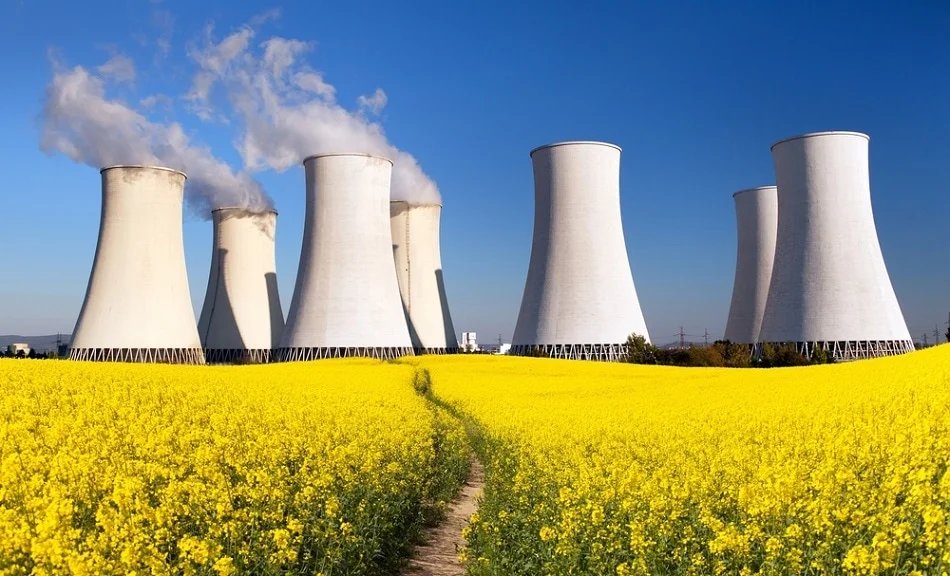
Today’s post is by frequent un-Denial visitor and friend Monk who does a wonderful job of explaining why nuclear energy is not a useful response to overshoot.
With increasing energy prices and sanctions on Russia, people are once again considering how we can power the global industrial machine with significantly less oil and gas. Alongside this, environmentalists are getting more savvy in spotting the critical problems with the likes of wind and solar and other green hopium nonsense (green hydrogen anyone?). But for some reason, many people struggle to make the final step and admit that nuclear is not going to save us from peak oil and / or climate change.
In this article, I would like to briefly layout what I see as the high-level problems with nuclear. This is just a summary of my own personal reasons for why I’m not convinced. It is by no means a thorough technical analysis!
What I’d like us to consider is this: is it DENIAL stopping our smart and critical thinkers from admitting the problems with nuclear? People who do become aware of the problems with our system tend to jump to nuclear as a last bastion of hope. Modern commentators like to tell themselves nice stories about nuclear. This prevents them from having to seriously consider energy collapse. How often have you heard these affirmations?
- Nuclear energy is cheap
- Nuclear energy is safe
- Nuclear energy is clean and green
- Nuclear energy is a low carbon energy source
- Nuclear energy can meet our energy needs when fossil fuels run out (peak oil)
- New innovations will make nuclear energy better, such as micro plants, newer generations, sustained fusion etc.
We shouldn’t just believe in nuclear like it’s a fairy godmother who is going to save us from our poor energy planning. We should thoroughly interrogate claims about nuclear through the lenses of environment, energy, economy, and safety.
Nuclear energy may have a negative energy return
If we accept money (currency) as a proxy for energy units, then it is pretty clear that nuclear plants are incredibly energy expensive to plan, build, maintain, and decommission. Nuclear plants are some of the most expensive projects undertaken. The capital costs are horrendous. What that should tell you is it takes a shed load of energy just to build a nuclear power plant.
To see if this upfront energy spend is worth it, we need to see how much energy we get back. Utility providers will look at costs as a ‘cost per electricity unit’. If you compare nuclear to other electricity sources, you are spending a lot more to get nuclear. Here is an example of that type of comparison looking at just the capital cost per kilowatt:
| Type | Capital cost per kilowatt (kW) |
| Nuclear | $7,675 to $12,500 |
| Coal plant | $3,000 to $8,400 |
| Gas combined | $700 to $1,300 |
Source (well worth a read): https://world-nuclear.org/information-library/economic-aspects/economics-of-nuclear-power.aspx
By the time we factor in all the other costs associated with nuclear – that other electricity generation doesn’t have – I’m not convinced nuclear is generating a net return at all. If that’s true (I’m happy to be wrong), you might ask why countries continue to build them? A few possibilities include:
- Accepting burning existing fossil fuels now to get longer lasting consistent electricity in the future.
- To support ongoing research.
- To support the military.
I often hear pro-nuclear people talk about how much energy we can get from such a small volume of uranium. I think that is disingenuous considering all the energy we have to burn in setting up a plant before we even get a single unit of energy from uranium.
Please note that net energy studies are notoriously difficult, because it’s up to the researcher how much of the supply chain and lifecycle they factor in. That’s why I find looking at currency a useful way to approximate EROEI (energy returned on energy invested). Of course, the nuclear industry will say they generate a very positive EROEI. Here’s a good example with references: https://world-nuclear.org/information-library/energy-and-the-environment/energy-return-on-investment.aspx. However, academic “meta-analysis of EROI values for nuclear energy suggests a mean EROI of about 14:1 (n of 33 from 15 publications)” (Hall et al., 2014) NB this was looking at traditional nuclear only.
Nuclear produces electricity, not liquid energy, not coal, and not gas
Our predicament is not one of electricity, but of diesel, natural gas, and coal. These are critical energy and resource sources that cannot be replaced by electricity (or at least not with a positive energy return). A couple of simple examples:
- We can’t make silicon wafers or industrial steel without coal.
- We can’t move stuff around or dig it out of the ground without diesel.
- We also have the issue that the world vehicle fleet is already built and requires petrol or diesel for the most part. There are no longer enough minerals left to build an entirely new electric vehicle fleet – a fact that surprising few anti-car new urbanist types are unaware of.
- Natural gas provides us with nitrogen fertilizer (essential for feeding billions of people in the modern agricultural system) and plastics with many uses.
Another challenge is that if nuclear was to replace all energy from fossil fuels, we would need a better way to store excess energy. Although nothing like the intermittency problems of wind and solar, nuclear has a related type of problem in that it likes to always be running and producing a steady-ish amount of electricity. Currently this doesn’t matter where nuclear is part of the total energy mix, but if it were the bulk of the energy mix, storage would become a major consideration. There are a whole lot of issues with electricity storage that have been well-explained in the issues with wind and solar, namely finite amount of materials to build batteries, expense, and battery storage capacity.
One potential upside of nuclear energy could be to replace natural gas as the main electricity generator that balances out wind and solar intermittency. But due to the costs of nuclear compared to gas this hasn’t been done. Moreover, gas generation is preferred because it is easier to switch off and on.
Nuclear is entirely dependent on fossil fuels
A nuclear power plant could not even be built without fossil fuels:
- Coal to make the steel
- Diesel to mine the uranium
- Diesel to mine the sand for concrete
- Diesel to mine the copper to make the electric components
- Gas to make the plastics for componentry and systems
- Gas to make the food to feed the workers
- I could go on and make this a very long list, but hopefully you get the point.
Because building a nuclear power plant is impossible without fossil fuels, that also means we will not build new nuclear power plants after the end of oil. Just like wind turbines and solar panels cannot make more of themselves, neither can a nuclear reactor.
Nuclear is not zero emissions
Obviously to build a nuclear power plant you are going to need a lot of diesel-powered plant and equipment. There is also concrete to factor in, which is a massive emissions source, accounting for approximately 8% of total global emissions.
With all those fossil fuels going into making a nuclear power plant, it should be obvious that nuclear is not and will never be net “zero emissions”. The focus on operating or tailpipe emissions is pointless when you’re still making an overall net positive addition to emissions. And arguably the world already has more than enough electricity, so building nuclear is possibly a complete waste of emissions.
Inputs to nuclear power plants are also reaching peak
As the capital costs suggest, nuclear energy plants are massive construction projects. They require vast raw materials – all of which have their own supply limitations. It is not just oil that is reaching peak, but many other raw inputs from copper to even boring old sand. Yes, peak sand is a thing. If you look at a picture of a nuclear plant, you’ll see a lot of concrete. That is sand! Concrete also requires other raw materials including calcium, silicon, iron, and aluminium. Is there even enough sand left in the world to build enough nuclear power plants to meet our energy needs? And the concrete needs will still be there for a hypothetical fusion plant, or any such other “innovative” nuclear power generation.
The story is the same for any other rare (or getting rare) earth element. There’s approximately 17 years left of zinc, 21 for silver, 35 for nickel and 64 for cobalt. Even if these numbers are wrong, it still shows that physical limits are approaching. This provides a real limit to the number of nuclear plants that it is even feasible to build. Moreover, if our system is going to rely on more electrified plant and equipment, these minerals will run out much sooner.
Uranium is finite
It’s kind of ironic that some people see nuclear as a solution to peak oil when the actual feed for nuclear is also reaching peak. How much proven uranium reserves are out there is hotly debated. Really, I don’t care because if there’s 10 years left or 100 years, it’s the same result – our industrial system runs out of power. Apparently, proven uranium reserves would last 90 years at the current rate of use (Murphy., 2021 he has lots of references).
What we can know for certain is that uranium will peak at some point and then reach a diminishing point of return where it is no longer economically viable to get it out of the ground. Bear in mind, most (some?) of the value in mining it is for weapons – with electricity just being the side gig!
Uranium is often in hard-to-get areas (including Russia, now embargoed). We can’t mine the uranium out of the ground once we run out of diesel, which would put the end of uranium to 40 years, not 90. The only hopium here is to hope they’ll invent some amazing electricity-powered mining plant and equipment, but then we are back to the peak mineral problem. For now, we are stuck with diesel and the associated carbon emissions.
Environmental considerations
Making nuclear power plants degrades the environment. This includes:
- Mining all the materials required.
- Burning all the diesel, gas, and coal in the manufacturing and construction phases.
- Building all the roads and parking required for the plant.
- And polluting the environment for hundreds of thousands of years with radioactive material that causes birth defects, genetic degradation, cancer, and death.
Michael Dowd regularly asks us to contend with the question of radioactive waste. What right do we present day humans have to pollute the world for thousands of years, just so we can run another dishwasher? It is highly likely that some, if not most, nuclear reactors will meltdown, because they will not have been safely decommissioned due to peak oil production. What an inheritance for our descendants, if we have any left!
What do we do with the waste?
Nuclear waste is incredibly dangerous to human health and the environment. Waste can also be utilised by terrorists (or bad state actors) to create a dirty bomb. So based on these problems, we need to be very careful where and how we store the waste. Not surprisingly, this is another thing humans seem determined to f-up. For starters, a lot is stored at or near sea level – great for getting water to keep it cool – not so great when you get a sea-based disaster. Sea water corrodes infrastructure at a faster rate, increasing the likelihood of failure of the waste containment. Plus, what happens with rising sea levels from climate change?
When digging more into this topic, you’ll see humans are running out of places to put this waste and the costs of waste-storage projects are increasing. This makes it less likely that a company will be 100% focussed on quality for a capex project that generates no returns.
Alice Friedemann has argued that burying nuclear waste should be a top priority, as after peak oil production, oil will be rationed to agriculture and other essential services. Spent fuel from nuclear lasts a very long time. According to Archer (2008): “… there are components of nuclear material that have a long lifetime, such as the isotopes plutonium 239 (24,000 year half-life), thorium 230 (80,000 years), and iodine 129 (15.7 million years). Ideally, these substances must be stored and isolated from reaching ground water until they decay, but the lifetimes are so immense that it is hard to believe or to prove that this can be done”.
Once the containment for nuclear waste starts to degrade, the waste can leak into ground water, contaminating drinking water and getting into the food system. Where waste gets into the ocean, the currents can travel it all over the globe. This is happening in our lifetime, forget about a thousand years from now.
Are nuclear plants really safe?
Taken at face value statistically, nuclear plants are very safe. But I think this is a sneaky statistic because this is old data from when nuclear plants were young and well-resourced. We really don’t know how the safety stats will hold up as the plants age out. Once they are over 40 years old, the risk of disaster is much higher. This risk is heightened by very old systems and componentry and the specialised nuclear workforce retiring and not being replaced.
Many nuclear plants are built close to the sea, exposing them to natural risks including sea level rise, tsunamis, typhons / hurricanes, and erosion. Near misses are surprisingly common, often a result of human error and the just mentioned old systems. There is evidence that significant near misses are underreported officially, leading to misconceptions about the safety risks posed.
There have been two major nuclear power plant disasters that I’m sure you are familiar with. The first is the 1986 meltdown at Chernobyl where a design flaw, triggered ironically by a safety test, led to a reactor meltdown. The second was the 2011 Fukushima disaster, where an earthquake-triggered tsunami damaged the emergency diesel generators, leading to a loss of electric power. By the way, look there’s another essential use of fossil fuels in operating nuclear plants!
Here are two minor anecdotes to show you the environmental outcomes. Following the Chernobyl disaster, a farm in Scotland had all their new-born lambs born without eyes and they had to be culled. As a result of Fukushima, across the Pacific, there is plenty of scientific evidence of radioactive contamination in fish and shellfish – tasty!
When we look at total confirmed human deaths from these nuclear incidents, we are looking at around 100 people. Total deaths from COVID-19 thus far is around 6.6 million. So how can we say nuclear is unsafe? Well, what the official incident deaths don’t tell us is how many people are dying from cancers years after a nuclear incident. Moreover, there’s little incentive for a government to try and track each death that could be attributable to a nuclear disaster – that will only make them look bad. Considering nuclear waste is toxic for 100,000s of years, we can’t even account for the untold future suffering of humans and non-humans.
Maybe the initial risks of nuclear have been overstated, but what would happen if most or all of them failed? For example, a risk that you barely ever hear mentioned is if multiple reactors were hit by an EMP or solar flare? If the grid is wrecked, so are the nuclear reactors. Maybe that might never happen, but it does seem likely that most plants won’t be properly decommissioned (due to peak oil), which will see most of them melting down over this century.
Terrorism
Nuclear plants are a target for terrorism and potentially could be used to inflict massive damage to people and the environment. From Alice Friedemann: Plutonium waste needs to be kept away from future terrorists and dictators for the next 30,000 years. But world-wide there’s 490 metric tons of separated plutonium at military and civilian sites, enough to make more than 60,000 nuclear weapons. Plutonium and highly enriched uranium are located at over 100 civilian reactor plants. In addition, there’s 1,400 tons of highly enriched uranium world-wide. A crude nuclear bomb can be made from as little as 40 to 60 kilograms of U-235, or roughly 28,000 nuclear bombs.
Decommissioning is fraught with challenges
Decommissioning is essential as once plants age out, they become too radioactive and are likely to decay. You would then get a full or partial meltdown. Like everything else to do with nuclear, decommissioning too is a very expensive and lengthy process, often exceeding budgets. Decommissioning also requires experienced nuclear engineers who are retiring. Younger engineers no longer see nuclear as a viable career path, so the next generation of skilled nuclear workers is not there. As the nuclear plants reach the end of their design life, it will get harder and more expensive to safely decommission them. And when has a large corporate ever been good at cleaning up after itself?! Moreover, us poor taxpayers will be increasingly impoverished by peak oil economic destruction, leaving governments with less funds to pick up after the energy companies.
We might ask, where is the proof that decommissioning is happening currently and where are the government budgets put aside for decommissioning? Countries like France and the USA are also delaying decommissioning plants at the moment, possibly worried about electricity shortages and unwilling to take another source offline.
As citizens, why should we support the building of new nuclear plants when there’s barely any proof that the current ones are being safely dealt with at their end of their life?
Financial problems
Investors are not keen on nuclear power projects. They have a habit of blowing out budgets and timelines and failing to return investment (a big clue that they are negative EROEI). There’s also a bit of a wait of 7 to 10+ years for project completion before you can even hope to start seeing a financial return. Remember the cost of construction is only ever going to get more expensive now due to peak oil. Oh, and there are uninsurable liabilities!
Governments often need to invest in electricity infrastructure, and especially for nuclear, to make up this shortfall in private investment. Citizens quite rightly should demand proof that nuclear plants are worth spending energy on. They should demand Governments provide detailed risk management against all the criteria we’ve just discussed. Because nuclear is not popular with the average citizen, democratic governments are increasingly unwilling to invest in nuclear. Moreover, governments are encouraged by their populations to keep electricity prices affordable. Wind and solar are much more popular and tend to get more of the subsidies. They have also damaged the profitability of nuclear with wind and solar going first to sell to market (government policy in parts of Europe).
Replacing fossil fuels with nuclear energy is a pipe dream
In a 2019 Forbes article, Roger Pielke ran a thought experiment on how many nuclear plants the world would need to get to the 2050 net zero goal. “To achieve net-zero carbon dioxide emissions by 2050, the world would need to deploy 3 [brand new] nuclear plants worth of carbon-free energy every two days, starting tomorrow and continuing to 2050. At the same time, a nuclear plant’s worth of fossil fuels would need to be decommissioned every day, starting tomorrow and continuing to 2050.”
We can already see that this just isn’t happening, and for the reasons laid out in this article it’s clear this can never happen. It looks like 2022 saw just 53 nuclear reactors under construction world-wide – that’s not finished by the way, just in some stage of construction.
But what about innovation
Honestly each ‘innovation’ to nuclear reactors could be an article all on its own. I have to confess I have a lazy heuristic: I just write off all of these as nonsense and don’t really give them fair consideration. But if I had to provide a high-level critic, this would be it. I have just noted the additional problems with these “innovations” – they still have all the same problems described elsewhere:
- Fusion – The gold standard of hopium. As the idiom goes, sustained fusion is just 20 years in the future and always will be.
- Breeder reactors – Recycling costs more energy than you get back. Also, more expensive than regular reactors, which are already too expensive.
- New generation – Less safe and more toxic (go ask Alice).
- Thorium – Perhaps it could have worked but looks like it’s too expensive now. That’s a good hint it would be negative EROEI. Might not be viable in reality.
- And this goes for lots of things: just because something is feasible in a lab situation or theoretically possible, does not mean it will ever be a viable solution. You can do a lot if you have oodles of energy and billions of dollars to waste. We might ask, is indulging the fantasies of scientists really a good use of our last remaining surplus resources?
Well, that’s bleak, what does the future of electricity look like
Humans already have access to more electricity than we ever imagined 100 years ago. If we had a stable or reducing population (shout out to Rob), then we wouldn’t even need to worry about bringing on new electricity generation.
Categorically all forms of electricity generation have their negative drawbacks. Eventually, all the hydroelectric dams will silt up – this can take hundreds of years – and finally they will all fail. Wind turbines last for 30 years, though in reality production efficiency reduces much earlier. Coastal wind turbines will decay after 10 years due to erosion from salt water. Solar panels will last 30+ years, but the associated systems and batteries to collect and store the electricity fail much sooner and need replacement parts. Nuclear plants last for a design life of 40+ years minimum and then should be decommissioned over the following 20 years. With natural gas shortages due to the Russian Invasion, countries are delaying decommissioning their plants. Most western nuclear is aged out.
Humans could continue to produce electricity by burning coal and natural gas. There are approximately 400 years left of coal and 150 years left of natural gas. But (and it’s a big but), there is only 40 years left of oil (BP Statistical Review). Without oil we don’t have diesel powered equipment, which will make it all but impossible to extract coal and natural gas. Without coal, we can’t make industrial wind turbines, solar panels, or nuclear reactors.
What this means is that by the year 2060, we are looking at a world with much less electricity production and eventually moving to almost zero electricity as the hydro dams fail in the coming centuries – and no we can’t build new ones of scale without diesel. Perhaps some smart individuals can maintain rudimentary electricity where they live, but the days of large electric grids are numbered.
By the way, if you do want to dive into the technical details, I can point you in the direction of plenty of useful references. Just let me know 😊
 un-Denial
Regarding diesel going away first: I suspect that means our forests and/or ag land would follow soon thereafter to make biodiesel as a replacement. We’re already shoveling huge amounts of wood into electricity generation to replace coal. (Drax!)
LikeLiked by 2 people
Alice F worked out all the forests in North America would be gone in one year from heating and cooking without fossil fuels. Biomass just doesn’t exist in the quantities that would be any use. There’s also arguments that biodiesel is negative energy return on investment. Maybe some combination of coal-to-diesel and biodiesel will be used for a time – especially when electricity can still be used for heating and cooking.
LikeLiked by 1 person
The common derogatory term for the super obese folks who are so common throughout America but seem to be most easily sighted at Walmart is “whale”.
I propose a new start up that refines this new product that will power the future called…….. Whale oil! [Patents pending]
LikeLiked by 2 people
Oh dear haha. Extra fat is one way of prepping
LikeLike
Also might solve our food issues;
https://www.yahoo.com/news/japan-launches-whale-meat-vending-042634811.html
LikeLiked by 1 person
OMG Jef you are are naughty 😉
LikeLike
“combination of coal-to-diesel and biodiesel” — Combination fossil diesel and biodiesel is what airline industry is promoting as “lower” GHG fuel. IMO about as stupid as battery powered airplanes.
LikeLiked by 1 person
yes haha – the airlines tell a good story. Our airport in Auckland just got flooded. They have a 50 year masterplan. LMAO they think there will be fuel and a sea-level airport still in 50 years.
LikeLike
Germany pre war ..no oil used coal to make liquid fuel..very inefficient..
LikeLike
All of the above reinforces for me that the ONLY good path is rapid population reduction and the fact that this is not intuitively obvious to everyone means Dr. Varki’s MORT theory is probably true.
LikeLiked by 2 people
Yes, resources would be plentiful in a slowly reducing pop. Bonus points if we could be improving our soils at the same time as reducing pop
LikeLike
Just prior to Monk’s above essay being posted, Gaia contributed a lengthy and interesting comment on the last post sharing her knowledge on covid vaccines. It would be a shame for readers to miss Gaia’s comment so I’ve copied here for visibility.
LikeLiked by 1 person
thanks Gaia, that was really interesting
LikeLike
I appreciate your desire to explain but your overly complicated comments do more harm than good when it comes to the average person reading it. It almost seems like you are trying to muddle the issue???
Here is what is true and important;
It is important to understand that biotech is mostly just wet chemistry.
For those confused about the graphene vs no graphene, from what I have read the batches of the jab vary quite a bit so it is very possible that some can’t find it. This keeps everyone guessing and divided.
There are most definitely viruses and they play an enormous roll in all life on the planet. We would not be here without them.
With regarding germ theory vs terrain, which is what most arguments surrounding C-19 and the jab boil down to, both are of course are necessary. It is a proven fact that healthy cells, tissue, and bodies, resist being overtaken by most germs, bacteria, virus, etc. It is why all vaccines have an adjuvant incorporated into them. Adjuvants are toxins, poisons, which when healthy cells, tissue, and bodies are exposed to and compromised, that then allows the attenuated virus in.
Science knows this, has known this for a very long time (100 years+) . The CDC has a whole department that focuses entirely on toxic events and are always deployed when there is an outbreak of disease. They don’t talk about or show their findings as that info would be …inconvenient because the western economy is 100% invested in germ theory only.
Because modern populations are constantly and increasingly being poisoned with thousands of manmade toxic elements we can expect to be increasingly detrimentally infected with all sorts of bugaboos.
Ironically the best way to address the increasing toxic spew would be to poison everyone…that’s what I would do.
The spike protein that the mRNA jabs produces is toxic…even the producers of the jabs have admitted to this. This is not seen by TPTB in Pharm as bad, in fact it is the historical desired goal. The belief is that if people are pre-poisoned they will be better off. They also believe they can release a toxin in the human body that will only focus on what they have “programed” it to attack and leave the rest of the human physiology uneffected. This is ignorance and hubris on a scale beyond anything humans have ever achieved and thats saying a lot.
LikeLike
Every once in a while Ivor Cummins provides a nice big picture evidence based summary of what we know about Covid. He’s done 2 of these in the last 2 days.
The first one rejects Scott Adams’ lame mea culpa showing the evidence Adams missed.
The second one looks at the benefits of the vaccines and shows that even if you ignore the “magic” pharma used to inflate the benefits, and if you ignore all of the harms, there is no evidence to justify the policies of our “leaders”.
LikeLike
Nice trolling the comments about vaccines… but in case you missed it… sigh… that is NOT what this article is about.
LikeLiked by 1 person
Yes, it’s true I’m obsessed with how incompetent and/or evil our leaders have been on covid.
I understand why our leaders deny overshoot and energy depletion and therefore do nothing intelligent about these issues.
I do not understand why they performed so poorly on covid.
I probably won’t stop until they are dead from mRNA side effects or in prison.
LikeLiked by 1 person
Your obsession is why I don’t feel comfortable referring people to your site.
LikeLike
Covid has obsessed many truth seeking people. It may prove to be the biggest crime in history and the majority of citizens don’t even attempt to understand what is going on despite possible harms to themselves and their children. It’s totally fascinating. We could be witnessing the most impressive example of Varki’s MORT ever.
LikeLike
Your not feeling comfortable makes me feel uncomfortable.
I can’t possibly recommend this blog when commenters are obsessed about feeling comfortable.
LikeLike
Don’t let it bother you. It doesn’t bother me; it just means I don’t include un-denial on my list of go-to references to educate people about limits to growth and overshoot. Aside from the fact that I think it’s paranoid, borderline wacko anti-vax, and irrelevant.
LikeLike
I have shared mountains of evidence that persuades me mRNA costs exceed benefits, and that the people in charge are unethical and/or unintelligent.
Please share the evidence that persuades you that mRNA benefits exceed costs, and the people in charge are intelligent and have pubic health as a priority.
LikeLiked by 2 people
Well Rob I don’t think your a wacko or anti vax and for that matter neither are any of the commentators. I certainly don’t think that humans ability to deny reality is irrelevant so keep up the good work.
LikeLiked by 2 people
Its too bad we’re all so scared of reality.
Thanks for putting it up Rob.
LikeLiked by 1 person
Hah, they only play the audio only for me, green screen video. So I still cant see the Scott Adams charts!!
I have a feeling I already know the basics anyway.
LikeLike
The videos are very good, Ivor does a great job using official souces. It was the win10 that was fighting me maybe.
LikeLiked by 1 person
Natural gas is CH4… meaning 4 atoms of HYDROGEN…
so for a hydrocarbon, it is one of the cleanest of the bunch.
LikeLiked by 1 person
Nice one, monk. Nuclear advocates, though, would probably be able to pull nonsense from their arses to counter most of it. Doesn’t matter; it’s not going to happen. If Pielke is right, we need about 15,000 new nuclear power plants (and that would be just for current energy use). Your safety concerns start to explode if one thinks about not just 450 NPPs but 15,000 NPPs. Statistically, it wouldn’t surprise me to find we’d experience one serious nuclear incident a month or a year, multiplying safety concerns.
I’d love to get confirming evidence of Michaux’s work on the material needs. There is a new paper, written about the same time, which claims that there are enough materials for a transition but it seems to have some flaws and I’m fairly certain was written by those who are desperate that a transition is possible. I don’t know how anyone can be objective about this but we have to find that objectivity to avoid pouring resources into a dead end and to avoid the attendant ecological destruction.
Regarding steel making, there are a number of companies claiming to make fossil-free steel but I’m skeptical (they are often couched in terms of a future aim for fossil free, even if some strides have been made towards that goal). Regardless, anything claimed as sustainable is bound to be a lie.
On nuclear innovations, I often wonder why ideas touted by nuclear adherents don’t appear to be making it into new builds or nowhere near as often as would be needed (e.g. breeders). It could be that the industry doesn’t share the rosy view of such innovations.
One of the points never addressed by nuclear adherents such as James Hansen (a great climate scientist) is “what if the attempt fails?” There could be thousands of nuclear reactors running as societies start to crumble due to environmental or resource issues (likely both). The risks then go through the roof.
We’ll be looking for a way out even as the last community succumbs to nature.
LikeLiked by 1 person
I have looked into the fossil fuel free steel, and all the ones I researched are bogus. They are either making pig steel or using offsets to claim they are fossil fuel free.
LikeLike
All of these fossil fuel replacements are really just discussions and information posted on the internet. Money will keep being injected into solar farms, wind farms and new hydroelectric projects. Meanwhile fossil fuel consumption keeps rising and it’s percentage of total energy consumed remains about the same. Electricity use rises every day as the data storage centers store more articles on renewable energy, more Youtube videos and more tweets.
Not only are we looking for FF replacements but to keep the economy going we need more electricity all the time, otherwise the system will crash. So in reality, all the alternatives (including nuclear) are just keeping up with increases.
LikeLiked by 1 person
Using fossil fuels to build our their replacements can be like throwing good money after bad. If the population was not growing, we wouldn’t need to keep growing the energy system. The end point looks certain, when we get, and in what way, is still to be found out
LikeLike
Following Tim Garrett’s work, it’s not so much the growing population that requires more energy (though it does) rather the continued accumulation of wealth, which would happen even if population was falling, provided some resemblance to the current economy continues.
LikeLiked by 1 person
agreed and add to it the electricity consumption of crypto, CBDC, healthcare records.
LikeLike
Hi all. Sorry to change the subject, but New Zealand has had a terrible weather event over the week. Our largest city Auckland had the worst flooding on record. Essentially we had a cloud burst, coinciding with a king tide. I know for Americans this might not look like much compared to your hurricanes. But this was seriously scary for us. https://www.theguardian.com/world/2023/jan/29/auckland-flooding-death-toll-rises-as-new-zealand-hit-with-more-heavy-rain-and-landslides
LikeLike
Wow. I hope you and yours are ok.
We seem to be under assault from every direction: weather, economy, war, pandemic, corrupt & incompetent leaders, etc.
LikeLiked by 1 person
Everyone is fine thankfully, one of my friends had her business completely flooded 😦
I typically don’t like blaming every bit of weather on climate change, but in this case, it seriously is hard to explain without climate change
LikeLiked by 1 person
Yes. Attribution studies generally state that the likelihood of such an event has increased. One in a hundred year events become one in fifty year events then one in twenty year events. I know someone who had to move their garden because a one in 20 year event happened three times in five years.
I’m just on the outskirts of Auckland and recorded 217mm in a 24 hour period (it’s a good job I emptied the rain gauge half way through, otherwise it would have overflowed). Auckland apparently had its wettest day on record but the second wettest was in the 80s with a cyclone. This even had no associated cyclone and the pressure of the associated low pressure zone would often be regarded as high pressure in different situations.
My son and grandson were kayaking around our orchard. Thankfully, the water got nowhere near our house (it would probably have taken many more days of that level of rainfall, for that to happen – but I wouldn’t rule it out in future). The system is being pushed back over us so we may get another extreme event in the next day or two. Fingers crossed.
LikeLiked by 2 people
I hope your house and property weren’t damaged? We were told over and over for decades to expect weather events to get worse, so we can’t act surprised. Only sad we didn’t reduce our carbons.
LikeLike
Know how you feel. I experienced the Lismore floods in NSW Australia.
Huuuuggggee.
The town is still a shadow of its former self.
LikeLiked by 1 person
It takes a while for a town to recover – Christchurch is still not the same 10 years after the earthquakes. It’s worse if people abandon the town as well. That flooding in Aus was crazy, especially so soon after the fires
LikeLike
Collapse happens one day at a time.
Who knew?
Think of it as training for really hard times.
Imagine the cleanup when you watch it and then consider what happens when there is no diesel.
Lismore would still be a flotsam and jetsam disaster zone.
LikeLiked by 1 person
Nobody works up a sweat anymore. Diesel is like magic.
LikeLike
except diesel mechanics perhaps
LikeLike
Mechanics have cranes to help them. I was going to say mason helpers and small scale farmers. I’ve done both.
LikeLike
In New Zealand we spend a lot on keeping our roads open. We have a lot of rivers and creeks, lots of slopes and mountains, and a lot of earthquakes. Bridges and roads wash out, slips happen, trees fall over roads, roads break from earthquakes. Every day, there are highwayman driving everyone of our state highways working to keep them open. Without diesel, much of NZ would be impassable very quickly
LikeLike
Thanks. No damage to our house. Whether trees have been damaged or not is uncertain. The effect of inundation may not play out for a while, but no visible damage.
Reducing carbon and other GHGs is vital but this won’t get any better until all human caused GHGs are reduced to zero but, even then, we’d have to live with unstable climate for the rest of our lives.
LikeLiked by 1 person
Have you investigated weaponized weather, aka HAARP? I remember it from the 70s and 80s alerts by Michael Ruppert. Now it’s back in the news.
and this Romanian senator’s news conference on the Turkish earthquake: Romanian Senator Diana Socoaca claims HAARP technology was used to cause the Turkey Earthquake as a warning to go “With the flow” and follow “Deep State” orders…With what’s happened over the last 2 years, anything is possible..
LikeLike
Hi monk, Mike, Campbell and all other Kiwi friends,
Glad to hear you’re all okay and hopefully NZ will be getting some breathing space for the massive clean up operation ahead. What a big first task for your new PM. As you would know, Australia has also experienced record flooding last year, some areas were underwater 3 times in a year, so these events are becoming record holders not only for amount of water but also how quickly occurring in succession.
It’s always good to live on high ground, and never too late to put in more drainage infrastructure to prepare for the next deluge. I hope everyones’ gardens are okay and your fruit trees won’t mind a bit of wet feet for a little while.
What does someone with real meteorological knowledge think about the idea that these torrential rains have been seeded in part by that volcano off Tonga last year? All I know is that it sent up record amounts of water vapour into the stratosphere which is forecast to increase global warming further over the next few years before dissipating. Could this also have contributed to these rain bombs that are exploding all over the planet, especially in the Southern hemisphere?
Stay well and dry everyone, and thank you for all your community spirit and help for those in need. These are also times which draw out the best in people, and I trust you will find many uplifting stories to keep your spirits high.
Namaste.
LikeLiked by 3 people
Thanks, Gaia. Yeah, we’ve had it bad but others have had it much worse and the situation isn’t going to improve in our lifetimes. I don’t know about that Tonga volcano. I doubt it, though. Water vapour isn’t a well mixed gas like CO2 so any effects could be localised. Also, the stratosphere has been cooling, as the troposphere and surface have been warming, so extra water vapour up there may not act in the same way. I haven’t noticed any research on that, though.
LikeLiked by 1 person
We don’t have an energy problem. We have a cognition problem.
LikeLiked by 1 person
true dat, we have more energy now than we’ve ever had 🙂
LikeLike
I like this short piece by Chris Martenson.
He points out that (while there are no easy solutions to overshoot) we could be doing a LOT better than we are with appropriate priorities.
LikeLiked by 2 people
You seemed to imply that there was some reference to overshoot but it was nothing to do with overshoot. However, I’m surprised he didn’t mention another option, apart from screwing retirees or younger people. Tax the rich. The top 1% could cover the shortfall without blinking.
LikeLike
Sorry, my bad. I was trying to say we could be doing so much better in the short term, without also saying that we can avoid the coming pain from overshoot collapse.
LikeLike
OK. So you think that there is a realistic way that we can avoid pain of collapse? I sure hope so.
LikeLike
I’m still not clear. Reverse what you think I said and you’ve got what I tried to say correct.
LikeLike
Nuclear power plants are just steam powered engines, more complicated but not that different. They consume water for cooling as well as for generating steam to power the generators. Therefore they must always be located next to reliable, continuous, abundant water flows 24/7/365.
Last year something like 6 of the worlds top rivers dried up enough to stop all traffic, some dried to a trickle, many no longer reached the sea. With the loss of glaciers, longer droughts, massive rainfall in very short timeframes, and warming waters (not able to adequately cool the facilities) it doesn’t seem prudent to put our hopes on this source of electricity.
A couple years ago France had to shut down several facilities due to low or no water flows. Expect a lot more of that.
One of the largest facilities is Palo Verde in AZ. it has no natural water source anywhere near. It primarily uses waste water from Phoenix and is now petitioning to use groundwater as the water restrictions in AZ are slowing down wastewater flows…at the same time as increased demand for electricity. What could go wrong?
LikeLiked by 3 people
Many thanks for sharing
LikeLike
Dr. Malcolm Kendrick is my most trusted doc. He has impeccable integrity.
Kendrick was an early critic of covid policies but quit writing when he concluded none of the data could be trusted and therefore it was not possible to do a useful analysis on anything.
He’s back today with a fresh look at the only data that can be trusted: all cause mortality.
His conclusion: covid was a nothing-burger and lockdowns did far more harm than good.
Sadly, he also concludes we will learn nothing from our mistakes and the people who screwed up will never be held accountable meaning we are guaranteed to repeat the mistake.
I’d say this is a must read if you’re still interested in covid.
https://drmalcolmkendrick.org/2023/01/31/returning-to-covid19/
LikeLike
Great piece. His takedown on Ardern was excellent. I remember thinking before Covid that New Zealand would be a great place to live and then during Covid, with the PM’s performance and the strict lockdowns, I had second thoughts. Good luck in the future to all you Kiwi’s.
I thought Kendrick’s best quote was: “… I have begun to see everything as a conspiracy nowadays.” – So you’re in good company Rob!
AJ
LikeLiked by 2 people
I note he did not touch gain of function research, lab leak, mRNA safety and effectiveness, vaccinating children, blocked safe and effective alternatives, variant promotion, Omicron origins, deliberate data obfuscation, etc.
He makes a damning case against our leaders and doesn’t even touch the important bits.
LikeLiked by 1 person
Adern was probably the worst PM in my lifetime. And I particularly despise the way any criticism of her or her terrible policies is labelled as sexist…eye roll. She was voted in with a clear majority in the last election, something that is very hard to achieve in NZ.
Under Adern’s leadership, NZ political discourse has suffered. We’ve have become more polarized. She has promoted harmful and hateful rhetoric. She leaves with the housing crisis worse than ever and public debt through the roof. Idealistic self-aggrandizing numpty.
A lot of us expected her to abandon NZ for a cushy job at the UN
LikeLike
The most recent leader is always thought of as the worst … until the next one comes along. I don’t think she was worse than Key but people have different priorities. At the end of the day, it doesn’t really matter who the alleged leader is, they all seem to be intent on destroying the planet we live on. In NZ’s case, it’s mostly harmless, being small, but still complicit.
LikeLike
I do sort of agree with that, but then there are quantifiable outcomes you can compare
LikeLike
Or WEF might take her in?
LikeLiked by 1 person
They made her, they should take her back LOL
LikeLike
Goodness, I wouldn’t base an opinion of any place being good to live on the basis of a short lived PM term. The whole world needs luck and future PMs are guaranteed to be as bad as Ardern.
LikeLike
His take on global deaths is weird; half close your eyes and there seems to be no difference during COVID. Not very scientific. It looks very different to me though I don’t think he thinks COVID was a nothing burger (i.e. that it was no different from normal, in terms of deaths). Of course, COVID is more than just a potentially fatal disease as there could be a lot of long term damage.
LikeLike
Geert Vandenbosch has book out now on the inescapable immune escape epidemic which provides a “thought-provoking analysis of the complex interactions between the virus and the host immune system that underlie the evolution of the COVID-19 pandemic. The author delves into the impact of mass vaccination on individual and global health, and explains how powerful organizations, institutions, and industries lacking an understanding of this complex environment have turned a natural viral pandemic into one of disastrous immune escape. The author’s predictions are compelling and indicate that Nature will correct this mistake, but at a substantial cost to human lives in highly vaccinated countries. ” https://voiceforscienceandsolidarity.substack.com/p/vss-scientific-updates-during-pandemic-397?publication_id=555295&post_id=102124242&isFreemail=true
LikeLike
IMO the greatest tragedy/crime against humanity and almost no one focuses on it,and that’s the fact that the global health authorities disallowed treatment. I’m not just talking about HCQ or IVM but any and all treatments for sick people. By disallow I mean serious punishment for those who disobey.
It has been widely reported that there were dozens of successful treatments performed from the very begining but were either shut down or disappeared. Physicians who were part of these relatively new MD provider corporations were told they would be knocked down the priority list or even sidelined if they started any of the treatments. People were told to just go home and wait until you are very sick then you can come in. This was not because of overcrowding either.
This practice is responsible for millions of deaths and it is becoming understood as the most likely cause of long covid.
Someone needs to climb on this issue big time.
LikeLiked by 1 person
That’s a good point Jef.
I think for me the biggest crime was not collecting and making public the correct data.
Let’s assume a world of leaders with good intentions. They make a judgement call in what they believe is an emergency and decide to roll out a promising novel technology with insufficient testing to confirm effectiveness or long term safety.
Those leaders would know it was vitally important to collect and publish the data necessary to validate their decision. If the mRNA is safe and effective as hoped the data would encourage the skeptics to get injected. If the data shows the mRNA is not safe or effective then it will stop any further injections thus preventing further harm.
How is it possible that there is not a single country in the world that publishes clean trustworthy data on all cause mortality for vaxed vs. un-vaxed?
Why did the doctors permit them to do that???
How is that possible???
It’s not unless our leaders and doctors are evil or really stupid.
LikeLike
Imagine if civil engineers influenced governments and the news media to not collect data and report on bridge collapses because they did not want to harm their business by having to pay damages and revise their design standards.
LikeLike
Love Malcolm K, too.
LikeLiked by 1 person
Dr. Kendrick in a comment states what he thinks happened with covid.
https://drmalcolmkendrick.org/2023/01/31/returning-to-covid19/#comment-262998
LikeLike
Baba today on free will.
No mention of MORT blocking it.
LikeLike
I love Scott Ritter: :”You should thank me, I saved your life by helping to negotiate arms control.”
LikeLiked by 1 person
The mainstream media narrative about Ukraine isn’t completely watertight. Salon has been able to sneak in an occasional Chris Hedges article on msn.com:
https://www.msn.com/en-us/news/world/don-t-believe-the-hype-ukraine-is-rapidly-becoming-another-war-gone-wrong/ar-AA16Wkea?ocid=msedgdhp&pc=U531&cvid=0b9f79d3a5454dad8acd8b95897d9841
LikeLike
The IMF obviously didn’t read Gail Tverberg’s last piece and are predicting brighter prospects for the global economy this year, and next. I hope they’re wrong.
LikeLike
Chris Martenson is excellent today. Wide ranging discussion of the insanity we are swimming in. He also explains how my government damaged many of my family and friend relationships.
LikeLiked by 1 person
yes but at what point do you think anyone is going to wake up? Chris is still peddling his hopium. Can’t blame him, its how he makes a living. But if you read between the lines as to what he is saying, I think we are in for not interesting times as Chris likes to think but devastating times that hit you sideways.
LikeLiked by 2 people
It was the insurance industry that forced citizens to accept the reality of climate change by raising rates due to extreme weather damage.
Maybe they’ll do it again for covid.
LikeLiked by 1 person
Glad I at least resisted getting any boosters. Much better odds if I had resisted the initial dose. Good for you Rob.
AJ
LikeLiked by 2 people
I won’t get boosted either. I also tried to leave a good gap between the two vaccinations. In NZ, when they first started vaccinated, they hit a lot of medical workers with the two rounds at the same time! Not good
LikeLiked by 1 person
Saw a post by Pierre Kory who thinks those who got a booster (or it might have been any jab) more than 4 months ago are probably OK. Ah well, mine was more than a year ago (at the time, the data here did support the idea that it was effective, not now). I’m not intending to get a further booster until there is a properly clinically trialled vaccine.
I don’t recall medical workers getting two vaccinations at the same time though the gap was reduced from the original protocol.
LikeLike
I disagree. I think that it is a slow burn of tolerance fixation that will allow the virus through repeat infection kill the majority of the vaccinated. Lets be honest, the spike is a killer and the vaccines make you tolerate it being in you. Not good. My whole family is vaxxed so I am not happy about this.
LikeLiked by 1 person
Mine were over a year ago too. I heard about the double-jab directly from a medical worker. Certainty wasn’t public knowledge. Pfizer still makes money out of me for my birth control
LikeLike
If I am not mistaken even radioactive materials from hospitals can be used to make a crude dirty bomb. You don’t need enriched uranium or plutonium. Imagine what terrorists and extremists would be able to do with thousands and thousands of tons of radioactive waste once civilization begins to break down and no one is left to guard them. Please correct me if I am wrong on this but it appears that the current plans for waste disposal if they even exist are prioritising high level waste not low level radioactive waste which can still be used to make dirty bomb.
LikeLiked by 1 person
It would depend on each country’s regulations I think. There’s been a few near misses in Australia lately, where construction workers have lost radioactive capsules from their nuclear densometers (used for testing density of road subgrades)
https://au.finance.yahoo.com/news/dangerous-radioactive-capsule-found-remote-072422584.html?soc_src=social-sh&soc_trk=ma
LikeLike
Thanks to Mike Stasse for finding this excellent new interview with Simon Michaux.
Lots of new insights in this interview. Michaux goes big picture with speculations on what is going on in geopolitics. Also predicts the big crash will start this year.
Relevant to Monk’s post they discuss (in part 2) the nuclear energy policy of Finland.
It’s quite remarkable how one guy has shown that all of the work on a ‘green’ future by millions of people and trillions of dollars is a complete fantasy.
I don’t think this is possible unless MORT is true.
LikeLike
Yeah, I wonder if we are “granted” one more year of relative normalcy. I know that already happened in countries like Pakistan or Sri Lanka but here in Central Europe things still go on rather … normal. Or if BAU is already past us and we didn’t recognize it yet?
LikeLiked by 1 person
He’s talking about industrial clusters again. I think he’ll be on that for quite some time before he realises it won’t work, even if we scale back or eliminate unnecessary stuff (we won’t). I wonder if he’s come across Tim Garrett’s work yet. We need all of these pieces, perhaps considered extreme at the moment, to coalesce to give us the big picture of what will work and what won’t. However, I can’t get away from the conclusion that there will be an almighty crash and the world will have to regress to primitive living when all the tumult dies down (in decades or centuries).
LikeLike
You can see Michaux’s brain doing back flips trying not to give up hope. I thought the interviewer might have had some ideas grounded in reality, like how big of a wood lot each person needs to survive.
I listened with one ear, will go back for a more careful listen.
I hate to say it but I think we’ll use the nukes when the shit gets real.
LikeLike
I’ve never heard Simon speak before. Pleasantly surprised to hear an aussie accent 🙂
Andrii Zvorygin is doing a great job with his interviews
LikeLike
Our species can do amazing things.
LikeLiked by 1 person
Sometimes I think (maybe it’s just emotion??) that even if we lost Science and all the insights it has provided for us into the Universe/Life/Consciousness; if we could keep great Art (classical music, Da Vinci, Van Gogh) our civilization would not have been a waste??????
Probably a vain hope.
AJ
LikeLiked by 2 people
Meanwhile our idiot leaders push boosters and never mention vitamin D.
LikeLike
Hi there again AJ and friends,
Life has not been a waste, every near-infinite solution in this cosmic Space and its sidekick
Time is just part of the Everything that ever was and could be. Everything happens to include our particular and peculiar consciousness in the form of this hominid vehicle which happened to evolve on this speck of dust and gas in this far-flung corner of the known universe. It’s been quite the ride hitchhiked to this third planet from our Sun, for all life forms and processes that have had their creation and demise on it. But holding onto the progeny of our consciousness in way of achievements is a pipe dream anyway, and all will eventually end. But, take heart! The universe is a circular economy on the grandest scale, the atoms of everything we have borrowed for our bodies and creations will be recombined again in some fashion and arise again as part of another life form or the ground and air that sustains it. And in due course, all return to infinite void, perhaps to be birthed into a new universe.
What we Homo sapiens have created in our Art, Music, and Architecture has been a large part in response to the grandeur and awe that the Universe has provided, there is no more majestic cathedral than the soaring canopy of trees, and the music of the spheres resonates over and above all other vibrations. Can our consciousness also give us the grace to accept that our brilliant spark happened as it did, once and for all? Can we be humbled into gratitude for just the chance to experience Life and awareness of Life and its mysteries? Can we have the courage to be content with that, and find the peace in knowing it is enough?
We are here and now, let it be well.
LikeLiked by 1 person
Gaia, please send me some of the stuff you’ve been smoking from your garden. I want the same feeling.
LikeLiked by 2 people
Haha Rob, that’s a good one! I did actually LOL! You should notice that I didn’t say I felt what I wrote musingly, only asked the question Can we? Godknows that everyday I struggle with trying to find some peace and meaning with everything that’s been happening. Generally I am not a stressbucket but over the past year I have cracked several molars, apparently from grinding my teeth at night, a more common phenomenon now.
All I know is hard physical work (including sweating!) and eating fruits and veggies of your own labours (often these activities are related) are the main sources of keeping me relatively grounded nowadays and taking joy in what we can still do for ourselves.
It just happens that Tasmania is the largest producer of opium poppy in the Southern hemisphere, and that will probably be a very good thing for us down here.
LikeLike
It is hard right now. Everyone is crazy. Except me of course.
Growing opium poppies is a very very good idea. I hope you succeed.
LikeLike
Yowser!!
I subscribed to Andrii Zvorygin’s channel. He’s the guy a couple comments above that recently interviewed Simon Michaux. This was the next video he published.
It looks like Greer, Kunstler, Dowd, and others, were right when they predicted that the successful survivors of overshoot collapse will form groups around new religions.
I’m doomed. I believe in the laws of thermodynamics. 😦
Gaia’s gonna live long and prosper. 🙂
Gaia, how’s your project going to clear land so like minded people can join your tribe?
LikeLike
Notice that this Law of One religion believes in life after death (that lasts for trillions of years), as Varki’s MORT predicts.
They also believe that their religion provides a feeling like sexual orgasm. MORT doesn’t predict that but it’s a nice add-on, and might be a better attractor than turning water into wine.
Maybe I’ll give it a second look. I could do with some sex.
LikeLike
I kinda still like Dawkins’ idea that religion is a virus of the mind(meme) and works best on the young. All the word salad arguments are lost on me now. Rational scientific thought has never been very popular in civilization except when it has produced stuff with copious energy. Even then the vast majority wallow in superstition and woo. The End is Near (yeah, it might be).
AJ
LikeLiked by 1 person
Dear Rob,
If I may, I would like to recommend you listen to some of Paul Hedderman. For instance:
or any other randomly picked from his channel: https://www.youtube.com/@zenbitchslap373
Simply put, that’s how I see it:
* if you believe you are a separate long-lasting independent entity (sustained by the body), then it is a certainty you will die,
* if you believe you are Reality temporarily experiencing itself through the senses of a mortal vehicle, then you will never die (as you were never born).
So it is not about life after death. It is not about immortality but rather about eternity (or shall I say, the Eternal).
To make an analogy with a toaster. Does it toast because of its inner machinery, or because of the electricity that goes through it?
Can we just agree that both options are in equal ways suppositions, interpretations, beliefs, maybe illusions? Both may be true at the same time.
To me, the only sincere position is to accept we can’t ever know, we can’t ever describe what is. From there, we are free to choose and live our life the way we see fit. We give life all the meaning it has. This is the ultimate freedom.
That’s why I see science as just another religion. It conceals what it can’t explain by making you prisoner of a model. They always say “think outside the box”, while presenting to you even smaller boxes than the one they control. There is no box. We don’t even know the shape of the box.
And that is why it is said that “there is no-thing” and amen means “so be it”. Ultimately, we can’t grasp It, just be in awe.
Enjoy.
LikeLike
Thank you Charles for the videos and I will watch them.
There are two things about what (I think) you’re saying that I do not understand.
1) Why is immortality as you define it, or life after death as most religions define it, important? There is nothing unpleasant about going to sleep, and if I never woke up I’d never know the difference. What’s the big deal about immortality?
2) You are correct that science does not yet answer many questions. It’s a process that slowly improves our understanding of how the universe works, and there are probably many things our brains will never understand.
Life is unimaginably complex, and yet we understand plenty enough to marvel at the reality of our existence, and have a pretty good idea of how and why it happened. There is no need for an invented spirituality to provide awe and wonder, science provides plenty.
A religion grounded in science might lead to commandments that would preserve the rare life that exists on this rare planet.
LikeLiked by 1 person
I watched all 3 videos and honestly did not understand a word of what was said, nor could I understand why they were saying it.
It seems to be a philosophy to assist with addiction recovery but I don’t get how it would help. I have some experience in this area (nicotine & alcohol) and quit both with no relapses and no need for spirituality 15 or so years ago.
LikeLike
Well, it is interesting how the same things can make sense to some and sound like utter gibberish to others. Anyway thank you for having the patience to listen to it even when it doesn’t speak to you at all. I apologize if it turned out to be a waste of your time.
Non-duality (advaita vedanta) is rooted in hinduism. But Paul is an A.A which probably gives a certain flavour.
What Paul is emphasizing (in the second video) is the fluid nature of life (a place of verbing, there are no nouns). This is related to impermanence and absolute unicity.
Then he goes on to stress the difference between the life experienced as child with life as an adult. What has changed, is that at some point, thoughts appeared alongside and changed the experience (“and then suddenly life is happening is seen as life is happening to me“, “to me is an interpretation”).
He then explains the nature of the interpretation. Basically there is consciousness (seeing, feeling, hearing, tasting, touching). This can’t be denied. But then, immediately the mental state claims it to create a fictitious actor (seeing implies the existence of a seer, etc). The last trick of the mental state is then to put this fictitious actor in front of consciousness: the doer is suddenly (magically) the one doing.
The actor, the “I” may thus simply be a fiction constructed by the mental state: “there can be tons of seeing without seer, but there is no seer without seeing”.
To realize this is pretty disconcerting. He is pointing out one of the assumption we automatically make, but do not see any more. The assumption of the existence of a self, which then leads to self-centeredness and other wrongs.
Basically, his talks are all about separating the mental chaff from the wheat: what is really true, really experienced from what is just mental interpretation, mental constructs, mental obsessions (about the past, the future…).
Have you noticed how a lot of life experiences are feared more beforehand than they actually hurt when they really play out?
This is true of many things. To give a concrete example that is close to us: isn’t worrying about collapse making our life more miserable than needs be? This worry is not a real experience (yet). So it may play out in a totally different way than we imagine.
Waiting for collapse, isn’t the same mechanism as waiting for “grace”/enlightenment, or waiting for death. It is about the mental state keeping us in check, at his whim. And it is diverting us from our concrete experience. This is sometimes referred as denial of living.
To me, spirituality is about taming the mental illusions. About eliminating all that is imagined rather than really felt. Following the lamb wherever it goes.
LikeLike
Dear Rob,
Thank you for taking the time to think about my post and ask questions.
I will try to answer as precisely as possible. It is not easy because I believe the very fact of putting reality in words distorts it. The language is misleading.
I was talking of immortality because I was responding to the “law of One” video. So I was trying to defend that one could rationally entertain this way of interpreting what’s around.
To me, it is not that immortality (more precisely eternity) is important per se. They are other ways to see the world that completely eliminate the “self”. For instance, one could say, we are just a bunch of atoms, or just energy flowing around, or magnetic waves. We could say we are a collaboration of cells that make a community, or a community of diverse beings (microbes and all), or that there is no existence outside of whole ecosystems. All these ways of seeing reality are somewhat true and somewhere false at the same time.
So it is not that one model/belief is better than the other. The important part to me is to see we live without knowing. Nobody knows. Nobody can capture Truth (or has any legitimacy to impose his truth on other).
To try an analogy: by putting on another pair of glasses, we can understand we were wearing glasses in the first place and that they can be removed.
A few years ago, I saw the cage bars of my reality. I saw I was interpreting everything through the lens of my humanist/rational upbringing. This experience was liberating. It immediately created more space, room for possibilities. Since, in the end we are the ones giving life all the meaning it has. Some ways of seeing life are particularly dark, others are particularly rosy, other are very cold… Pick the one that corresponds you the best. We are free not to despair. This is not denial of reality, this is seeing that reality is not reduced to the model of reality we have in our mind.
Maybe science is “a process that slowly improves our understanding of how the universe work”. But, to me, that is problematic in itself. There are core assumptions which can not be proved or disproved. These assumptions are not less arbitrary than the ones found in other beliefs.
One of these assumptions is that there is some kind of regularity in the universe that can be unveiled (in the form of equations). But that is not necessarily the case.
Another assumption is that this process is worthwhile. But do we really want to eliminate all mystery?
I would also like to refute the fact that “a religion grounded in science” (isn’t it a strange expression?) might lead to the preservation of life. It seems to me, we currently have a religion grounded in science. The consequences are all around us.
I totally agree with the fact that there is plenty enough to marvel. However, I would refute the fact that spirituality (sincere spirituality, not the ones made up to profit from the credulity of other) is invented. It is very much grounded in reality. It focuses on other aspects of reality than the ones that can be studied through science, such as: the subjective, the inner experience, the non-repeatable, the unique, contemplation without com-prehension (which is really an act of grasping)…. All these are part of reality too.
Thank you for this exchange of ideas. I enjoy it.
LikeLike
Hello Charles,
Thank you so much for the thoughtful and gentle offering above. You have a lovely way of expressing that which is inexpressible to leave a feeling of openness and possibility. I see you and enjoy your acceptance of reality very much.
All the best to you.
LikeLike
Thank you Gaia for your kind words.
I love the expression “I see you”. I seldom heard it before, except maybe in the movie “Avatar”.
Is it specific from your part of the world?
LikeLike
Hi Charles,
I trust this day finds you and your family well. I did learn to use “I see you” from the movie Avatar as the meaning resonated with me (and the story). It is a way to express how I wish to perceive the world through as many perspectives as I can and in doing so, refine my own with more humility, compassion, and kindness. Like you, it matters not whether my or others’ views are in agreement, but the possibility of their evolution and how our consciousness can integrate them is the path I wish most to take. I take heart knowing that you understand me and thus “see” me, and others here, too.
Namaste.
LikeLike
I see you too then. We are on the same page about the beauty of diversity of views. And Avatar is an inspiring tale.
LikeLike
Bunch of navel gazing BS. 99.999% of philosophy, religion, spirituality wuwu, is meaningless crap that people…PEOPLE…humans, make up so they don’t have to accept the hard cold realities of life.
Why oh why can’t we just cherish the physical realities of of the most uniquely incredible planet in the entire cosmos? There is nothing that anyone can point to that is more awe inspiring, beautiful, and fulfilling that the natural world. It is really that simple. Fuck all the millions of opinions of how complicated the minutiae of human thought can be. All it does is distract us from living simply and directly in the here and now in the natural world.
It isn’t even that we make up all this BS about ourselves, about humanity, about society, about psychology, that would be bad enough. No we go way beyond that and use all of that to destroy the most wondrous planet in a vast, nearly infinite sea of planets.
Please lets just stop all the bull shit.
LikeLiked by 2 people
Indeed. Humans may have some unique abilities in the animal kingdom but our species is really no different from others, in essence, it’s just that our species has the capability to access more resources to do more damage than any other.
The shame is that the planet was even more inspiring than it is now, before we wrecked it. But, yes, we should just be living simply. Maybe all the BS is because we seem to have lost the innate abilities and some of the handed down wisdom that we would have if it wasn’t for civlisation and our energy slaves.
LikeLike
Well, that is a bit harsh. It may sound like BS to you. And that is fine. This simply either means it is not for you at all, or maybe on the contrary there is a part of you which strongly resonates with it 🙂
Anyway, I would like to stress the fact that this “crap” is a pretty precise description of the mental tricks that lead some (many?) people to live hellish lives.
By understanding the mechanism and studying it, it can help breaking out of compulsive destructive (self or not) behaviours.
And doesn’t the world around us partly reflects our inner wounds?
LikeLike
The #1 thing that might “help” people is for them to understand the depth and degrees of how they have been lied to for generations. Not one in a million understands how the world really works and the “owners” make sure it remains that way.
The reason people have “compulsive destructive (self or not) behaviours” is because nothing makes sense when all the lies don’t come even close to explaining the convergence of catastrophic collapse happening all around us. 80% of the population of the planet are poor, half are very poor, a billion+ are starving to death slowly. 20% are doing ok, 10% are doing great, 1% are rich as fuck.
How are people to reconcile this in their mind? It ain’t by contemplating your kundalini or what ever. I am of the belief that no one can truly get straight and healthy while living in this profoundly fucked up society, to paraphrase Krishnamurti. Not even our genetically enhanced ability to deny can help us with that one…IMO.
LikeLike
Thank you for your explanation.
To me, the world seems more complex than that. I am unsure about much. And it’s a good thing because I have the belief that no one force can utterly control everything else.
My personal approach is to work on both planes: introspect, contemplate my beliefs, discard some, do a few changes in my life and behaviour, introspect again and so on.
For me, this is a small, incremental effort both inner and outer.
Anyway, I wouldn’t discard any approach. I respect every one’s agency.
A way I like to visualize the biosphere is a gigantic adaptative force seeking for ever better solutions to maintain and expand its own existence. So I am pretty confident (even if it means the end of humans 🙂
LikeLike
I tend to agree with JMG that we will see a return to traditional Christendom (or something similar) as collapse progresses. Christianity is a religion that started in the collapsing era of the Roman Empire. At it’s core, it is a religion that is anti financial fraud, recognizing the harm that currency manipulation and interests had on the everyday person. Probably it will go back to its roots (catholic and orthodox), rather than the newer protestant versions (which were part of modern capitalism really). I have always loved woo-woo stuff, but really in my heart I am a dogmatic materialist sigh
LikeLiked by 1 person
My reading of the history of Christianity says it was successful because it had a low entry barrier (all welcome, no need to cut your penis), was an effective competitor (must disavow other gods), provided valuable social safety net services (food bank, health care, etc.), and its leaders were very skilled at using magic tricks to prove its god could deliver wealth with miracles.
LikeLiked by 1 person
And don’t forget the fact that if you didn’t convert to Christianity, your whole tribe and culture could be wiped out providing glory to god by conquering the heathen. That’s a very persuasive and not so subtle inducement.
LikeLike
A few years ago I toyed with the idea that a way out of our mess that might actually work would be to found a new religion grounded in science that worships the rare miracle of life on earth, its diversity and beauty, and our responsibility to cherish and protect it. Perhaps the need for a life after death story (as explained by MORT) could be fulfilled with the “we are all recycled stardust” story.
I was curious how Christianity became popular and powerful so quickly. I summarized what I think were its keys to success above.
I didn’t pursue the idea because I lack the charisma to pull it off, and because I suspect a religion that does not offer a “real” life after death story will not succeed. Doubly so if the god tells everyone to have fewer kids and make do with less rather than promising more abundance provided you pray and follow the rules.
LikeLike
That’s the ticket! Let’s start a new religion that does all of what you wrote about and until we can get enough rich converts to fund our hippy happy permaculture communes that will magically spring up like mushrooms around the countryside, we can grow opium poppies and call it Hopium for the Masses, good for whatever ails you.
We will of course need to grow this movement by attracting new members only as one of our 10 commandments will be Thou shall not procreate. That’s not the same as not having sex, of course.
Back to our main competitor religion, that would be all the 60,000 plus sects of Christianity. I think the main reason it prospered as it did and spread like the plague is because it was championed as a state religion by the right person at the right time, in this case by Emperor Constantine of the Roman Empire. It was always a stunning political move and Constantine knew that the marriage of state and religion would solidify power. As for whether he truly was a “believer”, well, he conveniently “converted” on his death bed, or so goes the story. They weren’t stupid, those Roman rulers, and figured out quick smart that the best way to control the burgeoning masses in far-flung parts of the globe was to install a religion that gave the people what they wanted to hear, especially the poor and downtrodden who will get their reward in heaven after death, and in the meantime construct a society that used this dogma to control just about every part of everyday life.
The leaders of the day met at a council in Nicaea in 325AD to flesh out what beliefs would be deemed as the official doctrine (hence known as the Nicene Creed) and everything else forthwith would be heresy. For this feat they combed through early Christian documents to produce what was decided as correct belief, leaving out many texts and translations that would have led the development of so called Christianity down a completely different path, but probably not so geopolitically expedient for the time. Just a small but critical example, the original Aramaic word for young woman was interpreted as virgin in Greek meaning not having had first intercourse and therefore we get the whole story of Jesus and the immaculate conception and virgin birth. Of course this was deliberately chosen to highlight the mystical aspect and also follow through with a very common theme of popular religions where gods mated with humans and produced powerful offspring that often interceded between man and god. After all, Christianity had to be sold to those who subscribed to favoured religions of the day and it couldn’t be totally “out there” without recognisable themes and memes. Thus, the birth of Christ was chosen to coincide with a certain commonly celebrated festival, same with Easter, which amalgamated the resurrection after death (thus promising everlasting life to those who believed) with the near universal reverence for Spring (life returns again) and fertility rites (think eggs and bunnies).
We only know of some alternate interpretations of early Christianity by pure happenstance as most of the rejected texts were destroyed (once they were not part of the chosen canon) or passed into obscurity with other sects now deemed heretical. It turned out that a large cache of the banned texts were found in 1945 buried in urns at Nag Hammadi, a small town in Egypt and changed our understanding of how Christianity evolved. Of course, the horse was long out of the barn by then as the official version of orthodox Christianity already overtook the Western world and thus all the rest of the world it conquered under its aegis. And no amount of logic and reason will shake what is ingrained belief in the majority, especially one that is based on pure faith to begin with. It’s crazy how a few key points in history are literally the knife edge or pen stroke on which the rest of history unfolds. Whereas many of the younger generations no longer subscribe to the fullest manifest of fundamental Christianity, it really doesn’t matter, the end result has already been enacted and that is the basis of our world today. The fact that we enjoy our lives in a wealthy country built on the backs of hundreds of thousands of African slaves is a direct consequence of the Christian religion, but what can make any reparation to that now? Ditto for all the conquests in all the so-called New World and Terra Australis. The harm is already done and we continue to benefit from it, having ditched the religion we still get to keep its ill-gotten gains.
Argh! Sorry to have gotten started in this, I meant to have a light-hearted repartee as a response but as you can see, this topic has been a bee in my bonnet for some time. No wonder I grind my teeth at night.
LikeLike
Excellent history refresher and observations Gaia. Agrees with what I have read except the first bit. I think Christianity had already become a powerful force through clever marketing and by providing desperately needed services like health care before Constantine jumped on the band wagon. He pushed it to the next level but it was already succeeding.
In case anyone thinks I’m anti-religion, I’m not. Religions have been present in every tribe and in every geography since behaviorally modern humans emerged for very good reasons.
I just wish we had a religion that focused on sustainable living and worshipping the miracle of life. The real miracle of course, as explained by Charles Darwin, Dr. Nick Lane and Dr. Ajit Varki.
LikeLiked by 1 person
Your remark about sustainable living reminded me of a recent realisation. Nothing can be sustainable (defined as can go on indefinitely) in isolation. The global life web has to be sustainable otherwise something pretending to be sustainable can’t go on indefinitely. So no group can live sustainable unless all groups are. It certainly makes no sense to label this or that “sustainable” if they are embedded in an unsustainable system.
The fact that probably all ecosystems are in a perturbed state might complicate this somewhat.
LikeLike
Hello Mike,
I have been repeatedly thinking these past days about this comment of yours. Because, I had the intuition it contained something profound. But, unfortunately, I wasn’t really able to fully understand what you meant on my own.
Specifically I don’t understand “no group can live sustainably unless all groups are”.
* wouldn’t it be possible for a primitive tribe laying on the fringe of an empire to outlive its rise and collapse cycle?
* or similarly, wouldn’t a culture that goes underground may find a way to outspan an oppressive regime?
* do you mean that nothing can outlive a force that is so destructive it compromises all multicellular life on earth?
* do you think the current situation is that extreme?
(Also the word sustainable is a bit vague to me, since all things eventually come to an end)
Thank you.
LikeLike
Hi Charles.
I guess it’s possible for a tribe living a simpler life outside of an empire to continue indefinitely and outlive that empire. However, due to the ecological impact of that empire, this isn’t guaranteed. For example, that empire may have perturbed ecosystems so much that the perturbation affects that tribe’s ecosystem and something they normally rely on goes away (some species may go extinct, leading to knock-on effects). Because no ecosystem is completely isolated (though some could appear that way for millennia) they will all interact, to some degree. The obvious perturbation we see now is climate change (but there are many other environmental stresses) which can have an effect planet wide.
For a world to be sustainable (continue indefinitely) resources must not be used beyond their renewal rates and environmental damage must not happen at higher rate than the environment can assimilate that damage and recover. If the world is not sustainable then nothing in it can be sustainable, so it’s pointless pretending this or that company, this or that activity, is sustainable.
LikeLike
Thank you Mike for the explanation. I understand and agree.
Note: I am replying to my own comment, because the reply button is not appearing on yours (I guess there is a limit on comments’ depth).
LikeLike
A new Christianity will no longer be comparable to the old church.
Perhaps you have heard of Oswald Spengler? In “The Decline of the Occident” he described the rise and fall of civilizations. We are not the first civilization to go down – just the one with the most impressive fall (probably).
He described that the phase of “democracy” marks the beginning of the decline. This is doomed to fail and will produce a new Caesar/Imperator who will give the desperate population new hopes for a better world. In this move, the general interest in politics will also be lost and the “second religiosity” will set in. But this can only be a simulation of the old religion, which tries to create a comparable feeling, but this is not possible because of the changed consciousness. People in the past really believed in heaven and hell, the rituals of the church were magic. But they have lost their magic. The second religion will be a different one.
Stefan Gruber described this in his “Book for No One”:
Translated with http://www.DeepL.com/Translator (free version)
LikeLike
Of course things never go back to the way they were. Kunstler had a nice saying for this, history doesn’t repeat, but it does rhyme
LikeLike
You know Rob, it was strange to hear some of my permaculture ideas repeated back to me on that interview (notice no one mentioned how much diesel it would take to create those lovely landscapes of happy eco-communities rolling into the distance) but I was even more intrigued by the hopium of both Michaux (who has put all his eggs in the Finland-will save-us basket) and Andrii (who blisses out on the metaphysical). The juxtaposition of their views only made me realise even more how little I know of the universe and that no one, and especially not the universe, cares. Somehow that is very comforting and gives me even more motivation to quietly seek out that which both grounds me to this physical reality and transcends it. I know everyone has had those peak experiences where everything seems just so right and peaceful with that rightness, and that we are part of something more than ourselves, whatever you want to call it. Whether or not it’s just a nifty trick of our consciousness to make us feel so, it’s certainly a hit and no wonder we keep seeking for more. Just as long as our beliefs aren’t forced on anyone else and cause them harm, too bad that’s practically become the definition of religion.
You are all welcome to join Gaia’s We are All One Commune opening up soon on an empty field near you! BYOD (Bring your own diesel), we’re gonna still need it!
LikeLike
BYOD 🙂 🙂
LikeLike
It seems those that understand overshoot best, like Michaux, display flashes of crazy mixed in with their normally intelligent and aware thoughts. We may be witnessing a battle in the brain with the denial module that is trying to re-assert itself.
Today it is Tim Morgan’s turn. WTF is he saying?
https://surplusenergyeconomics.wordpress.com/2023/02/02/247-the-surplus-energy-economy-part-two/
LikeLiked by 1 person
I try to translate it LOL
Energy is getting more energy expensive. Renewables can’t help.
Even though my maths shows renewables won’t help much, I still think it’s important to transition to renewables. (Also, I love fluffy academic language).
It’s going to be shit no matter which way I look at it. But hopefully renewables will make it slightly less shit.
He’s saying if we completely f things up, there won’t be any economy at all. Touches of denial of how bad collapse will actually be. Is living in a local tribe in your local area still an economy? Sure, but it’s not really comparable to what we have today.
We are not going to Mars.
We are doomed really.
LikeLiked by 2 people
Excellent, thank you.
LikeLiked by 1 person
Very good translation 🙂
LikeLiked by 1 person
I think Tim is saying
The rising energy cost of energy for fossil fuels has reached a point where economic growth is no longer possible. Renewables can’t bring back growth, at best they can mitigate some of the hardships caused by shrinking net energy.
LikeLiked by 1 person
Thanks! I don’t buy his logic.
Renewables don’t provide what we really need to survive, and creating renewables burns up faster what remains of what does produce and operate what we need to survive: tractors, combines, trucks, trains, ships, mining equipment, steel, cement, fertilizer.
Population reduction is the only good path.
LikeLiked by 2 people
Right, I don’t buy the logic either.
I was listening to Tim Garrett again, in a chat with Steve Keen, and realised that his theory also explains the idea that global economy is apparently becoming less energy intensive. This is because the energy part of the calculation is used as though it was powering only the GDP that happened that year. I’m not sure how to do the calculation only for the part of the economy that represents additional wealth. Energy is constrained by accumulated wealth, not a single year’s economic activity.
I doubt Tim Morgan has looked at Tim Garrett’s work. Otherwise he’d realise that there is no economy that can be made to work, since it would always require more energy each year (and, thus, more ecological destruction each year).
LikeLiked by 1 person
Nice job connecting the dots on Garrett’s theory.
LikeLiked by 2 people
Latest data confirms masks are completely ineffective for covid.
Including N95’s which is news to me.
Not only did our leaders not get a single thing right, they got everything exactly opposite of correct.
Lots of people wearing masks in the grocery store yesterday. Saw someone alone in a car wearing a mask.
LikeLike
I agree that they offer little or no benefit in the real world but note that the review stated that “Adherence with interventions was low in many studies” and this, I think is key. If N95s were fitted and worn properly, would they have been effective? The review also stated that there was low confidence in their results (some of which did show a RR reduction, though small). So I don’t think this is definitive proof though it is additional evidence that mask mandates, as configured, didn’t work.
LikeLike
US Col. Richard Black today discusses the risks of nuclear war.
One of his key points: No one in the west is in charge.
Black exposes some of his intolerant religious beliefs here. First time I’ve seen them. Everyone has chaff with their wheat.
LikeLike
I watched a new BBC science documentary today. I could only take about 10 minutes before quitting. Totally dumbed down. Continuous nauseating muzac to bring drama to the words of the not so bright narrator.
I have about 5000 documentaries in my library going back to when they were first produced.
There is a clear and disturbing trend.
It seems to mirror the intelligence trend of our leaders.
LikeLiked by 1 person
I watched (listened to while I painted my bathroom) the BBC doc about the recent Hansen paper. I felt the exact same way the soundtrack was from some b grade sci-fi horror.
LikeLiked by 1 person
Have you seen ‘The Queen of Trees’? It’s part of BBC Natural World (2005). I like it quite a lot and you can watch it here in HD for free:
LikeLike
No I haven’t, thanks for the tip. I see MVGroup released a nice rip in 2008 and that it won the best nature documentary award for 2006. Downloading it now.
https://forums.mvgroup.org/index.php?showtopic=23900
LikeLike
Looks like either a bad link or an account is required.
LikeLike
Yes, you need to create an account but it’s free and they are trustworthy. MVGroup is the best source of documentaries on the web.
LikeLike
MVGroup usually encodes at much too high a bit rate. I was able to transcode it from 1.88GB XviD to 840MB CQ25 mp4 with no loss of quality. I’m a cheap bastard when it comes to conserving hard drive space.
LikeLike
I watched The Queen of Trees tonight. Thank you so much for the tip. It’s one of the best biology documentaries I’ve seen.
The fig tree ecosystem is amazingly complex thanks to the abundant carbohydrates produced by the tree.
Very similar to oil and humans except the fig tree is sustainable.
LikeLike
Yes. But I now think that nothing is sustainable because it is embedded in an unsustainable system. Humans have probably perturbed every ecosystem on the planet so nothing, at present, can continue indefinitely. Though I’m glad a fig tree grows in what current society thinks of as my garden.
LikeLiked by 1 person
El gato malo today with an excellent covid rant and more evidence that our leaders got everything exactly opposite of correct, deliberately.
https://boriquagato.substack.com/p/moving-the-goalposts-on-safe-part
LikeLike
Must watch presentation by Alexandra Latypova on vaccine manufacturing quality control problems and the US defense department’s role in the covid crimes.
I haven’t followed Latypova long enough to vouch for her but she seems legit.
I’m so pleased that a bunch of smart dedicated people are still trying to figure out what happened.
https://rumble.com/v288sjf-covid-19-countermeasures-evidence-for-an-intent-to-harm-full.html
LikeLike
https://youtu.be/Somda8SMtqs
I posted this three weeks ago,
obviously no BS at last – (-:, Rob!
Saludos
el mar
LikeLike
My old brain forgets a lot, thanks for reminding me.
LikeLike
In this topic there is also interesting interview with former WHO employee Dr. Astrid Stuckelberger.
https://t.me/RealWorldNewsChannel/25138
LikeLike
I wish these people who are worried about a world government and digital control had a deep understanding of overshoot and the risks of the coming collapse.
I don’t know if plans for a world government exist, but if they do exist these plans could be viewed as a wise attempt to avoid nuclear war, violent social unrest, and famine through control of movement and fair distribution of scarce resources.
I’ve never seen anyone discuss WEF, WHO, etc. in this light.
Perhaps our leaders are trying to do the right thing but because they are so stupid and science illiterate they f**cked up their first attempt with covid?
LikeLiked by 1 person
I would just like to remind you all that the vast majority of the population of the planet live lives of total desperation. Hunger games to put it mildly. How can we claim to be an advanced civilization when only 1% of the population live unencumbered, without need, with everything the world has to offer, while the other majority of the population suffers. I will bet that most if not all of you will have a ready excuse which is that those who are downtrodden are simply not capable or even worthy of a better situation or else , obviously, they would be better off.
Here too is where CRT comes in as most people who you might broach this subject with will eventually express the concept that these people are not capable of advanced, modern concepts. They have not advanced science, medicine, politics, etc. Bull Shit X 100.
Look up Timbuktu. A highly advanced civilization at the crossroads of trade in the middle of Africa. Paved roads, water and sanitation, dozens of highrise buildings many housing universities of education well beyond anything else. All this when most of Europe wae still living in mud and thathed huts.
Since WWI and actually well before, the owners have been destroying demand for whole continents. I understand that most of you can not allow this information in, it challenges too much of what you have been taught, but it is real. As a westerner you can’t understand how the world works unless you have worked very hard to get the information.
LikeLike
Who are you talking to? It looks like you may have posted on the wrong site.
LikeLiked by 2 people
Yes, seems to be misplaced. However, I’d take issue with some of his points.
LikeLike
The UN estimates that 10% of the world population is hungry. I’m going to guess around 20% more are in precarious situations. 13% of adults worldwide are obese. If you include overweight, it’s 39% – though bear in mind this is based on BMI which is a flawed measure depending on ethnicity and muscle mass. But yea I wouldn’t say it’s correct that the majority of people are hungry. However, I would expect the number of hungry people to increase over the coming decades
LikeLike
Right. I think the phrase, “the vast majority of the population of the planet live lives of total desperation” is something of an over-estimate by Jef. Compared to a few centuries ago, most people live like kings.
I also don’t think that high rise buildings and paved roads is any sign of a highly advanced civilisation (though it depends on what Jef means by “highly advanced”). Mud and thatched huts seems a much more intelligent way to live (though still unsustainable for 8 billion).
LikeLiked by 1 person
Mike said – “most people live like kings.” This is a prime example of how completely out of touch with reality you and most everyone else is. Only 1%, maybe 10% at most live like kings compared with a few centuries ago, unless you believe that daily struggle to find food to feed you starving children is so much better now than that daily struggle to find food to feed your starving children a few centuries ago.
Your second paragraph is just to ridiculous to even respond to.
LikeLike
” Your second paragraph is just too ridiculous to respond to ”
Mike’s second paragraph is quite correct. Once human societies develop into civilizations ( with populations large enough to support cities ), their fate is sealed. Collapse will inevitably follow,though it may take millenua to occur.
Cities are resource and energy sinks which convert cyclic nutrient systems into linear systems. The lands supplying the cities become increasingly degraded.
For a book length detailed explanation, read ” Feed or Feedback ” by Professor Duncan Brown.
Brown quips in the book that “Cities are the reason that this civilization will inevitably go down the tube “
LikeLike
First of all the UN is 100% complicite in creating poverty around the world. If you don’t understand this then you should believe that we just had a world shattering pandemic and millions died and are still dying and you should get the gene jab as often as it is offered.
I am not talking about hungry, “oh, I’m hungry”.
Oxfam and world bank claim that over half the population of the planet lives on around $6 a day, 3+ billion lives on around $2 a day, 1.4 billion are malnourished and slowly starving. Most do not have potable running water, including several million in the US. But hey it’s not that big a deal.
The US has destroyed the basic infrastructure, water, sanitation, electricity, transportation, etc, for several hundred million people in just the last 20 years, billions over the last 75 years. But hey they were all dark skinned people so no big deal.
You all talk about how the world works and how that just how it is because humans are …BAD! always have been, always will be. We have no idea how humanity is, how it might be, because we have aggressively, violently kept the majority of the population out of action, unable to be and live like they would.
All we know, and all any of you pontificate on is what a tiny % of the population of the planet, 99% white I might add, has done to bring us to where we are today.
LikeLike
Anything I’d thought of saying might be taken the wrong way so I’ll just say that everyone has their own opinion of how the world works and how it should work. Sometimes that leads to discussion, sometimes not.
LikeLiked by 1 person
Here is another great find by Mike Stasse.
This is a presentation by Mark Mills with a different spin on Simon Michaux’s message that the green transition will not happen because it cannot happen.
LikeLike
Another fascinating case study in denial. Mills spends 90% of the talk explaining that fossil energy cannot be displaced with green energy, and then concludes with a rosy picture that the future technologies will consume a lot more energy. He seems blind to overshoot, peak oil, and peak debt. He thinks energy is a political problem that requires more investment.
LikeLike
As I understand it, Mark Mills is an anthropogenic climate change denier. This tinges his message about the lack of resources for a transition, because he doesn’t think we need to reduce emissions. As you say, he’s blind to many aspects of our predicament so it’s hard to take him seriously.
LikeLike
Thanks for the background. I know nothing about Mills.
LikeLike
HHH @ POB
https://peakoilbarrel.com/open-thread-non-petroleum-february-3-2023/#comment-752405
LikeLike
http://benjaminthedonkey-limericksofdoom.blogspot.com/2023/02/extinction-taboo-it-looks-like-we-made.html
LikeLiked by 1 person
I probably already posted this presentation by Tim Watkins but it’s worth watching if you missed it. Lots of great insights that you do not see elsewhere.
LikeLike
Mike, this discussion between Tim Garrett and Steve Keen speaks to a point you recently made about energy and growth. Most energy is consumed to sustain what already exists. Only a small amount of energy is used to grow. This implies that stopping growth is not sufficient for sustainability.
Garrett believes it is not possible to contract without going all the way to zero. Keen believes it is possible for civilization to contract and survive.
The audio quality is very bad but the content is very good.
LikeLike
Thanks. Yes, that is where I got the notion that there can be an apparent reduction in energy intensity of the economy even if there isn’t, because economists only see last year’s production and the energy used in the same period.
I don’t know if Garrett is right but it is an extremely tight correlation (which isn’t causation) between global energy use and global accumulated wealth over the last 60 to 70 years. I wish other scientists would start looking at this also but, as far as I know, only Tim Garrett has done this research.
Both Tim and Steve can’t be right but I can understand Steve’s optimism. No-one wants to think that there is no way to continue the kind of global civilisation we have now.
LikeLiked by 1 person
My view is that it’s not possible to know which view is correct but it doesn’t matter because both paths lead to a lot of suffering and premature death and therefore we have all we need to know that the priority must be population reduction, if the goal is to minimize suffering.
If someone has a different goal, like escaping to Mars before the collapse, then perhaps population and suffering reduction is not important.
LikeLiked by 1 person
It is possible that people in position of power intuitively or explicitly understand that population reduction will result in an overall loss of their power, as illustrated during the black death in Europe: https://history.wustl.edu/news/how-black-death-made-life-better.
That may be an additional reason why planed population reduction is not championed.
In any case, I believe population reduction will soon (before the end of the decade) happen as we are seeing the worldwide trend of diminishing birth rate (either by choice or infertility) and increasing death rate. Life expectancy has been falling in the US for the past few years. Chinese population has been reported to go down. Etc…
About death, if I am not mistaken, suicide was practiced through antiquity and considered as the ultimate proof of free will. There is an old japanese movie “The Ballad of Narayama” which depicts the practice of sending elderly people die in the mountain. This may be only a myth, but it is true that Japan had to do with tight material constraints. I have also heard that infanticide existed in ancient societies (such as Greece). I don’t know if it is a myth, though.
This may sound ignorant and cruel. But, in the long run, I am even unsure reducing the natality (vs. having death rates increase by themselves) is really a good thing. Isn’t death the way evolution “selects for the fittest”? In face of rapid change (climate and other), wouldn’t species with short reproduction time and large offsprings fare better? Doesn’t this apply to humans too?
I don’t know. It’s a question.
Maybe, just maybe: in wanting to control the outcomes we often create unintended consequences, so sometimes the only way out is to trust the way things will unfold by themselves.
LikeLiked by 1 person
A small addition, just to make clear where I stand: I decided a long time ago to have only one child, even though my personal and cultural preferences would have been two. It was and still is the toughest decision in my life. (And I am even unsure it serves any purpose :). I rationalize by casting this as a small gift to other forms of life on the planet with whom I’d like our lineage to coexist)
LikeLike
“I have also heard that infanticide existed in ancient societies (such as Greece).”
I’ve heard that, too. For example in Roman bath houses (which where in fact like brothels), the women regularly laid their newborns outside and let them die, like skeleton findings near ancient ruins showed.
This seems cruel to us, but is basically “only” a question of moral. And moral is something one must be able to afford. As Bertold Brecht, a known German writer, wrote in his Threepenny Opera: “First comes the food, then comes the morale.”
LikeLike
Actually, the infanticide was very popular in pre-historic societies. Below is a fragment of the chapter titled “population control” from the great book of Craig Dilworth (highly recommended):
https://www.goodreads.com/book/show/7358370-too-smart-for-our-own-good
fragment below shows how one of the population checks included infanticide:
“…As regards infanticide, often involving exposure, a study of modern hunter-gatherers revealed that it was practised in 80 of the 86 societies examined”.
Sorry for too long quote but the book is excellent and eyes opening in many aspects.
Population control
As noted already in 1922 by Carr-Saunders, and as mentioned in Chapter 1, the evidence contained in the then-recent anthropological fieldwork on primitive societies showed that the use of internal population checks was so widespread as to have been practically universal. These checks were variable, and took the form of abortion, infanticide, prolonged abstention from intercourse, and the postponement of marriage, the result being an approach to the optimum number in each society. In the case of the Australian Aborigines for example, the first born were usually exposed to die; they were not supposed to be sufficiently ‘mature,’ and from the customs attendant on marriage there must always have been some doubt of their paternity. More generally, from one-third to one-half of the newly born were allowed to perish. Abortion amongst the Murngin, in which the pregnant woman’s sisters exert pressure on her abdomen with knees and hands, is not infrequent. When twins are born one is always killed. If they are a boy and girl, the girl is usually put to death.
It was said that a boy made a people strong while a girl only caused trouble.
A woman kills a twin because, she says, it makes her feel like a dog to have a litter instead of a single child. Among the Auen and Heikum Bushmen one twin is invariably killed by being buried alive by the mother or one of her attendants immediately after the birth. Usually only every second or third child is weaned, the one or two born in the interval being killed. Carr-Saunders sees the operation of these variable checks as dependent on the fact that humans are social animals, suggesting that in primitive cultures, where technological innovation is slow and social conditions more or less stationary, the optimum number of people may remain about the same over long periods of time.
As compared with more advanced cultures – particularly our own – modern hunter-gatherers have had excellent control of the size of their populations, showing no trend towards an increase in numbers until recently. The Aborigines of Australia are special from the point of view of the limitation of numbers, since at the time of their discovery by Europeans they were the only extant instance of a human population at the hunter-gatherer stage covering a complete land mass, without anywhere to emigrate and with no immigrants arriving. To this I might add that neither did they undergo technological change relevant to their vital needs, not developing the bow and arrow, for example, living as they did in a warm climate where such needs are more easily met. Being subject to no predatory wild animals, if internal mechanisms for the limitation of human populations exist they should be found among them.
As expressed by L. R. Binford, such data suggest that while modern hunting-gathering populations may vary in density between different habitats in direct proportion to the relative size of the standing food crop, nevertheless within any given habitat the population is homeostatically regulated below the level of depletion of the local food supply. In terms of population pressure, the fact that food is not scarce for hunter-gatherers suggests that the area in which they live is not overpopulated. As suggested by Carr-Saunders:
It is thus clear that within any group in any primitive race, the members of which co-operate together to obtain their food from a definite area to which they are confined, the principle of the optimum number holds good. There is, that is to say, taking into account the abundance of game, the fertility of the land, the skilled methods [technology] in use, and all other factors, a density of population which, if attained, will enable the greatest possible average income per head to be earned; if the density is greater or if it is less than this desirable density, the average income will be less than it might have been. Obviously it must be a very great advantage for any group to approximate to this desirable density.
Carr-Saunders’ reference to the greatest possible average income per head may also be seen as an expression of the species, through its populations, over the whole of its existence acquiring as much solar energy as possible.
Binford says:
Most demographers agree that functional relationships between the normal birth rate and other requirements (for example, the mobility of the female) favor the cultural regulation of fertility through such practices as infanticide, abortion, lactation taboos, etc. These practices have the effect of homeostatically keeping population size below the point at which diminishing returns from the local habitat would come into play.
Note the mention of taboos here.
The following quote of E. F. Moran includes, and perhaps pertains primarily to, horticulturists, though much of it is relevant to hunter-gatherers as well.
Female infanticide, abortion, long periods of sexual abstinence after childbirth, warfare, and a strong male fear of too frequent sexual contact with women are characteristic of many of the world’s peoples, including rain forest dwellers. Among some populations, intercourse between husband and wife is forbidden from the onset of pregnancy until the child is weaned – often not until between ages three and five. Sexual continence is commonly required prior to ceremonies, raids, and hunting. The number of prohibitions that are practiced varies a great deal and may be related to other forms of population control. All these practices have had the net effect of controlling the size of aboriginal populations throughout the humid tropics.
As regards infanticide, often involving exposure, a study of modern hunter-gatherers revealed that it was practised in 80 of the 86 societies examined; and it was estimated that between 15 and 50 per cent of all live births ended in infanticide in societies at this level of development. Another study found that abortion was practised in 13 of 15 such societies.
!Kung women practise infanticide when in their opinion it is necessary.
Sometimes a child is born that cannot be supported, in which case it is destroyed.
If a woman bears a child that is crippled or badly deformed, she is expected to destroy it, and if the season is very hard and she already has an infant under a year old, depending on her milk, she is forced to kill her newborn child187 (note the potential involvement of morals). Other instances of infanticide among the Kung include in the case of the birth of twins, only one of which is allowed to survive, or when a woman feels she is too old to produce milk for another baby. But with the Bushmen infanticide is purportedly rare. They have no mechanical form of contraception and do not know how to cause miscarriage or abortion, and, according to Elizabeth Marshall Thomas, prefer to abstain from intercourse for long periods rather than suffer such pain.
It has also been claimed that amongst the G/wi Bushmen in particular community perception of overpopulation is sensitive, and symptoms are recognised before a crisis develops.190 This being the case, as is implied by Carr-Saunders, suggests an ability on the part of humans not only to keep their population size at or under the carrying capacity of their environment, but to decrease that size through cultural checks when the carrying capacity is reduced. It may be, however, that the Bushmen constitute an exception among modern hunter-gatherers in that infanticide among them is uncommon.
In the case of Australian Aboriginals, when drought or other natural catastrophe occurs, cooperation and reciprocity in the division of the few available resources on the tracts of land owned by the various groups is essential for the survival of the community as a whole. Here we have a manifestation of the social instincts. It is better for the community to destroy an infant or young child whose chances of survival are small anyway than to hinder the mother unnecessarily in her task of food collecting. Cooperation and reciprocity are a matter of life and death for aboriginal societies.
LikeLike
Thank you for the book recommendation. “Primitive” societies were quite sophisticated. I love the fact that they reached the maximum income per head, by constraining themselves. This goes counter to the current popular belief that everything must always be exploited at its maximum (to avoid being conquered by some other country).
I hope we get to keep oil in the form of condom, though…
LikeLike
I also think, that just stopping growth does not work. Your Jenga tower does not stay stable, when you stop building more upon it while trying to remove some of the foundation bricks…
In one of my favorite books, which I currently read again, I found a link which fits like a glove.
It’s a report of the FEASTA from 2010. Maybe the following section teases you to read the whole report? Anyway, still the same conclusion as most here have now: Future will be bleak.
The whole report is here:
https://www.feasta.org/2010/03/15/tipping-point-near-term-systemic-implications-of-a-peak-in-global-oil-production-an-outline-review/
LikeLiked by 1 person
Thanks, yes unfortunately everything is dependent on oil. I remember following FEASTA 10+ years ago.
LikeLike
If we are not growing, we are collapsing. That’s the nature of dissipative structures. Collaboration is the winning strategy when the system is growing – but not when it’s contracting
LikeLike
Overshoot awareness, when it occasionally exists, is very often combined with reality denial, as Varki’s MORT predicts.
The result, despite good intentions, unfortunately, is an awareness that will achieve nothing at making the future less bad.
Nate Hagens’ latest guest is a poster child for this phenomenon.
See if you can count how many things she says that are not grounded in reality.
LikeLike
I got part way through and gave up. I find it fascinating that she could do all that work on limits to growth and then choose to work for a multinational mega corporation like Schnieder Electric.
LikeLike
“…then choose to work for a multinational mega corporation like Schnieder Electric.”
This addresses my response of why nothing ever changes, why all these people who talk and write about the converging catastrophes of collapse rarely ever do anything substantive, why nobody significantly changes their lifestyle after learning all the bad news…
Its because they have to go to work in the morning.
LikeLiked by 1 person
James today with a fresh spin on how thermodynamics governs our lives.
https://megacancer.wordpress.com/2023/02/08/stirred-by-the-sun-human-molecules-in-motion/
LikeLike
Monk,
Good post, thanks. I live in the Kansas City area, down stream from two nuclear power plants and down wind from another. I agree with you (and Dowd and Friedemann) that we better deal with the spent fuel while we still can.
You are obviously a fan of Alice Friedemann, me too. Recently, I’ve been thinking a lot about Peak Oil, which is what brought me to the collapse rabbit hole in the first place. Specifically, I’ve been thinking about how much diesel we have left in light of decreasing ERoI and the decreasing thermal content of liquid fuels per Nate Hagens’ last interview with Art Berman. I came up with a way to analyze cumulative petroleum discoveries and the amount we’ve burned so far to predict when we might be be back down to consuming 50 mb/d, roughly half the peak. I was shocked with the answer I came up with, 2028. Searching to see if others had used this method, I found this post from Alice:
https://energyskeptic.com/2019/net-energy-cliff-collapse-by-2030/ It’s well worth the read. It’s about a paper by Dave Murphy from 2011. He did the math a different way, but we arrive at the same conclusion. Alice calls Dave’s graph the scariest she’s seen, which is saying something.
Rob,
I sent you a message on the contact me form with my email address. I’d like to show you this analysis and see if you would allow me to write a post about it. I want to share this paragraph from Alice’s post with you, which she published just before COVID:
“The only way I can see this being prevented or the end of oil delayed a few years, is if a government has already developed effective bio-weapons and doesn’t care if their own population suffers as well.”
Brent Ragsdale
You have another (infrequent) commenter who signs “Brent”. That’s not me. Just for clarification.
Also, Don’t confuse Dave Murphy with Tom Murphy. I don’t know if either of these are the Murphy that Monk refers to regarding uranium reserves.
LikeLiked by 1 person
I brent, many thanks for the comments. I am a very big fan of Alice.
Sadly for humans I do think your analysis is right. I’m keen to here more about it!
I was quoting Tom Murphy, his excellent textbook Energy and Our Future 🙂 https://open.umn.edu/opentextbooks/textbooks/980
LikeLike
Whoops typos sorry. I meant “Hi Brent”!
LikeLike
@Rob this pertinent comment in the article Brent linked
“The only way I can see this being prevented or the end of oil delayed a few years, is if a government has already developed effective bio-weapons and doesn’t care if their own population suffers as well.” Richard G. Miller, 2014
https://www.resilience.org/stories/2014-02-17/peak-is-dead-and-the-future-of-oil-supply/
LikeLiked by 1 person
fyi to people monitoring this thread,
Brent and I had a nice offline conversation and I’m hopeful that Brent will author a guest post.
I am impressed with Brent’s work on predicting when modern lifestyles will end and my main feedback to him was that we should view his estimate as a best case scenario because all of his data assumes a functioning global financial and trade system, and that assumption may break down as soon as degrowth begins in earnest.
LikeLike
Rob et al,
Thanks for welcoming me into your circle. I’ve followed this blog for years but only occasionally posted a comment. I appreciate the tenor of the comments and how thoughtfully and respectfully they are presented (for the most part.)
So you know that I’m not an AI chatbot, here’s a couple of links where you can read about me:
https://botanicalbelonging.org/
https://kkfi.org/program/eco-radio-kc/
As I confided to Rob in an email, I’ve been really struggling emotionally with something akin to depression. For the first time in my life I’ve been seeing a therapist, attempting to sort myself out. He specializes in trauma, and though I’ve had my share of traumatic events and losses, (you can read about that at our Botanical Belonging website if you dig,) I don’t think that’s the root of my issue. Though the psychologist I choose is starting to get me and help me see some things about myself more clearly, he is not collapse aware. I described to him what I’m feeling as more of a pre-traumatic stress disorder associated with my understanding of our predicament. He seems to get that, but not really. Recently, I’m beginning to think that what is happening is that my level of cognitive dissonance around the crazy happenings since COVID just got to be too much for me to handle. Also recently, thanks in part to this blog, I’m formulating some reasons for why the craziness might be happening. Counselling and self-reflection has helped me see that lurking with likeminded folks online isn’t enough. I have a need to be understood, to say my bit out loud as a way of unloading a burden. Thanks for the invitation to submit a blog post, perhaps it will be cathartic.
LikeLike
Thanks for sharing your story and for stepping out of the closet.
I like your diagnosis of “pre-traumatic stress disorder”. It’s a good description of how many of us feel.
Covid broke something in me too. I was mentally prepared for many things but not my government doing the opposite of what they should have done if public health was their priority.
Many wise people say the most valuable post-collapse asset is personal relationships but I am breaking long-standing relationships with people who support the government covid evil. Our governments could not have done what they did without the majority support of citizens. These “citizens” are incapable of rational thought and I expect will support our governments entering a nuclear war.
LikeLike
@Monk, that quote is actually Alice’s thoughts not Richard Miller’s. Her next paragraph is this: I feel crazy to have just written this very dire paragraph with just a few of the potential consequences, but the “shark-fin” curve made me do it!
I just read the the Miller interview from 2014. Very prescient. He advocated for raising fuel prices to avoid what he called a sharp peak. Here’s a quote from the end of that article that sums it up nicely: “The worst case scenario is that we keep desperately trying to find and produce more oil such that it brings us to a sharp peak. If we get a sharp peak, we would simply get civil unrest and collapse, maybe in the space of a couple of years because that’s how quickly it could be. A loss of 5+% of global supply in two years would just be awful. But if we have a long slow decline in production with slowly rising prices—a bit like being in a war situation—none of the price change points would be sufficient to cause riots in the streets. So, that’s what I hope.”
Call it a sharp peak or a shark-fin peak, either way, I’m afraid that’s what we’re getting.
I
LikeLiked by 1 person
I’m not sure how Gail Tverberg’s (Our Finite World blog) take fits in. In her opinion (backed by a lot of analysis) a shortage of oil would cause prices only to peak briefly because if people can’t afford to buy it (or buy as much as they used to) they won’t, bringing prices down. Lower prices stifles supply even more, so what happens to prices?
For oil (and other depleting resources) The Oil Depletion Protocol seems like it would manage the fall off. Tradable Energy Quotas for all energy would share it out more fairly as it dwindles.
LikeLike
I understand and agree with Tverberg’s view.
I also agree with the opposing view which is that oil is more valuable than pretty much anything else we buy because 32L equals 1 year of human labor (except maybe food but you can use oil to grow food and you can’t use food to grow oil) which means people will give up other things and pay a lot more for oil when push comes to shove.
If both of these views are true then we can expect violent price swings and shortages regardless of price.
LikeLiked by 1 person
Whoops, thanks Brent!
LikeLike
I believe it was Richard Heinberg who a long time ago also proposed a wise response called (I think) The Oil Depletion Protocol. The idea was that all countries sign a treaty promising to reduce their oil consumption as a percentage in lock step with declining global production. The idea was to share pain evenly to avoid nuclear war.
LikeLiked by 1 person
We’ll take our chances with the nuclear war thanks.
LikeLiked by 1 person
Hello there monk, Mike, Campbell and all other Kiwi friends,
Just wanted to say you’re thought of and wished all the best through these challenging days for New Zealand. These times are surely testing grounds for resilience, may each of you find strength in yourselves and others to get through whatever you need. I know you won’t fall for platitudes like things will get better and there’s nothing we can’t overcome, so all I want to say is I am here thinking of what it must be like for you there and acknowledging all the emotions that are washing over you. It isn’t an easy path being human but there’s no other way through for us. Thank you for your courage in being both observer and participant in this latest instalment of our collective human tragedy/comedy/history.
Hey monk, interesting that you should mention taking chances with nuclear war, it was just a week ago that the Guardian ran a little piece declaring that Australia and New Zealand are thought to be the safest places to ride out a nuclear winter. It seems that every day now we are getting tidbits from MSN in direct reference to our knife-edge balance with irrevocable catastrophe. Despite the recent weather disasters, I know you know that you’re in a fortunate part of the planet and wouldn’t trade places with anyone. Now everyone else knows, too!
https://www.theguardian.com/world/2023/feb/09/australia-and-new-zealand-best-placed-to-survive-nuclear-apocalypse-study-finds
And how are you Mike? I was just hoping your fruit trees had a chance to dry off from the last flooding event and then comes a cyclone–this time I do not think your grandchildren were paddling a kayak in the backyard, however. Hope the drying off period can begin again but today I finally read a first news article (albeit MSN) that the Tongan volcano may very well have something to do with all our rain and flooding events, and the effects may linger for 8 years!
https://www.abc.net.au/news/2023-02-16/tongan-volcano-impact-australian-weather/101978886
Howdy Campbell and family, it’s been a little while since I’ve read a post from you and I am assuming that you have been flat out turning your beautiful block into a bountiful food forest. From the photos I recall it’s on a slope so I am hoping the rains haven’t affected your property too much, if anything, the extra moisture has probably kickstarted some of the trees (and especially the bamboo, not that they needed any encouragement!) If there’s any damage from the cyclone, consider it a hard prune and most subtropical trees will respond with even more growth, dealing with cyclones is in their DNA. Hope all is going well for you and you’re really starting to see the fruits of your labours, literally!
Namaste, friends. Thank you for holding the line wherever you are planted.
LikeLiked by 2 people
Hi Gaia. Thanks. Yes, fruit trees seem to be OK (though they don’t have any fruit apart from figs – they were just planted less than two years ago) so it may take a while to see if they’re OK though I think it may be too wet in that area and I’m going to plant more in a different area. A Paulownia tree (fast growing hardwood) looked very sorry for itself afterwards but has amazingly picked up again. The recent cyclone didn’t produce anything like the same rain (at least not here, others weren’t so lucky, unfortunately), so no kayaking, and not a lot of damage; just a couple of large branches broken off.
That Tonga effect paper is interesting. The last time you mentioned it, I thought effects would be localised and I think that may be confirmed by this paper. So the next 7 years may be a time to keep our fingers crossed but there is so much happening with our changing climate that the Tongan signal may not be so discernible.
LikeLike
Heinberg merely wrote the book. The protocol was proposed by Colin Campbell.
https://richardheinberg.com/odp
It has merit, as do TEQs, but I just can’t imagine the world agreeing to anything, let alone acknowledge the finite nature of the planet.
LikeLike
Thanks for correcting me.
Agreed, but never let it be said that there were no safe and effective things we could have done to mitigate collapse.
LikeLike
Sabine Hossenfelder today tears a strip off her colleague physicists. It seems the medical profession is not the only discipline that makes up shit to prove what they want to believe and to keep the money flowing.
LikeLike
How does Rob know when his war anxiety is increasing?
He buys more sardines despite his emergency supplies spreadsheet showing he has enough.
LikeLiked by 2 people
How does AJ know when war anxiety is increasing?
He starts drinking more and more every evening, feeling guilty but thinking why not?
All the bloggers I respect are sounding more and more anxious about the threat of nuclear war and the attendant reset of life back to multicellularity (going back to The
Great Cretaceous extinction event or even earlier).
So, stop worrying about Collapse, isn’t gonna happen. We are all gonna die soon of radiation, starvation in the really COLD dark of Nuclear Winter. All because The West has brain dead (Biden) leaders who are intent that they will dominate the planet OR NO ONE WILL!
Maybe democracy is a bad governance model for irrational, illogical, emotion driven tribe-like animals that deny reality that have learned nuclear bomb making?
There’s your answer to the Drake Equation/Fermi Paradox (all tech civilizations collapse before communicating their presence to the galaxy).
And that is your Monday morning happy note.
AJ
LikeLiked by 1 person
Aj,
First time commentator , long time stalker all the way sunny South Africa. Regarding democracy, allow me to quote from the great HL Mencken.
Hope this lightens up your day.
LikeLiked by 2 people
HI Craig, welcome. I like your quote. Sadly true.
LikeLiked by 1 person
Had a hunch you were down. Me too.
I honestly do not understand what is going on in the brains of western leaders.
What is their goal? What is their logic?
Overthrow the Russian government? Not gonna happen. Stop the flow of Russian energy and minerals? The entire world suffers. Attack Russia? We all die.
Stop China from reasserting control over its island? Not gonna happen unless we all die. Piss off the Chinese enough and they’ll make do with a bowl of rice a day and will turn off the flow of manufactured products causing the west to collapse into violent social unrest with coddled citizens who do not know how to survive with no meds and a bowl of rice a day.
LikeLike
Yeah, I’m generally an optimistic person; BUT the news coming at us from knowledgeable sources can lead one to depression. I sometimes think an “unexamined life” is the best, you know the “ignorance is bliss” crowd of most people. Sometimes I envy my dog, no real existential cares in the world. So, apart from running (exercise for the endorphin high) I have taken to watching video blogs of people sailing in the Caribbean or South Seas and enjoying life with no idea of how close we are to the end (pure mindless escapism).
AJ
LikeLiked by 1 person
Me as well AJ. As a student of history, the parallels are ominous
LikeLike
I keep favorite podcasts on my phone and periodically re-listen to them often finding that I missed or forgot important insights.
For anyone suffering from overshoot awareness depression this interview of Tim Watkins by Nate Hagens is filled with superb advice on how to mitigate your depression.
LikeLiked by 2 people
Hello everyone and especially our friends in New Zealand,
Just wanted to say I’m so glad you’re all here, whatever our ride we still have so much wonder and goodness to be thankful for. Despite what is battering at our doors and however we wish to escape through any available open window of our lives, it’s still beyond comprehension amazing that we are here to experience it and in doing so, have the ability to live out states of being that transcend, such as compassion and benevolence in ever increasing circles. Maybe it is when our very physical beings are most threatened that we reach a certain equanimity that allows for the most magnificent achievements of our collective humanity to emerge. Perhaps true greatness of our species is not to be measured in our accumulated knowledge and material dross, but that which is just as ephemeral but touches us as even more real and meaning-filled. In disaster such as the Turkiye/Syrian earthquake and the cyclone which has wreaked havoc upon NZ, we can measure our humanity not through the destruction but the countless acts of kindness and goodness arising from the rubble. If all is to end, one way or another, it is a grace that we can choose the manner in which we carry ourselves onward and over.
I trust all our Kiwi friends are safe and receiving the help they need, just as I am certain they are offering assistance to those they can. You are living out the best of us at these times and I am humbled and encouraged by your courage. AJ, Rob, and all friends in this space, I do see you and am glad you are here. I wish for you peace and joy found in every day, and I have learned that the best way to find it is giving that to another through some kindness, understanding, and service. Thank you for being and doing whatever you are. Here’s a smile and hug for everyone!
LikeLiked by 3 people
I see you’re into the poppies again. Go easy on them, you need to save some to trade for food. 🙂
Turkey/Syria is tragic and puts our small problems in context. We have a lot to be grateful for.
I was not aware of the NZ cyclone, good luck to you all.
LikeLiked by 1 person
https://www.stuff.co.nz/national/weather-news/300806341/in-pictures-cyclone-gabrielle-cuts-path-of-destruction?rm=a&cx_rm-ctrl=true
LikeLike
Wow.
LikeLiked by 1 person
Yeah, these past few years was a bumper harvest for the Hopium. It seems that even when all else fails to grow, we can still count on getting this to come up. I just like to look at the pretty flowers and get a bit high, watch out when I actually start inhaling!
LikeLiked by 2 people
I love reading your kind thoughts first thing in the morning-thanks!
LikeLiked by 1 person
http://benjaminthedonkey-limericksofdoom.blogspot.com/2023/02/crisis-as-in-climate-crisis.html
LikeLiked by 1 person
Pharma is powerful but is it powerful enough to explain what happened and continues to happen with covid?
Maybe, but I think probably not.
More likely pharma is a willing tool employed by the military(s).
Dr. David Martin here takes another deep dive into the sordid patent history of covid showing its many links to bioweapons research.
https://rumble.com/v296qyu-dr-david-martin.html
LikeLiked by 1 person
Here is just one of many pieces of evidence provided by Martin @ 35:40:
There’s a LOT more in Martin’s presentation.
It makes my head want to explode.
LikeLike
Thanks to Brent Ragsdale for introducing me to the work of John Peach who seems to be a top-tier overshoot/peak oil intellect that I was not aware of.
Here is an excellent peak oil primer by John Peach:
https://wildpeaches.xyz/blog/the-growing-gap/
And here is a very good recent interview of John Peach by Andril Zvorygin:
LikeLiked by 1 person
More evidence that Varki’s MORT is probably true.
I follow several financial blogs/channels to keep my finger on the pulse of what the pessimistic mainstream is thinking.
They are all thrashing around trying to explain economic metrics and other evidence that do not make sense based on historic precedents.
Not one of them is able to connect the dots to overshoot.
LikeLiked by 2 people
Curious minds want to know what an arrogant unethical bully who started a fight will do when he is publicly humiliated?
Looks to me like we won’t have to wait long for an answer.
LikeLike
I’ve been really enjoying Canadian Prepper’s overviews of the lead up to WW3. He brings a lot of humour and logic to a scary topic. His latest saying “there are no military exercises, only WW3 disguises”
LikeLike
LOL thanks!
I’m a Canadian Prepper too but not as good looking or tough, quite a bit older, don’t have a cool beard or hat, and I’m much less self-confident.
However, I’ll bet you a can of sardines that I’m better prepared than he is.
LikeLiked by 1 person
I seriously need to start preparing. We have had a couple of towns in NZ completely wiped out and cutoff from this bloody cyclone. There’s a high gang presence in those towns too. Quite scary really. Just a taste of what is to come
LikeLike
See this poor town as example https://www.1news.co.nz/2023/02/15/hawkes-bay-town-could-run-out-of-supplies-in-just-days-mayor/
LikeLike
I also feel bad for the livestock in flooded fields.
LikeLiked by 1 person
me too 😦
LikeLike
Sometimes I get so immersed in the details of what seems like insanity that I struggle to understand motives.
This Canadian Prepper video did a nice job of distilling 2 issues for me.
Q: Why drain the Strategic Petroleum Reserve (especially now when we’re on the verge of WWIII)?
A: Because it’s the only thing they can do to reduce price inflation which is required to avoid social unrest (and I’d add, to avoid raising the interest rate more which would crash the economy).
Note: I observe that with the US SPR now 50% empty, Russia just announced an oil production cut today. Smart move.
Q: Why is the US obsessed with winning and willing to spend gazillions in Ukraine?
A: Because if Russia wins the US dollar as reserve currency will be threatened which will reduce the American standard of living.
LikeLiked by 3 people