Thank you to Gaia for contributing this essay on her experience with growing coffee in Australia, and my apologies for the delay in posting. I have been procrastinating everything in my life of late, I’m sorry.
When I think about end of growth implications, and the coming scarcity of things we now take for granted, coffee is at the top of my list of things I will miss. My favorite moment of every day is the first sip of the triple espresso Americano I make every morning.
Preptip:
We cannot grow coffee here in Canada and someday I will probably have to make do without. As a hedge against inflation, and as a buffer for the early days when supply will likely be intermittent or unaffordable, I stock a fair amount of coffee.
I have learned that unopened roasted beans taste fine well past their best-by date. I have not yet done enough tests to know how much past the best-by date is ok, but I currently assume at least 2 years.
I consume 50 g per day which is 1 Kg every 20 days. When scarcity arrives, I will reduce my consumption in half to double the duration, and then halve it again if necessary. I stock about 20 Kg of roasted beans, plus 10 Kg of canned ground coffee which has a longer shelf-life, plus 6 Kg of instant coffee which has an infinite shelf-life.
When my preferred source of caffeine is no longer available, I will switch to black tea, which I also stock in large quantities because it has an excellent shelf-life, and is still very inexpensive.
One of my projects this year at the farm I assist is to construct a shipping container size dehydrator which we plan to use initially for making tea from black current leaves. Apparently it’s a tasty healthy tea, but alas has no caffeine.
As the end of growth approaches we know there will be price inflation for necessities. The price of all food has increased a lot in Canada over the last few years, but coffee stands out as one of the worst. I buy the cheapest espresso beans available in my community and the price has almost doubled over the last 4 years from $14/Kg in 2021 to $22/Kg today.
Why are coffee prices increasing?
Grok: Coffee prices are increasing due to a combination of environmental, economic, and geopolitical factors affecting global supply and demand. Severe weather events, particularly in major coffee-producing countries like Brazil and Vietnam, have significantly reduced crop yields. Brazil, the world’s largest coffee producer, has faced droughts, frosts, and excessive rains, leading to lower arabica bean production. Similarly, Vietnam, a key supplier of robusta beans, has experienced droughts followed by flooding, cutting output. These disruptions have tightened global coffee supplies, with some estimates suggesting deficits for multiple consecutive years.
Rising global demand is also a factor, as coffee consumption grows in markets like China and India, alongside steady demand in traditional markets like the U.S. and Europe. This imbalance between shrinking supply and growing demand has driven wholesale prices up, with arabica beans surpassing $4 per pound in early 2025, a level not seen in decades.
I’m sure printing trillions of dollars to force a little more growth from lethargic energy supplies, while using an engineered virus as an excuse, probably also has something to do with the price increases.
Also, after reading Gaia’s essay, it’s clear there is a lot of human and fossil energy required to produce coffee, which no doubt has also contributed to the price increase.
Now over to Gaia…
Some days I am just so disheartened by what is happening on our planet on all fronts, but yet we must bear it and bear witness to the fullness of what we as a species have wrought. That is taking more courage than I ever believed I could have, but yet I must try and it certainly is a comfort to have friends on your site who are sharing similarly. I am finding great joy in communing with nature, especially through tending food plants and feeling so much gratitude for their sustenance for body and spirit. I have been wanting to share snapshots in picture and words of my experience on the land to add to the collective wonder and appreciation of so many others’ homesteading stories and images, including your fulfilling season at the farm. I think I can manage in bite-sized snippets, and if a picture can tell a thousand words, then I should be out of business sooner or later!
I think you Rob are the number one coffee addict that I know and definitely the most prepared for when the SHTF. I think you could open SHTF Cafe at the End of the World, it only needs one table and chair just for you! In honour of your habit, these are the very first photos I will share relating to our property and lifestyle. You may refer back to the post where I described in some detail (and you thought it was TMI until I clarified a very critical point!) how I successfully processed coffee from bush to bean–for possibly the first and last time as it took quite a bit of effort for not very many cups of the finished drink, which I don’t even imbibe! I do drink decaf but there is no feasible home method for that, unfortunately. I cannot say how my single estate grown coffee tastes, but it did smell as heavenly as anything when I was roasting the beans, so at least that is something.
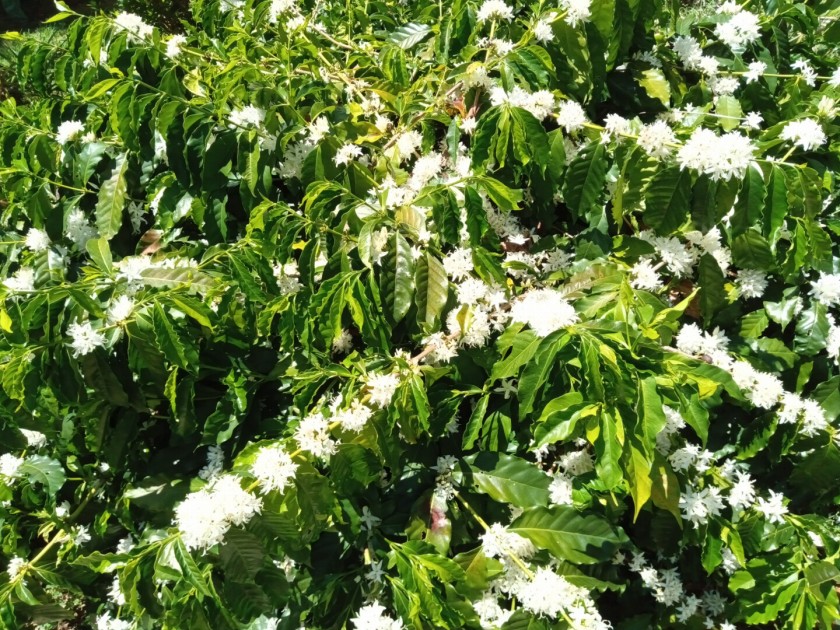
Coffee in Flower
The photo does not depict the intoxicatingly sweet fragrance from these flowers, just divine! This particular plant is a prostrate form and the flowers are layered on long branches, very attractive.
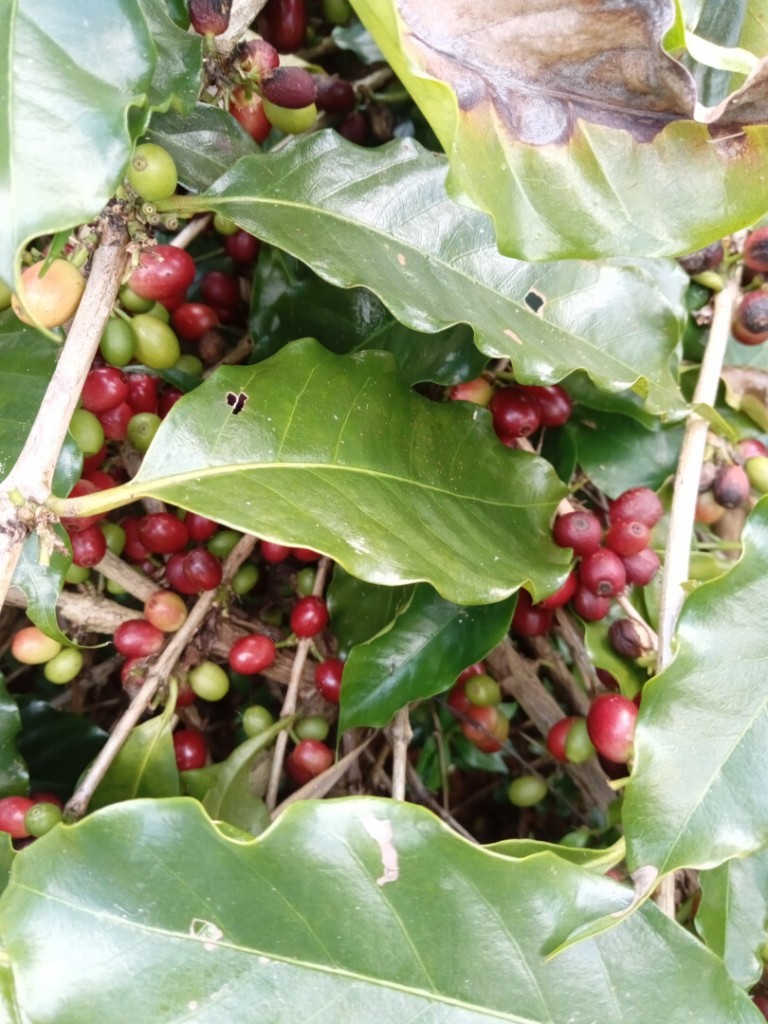
Ripe Coffee Berries
Here is the same plant about nine months later, with the berries finally ripe. Our property is located in highland tropics and the cooler climate which slows ripening of the fruit is supposed to produce a more complex flavour profile. I enjoy eating some of the red berries, the scant pulp has an appreciable sweetness, somewhat caramel-like, and the red skins which are loaded with antioxidants taste a bit like raw green beans, not unpleasant at all.
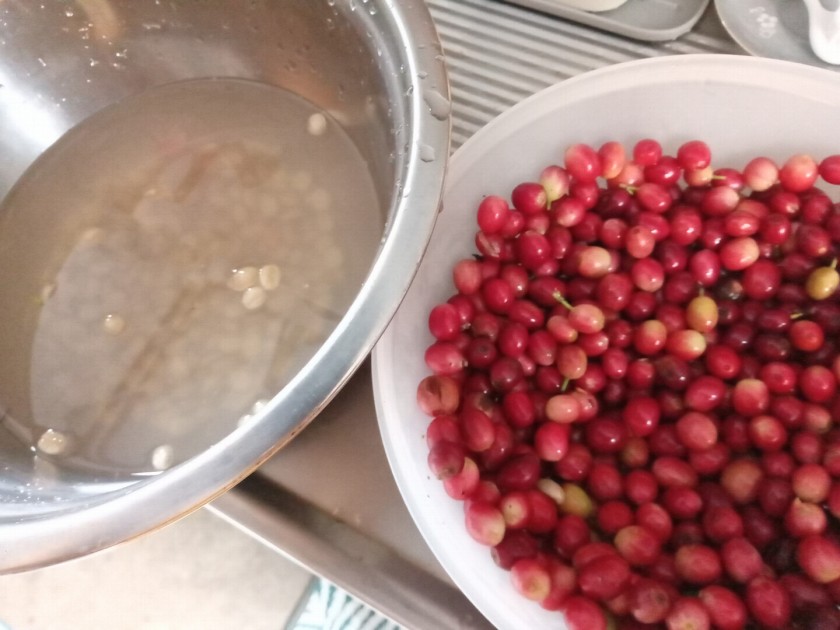
Berries and Squeezed Beans
It took about 15 minutes to pick this bowl of berries, not too onerous as one just strips the branch from top to bottom. Squeezing the berries to pop out the beans, usually 2 per berry, sometimes 3, takes a bit more time and I found it best to do it underwater otherwise the beans have a tendency to fly everywhere. Then you have to soak the beans for 24-48 hours to ferment off the slimy pulp surrounding them (this is what makes them slippery suckers that shoot in every direction).
I didn’t take a photo of the drying and hulling process, which is the next step. I placed the beans in a mesh bag and sundried them for about a day. You know when it’s dried when the outer parchment-like husk starts to crack a bit along the middle of the bean. Removing this rather hard covering is the most time-consuming and tricky part of the operation. I looked online for advice and it seems like putting the beans in a food processor that has plastic blades (some models have plastic blades for stirring function, I happen to have this) which won’t pulverise the beans is the best solution if you don’t want to try to remove the parchment layer by hand. There will always be some beans to be hand hulled, usually they rub off in 2 halves. The plastic blades agitate the beans enough to slough off the dried parchment hull on most of the beans, but you have to do this in small batches. Then you still have to somehow separate the beans from the removed hulls and the best method is winnowing, tossing the beans and hulls up and down on a tray in a current of air (on a windy day) and the air blows the hulls away whilst the heavier beans drop back down into the tray.
Finally, you will have achieved getting green coffee beans that are ready for roasting. You can do this on the stovetop, constantly shaking and stirring the pot, or in an oven, also turning the beans, but I found the easiest way is to use my hand-crank popcorn maker which is basically a pot with a metal wire stirrer on the bottom that you can keep turning whilst on the burner (this is an essential device if popcorn is your thing, and a very useful one in any case because you can toast all manner of nuts and seeds–and now coffee beans!) This took about 8 minutes of cranking (and heating) but so worth it as the smell of roasting coffee is as heavenly as the smell of the flowers from whence they originated. I was really quite chuffed when I got to this stage just for that irresistible aroma which was actually emanating from my own beans!
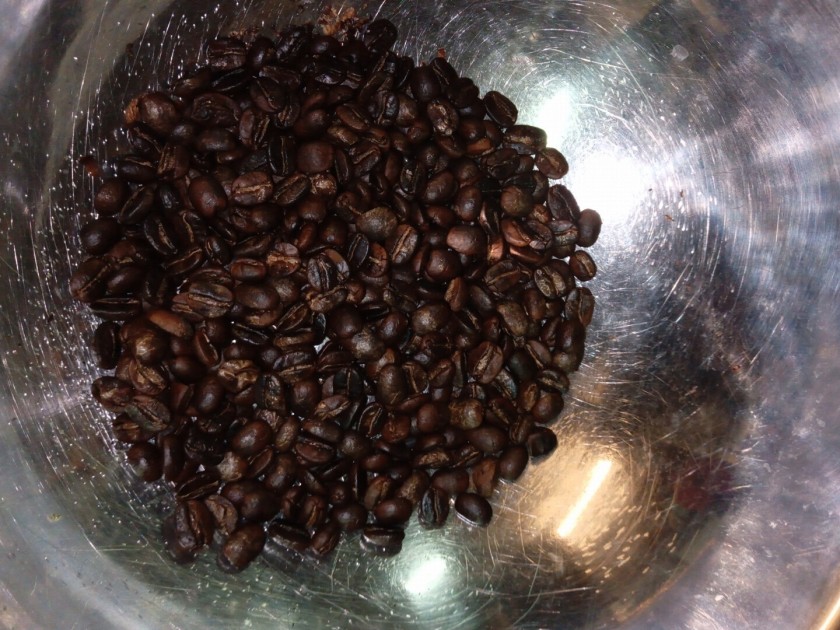
Roasted Coffee Beans
Viola! As you can see, I think I roasted them to an espresso strength. At long last, you have in your hand the pitifully meager result of all the work I have tried to describe in painstaking detail. In total, I think I processed in my first batch enough coffee for one person drinking one cup for about a week or less. But that’s not the point, which was really to experience all the labour involved if one had to do this by hand so we can appreciate all the more how mechanisation (and exploited labour) are the reason why we have so much for not much effort on our part other than probably the final grinding and boiling water. It highlighted for me the impossibility of being able to self produce (even if one lived in the right climate) even a fraction of the foodstuffs we take for granted daily if we were to use our own labour. In this example, I still had to use some modern devices, and certainly fossil fuels made possible the final brewing, which is the whole point of the whole endeavour. Very sobering indeed, rather than stimulating as from caffeine.
Well, it looks like it still takes Gaia 1000s of words to describe anything even when accompanied by pictures! I hope you all enjoyed this first pictorial installment of Gaia’s garden and kitchen. For all you coffee lovers out there, enjoy what you have whilst you can! This documentary has probably prompted Rob to invest in even more quantity of coffee, not a bad idea really. No doubt it will be a trading commodity in our near future.
Stellarwind72 proposed we write an essay on how to remain in good mental health while being aware of our overshoot predicament.
I have assembled here ideas from thirteen un-Denial participants plus my own.
If any reader would like to add their own list of tips, please send me a message and I will update the essay with your contribution.
14-Jun-2024 Friend Jack Alpert, who has developed the only viable plan to minimize suffering and retain some of our species’ best accomplishments, has contributed to this compilation.
ABC
The insights of yours truly, on how to engage with the predicament.
“We are survival machines – robot vehicles blindly programmed to preserve the selfish molecules known as genes.” – Richard Dawkins
“Right, as the world goes, is only in question between equals in power, while the strong do what they can and the weak suffer what they must.” – Thucydides
Both statements are correct, philosophically one might describe them followingly.
Yes, I am happy with what’s happening in the world. Whatever the outcome. Whatever the way it unravels. (Which doesn’t mean I don’t have problems which come and go and need to be solved, up and downs, fears and obsessions probably like many.)
I so wanted to share with you the ticket out of thinker’s hell, out of humanist’s hell. It turns out to be hard. It all seems so simple now, that I don’t even remember what exactly triggered a change of state.
I could try to recount my encounter with non-duality. I could list some of the leads I followed: Ramana Maharshi, UG Krishnamurti, Swami Prajnanpad, Ramesh Balsekar, Paul Hedderman. And, how one day, the whole mental edifice crumbled. The whole indoctrination of science, layers upon layers painstakingly acquired during years of learning, repetition and practice, nothing but rumbles. Not to be replaced.
Would it be understood (comparing science to a belief system is anathema to many: sometimes the only way to notice we are wearing a pair of glasses is to try wearing another one)? Would it be of any use? Isn’t one of the points that no generalization is possible, that every one’s experience is fiercely unique.
Maybe it’s the realisation that there is a limit to our ability to predict the future, or that the worst already happened (more than once) in the past (the Shoah, Native American genocide, …), or witnessing so many experts defending tooth and nail their own version of truth, or noticing that imagination of a dreaded outcome has nothing to do with the actual experience, or going through some hardships and realising that things just go on, or that the world is 1 without 2 (it is as it is and not some imaginary else), or seeing how tough life is on most people yet they somehow manage, or that it’s always all an experience, good or bad, it’s entertaining (like I am the station in front of which trains come and go and I have no agency on which type of trains or the schedule. So I might just as well enjoy the show), or realising the shallowness of the myths that have been stacked one upon each other (by religion, by science, by the self, by the mind, …) and for which we deploy so much fervour and energy.
Maybe it’s simply the recurring small encounters with beauty, with life. Gardening does that for me, fearlessly exchanging with people to reach the depths and truth of an aspect of their mental shape too (as we are doing now), or just greedily inhaling every small details reaching my small field of consciousness.
Or, it may just be getting bored of negativity.
As much as I had wished to share this state, it seems not to be really communicable. It will dawn on you, I am sure. And some day, you will be suddenly laughing out loud in the middle of the fields. If anybody sees you then, they will think all that worrying ended up getting the best of you. 🙂
Anyway, thank you for finding and periodically bringing to our attention smart people doing original thinking on this topic of collapse. I am grateful for your clear eyesight, your ability to separate the chaff from the wheat. Especially, it has been a great support during covid.
To conclude, here are the most important ideas I want to share:
Redemption, betterment, moksha, liberation, self-realization, illumination, enlightedment, progress, self-improvement, planet rescue… As if the world could be any different than it is. As if it could be improved upon. As if we had control. As if the dynamic of life were a math problem with an optimum solution. If you meet the Buddha, kill him. I say burn them all, Fahrenheit 451 style: Buddha, Jesus, Darwin, Einstein, Malthus, the Meadows. They clutter our souls. Time for renewal. Snap out of any form of idealism, absolutely any kind of indoctrination. Now the earth was formless and empty. Go back there and start anew.
To me, it’s thinking which shapes our experience by arbitrarily slicing, labelling everything, arbitrarily picking a perimeter to focus on (identification), a start and an end, creating concepts: birth, death, progress, evolution, species, collapse, NPK (chemistry), MPP, MORT, you name it… That’s all delusional. There is no way anything can be understood. It is not meant to. And that’s fine. There is nothing to be either fearful, angry, saddened or cheerful about. It is just as it is. And that’s awe-striking.
As far as I understand, this is UG Krishnamurti, this is non-duality (not 2, which does not imply 1 either).
And then, there is all that matters, that which can’t be put in words…
el mar
el mar´s approach:
Take care!
Be friendly and balanced, don’t believe every bullshit.
Be peaceful, self-critical but don’t put up with everything.
“Come down”, think “small”, for species-appropriate human husbandry.
Buy regionally, support local producers, manufacturers and craftspeople. Eat healthy, fresh, unprocessed food
Start a kitchen garden. Start small.
Learn something crafty and practical.
Cooperate and share with like-minded people.
Listen to your inner voice – not to ideologues and pied pipers from the right and left.
Avoid mass consumption and mass media.
Inspire other people to join this movement.
Saludos
Florian
It’s pretty funny to me, I’m a “young person” (< 40 years) and I’m not following a single of Robs points.
I live in a big city (I was born here) and work in tech (which I enjoy within reason) and I can afford to only work 30h. In a slow collapse scenario I will have to trade my database knowledge for food lol but, personally, this is not the future I envision.
My own version of the future is a lot more bleak so I live my life of pleasure, sitting comfortably in my office hardly working knowing that it could end next month, year or decade. Which also has it upsides because I don’t need to worry about my retirement.
Gaia
Do you remember my post on suffering that you decided should be a guest essay (and that quite floored me to see my words the next day front and centre!)? My core outpouring then, and even more now, is the question, was it all worth it? That so few have benefited so much at the expense of so many? Even to the point of the destruction of our biosphere, endangering life systems at the macro and molecular level through our hubris in thinking we can grasp power and control far beyond our reach. In my darkest hours I feel that deepest, helpless, purging sorrow is the only true emotion we can justifiably claim; all other feelings and reactions to our existence are derivative of our denial that allows us to continue living so. It’s denial that keeps me as positive and equanimous as I seem to all around, if anything I feel an imposter as I should be more depressed and grieving for the world and humanity as a whole. I consider this recent post a continuation of that lament on suffering and even more a personal outcry of remorse and regret that I was not as conscious of my role and responsibility in the greater good and suffering as I could have been, or if I was aware, I certainly was not courageous as I know is rightful in failing to use my one life boldly to declare justice as others have done.
As children, we naturally understand and feel injustice aggrievedly, possibly because we are otherwise helpless and dependent upon the goodness of others, but also in our naivete and innocence we trust that others know and care how we feel, and would treat us as we and they wish to be. Through a thousand thousand cuts of disappointment and breaches of trust, cog-turning assimilation into the culture and society into which we were born, it comes to pass that we throw off that banner of righteousness and justice in exchange for a yoke of resignation and complacency. We carry our burden with hardly a murmur, willingly or not, wittingly or not, so we can stake our claim of existence in this society upon which we are wholly dependent. To conform with the dominant tribe is our survival strategy, and the more complex our society becomes, it is clear that for the masses there is little choice but to continue the status quo or be cast out. We come to realize our relative individual unimportance to the system, so it is not much of a step to endorse anothers’ insignificance, especially those outside of our tribe. Then it is no matter at all to deny their right to existence, and all manner of injustices become justified. For all my complicitness of inaction, I shall bear my own guilt. It is through recognition of myself in the majority that will lead to my release of judgment for them, and if by grace I can come to some measure of forgiveness, I hope to absolve myself a little, too.
Truth to tell, at some level we know we are here because someone else is not, we have because someone else does not. My ancestors survived at the cost of another, and now I have my material life at the expense of another. There is no way else to balance this equation, however we try to reconcile it. It is all justified because we are who we are, and they are who they are–as in the developed world, complete and worthy, still deciding if the “developing” ones have a right to exist. The colour of our skin, the language we speak, the land we find ourselves, and most expediently, the exchange rate we decided upon, keeps everyone in their own respective domain and hierarchy of who shall have and not have. We call it fair trade to keep us in the West living in our high standard whilst those whose labour and resources we have stolen through our inflated dollars can only keep living in their degraded standards. Any child can see through this unfairness which we have called our globalised world. Genocide still may be abhorrent, but slavery, as long as it is at arm’s length, has its merits. I am a beneficiary of this and cannot and will not erase that stain upon my conscience. We need not wait for AI to overcome our humanity; we have already given away a greater part of that when as a species we chose to continue following the algorithms of power as a method for survival instead of allowing our still small voice of conscience to heed the golden rule. Until we embrace the earth as our village and kinship with all life, we are quite alone on this blue-green planet, spinning alone in this corner of the universe.
I contend that we all have the possibility of a Hitler as well as Mother Theresa–the only difference is quantity of intention and scope of action, but the quality is already in us. It must be so if we are a species together, the family trait of both runs deep and will out given the right circumstances. Our continued survival as a species has depended on at times dominance and exploitation, and at other times, cooperation and altruism. Daily we balance between the spectrum in all our decisions, whether consciously or not. As a species, we perhaps could never have evolved differently, but gifted with the birthright of consciousness and conscience, individually we could have chosen differently. We know it can be done because it has been done, we all have done it–have risen to the occasion of defending the defenseless, be it a rescued bird or standing for a friend against a bully. Courage in those moments is a direct line to our hearts, bypassing our brains working out what is in it for us. I daresay those are the times we felt most alive and sure of our purpose, the moments when we consider anothers’ well-being before our own. This quality of beneficence is every bit a part of our species as well, all we lack is consistency, which is the mark of mastery. Whilst some rare few may achieve instant enlightenment, the other path, however long and arduous, will also reach the goal through awareness and effort. We must be able to practice our kindness and goodness; it matters not how small the task before us as we have the quality already, it is merely the quantity we can choose to increase or withhold. We can choose kindness and rightfulness again and again, until it is no longer a choice but defines us.
Despite these physically, mentally, and emotionally draining times, I am going along as well as I can be, seizing the joy and wonder in every day as I know how precious life, and the passing time that unravels life, are. I now understand clearly why Cicero (considered a Skeptic, not a Stoic) stated that gratitude is the greatest of and the parent of all virtues. I find comfort in managing the daily tasks that so many wish they could do with as much freedom and ease as I have enjoyed all my life, and in helping others by being more generous with my time through practical action or listening ear. Giving back is the choice I am hanging onto for having the privilege of receiving so much. Knowing now as I do that our life of continued ease will be greatly foreshortened due to our own making, crystalises for me the certainty that my remaining days and choices are fast becoming last chances to consolidate what I have learned as a human being on this planet. And even more importantly, to prove to myself that my life has been an examined one and the highest version of what I can be. Whilst I cannot save humanity, I can still save the part of me that can be more grateful, kind, compassionate, accepting and forgiving. It is the only and true thing remaining for me to do, and for which my entire life was preparation.
Rob here, I’ve added to Gaia’s contribution a powerful paragraph she wrote as a comment a month ago:
The on-going genocide of the Palestinians really nailed it for me. Now we know that given the opportunity, we would act just the same way the majority of Germans did, in turning a blind eye to what we know is morally unjust and thinking we can continue with our own lives. We will watch the slaughter and deplore it, but why don’t we have the courage to upend our lives by doing something radical in effort to stop it? It’s the same for the response to Covid. It seems the most radical thing a Westerner can do (and more power to the pro-Palestine youngsters at universities who still have heart and guts) is publicly protest but why are we not all walking out of our jobs or going on hunger strikes and the like? What does it take to really take a stand, to deliberately override every instinct of survival by choosing suffering and even death (like Aaron Bushnell, who conflagrated himself) for an ideal? The drive to protect ourselves and just keep living the lives we are accustomed, especially us in the West is overwhelming–we have too much to lose and we know we cannot survive outside our system. We are workers in the hive, and we are programmed for only the hive. Knowing this, we finally come to understand that we are not free beings and never have been, but that does not mean we do not still have choice and our internal world can be closer to what we want to make it. That’s why the Stoic philosophy is particularly attractive to me; I have succumbed to relinquishing any hope of changing the outer world but I can still find meaning, purpose and joy in life by improving my inner self.
Hamish McGregor
There are no specific actions I take, to help with coping – unless being constantly negative, whining, passive aggressive and excess criticism (of everything) counts.
Hideaway
In working out where we are headed, I cope via a variety of mechanisms. We are a close family, my wife and our children, and we come from close families, so there is always the following of everyone’s progress through life as a positive to look forward to. We are financially well off, as I’ve invested well by predicting the way the world would try to head, given what I know of resources, which has allowed our children to have a much easier path. They are well aware of my findings and none of our children, in their 30’s, have chosen to have kids, so no grandchildren to worry about. They say they will just return to the farm when civilization collapses.
I have native areas of bush (forest for non Aussies) on our property that are regenerating from before we bought, 40 years ago. Taking a long walk through these areas gives a regenerative feel for the world overall. Life will go on after us, until it can’t, but will spring up somewhere else in the universe. Life is for living and I enjoy spreading the word of what’s happening in reality, so it doesn’t get me down at all. We have plenty of food, heat when necessary and great shelter that we built with our own hands. I cut wood from our bush for heating the house, mostly from storm damage, or dead/dying trees as the bush goes through it’s natural succession, so providing our own heat source in winter is also cathartic.
I get a type of internal peace knowing that there is no purpose to life, it just exists, so making the most of it with as many different experiences as possible in great company is what counts. being part of a like minded community of thinkers at un-Denial also helps with sanity as it clearly shows I’m not ‘out of my mind’ with my findings on the direction of the world, so thanks to all contributors at un-Denial and especially to Rob for hosting the site..
I am not going to prep for the down slope for four reasons:
There is no protection from the roving hoards. Both, preppers and non-preppers, will end up with nothing to eat but each other very quickly — probably in the next 50 years and most certainly in a hundred years.
Running, hiding, and being the last man eating the last can of corn in the last cupboard is not what I want to work toward.
I cannot drink a good glass of wine and watch the sunset without guilt.
That I am old and I might make it out of here before tragedy strikes brings me no joy.
I will feel bad every day if I do not try to fix things I can see are broken.
Some fixes I do not care to work on. I am done being distracted by efforts to fix the miss perceptions and dysfunctional behaviors resulting from our limbic brain which evolved too slowly to keep up with our cognitive capacities to create civilization’s momentum.
My work focus each day:
Define a viable Human Earth system in terms of behavior that controls mass and energy flows that can exist continuously without degradation of the earth’s productive capacity.
Define the collective behavior required to transition to this Human Earth system.
Implement the required behavior:
i) Extracting bad behavior takers from the population:
a) Old age deaths
b) Starvation deaths
c) Deaths from violence
ii) Coerce the required behavior from the remaining population:
a) Physical enslavement
b) Social contract enslavement
iii) Create universal upgrade in cognitive processes in every living person.
Some milestones on this journey:
The existing 8 billion people living today will not be living in 2100. They will have died from:
Old age
Starvation
Violence
The human population that exists in 2100 will be the sum of births after today. If the system that is viable under the above definitions is only 50 million that means births will have to be limited to about 500,000 a year.
If we have only natural births, not test tube babies, that will initially be only 1 birth for every 140 woman, but will increase until it reaches 2.00 in 50 years.
Implementing this will be a challenge.
At one extreme it will require immediate sterilization of 8 billion people with some mechanism for refertilization to get 500,000 annual births.
This path creates great injury and can only be selected when compared to the worse alternative of an estimated 13.4 billion people dying of starvation and conflict during the next 80 years on the present path.
The rest of the transition is equally painful and difficult to implement.
I expect that existing cultural machinery will struggle and probably fail in making a transition to the defined viable civilization. It is more likely to descend into a dark age — probably with little chance of recovery to present science and technology.
Some other more powerful transition mechanisms may be applied by groups or individuals to our predicament. Individuals may soon become powerful enough to sterilize the 8 billion. Others may become capable of culling any portion of the 8 billion.
These options may be implemented (not abiding current ethics) with much lower total lives or environments injured.
These alternative paths forward for the human experiment on earth may be selected and implemented independent of existing organizations.
I have worked my entire adult life understanding the creation of cognitive processes that if they were universal among the 8 billion, the collected behavior to implement a viable earth system would be possible. Each individual behavior would result with the same reliability as that individual selecting to not step off the curb in front of a rushing bus.
I have made much progress but lacking a quick and universal way of inserting these cognitive abilities into a whole global population over night I imagine the individual-produced interventions of sterilization and culling to be implemented to avoid the unrecoverable dark age on our horizon.
marromai
As far as I can see, it always comes down to the same thing: oneself is powerless when it comes to the big picture, you can only make sure that you and your loved ones are doing well. That’s also what I try to do as best as I can (like the closing words from my first guest post – carpe diem).
My coping methods are:
I am present at work because I need the money, but I only do the minimum required. I know that our economic system is doomed, but I cannot survive without it because I am inevitably a part of it.
I avoid the mass media and scrutinize any news.
The state is not my friend. I avoid contact wherever possible. State rules and laws are interpreted as flexibly as possible to my advantage (of course only where they don’t harm other people).
Most people don’t know what I know or dismiss it as nonsense. I keep my knowledge to myself and don’t try to “convert” anyone.
Current “Science” is just another religion – I know that I know nothing. However, (old) science offers us models and techniques that explain many things well or have made them possible in the first place. I use these where it makes sense to me.
I am not afraid of death, because I will return to the big picture – only dying could be unpleasant…
We will never understand the big picture, because as long as we are alive we are a split-off part of it, and can therefore never observe it in its entirety.
“I hope that when the world comes to an end, I can breathe a sigh of relief because there will be so much to look forward to.” (Donnie Darko)
But nonetheless:
Try not to worry too much – as long as I can survive this day, the next one will also be possible. It’s like an incremental approach on living 🙂
We should stop sinking into depressive moods we have created and start enjoying life in the here and now. The doomsday fantasies are due to the phase of prosperity, in which the human brain looks for new problems because our fundamental needs have already been satisfied. Even in ancient Rome, doomsday prophecies and the proclamation of new ages were booming – and yet the Romans lived relatively well for centuries without apocalyptic upheavals.
nikoB
nikoB’s farm
1993 was when I first became aware that progress (as we in the west generally think of it) was not really leading us to this consequence-free wonderful utopia in the not too distant future. The first was witnessing first hand, the clearfell logging occurring in forests across Australia. The second event that got doubts flowing in my head was my uncle casually remarking – what are we going to do when oil runs out?
Over the next decade I was a rampant greenie, studying ecology and horticulture but not really putting much of the bigger picture together. Climate change was a problem but still so far away – so fixable. That was all to change when a friend invited me to a lecture by Richard Heinberg and David Holmgren. Peak oil came and put a stop to all my illusions. The door was opened and I stepped through.
It was 2006 and I was in my mid-thirties with a young family just starting out. It wasn’t long before I was aware of the Oil Drum, Nate Hagens, Jim Kunstler, Dmitry Orlov, The Druid JM Greer, the Chris Martenson crash course and many, many other places of ideas and discussion. To say this altered my thinking on everything is a massive understatement. Priorities changed overnight and I launched myself into a personal crusade to bring the truth of the peril that awaited us to anyone who would listen.
So fast forward to today, to cut through what is really a fairly dull story with maybe a few juicy details, I basically learnt that no one gives a “solidly digested meal” about resource depletion and overshoot. No matter how many ways you approach the subject. For it became a passion to try and work out the magical key that will unlock humanity’s thinking. All it did was result in the loss of close friends and family. I was mostly just a downer to people when I used to be one of the funniest people in the room (thanks to class clown training).
So where does this leave me now nearly 20 years later of being a peak oiler and recent anti-vaxxer. Reevaluating everything I do because what I have been doing hasn’t yielded results in changing minds.
I am lucky to be blessed with a partner who shares much of the same view of overshoot and its consequences. We spend quite a substantial amount of time discussing all the issues it brings bubbling to the surface. I am also blessed in that she shares the same passion for self sufficiency living that I do and together we work our little farm in the hinterlands of the northern rivers area of New South Wales Australia.
What I am slowly coming to the realisation of, is that we must not lose our passions, humanity and connections. For too long they were side lined and sacrificed for the greater virtue of telling everyone just how it is. The loss I felt was immense but that was balanced by the anger that I felt that nobody could see that what I think is so bloody obvious and that no one cares to do anything about it.
So in order to repair broken relationships (because I miss them) I have had to change my priorities and my thinking as well I suppose, so that I don’t just naturally clash with most people. This is difficult, especially not judging people for their ignorance and self destructive behaviours. But as it turns out I have all my own ignorant self destructive behaviours.
Maybe time is short before collapse makes living a nightmare, Hideaway makes many compelling arguments that this complex system is exceedingly brittle and can only withstand so many spanners thrown into the gears. Or perhaps the druid is right and that the collapse is catabolic, step by step, some big, some small but pretty much all down hill. Either way my thinking has changed on how to deal with it, though I must say the covid saga produced a huge detour and removed many friends from my circle and I would venture to say that most are not destined to return. But now I am getting back on track to living while compartmentalising the potential horror of a potential future.
I have decided to let go of the major criticisms I have of the human condition which are beautifully spelt out here in Rob’s blog over and over again. I don’t know if any of it really matters as we are all dead in the end. It is the journey as they say that matters not the destination. If we really think about it we know that is true as the destination is a hole in the ground.
So now I look to seeking the connections I can find with people that are easy to build on and see where it leads. Time to encourage rather than discourage. Soak up the interpersonal transactions and notice when something deeper occurs. But at the same time I won’t gladly immerse myself in exchanges full of bovine discharges.
As a focus for my own passions, I am back to making music, finding the humour in most things without resorting to be overly sarcastic or caustic. Observing and appreciating absurdity is great for that. Giving love as much as I can and forgetting the anger and the hate. I won’t pretend that it is easy but it does seem to be the most beneficial path and I must remember to forgive myself if I stray from it at times.
Paqnation (aka Chris)
Surprisingly, our story was more depressing to me when I was in full Daniel Quinn sustainable/wisdom mode. The whole “where did we go wrong” thing haunts you when you know humans “can” get it right. Now that un-Denial has set me straight on some of these core issues, our story is less depressing in that respect. I do think denial is at the heart of the matter, but I bounce around on how much emphasis to put on MORT, eToM, and MPP. And I am now slowly shifting to a new state of mind where it’s all about energy constraints and you can pretty much throw everything else out the window.
Society can be full of Quinn type worldviews or full of overshoot, MORT aware citizens. It doesn’t matter. Once those sacred constraints are broken, there is no way out of the madness. And there is no way to resist using this new energy technology because if you don’t, someone else will, and you will be conquered and/or killed. By the time your civilization has enough EROEI to start understanding concepts like overshoot and sustainable vs unsustainable… it’s too late. You are now way too addicted to the comforts of this energy surplus to voluntarily decrease usage. And you’re already in massive overshoot because of all the self-induced damage to your environment (mining and domestication of plants/animals). Ditto for your worldviews too. Separation of nature along with a superior way of looking at your own species are unavoidable default worldviews that come along with busting through energy constraints. The most depressing thing for me nowadays is the realization that this kind of modern intelligence (cleverness) has no purpose in the entire universe.
I have two techniques for my sanity. One thing is trying to accept the inevitability of it all. Understanding that the best-case scenario for Mother Earth is NTHE, helps me to go with more of a “I might as well partake in the Peak before it’s all gone” mentality. But the most important technique is hanging out on this website. When I first came onto the scene of un-Denial, I was shot out of a cannon. The two years prior that I was learning about overshoot, etc., I never had a reliable outlet to ask any questions. That all changed when I got here. I cannot talk to anyone in my personal life about collapse, but now I have an online support group. The following is more of a love letter to you guys for how much you’ve given me and my appreciation for being part of this Tribal Connection.
Here are some quotes I collected from un-Denial comments that caused me think and increased my awareness:
Monk: Something that helps me a lot is when I see dumped rubbish, which happens a lot in “magical NZ”. And I just think to myself how excited I am for collapse, because spoilt brat humans don’t deserve everything that we’ve got when we can’t even do something so basic for nature as pointing rubbish in the bin.
Rob: For the last 10,000 years we broke through normal resource constraints with agriculture (bigger share of solar energy) and fossil energy (ancient solar energy) and became a destructive unsustainable species, that is smart enough to know better, but denies what it is doing.
Mike: In a climax ecosystem, the system appears to be in balance with all species living in harmony. But it’s an illusion and no species intended it that way. Quinn probably got it wrong, in that respect. (Chris here, Mike calling out Quinn like that was the beginning of my internal temper tantrum)
Gaia: So over time, the ascendancy of lighter skinned humans in the cooler climates prevailed and these were the climates where agriculture and feudal living flourished, cementing the dominance of this culture type rather than the nomadic style of earlier hunter/gatherer societies which matched well with the grassland/savannah fauna of equatorial Africa.
Rob: The probability of getting 100% of things wrong by mistake is 0%.
Monk: They dug up a lot of roman prepping gold in villas in the UK. Funny to think of them prepping all that gold and never getting to use it.
Hamish: Too many people treat dogs like fashion accessories and discard them immediately when they have health issues.
NikoB: I always think of it in terms of give and take. What did you take from this world in order to live and what did you give back?
AJ: …reinforcing my opinion that the grandchildren of the victims of genocide are now the perpetrators of genocide.
Charles: I love watching the activity in a compost bin, on the surface of a decomposing carcass, the eerie colours of mushrooms feeding off dead logs… Death doesn’t really feel like an end: there is so much activity going on, and (in good temperature and moisture conditions) recycling happens so fast one can almost witness the migration of energy.
Rob: I envy people who obtain comfort from believing there is some form of spirituality in the universe that cares about us. Unfortunately I see a flow of electrons looking for a home.
Gaia: That’s just it, Rob! I identify best with being a bunch of electrons looking for a home! …Then the electrons I borrowed can go do something else for the rest of eternity.
Stellarwind72: What if intelligence over a certain level is inherently maladaptive on long timescales, because it allows you to destroy the very ecology you depend upon.
Hamish: If I ever have to turn away people seeking help, I will offer them my thoughts and prayers – that seems to be the solution to all calamities from the shit stains in Washington DC and state capitals.
ABC: “Progress” equals to mental regress in many if not most aspects, nothing short of “wickedness”.
Florian: If you are happy with what you have or even downsize then you are, from an evolutionary perspective, a defective individual and the chance is very very high that you will be thrown on the genetic trash heap. There is this saying, To understand all is to forgive all and while it can be hard to not show emotion in this absolute cluster-fuck there is absolutely no point to attach yourself to an outcome.
Charles: Life, to me is a constant invitation (sometimes quite painful) to open up to possibilities.
Rob: I’m still fascinated by denial. I see it every day in every single person I interact with. No one speaks reality, except the few that hang out here.
AJ: The lack of humility and stating that one could make a mistake, always makes me suspicious of a person’s conclusions.
Monk: Without fossil fuels the planet would have become a frozen wasteland. It looked like earth was heading for permanent ice age because too much carbon got lock up.
Rob: I believe one of the reasons we had so much coal is that large plants were enabled by the evolutionary invention of lignin and it took quite a while for fungi to figure out how to digest lignin. Today coal would not accumulate in the same quantities.
Notabilia: Remember, none of us fossil fuel colossi have to stick around when our inherited profligate way of existence hits the ground below the cliff. That will become the one remaining “civil right”. (Chris here, this one got me focused on writing my exit strategy article)
ABC: Wisdom has no inherent value in a world of energy, and never stood a chance against unhinged violence.
NikoB: Perhaps having a good spice rack will put those cannibalism fears to rest.
Stellarwind72: Our leaders seem to think that if Putin is allowed to win in Ukraine, he will invade several other countries, similar to what Hitler did after the Munich agreement.
Gaia: Maybe we can even say that MORT (denial) has been our species’ only true religion, for through it we almost became like the gods, or more poetically, it was the way in which the gods could become human.
Charles: I believe Quinn/Murphy’s story will propagate because it shows a possible way ahead for survival. It is becoming useful in this world of limits, of civilisation/technology collapse.
Hideaway: Crocodiles have existed in pretty much the same form for 200 million years, that’s long term sustainability.
Monk: Anthropologists do think pre-historic people had a lot more sex than their civilized counterparts.
Charles: I find the terms reincarnation and “life after death” misleading. They are too loaded. One should perhaps use “informational remnant through structural reorganization”.
Hamish: I’ve given up on the idea of saving people, society, knowledge, culture, wisdom. If I can help nature that will be enough.
Rob: The problem is our citizens, not our leaders.
Hideaway: Increasingly I’m thinking most major solar and wind installations are nothing more than a scam paid for by subsidies from the government, then quickly sold to whatever pension fund that wants ‘green’ credentials in their portfolio.
Stellarwind72: If MORT is true, the story of humanity will turn out to be a tragedy. The species intelligent enough to realize it is in overshoot doesn’t do much about it due to denial.
Rob: Life is not some spiritual mystery, but rather a predictable outcome of the fact that the universe abhors an energy gradient, and life is its best mechanism for degrading energy. (and) “If life is nothing but an electron looking for a place to rest, death is nothing but that electron come to rest.” (Rob here, I think that’s a paraphrased quote from Dr. Nick Lane)
Chris here. These next two get me emotional and make me think about what could’ve been (Closest to me ever having my own family was in 2003, but we both agreed on abortion. One of my biggest regrets).
ABC: I’d like to have a family, rear children and experience being a father. I know it is extremely selfish if not cruel by all definitions knowing our predicament, however I cannot shake this primal biological urge of self-interest and naïveté of having a “sense of meaning”.
CampbellS: We saw the southern lights, aurora astralis, here in the Far North of NZ. First time for me in my 53 years. Pretty spectacular and awe inspiring. Was nice to share it with my teenage kids.
And this is a nice little moment between the young, cocky Skywalker and the much wiser Obi-Wan Kenobi. They could both see the magic early on:
Paqnation: I actually think he/she is Art Berman, Simon Michaux or someone like that. I have a hard time with energy (which is why I love Sid Smith), but Hideaway is like an energy oracle.
Rob: Hideaway is better than both Berman and Michaux. Berman is deeper on oil but shallower on other energies and overshoot. Michaux has some worrying woo-woo.
One final note. While going through all my comments, I came across what is by far the most MORT thing on this entire website = My anti-pornography article. 😊
scarr0w
My journey to tranquility ( 🙂 ) is as follows:
I’ve known for as long as I have memory that I was “different”. Not exactly on the spectrum, not genius, not sociopath, but maybe a dash of each. I was in parochial school my first four years, and it was not a good fit for me. To get along, one should just fill in the answer blanks in your Baltimore Catechism workbook, not ask the nun to explain grace. Questioning the pablum we are spoon fed is not a way to be one of the gang.
Anyway, from childhood experiences, I over time built a mental outlook that more or less has evolved to be expressed best by the Niebuhr/Wygal serenity prayer. I generally kept my own council, especially when I fully realized the overshoot predicament we are in while working for a company that builds stuff for the fossil industry. I guess you could say I was “in the closet”.
Serenity, or at least equanimity is not an easy thing to maintain all the time, but I’ve gotten better over time. Raising kids, staying on the treadmill even after realizing that’s what it is, etc… can test your resolve. While I follow collapse progress and analysis at sites like Rob’s and several others, it is more to keep current, not to perseverate on (and let’s face it, being witness to this huge event in the human story is fascinating). Mostly I am grateful that I was lucky enough to be born in a location and time that will never be again.
Currently, some mental energy is on local political issues (I’m on the county board, trying to see opportunities to shift policy into more future ready states), but primarily I try to slowly make a few acres of land more in tune with what the local biome wants to be. That will be enough.
I liked a lot of what others said, especially Gaia, but since my emotion circuits were partly burnt out as a kid, I just don’t get wound up over the path out culture has chosen, or my role in it. I know others suffer and indirectly I benefit, those of us aware just have to live with a foot in both worlds, slowly reducing our complicity as best we can. Not much help for others, but that’s where I am.
Stellarwind72
Being overshoot aware constantly weighs on me. Given my young age (I was born right before the turn of the millennium), I know that the sh*t will hit the fan in my lifetime. From time to time, I feel existential dread. I know that there is a substantial risk of me dying early due to the effects of overshoot and collapse.
Sometimes just being able to talk about this issue with other people helps me with anxiety, knowing that there are other people who are aware of what is going on.
I sometimes like listening to classical music and taking hot baths to calm my nerves, but given how those are both dependent on large amounts of surplus energy (I mostly listen to classical music on YouTube), I don’t know how long I will be able to keep doing that.
Rob Mielcarski
In no particular order of importance, here are some things that have helped me remain partially sane with overshoot awareness.
Collapse Early and Avoid the Rush
There is no way to predict which of the many paths we will take (inflation, deflation, war, confiscation, theft, etc.), however we know with certainty that the destination of fossil energy depletion will be less material wealth, less food abundance, a lower energy lifestyle, and much less help from governments.
I think it is a wise strategy to voluntarily downsize your lifestyle and learn to live happily with less so that when everyone else is shocked and losing their minds due to loss of wealth and entitlements, you are already happily living the new normal.
Some things that have worked for me include:
Pretend you can’t buy gasoline and see how little driving you can get by with.
Stop flying. Find ways to vacation locally like camping.
Monitor your electricity consumption in real time and practice using less.
Practice food storage and preparation without refrigeration.
Practice low energy cooking like one-pot meals and pressure cooking.
Practice living at lower temperatures in the winter.
Shower when dirty, not every day.
Change clothes when they are dirty, not every day.
Stop eating out. Cook all your food from scratch.
Cut your own hair.
Maintain your vehicles yourself.
Practice fixing things that break.
Local Food
I think we face 5 main threat vectors and it is unclear which will strike first:
nuclear war (due to resource scarcity)
accelerating warming (due to aerosol reduction)
asset bubble crash (due to extreme debt and degrowth)
energy scarcity (due to depletion of low-cost non-renewable reserves)
deadly covid variant a la Bossche (due to our idiot unethical leaders)
The most important common denominator is likely to be food scarcity.
I once had a dream to buy a farm and build a doomstead. I took a small scale farming course and after about 5 years of employment as a farm laborer I learned that I lacked the money and the passion and the time to pull it off successfully. So I switched to plan B. I now assist a local farm with construction and maintenance in return for a source of local food. I still buy the majority of my calories at the grocery store but I know we can ramp up calorie production when SHTF.
Prepping
I work hard at being a wise frugal prepper which means I stock things that:
I like to eat and have a good shelf life so they won’t be wasted
are likely to become scarce first like protein, fat, and caffeine
are essential for good health
are purchased when on sale to save money
I maintain a detailed spreadsheet of consumables with quantity, cost, date of purchase, best-by date, storage location, date opened, date finished, and predicted duration the item will last. This allows me to:
track my consumption of each item so I can accurately predict how long each will last, and to adjust inventory levels based on my assessment of world events
track price inflation and to stock more of what is expected to inflate fastest
rotate inventory so I always eat the oldest first
conduct shelf life tests and record results so I know when a best-by date can extended or ignored
calm down – reviewing my spreadsheet reduces my stress
I have methodically gone through every durable item and service I use and asked what will I do if that item breaks and cannot be fixed or replaced, or can’t be fueled. For those items that I consider essential I have purchased a spare, or I have plan for accomplishing the same thing a different way, or I know I can do without. Here are a few examples:
my town water supply is not gravity fed and depends on electric pumps so I installed a hand operated pitcher pump on an old shallow well on my property
I can light my living area with 4 different types of energy
I can cook with 7 different types of energy
I can heat my living area with 3 different types of energy and I have practiced living with the thermostat at 15C
I have 4 different modes of transportation and I have some spare parts
I can keep my refrigerator operating, which is the main thing I care about in a power outage, for a couple weeks
I have spare parts to keep my computer, which is my main indoor hobby, going until I’m dead
I have spare hiking boots, which is my main outdoor hobby, to last until I’m too old to hike
Doing something to prepare provides a sense of agency over things out of my control which improves my mental well-being.
Prepping is of course not a fix to permanent scarcity or a catastrophe, but it might sustain life during a temporary shortage, and it might make life more enjoyable when non-essential but highly valued items like coffee become unavailable.
Prepping can be a good use of limited savings given that inflation is a likely outcome of energy scarcity. I smile every time I see price increases on things I have in inventory.
Health
When things get tough, good health will be one of our most important assets.
Most available employment will require manual labor, and if you’re out of shape and overweight you may be unemployable.
I expect pensions and safety nets to vaporize so many will be forced to work until they die.
I expect the availability and affordability of health care services to decline as governments become impoverished.
Covid taught me that I do not want to use our unethical and incompetent healthcare system if I can avoid it.
So I try to maintain good health by:
eating healthy unprocessed, low sugar foods
fasting 16 hours every day
getting some exercise
sleeping 8 hours
taking a few critical supplements like vitamin D and C
no alcohol or tobacco
Gratitude
Someone wise said something like “the foundation of happiness is gratitude”.
I believe it.
The lifestyle of the poorest Canadian is better than a pharaoh. It is easy to forget how lucky we are in the rich western countries at this point in history.
The majority of my good fortune came from being born in Canada, not from my skill or hard work.
So I try to be grateful.
A few things that work for me include:
cook deliberately: I plan my meals, and I think about the path the food took to get to my kitchen, and I try to show respect to the food by cooking it nicely, and wasting nothing
eat deliberately: I try to slow down and appreciate what I am eating
drive deliberately: when I press the accelerator I think about the miracle of fossil energy
shower deliberately: I think about the path the water took to get to my house, and the energy it took to heat the water, and what a luxury a hot shower is
Learn to Enjoy Your Own Company
I spend quite a bit of time alone for several reasons:
I find it easier to “collapse early and avoid the rush” when I am not surrounded by people competing for status
nobody likes being around a doomer, I’m invited less these days
I struggle to chit chat about things that do not matter
I have become less tolerant of people who believe nonsense and are incapable of changing beliefs regardless of evidence – yes I know MORT is often the cause, but I still don’t enjoy the company of people in denial
So I have learned to enjoy my own company.
I have conversations with myself, and I listen to interesting (and sometimes aware) people via podcasts and audiobooks, and I interact with a few nice and aware people at un-Denial.
MORT
When you become overshoot aware you realize there is near zero awareness and zero discussion in society about anything that matters, and not only are we doing nothing that a wise species should do, we are doing everything possible to make our predicament worse. This can be crazy making.
Understanding Dr. Ajit Varki’s Mind Over Reality Transition (MORT) theory has been a big help to maintaining my mental health because it provides a scientific explanation for why almost everyone in the world, including our brightest intellectuals and all of our leaders, are oblivious to everything that matters.
If I Was a Young Person
If I was a young person, knowing what I know now, and wondering what to do, I would:
not live in a big city
avoid occupations that depend on discretionary spending (except maybe brewing beer and distilling alcohol)
learn a useful skill that poor people will need and value
learn a skill that can be performed with today’s complex power equipment, and yesterday’s simpler manual equipment
I’d personally lean towards a trade like carpentry, plumbing, masonry, electrician, roofer, mechanic, etc. but I’m sure there are many other viable occupations
farming would be good but land is too expensive for most people to buy today; a good compromise is a skill that generates income and a home garden or rented community garden plot that you tend after work; or if you are passionate about farming, join a good farm as a laborer and work up to a position with responsibility
Steve takes a local perspective and discusses what a wise community and individual might do to become more self-reliant and resilient, and to prepare for the collapse of our high tech, energy intensive society.
My premise is that at the global, nation-state, or even state level, the current hierarchical system is not capable of climbing down from overshoot, or anticipating and preparing for a lower energy, lower consumption future. Any efforts to prepare must be done at the personal, and then small, local level, where like minded people can coalesce and work as a cooperative community to make the needed transition in lifestyle.
Local self-reliance is foremost about the basics: food, water and shelter. There are abundant resources online and printed that range from the Foxfire Book series, which captured lore from Appalachian settlers, to the most up to date beans and bullets prepper website. Local self-reliance is not about saving the knowledge we humans have accumulated, or western culture (god forbid), and it is not even a solution. It is simply a greater than zero chance to get some humans through the bottleneck.
Collecting books is NOT enough. Sure, learn from others, to avoid newbie mistakes, but actual hands on doing is needed, even if the first step is just growing a tomato plant on your balcony or patio. Don’t be afraid of small failures. More is learned from mistakes than successes.
A short time frame response to collapse is the solitary prepper, for those with the means to do so. But a longer term and more resilient response to collapse and the coming new arrangement is a collective effort. Our forebearers survived the African veldt, and then went on to overrun the world, because of group cooperation. Any success at surviving the coming bottleneck will be a small, local, group effort. Think Dunbar’s number or smaller.
Cooperation is not an easy thing to accomplish, humans being a fractious, conniving species, with a hard-wired dark side permanently bound to our empathetic, benevolent side. Recall the back to the land hippie commune movement of the 60’s and 70’s, when environmental awareness and cultural turmoil drove many to try intentional communities. Virtually every one failed. In part due to ignorance of the earthly details of self-reliance and provisioning through human labor, but also due to governance and group cooperation dysfunction. Most intentional communities were ideology driven (Vietnam, civil rights, etc.), but few had long-term sustainability as their central purpose. And it’s damn hard work.
Somewhere between 2,000 and 3,000 communes existed in the U.S. in the 1960s and ‘70s with about 75 in the small state of Vermont, making it one of the epicenters of the experiment.
Describing what a sustainable small community would look like is fairly straightforward for the physical needs dimensions of food, water, and shelter, however the social dimensions of hierarchy, communal agreements, security, and governance are the difficult puzzles to solve.
The Amish are an example of a culture that has chosen to be very intentional about what technology they adopt. In general, farming and practical avocations that provide the essentials for rural life are the center of their economy. The size of Amish communities is constrained by a reasonable trip by horse to conduct business and socializing. There is, however, a tradeoff. Their rigid social structure is paternal and religion based, but has shown staying power, with many examples of effective cooperation, such as barn raising. Full religious commitment, and submitting to rigid community rules, will not be acceptable to many modern humans.
That said, even Amish are not long term sustainable, but a model to consider as a step down from where we are, and a kind of “training wheels” for adjusting to the next step down towards living within the local carrying capacity.
Being set in their ways, Amish will likely suffer like everyone else when flexibility in fast changing conditions is required, but they will at least already have strong social connections and a tradition of group effort.
Before cooperating at the level of a barn raising or similar large group efforts, and after simply being a good neighbor, is the level where barter and more involved trading favors need to be navigated.
I am still trying to figure out barter, and trading more substantial favors with neighbors takes time to develop trust and some sort of shared value system that is not denominated in dollars.
How many eggs is a bale of hay worth? What if you have too many eggs right now, but will need the hay next winter. Maybe eggs are free in the spring, but quite dear in winter, when hens have stopped laying. This is just one example of the myriad components of a truly local economy.
How does one remember all these transactions to make sure you are being a fair trading partner? Money turns out to be real handy unless it gets too concentrated and unleashes the dysfunctional side of capitalism or is welded by the more sociopathic among us.
The point is, it will take time to achieve a sophisticated level of cooperation, and is not something that will go smoothly if it has to happen immediately after a crisis ends BAU.
All future self-reliant communities will consist of collections of self-reliant households. Therefore developing self-reliant skills is important for all possible futures. It is time to simplify, reduce consumption, and prioritize. As John Michael Greer has said for years, “collapse now and avoid the rush.” Work on becoming a potential positive contributor to a “collapse community” should one emerge.
Here is a little on my background and personal journey towards self-reliance.
I was raised on a farm in Indiana, and left the farm as many did during the Earl Butz era, to work as an engineer for the same company my entire career. I was a small cog in the industry that builds extractive infrastructure for oil companies. Sigh.
After becoming aware it took me a long time to get off the treadmill. I was very lucky to have a wife who shares my world view.
I am now doing what little I can to pay restitution for my past. We are transitioning 40 acres (17 hectares) to a permaculture based system with food plants that are native or fill the same ecological role. I am learning skills and taking incremental steps to becoming more self-reliant.
We have quite a large garden and grow about 30 types of vegetables. We dehydrate, can, freeze, and ferment, including hard cider! We seed save many vegetables, and are working on saving more.
We have planted a dozen apple trees, ten cherry trees, eight pear trees, six mulberry, and hundreds of hazelnut and chestnut trees. The hazels are now 11 years old and in full production, the chestnuts are slower and are just coming on.
Our wooded areas were pasture until about 30 years ago, so are in transition, mostly brush and brambles. We have cut in trails, and have planted oak and hard maple to speed succession a bit.
We heat with wood in a Russian furnace, which is a type of masonry stove. We are not yet off grid, and it will be a huge lifestyle change when that happens, but we have two PV arrays, and capture rain water off the pole barn for watering trees and the garden. A cistern for water storage is in the works. Many more projects are planned to increase self-reliance, and to be contributors to whatever local community emerges.
We are slowly engaging neighbors in joint efforts. We share the cost and upkeep of a small tractor with two neighbors. I own a cider press that I share with the neighbors. A neighbor had some logging done, but the tops and branches left by the loggers were more than he could ever get to, so he let me harvest firewood.
Here are some tips for increasing self-reliance that I have learned, in no particular order of importance:
Eat the elephant one bite at a time – it’s overwhelming to think about doing all the things needed to be maximally self-reliant, or to create a local community. Just do one small thing, then another, rinse and repeat. (Although a bit of urgency is warranted given world affairs.)
If at all possible, move to a place with access to land to grow food. However you slice it, getting out of urban centers and figuring out how to be part of growing food, or learning a craft, or both, will be better than collapsing in place.
Grow food with priority to calories like potatoes and beans, not lettuce; perennials like fruit trees; and chickens- just a couple layers will help with kitchen scraps and learning husbandry.
Preserve food- can it, dehydrate it, ferment it, and freeze it while you can.
Reduce energy use- by whatever means you can afford/accomplish.
Build redundancy- more than one way to get water, more than one way to heat the house, etc.
Learn to repair things- house, car, clothes, appliances, etc.
Make things- clothes, chicken coops, root cellar, flour, beer, etc.
Security- think about how you might protect yourself, or be part of a collective security arrangement. Depending on location and how things play out, increased violence is very likely.
I have scores of bookmarked sites about homesteading, gardening and permaculture, and three book shelves full in our library, but these tend to focus on improving the skills of an individual.
Here are a few resources relevent to building community strategies and skills that I have found useful:
I volunteer at a local folk school. It’s a good way to acquire skills, and maybe link up with like minded people.
A book I found helpful for imagining a transition path to self-reliance is Sharon Astyk’s Depletion and Abundance.
Chris Smaje has written extensively about what a small farm economy might look like, and his book A Small Farm Future argues for a reversal of urbanization back to individual farms, and identifies local governance issues that need to be worked out.
The Living Energy Farm has ideas for small scale community energy systems.
I do not follow the transition towns movement, as I hear little about them any more. They had quite the buzz for a while, but perhaps tried to do too much? Maybe someone here knows if transition towns offer any useful resources?
I hope others add to this list of resources in the comments.
Rob here: If a substantial list of resources emerges I will copy and organize them somewhere for easy reference.
The US military defines its Defense Readiness Condition (DEFCON) levels as follows:
DEFCON 5 is normal readiness.
DEFCON 4 is above normal readiness.
DEFCON 3 is the air force ready to mobilize in 15 minutes.
DEFCON 2 is all forces ready to fight in 6 hours.
DEFCON 1 is the maximum state of readiness and means nuclear war is imminent or has already started.
I have my own definitions that I use for my personal life.
I spent the first 50 years of my life at DEFCON level 5. That would be as a normal, fully in denial, culturally conforming, dopamine & status seeking, energy maximizing, member of a superorganism.
Then I had a stress related meltdown and while recovering stumbled on peak oil. After seeking and failing to find a good path forward other than population reduction, I wondered what else I was in denial about, and widened my field of view to include climate change, pollution, species extinction, unsustainable debt, etc., all of which I eventually came to understand are related and fall under the umbrella of human overshoot.
Now at DEFCON level 4, a realty based state of awareness, I began to think about making changes to my life, took a 6 month course on small scale farming, and did some volunteer work on a small organic farm.
Then the 2008 global financial crisis (GFC) occurred and I went to DEFCON level 3.
Confident that a collapse would occur within 10 years, I changed everything in my life. A new location where I’d be happy finishing my life, a simpler slower lifestyle, satisfying physical work, improved health, and thank goodness, Varki’s MORT theory to keep me sane with an explanation for the insanity all around me.
I also began to methodically plan and implement some preparations for a different world that I expected would arrive soon. The basic idea was to convert some retirement savings into things needed to survive and/or that might provide some joy in a harsher simpler world, and that won’t go bad, will never be cheaper, or better quality, or more available than today.
In hindsight I didn’t have a powerful enough imagination to predict that our leaders would loan into existence many trillions of dollars that can never possibly be repaid, to avoid having to acknowledge overshoot, and to extend and pretend business as usual a few extra years, at the expense of making our destination worse, but they did.
Then early in 2020 I saw the Chinese panicking over a virus before anyone here was discussing it, and I went to DEFCON level 2.
Now I got serious about completing most of my preps, which was an easy low stress exercise, because I already had a plan and simply had to execute it.
By the time the majority was scrambling, I was done, and completely calm and confident.
Today, two years into the pandemic, I’m seeing threats that have caused me to go to DEFCON level 1:
Many supply chains are broken and are getting worse, not better. This is a strong signal that our complex civilization is simplifying in unpredictable ways, as predicted by David Korowicz.
Energy shortages have emerged simultaneously in multiple strategically important regions. This is a big deal because fossil energy underpins everything our species depends on to survive. Net energy peaked a few years ago and we have been on a plateau made wider by unprecedented money printing, but once we fall over the edge I believe the decline will be much faster than the few percent per year that an unstressed geology and monetary system would deliver. I do not know if we’ve already fallen off the plateau, but I do know it will happen soon, and when it does, the changes will be profound, rapid, and painful. Regardless if the current energy problems prove to be temporary, they are a serious threat to an already fragile economy, civil society, and war-free world.
The Chinese economy is showing signs of stress from excess debt similar to the west’s 2008 GFC. Our vulnerability to a sick China is much greater than most assume because everything we depend on is dependent on Asian manufacturing, and a functioning global shipping system, and a functioning global banking system. This time I doubt more debt will fix an excess debt problem.
There are worrying signals that our vaccination policy is failing with health risks for both vaccinated and unvaccinated increasing, and that the boosters everyone is counting on may not work.
The leaders of the majority of countries seem incapable of absorbing and integrating evidence to improve their Covid strategy. If they are incapable of effectively managing Covid, we can be confident they will not be capable of managing the much more complex and profound implications of declining energy and the economic contraction it will cause.
All paths lead to food and we are 3 missed meals away from civil disorder. The climate seems to have shifted a gear this year and I expect this will negatively impact agricultural yields soon. Energy shortages will also negatively impact food production and distribution. As will supply chain problems. As will more Covid problems. As will a global economic depression.
DEFCON level 1 does not mean I’m expecting the end of the world, but it does mean I intend to complete everything I can think of to prepare for what I think is coming, on the assumption that we are near the end zone, and that by the time our arrival is confirmed, it will probably be too late to do anything.
There’s nothing wrong with being prepared a little early. Especially when being late means it may be impossible to prepare.
Chris Martenson is thinking along the same lines and recently produced an excellent video explaining what’s happening around the world with energy.


 un-Denial