On the Leap Manifesto

The Leap Manifesto is being discussed within Canadian political circles, and is gaining support from prominent environmental leaders.

The intentions of the Leap Manifesto are admirable, but its thermodynamics are flawed.

Society does not subsidize fossil energy. Fossil energy subsidizes everything in modern society to the tune of over 50 energy slaves per person. These slaves have and will continue to demand more pay because the easy to extract oil is gone. What oil remains becomes more expensive to extract with each passing day.

Do not confuse oil price with cost. The oil price today is low because consumers have maxed out their credit cards and can no longer afford to pay their energy slaves.  Oil companies are going broke because it costs more to extract oil than they can sell it for. Think about this. It’s a big problem.

The fact that our energy slaves have become more expensive than we can afford is the root cause of dangerous worldwide public debt growth, and a fragile economy that has required zero percent interest for 8 years. All of the idiot lights are flashing red on our dashboard if we care to look. The weaker countries are already starting to fail.

It takes fossil energy slaves to make renewable energy slaves. And the renewable energy slaves require even more pay than the fossil energy slaves because their muscles are weaker, and they need some fossil energy to stay fit. For example, think about the roads and trucks and tools and parts needed to maintain a windmill or solar panel.

We need renewable energy and we have no choice but to move in their direction. But we can’t run today’s society with them. Don’t take my word for this. Pay attention. Look for any example in the world that contradicts what I just said. But look honestly. You must include all of the energy that is consumed, including, for example, the coal it took to manufacture the goods, and the oil used to produce and transport the food, that was purchased from another country.

We need to understand our predicament before we can construct useful policies.  And we need to reset our expectations. While we might enjoy 50 slaves today we may have to make do with 5 slaves in the future. That’s still a lot better than most people have enjoyed for the last 10,000 years.

It’s also important to understand that no one is at fault. The last few generations got lucky with a fossil energy windfall. Kind of like mice that had a party in an overturned grain truck.

A deep and honest understanding will lead to policies that emphasize conservation, austerity, population reduction, wealth gap reduction, re-localization, and lastly, renewable energy.

I do not see any mention by the Leap Manifesto of the first 3 and most important items in my list. Conservation, austerity, and population reduction. These are important because we are in severe overshoot and would be wise to voluntarily climb down from the cliff.

It’s doable and desirable. Most people in the developed world consume much more than they need to have happy and healthy lives. All of these policies will help to reduce many serious environmental threats like climate change.

WASF

There is hope, but not for us - Franz Kafka

One portion of the population doesn’t believe humans are in overshoot and therefore sees no need to change their lifestyles.

Another portion is vaguely aware of a problem but prefers not to think about it nor possible changes to their lifestyles.

Another portion believes overshoot is real but thinks others need to change their lifestyles first.

Another portion thinks we have a problem but it is not caused by humans so there is no need to change.

Another portion thinks everything is in the hands of God so there is no need to change.

Another portion thinks they’ve already done enough by buying a new electric car, recycling, and reusing grocery bags.

Another portion believes renewable energy, carbon capture, and other technologies will solve the problem.

Another portion understands the problem but chooses not to change because they do not believe their sacrifices will make a difference.

The balance of the population thinks it’s too late to do anything and therefore see no need to change.

The only thing everyone agrees on is that there is no need to change.

WASF

By Nate Hagens: A Guide to Being Human in the 21st Century: Resource Depletion, Behavior and the Environment

Nate Hagens gives the best big picture talks on how fortunate we are to be alive at this point in history, and on the challenges we face.

Here is his latest talk given this week at the University of Wisconsin Stevens Point.

If you search this site you will find other work by Nate.

Overshoot Awareness: The Pros and Cons

I want to discuss the pros and cons of broad public awareness of our overshoot predicament.

Disadvantages of Overshoot Awareness

Sooner Economic Contraction

Today’s global economy is a massive bubble waiting to pop.

Bubbles are created when many people believe that the price of an asset will go up and use debt to purchase the asset. This creates a self-fulfilling positive feedback loop as purchases bid up the price which increases collateral for more debt to fund more purchases.

Assets inflated by a bubble do not generate sufficient wealth to justify their price. Bubbles are accidents waiting to happen because an unpredictable shift in belief towards realism or pessimism will cause a collapse in price as the market unwinds its debt leverage, usually oscillating below fair value and damaging innocent bystanders in the process.

Bubbles have been common throughout history but today’s bubble differs in that instead of one asset class such as dot-com or tulip mania, all asset classes are inflated and its size relative to GDP, and especially future GDP, is unprecedented.

A few examples:

1) The quantity of government debt and other obligations exceeds the servicing ability of future taxpayers, doubly so when interest rates rise in response to the risk of default. Government economic models assume more growth than is physically possible with depleting fossil energy. This means all currencies are over-valued. Currencies have retained their value because most people still believe what their governments tell them.

2) The quantity of corporate and private debt exceeds the servicing ability of realistic future income. This bubble has not yet popped because governments have held interest rates at near zero for 8 years. When interest rates start to rise, as they must when default risks become impossible to deny, this house of cards will collapse in defaults.

3) Stock prices have been inflated by cheap debt and the majority’s belief in infinite growth. Companies have used debt to buy back stocks to falsely improve their appearance to investors. Speculators have used debt to profit from stocks. Central banks have used debt to manipulate stock prices up to create the facade of economic well-being. A rational analysis of stock prices relative to future earnings, especially in light of declining net energy, and an eventual increase in interest rates, would show that stocks are a massive bubble waiting to pop.

4) Real estate is over priced. In the long run the average price of a home must equal the average income’s ability to obtain and service a mortgage. Incomes are falling and will continue to fall as energy depletes. When interest rates rise, many mortgages will become unaffordable and real estate prices will drop. Furthermore, the availability of mortgages, which are needed to support real estate prices, is dependent on a financial system that can create generous credit, which in turn is dependent on reasonable economic growth, which is not possible with declining energy.

Central banks have done a surprisingly good job over the last 8 years of not permitting the bubbles to collapse. Their ability to continue supporting the bubbles is highly dependent on public sentiment. If the majority loses faith in the central bank’s ability to stimulate growth then it is game over and the economy will experience a large correction.

A disadvantage of overshoot awareness is that it would trigger an economic correction sooner than letting the random vagaries of belief take their course, or letting mathematics and physics force the correction.

The larger a bubble gets the more pain it causes when popped because its deflation usually swings below the mean on the way to reality, and more innocent bystanders get hurt.

It’s best to avoid a bubble in the first place, and although we’re well past that point, the sooner we remove the bandage the better off we’ll be in the long run.

Put more succinctly, there is no free lunch.

Hoarding and Shortages

We live in a very efficient world. Companies use just-in-time delivery to minimize inventory and waste. Citizens no longer have root cellars or put up preserves for winter consumption because grocery stores are so abundant and convenient. Grocery stores have about 3 days stock on hand and depend on a complex network of credit, energy, and technology to operate.

Resilience to shocks is improved by building buffers and redundancies. A probable outcome of broad overshoot awareness would be buffer building induced shortages of important staple goods.

This risk could be mitigated by rationing policies as were used during World War II.

Mental Health Problems

Acknowledging overshoot forces one to question and overturn several hundred years of growth based culture, religion, education, and deeply held beliefs by the majority. The adjustment can be traumatic.

To succeed in today’s society you must contribute to overshoot. An aware person knows they can be happy with less consumption, but choosing a frugal lifestyle often makes you a failure in the eyes of an unaware majority.

There is no “happy” solution to overshoot. The future will be painful for most. The best possible outcome is a lot of hard work to make the future less bad. It is difficult to be motivated with this awareness.

For these reasons a common outcome of overshoot awareness is depression.

Mental health problems perhaps could be minimized if overshoot awareness was accompanied by an understanding that overshoot is a natural outcome of abundant non-renewable energy and evolved human behavior. Perhaps not. A renewed belief in religion is a more likely outcome.

Having the majority and their leaders aware and working together to prepare for a low energy world, rather than individuals working in isolation, offers the best chance of minimizing mental health problems. But this outcome would require the majority to override their inherited denial of reality which makes it improbable.

Relationship Damage

Becoming aware of overshoot before friends and family become aware can damage relationships. The aware person wants to educate and warn those closest to them. Those not aware usually do not want to hear the message because most humans have an evolved tendency to deny reality. This stress can damage families and friendships.

Advantages of Overshoot Awareness

Fewer Despots and Wars

As energy depletes and the climate worsens, incomes, wealth, and abundance will decline. Eventually there will be life threatening shortages of food and other necessities.

Tribes evolved to survive in times of scarcity by fighting other tribes for resources. The most united tribes with the most warriors willing to sacrifice their lives often had the best chance of winning and surviving. This in part explains the evolutionary success of religions.

To fight effectively requires a well-defined enemy. There is thus a natural tendency to blame other groups for hardship.

In the absence of understanding what caused scarcity, the majority will support despots that blame others, and these despots will start wars.

Wars in the past often improved the lives of the winners because the most important resource was land.

Wars in the future will make things worse for both the winners and the losers because the most important resource is energy. Modern wars consume large amounts of energy and will accelerate the depletion of the resource that is being fought over, leaving less energy for everyone when the war ends. This is sometimes referred to as a resource depletion death spiral.

It is of course possible that a despot will decide to eliminate the energy-consuming population of its enemy with nuclear weapons. This scenario will also make everything worse for both the winners and the losers, for obvious reasons.

Humans would therefore be wise to avoid future wars. Awareness that overshoot is causing scarcity, that no one is to blame, and that war will make things worse, is the only reasonable path to avoiding future despots and wars.

It would be much wiser to use the remaining surplus energy to proactively reduce our population, and to create infrastructure required to survive in a low energy world.

But again, as mentioned above, we first need to break through our evolved denial of reality.

More Acceptance and Cooperation

Awareness of the underlying overshoot related causes of problems experienced by individuals would increase the acceptance and cooperation necessary to make a bad situation better.

Most viable mitigation strategies will require broad societal cooperation. These strategies include rationing of scarce resources, proactively shifting economic activity from one sector to another, progressive taxation and wealth redistribution, and generally more government involvement in all aspects of life.

More Preparedness

Although per capita energy is in decline, we still have a considerable amount of surplus energy available to do useful work. The longer we wait the less surplus energy will be available to help us prepare for a low energy world.

Broad awareness of overshoot would accelerate our preparedness for the inevitable, and reduce future pain.

Positive Behavior Changes

Although there is no “happy” solution to overshoot, a broad awareness and voluntary shift in behavior would help. For example, a lower birthrate, reduced luxury consumption, less travel, and more care of the commons would all help.

Avoiding a Chaotic and Dangerous Crash

All of the above advantages to overshoot awareness fall under the umbrella of replacing a chaotic and dangerous crash with a more orderly and planned contraction.

Many of the things that made life pleasant over the last century will be at risk in a chaotic crash. These include democracy, law and order, health care, social safety nets, peaceful trade, environmental protection, and functioning electricity, water, sewer, and communication grids.

We would be wise to preemptively release the pressures that threaten a chaotic crash.

Conclusions

On balance I think the advantages of overshoot awareness outweigh the disadvantages.

A society with its majority understanding overshoot, what caused it, and that no one is to blame, would help make the future less bad.

Unfortunately our evolved denial of reality is a powerful impediment to awareness.

I fear the majority will never understand what is going on.

I wrote more on this issue here.

Utopia: What’s Wrong with Curing Malaria?

A clip from the 1st episode of the 2nd season of the TV series Utopia.

By Gail Zawacki: Earth Embalmed

A nice article by Gail Zawacki in which she summarizes some of the recent news on the damage we are doing to our home.

http://witsendnj.blogspot.ca/2016/04/earth-embalmed.html

There are so many calamities – fish kills in Florida and birds falling out of the skies, epic floods and droughts, the slowing of the ocean currents – that when I prepared the 26th Dispatch From The Endocene I left out a major incident I had intended to include – the abrupt and near total coral bleaching of the Great Barrier Reef in Australia.  The fact that it is just one item on the roster of grotesque environmental disasters that will catalyze NO change whatsoever in the engine of human civilization – even though it has to be the most egregious, most atrocious, most stunningly heinous example of anthropogenic ecocide – is astonishing.

It is proof, were any to be needed, that nothing – nothing, not an ice free Arctic, not a huge ice shelf breaking off Antarctica raising sea levels a foot in a week, not thousands of deaths in a heat wave, not storms so violent they lift boulders from the bottom of the sea – NOTHING will stop people from availing themselves blindly and greedily to the bounteous largess of Earth…until it is all gone, and there is none left.

The debacle in the reef is the latest example of humanity ceaselessly rendering the biosphere into a morgue.  It’s as awful as though all the forests were dying, and we managed to ignore it.

Oh, wait.

By Jack Alpert: How Much Degrowth is Enough?

This analysis by Jack Alpert of what is a sustainable long-term population uses a different approach to that discussed by Paul Chefurka here.

The two independent calculations arrive at roughly the same number of less than 100 million meaning we need more than a 98% population reduction to be sustainable.

By Gail Tverberg: Why We Have a Wage Inequality Problem

Here is the latest excellent work by Gail Tverberg.

https://ourfiniteworld.com/2016/03/29/why-we-have-a-wage-inequality-problem/

In this essay Gail explains what is causing the discontent that has enabled the rise of Trump, and probably other worse leaders to follow that exploit human hardship.

Gail explores a wide solution space and concludes that there is nothing we can do to avoid collapse other than perhaps kick the can a little longer.

This led me to ponder the following…

If humans were able to break through their evolved denial of reality and understand their predicament, then we might avoid wars and violence associated with blaming others for our misfortune.

However, if the majority understood our predicament the system would likely collapse immediately because it is elevated today in large part by faith and belief.

Given that collapse is imminent regardless of what we believe, I’m thinking I’d prefer a world where people understood what is going on and worked together to make the best of a bad situation rather than seeking scapegoats.

But since life at its core is replicating chemical reactions competing for finite resources, we should expect the worst and be very grateful for anything better.

It would be really nice to “roll back” the world economy to a date back before population rose to its current high level, resources became as depleted as they are, and pollution became as big a problem as it is. Unfortunately, we can’t really do this.

We are now faced with the question of whether we can do anything to mitigate what may be a near-term crisis. At this point, it may be too late to make any changes at all, before the downward slide into collapse begins. The current low prices of fossil fuels make the current situation particularly worrisome, because the low prices could lead to lower fossil fuel production, and hence reduce world GDP because of the connection between energy consumption and GDP growth. Low oil prices could also push the world economy downward, due to increasing defaults on energy sector loans and adverse impacts on economies of oil exporters.

In my view, a major reason why fossil fuel prices are now low is because of the low wages of “ordinary workers.” If these wages were higher, workers around the globe could be buying more houses and cars, and indirectly raising demand for fossil fuels. Thus, low fossil fuel prices may be a sign that collapse is near.

One policy that might be helpful at this late date is increased focus on contraception. In fact, an argument could be made for more permissive abortion policies. Our problem is too little resources per capita–keeping the population count in the denominator as low as possible would be helpful.

On a temporary basis, it is also possible that new programs that lead to rising debt–whether or not these programs buy anything worthwhile–may be helpful in keeping the world economy from collapsing. This occurs because the economy is funded by a combination of wages and by growing debt. A shortfall in wages can be hidden by more debt, at least for a short time. Of course, this is not a long-term solution. It simply leads to a larger amount of debt that cannot be repaid when collapse does occur.

By Paul Chefurka: No really, how sustainable are we?

I was starting to write an essay on overpopulation exploring the solution space where a breakthrough in denial enabled a planned global birthrate reduction. My goal being to present a reasonable scenario for making the future less bad.

Then I read this paper by Paul Chefurka who is one of the wisest people on the planet and I decided to trash my paper and point to his. Paul takes a close look at the maximum size of a truly sustainable human population. His conclusion is 10 million.

The analysis seems sound to me. The obvious conclusion is that we can’t get there from here with any form of awakening or proactive action.

Paul ends by saying:

…the analysis suggests that Homo sapiens is an inherently unsustainable species.  This outcome seems virtually guaranteed by our neocortex, by the very intelligence that has enabled our rise to unprecedented dominance over our planet’s biosphere.  Is intelligence an evolutionary blind alley?

I wish Paul would read Varki’s book on denial. I suspect Paul would appreciate it because Varki presents a theory that confirms Paul’s speculation about the inherent unsustainability of humans.

In summary, the evolution of the powerful human brain required a mutation for denial of reality, and this denial prevents us from acknowledging our predicament.

Here is the full conclusion from Paul’s essay:

http://paulchefurka.ca/Sustainability.html

Conclusions

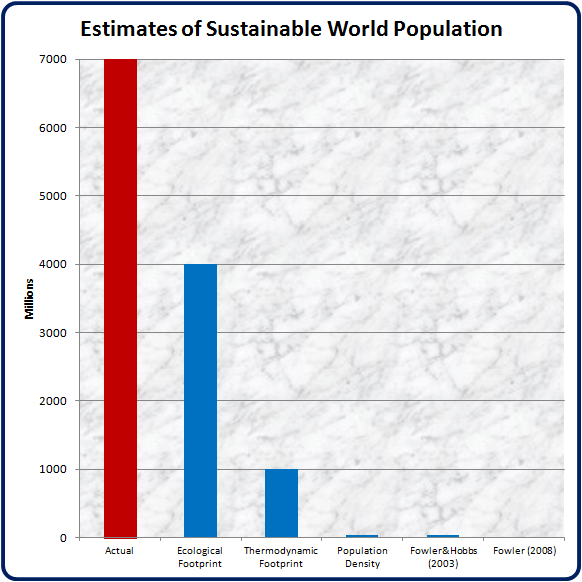
As you can see, the estimates for a sustainable human population vary widely – by a factor of 500 from the highest to the lowest.

The Ecological Footprint doesn’t really seem intended as a measure of sustainability.  Its main value is to give people with no exposure to ecology some sense that we are indeed over-exploiting our planet.  (It also has the psychological advantage of feeling achievable with just a little work.)  As a measure of sustainability, it is not helpful.

As I said above, the number suggested by the Thermodynamic Footprint or Fossil Fuel analysis isn’t very helpful either – even a population of one billion people without fossil fuels had already gone into overshoot.

That leaves us with four estimates: two at 35 million, one of 10 million, and one of 7 million.

The central number of 35 million people is confirmed by two analyses using different data and assumptions.  My conclusion is that this is probably the absolutely largest human population that could be considered sustainable.  The realistic but similarly unachievable number is probably more in line with the bottom two estimates, somewhere below 10 million.

I think the lowest two estimates (Fowler 2008, and Fowler 2009) are as unrealistically high as all the others in this case, primarily because human intelligence and problem-solving ability makes our destructive impact on biodiversity a foregone conclusion. After all, we drove other species to extinction 40,000 years ago, when our total population was estimated to be under 1 million.

So, what can we do with this information?  It’s obvious that we will not (and probably cannot) voluntarily reduce our population by 99.5% to 99.9%.  Even an involuntary reduction of this magnitude would involve enormous suffering and a very uncertain outcome.  It’s close enough to zero that if Mother Nature blinked, we’d be gone.

In fact, the analysis suggests that Homo sapiens is an inherently unsustainable species.  This outcome seems virtually guaranteed by our neocortex, by the very intelligence that has enabled our rise to unprecedented dominance over our planet’s biosphere.  Is intelligence an evolutionary blind alley?  From the singular perspective of our own species, it quite probably is. If we are to find some greater meaning or deeper future for intelligence in the universe, we may be forced to look beyond ourselves and adopt a cosmic, rather than a human, perspective.