Overshoot Awareness: The Pros and Cons

I want to discuss the pros and cons of broad public awareness of our overshoot predicament.

Disadvantages of Overshoot Awareness

Sooner Economic Contraction

Today’s global economy is a massive bubble waiting to pop.

Bubbles are created when many people believe that the price of an asset will go up and use debt to purchase the asset. This creates a self-fulfilling positive feedback loop as purchases bid up the price which increases collateral for more debt to fund more purchases.

Assets inflated by a bubble do not generate sufficient wealth to justify their price. Bubbles are accidents waiting to happen because an unpredictable shift in belief towards realism or pessimism will cause a collapse in price as the market unwinds its debt leverage, usually oscillating below fair value and damaging innocent bystanders in the process.

Bubbles have been common throughout history but today’s bubble differs in that instead of one asset class such as dot-com or tulip mania, all asset classes are inflated and its size relative to GDP, and especially future GDP, is unprecedented.

A few examples:

1) The quantity of government debt and other obligations exceeds the servicing ability of future taxpayers, doubly so when interest rates rise in response to the risk of default. Government economic models assume more growth than is physically possible with depleting fossil energy. This means all currencies are over-valued. Currencies have retained their value because most people still believe what their governments tell them.

2) The quantity of corporate and private debt exceeds the servicing ability of realistic future income. This bubble has not yet popped because governments have held interest rates at near zero for 8 years. When interest rates start to rise, as they must when default risks become impossible to deny, this house of cards will collapse in defaults.

3) Stock prices have been inflated by cheap debt and the majority’s belief in infinite growth. Companies have used debt to buy back stocks to falsely improve their appearance to investors. Speculators have used debt to profit from stocks. Central banks have used debt to manipulate stock prices up to create the facade of economic well-being. A rational analysis of stock prices relative to future earnings, especially in light of declining net energy, and an eventual increase in interest rates, would show that stocks are a massive bubble waiting to pop.

4) Real estate is over priced. In the long run the average price of a home must equal the average income’s ability to obtain and service a mortgage. Incomes are falling and will continue to fall as energy depletes. When interest rates rise, many mortgages will become unaffordable and real estate prices will drop. Furthermore, the availability of mortgages, which are needed to support real estate prices, is dependent on a financial system that can create generous credit, which in turn is dependent on reasonable economic growth, which is not possible with declining energy.

Central banks have done a surprisingly good job over the last 8 years of not permitting the bubbles to collapse. Their ability to continue supporting the bubbles is highly dependent on public sentiment. If the majority loses faith in the central bank’s ability to stimulate growth then it is game over and the economy will experience a large correction.

A disadvantage of overshoot awareness is that it would trigger an economic correction sooner than letting the random vagaries of belief take their course, or letting mathematics and physics force the correction.

The larger a bubble gets the more pain it causes when popped because its deflation usually swings below the mean on the way to reality, and more innocent bystanders get hurt.

It’s best to avoid a bubble in the first place, and although we’re well past that point, the sooner we remove the bandage the better off we’ll be in the long run.

Put more succinctly, there is no free lunch.

Hoarding and Shortages

We live in a very efficient world. Companies use just-in-time delivery to minimize inventory and waste. Citizens no longer have root cellars or put up preserves for winter consumption because grocery stores are so abundant and convenient. Grocery stores have about 3 days stock on hand and depend on a complex network of credit, energy, and technology to operate.

Resilience to shocks is improved by building buffers and redundancies. A probable outcome of broad overshoot awareness would be buffer building induced shortages of important staple goods.

This risk could be mitigated by rationing policies as were used during World War II.

Mental Health Problems

Acknowledging overshoot forces one to question and overturn several hundred years of growth based culture, religion, education, and deeply held beliefs by the majority. The adjustment can be traumatic.

To succeed in today’s society you must contribute to overshoot. An aware person knows they can be happy with less consumption, but choosing a frugal lifestyle often makes you a failure in the eyes of an unaware majority.

There is no “happy” solution to overshoot. The future will be painful for most. The best possible outcome is a lot of hard work to make the future less bad. It is difficult to be motivated with this awareness.

For these reasons a common outcome of overshoot awareness is depression.

Mental health problems perhaps could be minimized if overshoot awareness was accompanied by an understanding that overshoot is a natural outcome of abundant non-renewable energy and evolved human behavior. Perhaps not. A renewed belief in religion is a more likely outcome.

Having the majority and their leaders aware and working together to prepare for a low energy world, rather than individuals working in isolation, offers the best chance of minimizing mental health problems. But this outcome would require the majority to override their inherited denial of reality which makes it improbable.

Relationship Damage

Becoming aware of overshoot before friends and family become aware can damage relationships. The aware person wants to educate and warn those closest to them. Those not aware usually do not want to hear the message because most humans have an evolved tendency to deny reality. This stress can damage families and friendships.

Advantages of Overshoot Awareness

Fewer Despots and Wars

As energy depletes and the climate worsens, incomes, wealth, and abundance will decline. Eventually there will be life threatening shortages of food and other necessities.

Tribes evolved to survive in times of scarcity by fighting other tribes for resources. The most united tribes with the most warriors willing to sacrifice their lives often had the best chance of winning and surviving. This in part explains the evolutionary success of religions.

To fight effectively requires a well-defined enemy. There is thus a natural tendency to blame other groups for hardship.

In the absence of understanding what caused scarcity, the majority will support despots that blame others, and these despots will start wars.

Wars in the past often improved the lives of the winners because the most important resource was land.

Wars in the future will make things worse for both the winners and the losers because the most important resource is energy. Modern wars consume large amounts of energy and will accelerate the depletion of the resource that is being fought over, leaving less energy for everyone when the war ends. This is sometimes referred to as a resource depletion death spiral.

It is of course possible that a despot will decide to eliminate the energy-consuming population of its enemy with nuclear weapons. This scenario will also make everything worse for both the winners and the losers, for obvious reasons.

Humans would therefore be wise to avoid future wars. Awareness that overshoot is causing scarcity, that no one is to blame, and that war will make things worse, is the only reasonable path to avoiding future despots and wars.

It would be much wiser to use the remaining surplus energy to proactively reduce our population, and to create infrastructure required to survive in a low energy world.

But again, as mentioned above, we first need to break through our evolved denial of reality.

More Acceptance and Cooperation

Awareness of the underlying overshoot related causes of problems experienced by individuals would increase the acceptance and cooperation necessary to make a bad situation better.

Most viable mitigation strategies will require broad societal cooperation. These strategies include rationing of scarce resources, proactively shifting economic activity from one sector to another, progressive taxation and wealth redistribution, and generally more government involvement in all aspects of life.

More Preparedness

Although per capita energy is in decline, we still have a considerable amount of surplus energy available to do useful work. The longer we wait the less surplus energy will be available to help us prepare for a low energy world.

Broad awareness of overshoot would accelerate our preparedness for the inevitable, and reduce future pain.

Positive Behavior Changes

Although there is no “happy” solution to overshoot, a broad awareness and voluntary shift in behavior would help. For example, a lower birthrate, reduced luxury consumption, less travel, and more care of the commons would all help.

Avoiding a Chaotic and Dangerous Crash

All of the above advantages to overshoot awareness fall under the umbrella of replacing a chaotic and dangerous crash with a more orderly and planned contraction.

Many of the things that made life pleasant over the last century will be at risk in a chaotic crash. These include democracy, law and order, health care, social safety nets, peaceful trade, environmental protection, and functioning electricity, water, sewer, and communication grids.

We would be wise to preemptively release the pressures that threaten a chaotic crash.

Conclusions

On balance I think the advantages of overshoot awareness outweigh the disadvantages.

A society with its majority understanding overshoot, what caused it, and that no one is to blame, would help make the future less bad.

Unfortunately our evolved denial of reality is a powerful impediment to awareness.

I fear the majority will never understand what is going on.

I wrote more on this issue here.
By Gail Zawacki: Earth Embalmed

A nice article by Gail Zawacki in which she summarizes some of the recent news on the damage we are doing to our home.

http://witsendnj.blogspot.ca/2016/04/earth-embalmed.html

There are so many calamities – fish kills in Florida and birds falling out of the skies, epic floods and droughts, the slowing of the ocean currents – that when I prepared the 26th Dispatch From The Endocene I left out a major incident I had intended to include – the abrupt and near total coral bleaching of the Great Barrier Reef in Australia.  The fact that it is just one item on the roster of grotesque environmental disasters that will catalyze NO change whatsoever in the engine of human civilization – even though it has to be the most egregious, most atrocious, most stunningly heinous example of anthropogenic ecocide – is astonishing.

It is proof, were any to be needed, that nothing – nothing, not an ice free Arctic, not a huge ice shelf breaking off Antarctica raising sea levels a foot in a week, not thousands of deaths in a heat wave, not storms so violent they lift boulders from the bottom of the sea – NOTHING will stop people from availing themselves blindly and greedily to the bounteous largess of Earth…until it is all gone, and there is none left.

The debacle in the reef is the latest example of humanity ceaselessly rendering the biosphere into a morgue.  It’s as awful as though all the forests were dying, and we managed to ignore it.

Oh, wait.

By Jack Alpert: How Much Degrowth is Enough?

This analysis by Jack Alpert of what is a sustainable long-term population uses a different approach to that discussed by Paul Chefurka here.

The two independent calculations arrive at roughly the same number of less than 100 million meaning we need more than a 98% population reduction to be sustainable.

By Chris Martenson: We’re Not Going To Make It… without real sacrifice

Slowly but surely Chris Martenson is speaking with more confidence and reality, and less hopium and denial, especially about climate change.

I’m starting to like his new more honest voice.

http://www.peakprosperity.com/blog/97643/we%E2%80%99re-not-going-make-it%E2%80%A6

The world is just not yet serious enough about the urgency of transitioning away from fossil fuels.  The math says that without a tremendous change in behavior, far greater than anything currently on display, we simply won’t “get there” waiting for market forces to do the job for us.

We’ll have to make and adhere to very different priorities. Such as completely redirecting our entire defense budgets to the process of retooling our entire relationship to energy.

We’ll need our buildings to use less energy. And we’ll need to live closer to where we work and play.

Our food will have to be grown differently. And it will have to travel less far to get to our plate.

Electricity will have to come from sources other than fossil fuels too.

Is it possible to figure this out in time? Well, whether it is or not is sort of beside the point. Because these changes are going to be forced on us anyways if we don’t.

So I guess I could be an optimist on the UN panel by telling them that I have 99% confidence that humans will someday be powering 100% of their energy needs from the sun.

I’ll just leave out that what I mean is that, in 100 or 200 years, humans will have painfully reverted back to a 1600’s-style subsistence farming lifestyle.

The point of this article is to refocus our attention on the need for each of us to lead the way, to begin our own individual energy transitions without waiting for some top-down solutions to come forward. The calvary simply isn’t going to show up.

book review: The Vital Question: Energy, Evolution, and the Origins of Complex Life by Nick Lane

Nick Lane has long been one of my favorite science writers, setting aside Varki of course who will always have a special place in my heart.

Nick Lane’s last book Life Ascending: The Ten Great Inventions of Evolution” discussed the 10 most important inventions of evolution: the origin of life, DNA, photosynthesis, the complex cell, sex, movement, sight, hot blood, consciousness, and death. I read the book 4 times, was enthralled each time, and no doubt will read it again.

An earlier book by Nick Lane, “Oxygen: The Molecule that Made the World” discussed the amazing transformation of our planet by photosynthesis. After reading this book I look at grass with different eyes. And I love to tell the story of oxygen to any soul who will listen.

In his latest book “The Vital Question: Energy, Evolution, and the Origins of Complex Life” Lane has outdone himself.

The book is sweeping in scope, tackles the most cosmic question, as well as some important earthly questions, is beautifully written, and reads like a page turning mystery thriller.

There is so much here, where to begin?

Lane presents the latest science on the origin of life and makes a compelling case that prokaryotic (simple single cell) life is probably common throughout the universe because all that is required is rock, water, CO2 and energy, all of which are found within alkaline hydrothermal vents on geologically active planets, of which there are 40 billion in our galaxy alone, and probably a similar number in each of the other 100 billion galaxies.

Life emerges as a gradual and predictable transition from geochemistry to biochemistry. Life is not some spiritual mystery, but rather a predictable outcome of the fact that the universe abhors an energy gradient, and life is its best mechanism for degrading energy.

This theory elegantly explains why LUCA (the Last Universal Common Ancestor of all life) and all life that followed is chemiosmotic meaning that it powers itself with a strange highly unintuitive mechanism that pumps protons across a membrane.

The human body, for example, pumps a staggering 10 to the 21st power protons per second of life.

If life is nothing but an electron looking for a place to rest, death is nothing but that electron come to rest.

Lane then turns his attention to the origin of complex life: the eukaryotic cell. All of the multicellular life on earth that normally interests us such as plants, animals, fungi, and hot girls or guys, have a common eukaryote ancestor, and it appears this ancestor emerged only once on earth about 2 billion years after the emergence of simple life. Lane considers this the black hole of biology. A vital but rarely acknowledged singularity that requires explanation.

Lane presents a theory to explain the emergence of the eukaryote and shows that unlike simple life which is probable and predictable, complex life is improbable and unpredictable. It depended on a rare endosymbiosis (merging) of prokaryotes (simple cells) somewhat analogous to a freak accident. The resulting LECA (Last Eukaryotic Common Ancestor), having 2 genomes that needed to cooperate and evolve in harmony, was probably fragile, sickly, and vulnerable to extinction which forced it to evolve many unusual characteristics common to complex life such as the nucleus, sex, two sexes, programmed cell death, germline-soma distinction, and trade-offs between fitness and fertility, adaptability and disease, and ageing and death.

As the endosymbiont (cell within the cell) evolved into mitochondria (the energy powerhouses), eukaryotes were able to break through the energy per gene barrier that constrained the morphological complexity of bacteria and archaea for 2 billion years. Suddenly there was enough energy to power the evolution of complex structure, multi-cellular life, nail salons, and the iPhone.

How lucky that our minds, the most improbable biological machines in the universe, are now a conduit for this restless flow of energy, that we can think about why life is the way it is.

This theory will be particularly satisfying to students of human overshoot who understand that abundant non-renewable energy is the main reason for the size and complexity of today’s human civilization.

The universe, life, and complexity are all about energy.

I am a fan and student of Varki’s theory that human success is the result of a rare simultaneous mutation for denial of reality and an extended theory of mind.

Combining Nick Lane’s theory with Ajit Varki’s theory, and an understanding of our place on the overshoot curve, leads one to an amazing and almost mystical conclusion.

Intelligent life with an extended theory of mind is the result of a rare and unpredictable double mutation, layered on the emergence of complex cells, another rare and unpredictable accident. Intelligent life in the universe is therefore rare and will probably exist for only a short time before its intelligence fueled overshoot, and denial thereof, causes it to go extinct.

The fact that we are alive to witness and understand a very rare peak of intelligent life in the universe is cause for genuine awe.

We should savor it while it lasts.

Here is Nick Lane talking about some of the ideas in his book. I much preferred the book because the subject is too deep to be covered in a 30 minute talk but it’s a taste if you don’t have time for the full meal.

Here is an excerpt from the book’s epilogue.

All life on earth is chemiosmotic, depending on proton gradients across membranes to drive carbon and energy metabolism. We have explored the possible origins and consequences of this peculiar trait. We’ve seen that living requires a continuous driving force, an unceasing chemical reaction that produces reactive intermediates, including molecules like ATP, as by-products. Such molecules drive the energy-demanding reactions that make up cells. This flux of carbon and energy must have been even greater at the origins of life, before the evolution of biological catalysts, which constrained the flow of metabolism within narrow channels. Very few natural environments meet the requirements for life – a continuous, high flux of carbon and usable energy across mineral catalysts, constrained in a naturally microcompartmentalised system, capable of concentrating products and venting waste. While there may be other environments that meet these criteria, alkaline hydrothermal vents most certainly do, and such vents are likely to be common on wet rocky planets across the universe. The shopping list for life in these vents is just rock (olivine), water and CO2, three of the most ubiquitous substances in the universe. Suitable conditions for the origin of life might be present, right now, on some 40 billion planets in the Milky Way alone.

Alkaline hydrothermal vents come with both a problem and a solution: they are rich in H2, but this gas does not react readily with CO2. We have seen that natural proton gradients across thin semiconducting mineral barriers could theoretically drive the formation of organics, and ultimately the emergence of cells, within the pores of the vents. If so, life depended from the very beginning on proton gradients (and iron–sulphur minerals) to break down the kinetic barriers to the reaction of H2 and CO2. To grow on natural proton gradients, these early cells required leaky membranes, capable of retaining the molecules needed for life without cutting themselves off from the energising flux of protons. That, in turn, precluded their escape from the vents, except through the strait gates of a strict succession of events (requiring an antiporter), which enabled the coevolution of active ion pumps and modern phospholipid membranes. Only then could cells leave the vents, and colonise the oceans and rocks of the early earth. We saw that this strict succession of events could explain the paradoxical properties of LUCA, the last universal common ancestor of life, as well as the deep divergence of bacteria and archaea. Not least, these strict requirements can explain why all life on earth is chemiosmotic – why this strange trait is as universal as the genetic code itself.

This scenario – an environment that is common in cosmic terms, but with a strict set of constraints governing outcomes – makes it likely that life elsewhere in the universe will also be chemiosmotic, and so will face parallel opportunities and constraints. Chemiosmotic coupling gives life unlimited metabolic versatility, allowing cells to ‘eat’ and ‘breathe’ practically anything. Just as genes can be passed around by lateral gene transfer, because the genetic code is universal, so too the toolkit for metabolic adaptation to very diverse environments can be passed around, as all cells use a common operating system. I would be amazed if we did not find bacteria right across the universe, including our own solar system, all working in much the same way, powered by redox chemistry and proton gradients across membranes. It’s predictable from first principles.

But if that’s true, then complex life elsewhere in the universe will face exactly the same constraints as eukaryotes on earth – aliens should have mitochondria too. We’ve seen that all eukaryotes share a common ancestor which arose just once, through a rare endosymbiosis between prokaryotes. We know of two such endosymbioses between bacteria (Figure 25) – three, if we include Parakaryon myojinensis – so we know that it is possible for bacteria to get inside bacteria without phagocytosis. Presumably there must have been thousands, perhaps millions, of cases over 4 billion years of evolution. It’s a bottleneck, but not a stringent one. In each case, we would expect to see gene loss from the endosymbionts, and a tendency to greater size and genomic complexity in the host cell – exactly what we do see in Parakaryon myojinensis. But we’d also expect intimate conflict between the host and the endosymbiont – this is the second part of the bottleneck, a double whammy that makes the evolution of complex life genuinely difficult. We saw that the first eukaryotes most likely evolved quickly in small populations; the very fact that the common ancestor of eukaryotes shares so many traits, none of which are found in bacteria, implies a small, unstable, sexual population. If Parakaryon myojinensis is recapitulating eukaryotic evolution, as I suspect, its extremely low population density (just one specimen in 15 years of hunting) is predictable. Its most likely fate is extinction. Perhaps it will die because it has not successfully excluded all its ribosomes from its nuclear compartment, or because it has not yet ‘invented’ sex. Or perhaps, chance in a million, it will succeed, and seed a second coming of eukaryotes on earth.

I think we can reasonably conclude that complex life will be rare in the universe – there is no innate tendency in natural selection to give rise to humans or any other form of complex life. It is far more likely to get stuck at the bacterial level of complexity. I can’t put a statistical probability on that. The existence of Parakaryon myojinensis might be encouraging for some – multiple origins of complexity on earth means that complex life might be more common elsewhere in the universe. Maybe. What I would argue with more certainty is that, for energetic reasons, the evolution of complex life requires an endosymbiosis between two prokaryotes, and that is a rare random event, disturbingly close to a freak accident, made all the more difficult by the ensuing intimate conflict between cells. After that, we are back to standard natural selection. We’ve seen that many properties shared by eukaryotes, from the nucleus to sex, are predictable from first principles. We can go much further. The evolution of two sexes, the germline–soma distinction, programmed cell death, mosaic mitochondria, and the trade-offs between aerobic fitness and fertility, adaptability and disease, ageing and death, all these traits emerge, predictably, from the starting point that is a cell within a cell. Would it all happen over again? I think that much of it would. Incorporating energy into evolution is long overdue, and begins to lay a more predictive basis to natural selection.

Energy is far less forgiving than genes. Look around you. This wonderful world reflects the power of mutations and recombination, genetic change – the basis for natural selection. You share some of your genes with the tree through the window, but you and that tree parted company very early in eukaryotic evolution, 1.5 billion years ago, each following a different course permitted by different genes, the product of mutations, recombination, and natural selection. You run around, and I hope still climb trees occasionally; they bend gently in the breeze and convert the air into more trees, the magic trick to end them all. All of those differences are written in the genes, genes that derive from your common ancestor but have now mostly diverged beyond recognition. All those changes were permitted, selected, in the long course of evolution. Genes are almost infinitely permissive: anything that can happen will happen.

But that tree has mitochondria too, which work in much the same way as its chloroplasts, endlessly transferring electrons down its trillions upon trillions of respiratory chains, pumping protons across membranes as they always did. As you always did. These same shuttling electrons and protons have sustained you from the womb: you pump 1021 protons per second, every second, without pause. Your mitochondria were passed on from your mother, in her egg cell, her most precious gift, the gift of living that goes back unbroken, unceasing, generation on generation, to the first stirrings of life in hydrothermal vents, 4 billion years ago. Tamper with this reaction at your peril. Cyanide will stem the flow of electrons and protons, and bring your life to an abrupt end. Ageing will do the same, but slowly, gently. Death is the ceasing of electron and proton flux, the settling of membrane potential, the end of that unbroken flame. If life is nothing but an electron looking for a place to rest, death is nothing but that electron come to rest.

This energy flux is astonishing and unforgiving. Any change over seconds or minutes could bring the whole experiment to an end. Spores can pull it off, descending into metabolic dormancy from which they must feel lucky to emerge. But for the rest of us … we are sustained by the same processes that powered the first living cells. These processes have never changed in a fundamental way; how could they? Life is for the living. Living needs an unceasing flux of energy. It’s hardly surprising that energy flux puts major constraints on the path of evolution, defining what is possible. It’s not surprising that bacteria keep doing what bacteria do, unable to tinker in any serious way with the flame that keeps them growing, dividing, conquering. It’s not surprising that the one accident that did work out, that singular endosymbiosis between prokaryotes, did not tinker with the flame, but ignited it in many copies in each and every eukaryotic cell, finally giving rise to all complex life. It’s not surprising that keeping this flame alive is vital to our physiology and evolution, explaining many quirks of our past and our lives today. How lucky that our minds, the most improbable biological machines in the universe, are now a conduit for this restless flow of energy, that we can think about why life is the way it is. May the proton-motive force be with you!

By Gail Tverberg: Why We Have a Wage Inequality Problem

Here is the latest excellent work by Gail Tverberg.

https://ourfiniteworld.com/2016/03/29/why-we-have-a-wage-inequality-problem/

In this essay Gail explains what is causing the discontent that has enabled the rise of Trump, and probably other worse leaders to follow that exploit human hardship.

Gail explores a wide solution space and concludes that there is nothing we can do to avoid collapse other than perhaps kick the can a little longer.

This led me to ponder the following…

If humans were able to break through their evolved denial of reality and understand their predicament, then we might avoid wars and violence associated with blaming others for our misfortune.

However, if the majority understood our predicament the system would likely collapse immediately because it is elevated today in large part by faith and belief.

Given that collapse is imminent regardless of what we believe, I’m thinking I’d prefer a world where people understood what is going on and worked together to make the best of a bad situation rather than seeking scapegoats.

But since life at its core is replicating chemical reactions competing for finite resources, we should expect the worst and be very grateful for anything better.

It would be really nice to “roll back” the world economy to a date back before population rose to its current high level, resources became as depleted as they are, and pollution became as big a problem as it is. Unfortunately, we can’t really do this.

We are now faced with the question of whether we can do anything to mitigate what may be a near-term crisis. At this point, it may be too late to make any changes at all, before the downward slide into collapse begins. The current low prices of fossil fuels make the current situation particularly worrisome, because the low prices could lead to lower fossil fuel production, and hence reduce world GDP because of the connection between energy consumption and GDP growth. Low oil prices could also push the world economy downward, due to increasing defaults on energy sector loans and adverse impacts on economies of oil exporters.

In my view, a major reason why fossil fuel prices are now low is because of the low wages of “ordinary workers.” If these wages were higher, workers around the globe could be buying more houses and cars, and indirectly raising demand for fossil fuels. Thus, low fossil fuel prices may be a sign that collapse is near.

One policy that might be helpful at this late date is increased focus on contraception. In fact, an argument could be made for more permissive abortion policies. Our problem is too little resources per capita–keeping the population count in the denominator as low as possible would be helpful.

On a temporary basis, it is also possible that new programs that lead to rising debt–whether or not these programs buy anything worthwhile–may be helpful in keeping the world economy from collapsing. This occurs because the economy is funded by a combination of wages and by growing debt. A shortfall in wages can be hidden by more debt, at least for a short time. Of course, this is not a long-term solution. It simply leads to a larger amount of debt that cannot be repaid when collapse does occur.

By Paul Chefurka: No really, how sustainable are we?

I was starting to write an essay on overpopulation exploring the solution space where a breakthrough in denial enabled a planned global birthrate reduction. My goal being to present a reasonable scenario for making the future less bad.

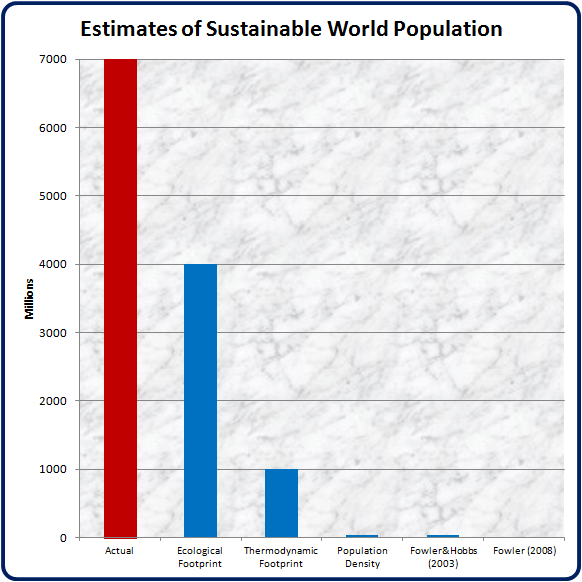
Then I read this paper by Paul Chefurka who is one of the wisest people on the planet and I decided to trash my paper and point to his. Paul takes a close look at the maximum size of a truly sustainable human population. His conclusion is 10 million.

The analysis seems sound to me. The obvious conclusion is that we can’t get there from here with any form of awakening or proactive action.

Paul ends by saying:

…the analysis suggests that Homo sapiens is an inherently unsustainable species.  This outcome seems virtually guaranteed by our neocortex, by the very intelligence that has enabled our rise to unprecedented dominance over our planet’s biosphere.  Is intelligence an evolutionary blind alley?

I wish Paul would read Varki’s book on denial. I suspect Paul would appreciate it because Varki presents a theory that confirms Paul’s speculation about the inherent unsustainability of humans.

In summary, the evolution of the powerful human brain required a mutation for denial of reality, and this denial prevents us from acknowledging our predicament.

Here is the full conclusion from Paul’s essay:

http://paulchefurka.ca/Sustainability.html

Conclusions

As you can see, the estimates for a sustainable human population vary widely – by a factor of 500 from the highest to the lowest.

The Ecological Footprint doesn’t really seem intended as a measure of sustainability.  Its main value is to give people with no exposure to ecology some sense that we are indeed over-exploiting our planet.  (It also has the psychological advantage of feeling achievable with just a little work.)  As a measure of sustainability, it is not helpful.

As I said above, the number suggested by the Thermodynamic Footprint or Fossil Fuel analysis isn’t very helpful either – even a population of one billion people without fossil fuels had already gone into overshoot.

That leaves us with four estimates: two at 35 million, one of 10 million, and one of 7 million.

The central number of 35 million people is confirmed by two analyses using different data and assumptions.  My conclusion is that this is probably the absolutely largest human population that could be considered sustainable.  The realistic but similarly unachievable number is probably more in line with the bottom two estimates, somewhere below 10 million.

I think the lowest two estimates (Fowler 2008, and Fowler 2009) are as unrealistically high as all the others in this case, primarily because human intelligence and problem-solving ability makes our destructive impact on biodiversity a foregone conclusion. After all, we drove other species to extinction 40,000 years ago, when our total population was estimated to be under 1 million.

So, what can we do with this information?  It’s obvious that we will not (and probably cannot) voluntarily reduce our population by 99.5% to 99.9%.  Even an involuntary reduction of this magnitude would involve enormous suffering and a very uncertain outcome.  It’s close enough to zero that if Mother Nature blinked, we’d be gone.

In fact, the analysis suggests that Homo sapiens is an inherently unsustainable species.  This outcome seems virtually guaranteed by our neocortex, by the very intelligence that has enabled our rise to unprecedented dominance over our planet’s biosphere.  Is intelligence an evolutionary blind alley?  From the singular perspective of our own species, it quite probably is. If we are to find some greater meaning or deeper future for intelligence in the universe, we may be forced to look beyond ourselves and adopt a cosmic, rather than a human, perspective.

Overpopulation Denial

Most non-domesticated life on earth is in decline and about 200 species a day are going extinct due to a wide range of environmental problems. Many humans are at risk of being harmed or killed by related problems this century.

All of the many problems are caused by the same thing: humans have used non-renewable energy to explode their population from 1 billion to 7 billion in 100 years, and now consume so large a share of the earth’s resources that almost all non-domesticated species are in decline.

Note that I use the word “resources” here in a broad context meaning land, water, minerals, photosynthetic output, biomass, and the planet’s capacity to recycle waste products.

The total quantity of resources consumed by humans equals the human population times the average consumption per person.

About 75% of the world’s population are poor and do not consume much more than is required for subsistence, although they desire and are working hard to consume more. The privileged 25% are working hard to maintain and grow their level of resource consumption and the majority are unwilling to contemplate a voluntary reduction in consumption, in part because they know that if they reduce their consumption others will consume the freed resources.

This dynamic makes it difficult to reduce the total human footprint by reducing per capita consumption.

Therefore, any progress towards solving the problems caused by human overshoot must come from a reduction in human population.

Paraphrasing Albert Bartlett, “There is no problem on earth that does not improve with fewer people”.

Establishing an effective and fair global population reduction policy will be very difficult and may be impossible for many reasons, not least of which it conflicts with what our genes want to do.

It may also be too late for a reduction in birth rate to prevent the worst consequences of overshoot. We can however say with certainty that a rising population will make things worse and a falling population will make things better. Therefore we should try to get the population down regardless of the prognosis.

Given that population reduction is the only thing that might help our predicament, why do we not even discuss it?

More to the point, why do those individuals and organizations with the best understanding of the seriousness of our predicament not speak out for population reduction? I am talking about environmental organizations, climate scientists, biologists, ecologists, deep greens, peak oilers, doomers, you name it. Almost without exception they are silent on population reduction.

I see the same dynamic in activist friends and acquaintances who deeply care about the planet and who work hard on environmental and social issues but never mention population reduction, despite the fact that population reduction is the only thing that might improve long-term environmental and social issues.

I understand that it may be impossible to gather enough political support, and that we might conclude that unintended consequences of population reduction policies are worse than the problems we are trying to solve. But at least we would have had the conversation and made a deliberate decision to not change course.

As it stands today we are racing towards a cliff without even discussing if we should slow down or change direction.

I like to think that if citizens understood that the choice was between having one child with some chance of a happy life versus having several children with no chance of a happy life, I think most people would choose a small family. Especially if they had confidence that the rules would be applied to rich and poor alike, and that cheaters would be punished. But if we don’t discuss it we’ll never find out if I am right or wrong. We’ll just blindly go off the cliff.

The fact that we do not discuss the only thing that might actually improve the future is amazing. I concluded several years ago that denial must be genetic. I later found a theory for evolved denial by Ajit Varki and Danny Brower and it is the reason this site exists.

Today, Alice Friedemann of the Energy Skeptic blog published a paper addressing this issue by Roy Beck & Leon Kolankiewicz titled “The Environmental Movement’s Retreat from Advocating U. S. Population Stabilization (1970-1998): A First Draft of History“.

It’s a long rambling paper on an important topic so I thought it worthwhile to summarize its key points here. Note that the paper has a U.S. focus with little analysis of what happened in other areas of the world.

What changed from 1970 to 2000?

  • In 1970 the need for population control was broadly understood and accepted by political leaders, business leaders, environmental organizations, universities, and the public. Strong environmental laws were passed. Earth Day had population control as a priority.
  • Thirty years later in 2000 the problems caused by population growth were still discussed but there was no discussion of the underlying population growth problem. The US population had increased by 70 million (33%) since 1970 . There was more nitrogen oxide pollution, more CO2, more endangered species, and fewer wetlands. Environmental groups no longer had population control as a priority and did not oppose laws that increased immigration. Earth Day did not mention population control.

What caused these changes from 1970 to 2000?

  • In 1970 the fertility rate of the white population fell below replacement level. All population growth after 1970 came from immigration and higher birth rates of the non-white population.
  • Environmental groups backed away from population control as a priority for fear of membership and donation loss due to potential charges of racism and the increased demographic influence of immigrants. Environmental groups competing for members and donations focused on issues that could demonstrate short-term successes rather than issues like population control that take decades to show results. It is much harder to raise funds for preventing future problems than for fixing an existing problem. In summary, protection of environmental institutions took precedence over protection of the environment.
  • Business used donations (or the lack thereof) to influence environmental groups to drop population control as a priority because they wanted the economic growth created by immigration and reduced labor costs from an expanding labor pool.
  • Politicians did not want to touch the population issue because of the increased voting power of immigrants.
  • The Catholic Church aggressively opposed any group in favor of population control, especially after abortion was legalized. It appears the Catholic Church had a large influence on government population policies but historians need to research this to confirm.
  • Women’s issues emerged as a priority which shifted the narrative from racially sensitive population control to politically correct empowerment of women.
  • A view emerged within the left that most environmental problems were caused by unfair distribution of resources and capitalism rather than overpopulation. Priorities shifted from population control to changing the economic system.
  • A view emerged that it was wrong to block immigration and to conserve resources for future generations while poor people struggled in developing countries.

The paper concludes with the following statement:

Historians need to explain how an environmental issue as fundamental as U.S. population growth could have moved from center-stage within the American environmental movement to virtual obscurity in just twenty years. For the American environment itself, the ever-growing demographic pressures ignored by the environmental establishment showed no signs of abating on their own as the nation prepared to enter the twenty-first century.

I found the paper to be a disappointment. I think it did a good job of explaining why environmental groups dropped population control as a priority. In summary they chose to give higher priority to protecting themselves than the environment. That’s no surprise.

A much more important issue that was not addressed was why did the majority of the public drop population control as a priority? Given that public sentiment shifted it is no wonder that political leaders, business leaders, universities, and environmental groups followed suit.

What really happened? I have a theory.

In 1970 economic growth was strong. The middle class was healthy and not threatened. Most white families, for whatever reason, had already decided to have 2 or fewer children. Making population control a priority did not require lifestyle changes for most. There was surplus wealth to spend on environmental protection laws and enforcement. People who understood the threat of overpopulation could form organizations and raise funds to support themselves.

By 2000, economic growth had slowed. The middle class was in decline and feeling threatened. Recent immigrants with higher birthrates became a powerful political force and resisted changes to their lifestyles or immigration reductions. Environmental groups chose survival over principles. Government deficits had replaced surpluses. Economic growth was becoming harder to achieve due to depletion of low-cost non-renewable energy. Our monetary system requires growth or else it collapses, however it will not collapse if per capita economic activity decreases as long as total economic activity increases. Therefore continued growth of the population via immigration became necessary to maintain some overall economic growth despite falling real incomes for individuals.

Today, 15 years later, the middle class is under even more pressure because low-cost non-renewable energy continues to deplete and globalization has eroded their standard of living. They see that immigration has not benefited them, seek someone to blame, and many have decided to vote for Trump.

If I am right, it is ironic that economic growth slowed due to the overpopulation related depletion of non-renewable resources which then required a further population increase to maintain some economic growth to avoid collapse. It’s analogous to the positive feedback loop of rising temperatures causing ice loss and methane release.

We have only two paths. We can find a way to break through our evolved denial and proactively act. Or we can let nature act for us.

Denial is the Only Topic Less Popular than Overshoot

I observe most people close their minds when I discuss overshoot but they don’t get upset.

It’s easy and natural for us to deny unpleasant things, as Varki’s theory predicts.

When I discuss denial I find people not only close their minds but also become agitated.

Talking about denial seems to get too close to a nerve.

I’ve yet to find a single person that shares my fascination with denial, despite denial being the most powerful and destructive force at play in our society.

We are causing the 6th great extinction. About 200 species a day are going extinct. We don’t talk about it.

The resource that created advanced civilization and 6 of our 7 billion people will be depleted within 20 years. We don’t talk about it.

Climate change is accelerating faster than most predictions and the problems are already obvious if you care to look. We don’t talk about it.

Fisheries are collapsing and the coral reefs are dying. We don’t talk about it.

Trees are in decline worldwide. We don’t talk about it.

We’ve had 8 years of zero interest rates. We don’t ask why.

Debt is so high now that we avoid talking about its implications.

40,000 climate change experts and concerned citizens met in Paris and did not even discuss the only thing that might make the future less bad.

Weaker countries are starting to fail. We avoid connecting the dots.

Leaders pretend everything is OK. Citizens seek someone to blame. No one seeks a science based understanding of what is happening.

The state of the union speech by the most powerful person in the world did not even mention any of the most important issues we face.

Denial is amazing!

By John Weber: Solar Devices Industrial Infrastructure

John Weber presents here the industrial infrastructure required to manufacture a “green renewable” solar panel.

Solar energy collecting devices also have an industrial history. It is important to understand the industrial infrastructure and the environmental results for the components of the solar energy collecting devices so we don’t designate them with false labels such as green, renewable or sustainable.

This is an essay challenging ‘business as usual’. If we teach people that these solar devices are the future of energy without teaching the whole system, we mislead, misinform and create false hopes and beliefs.

http://sunweber.blogspot.ca/2015/04/solar-devices-industrial-infrastructure.html