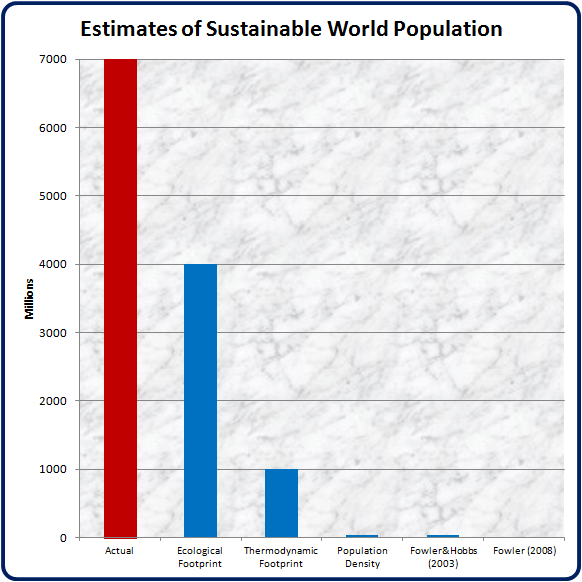
By Jack Alpert: How Much Degrowth is Enough?

This analysis by Jack Alpert of what is a sustainable long-term population uses a different approach to that discussed by Paul Chefurka here.

The two independent calculations arrive at roughly the same number of less than 100 million meaning we need more than a 98% population reduction to be sustainable.

By Chris Martenson: We’re Not Going To Make It… without real sacrifice

Slowly but surely Chris Martenson is speaking with more confidence and reality, and less hopium and denial, especially about climate change.

I’m starting to like his new more honest voice.

http://www.peakprosperity.com/blog/97643/we%E2%80%99re-not-going-make-it%E2%80%A6

The world is just not yet serious enough about the urgency of transitioning away from fossil fuels.  The math says that without a tremendous change in behavior, far greater than anything currently on display, we simply won’t “get there” waiting for market forces to do the job for us.

We’ll have to make and adhere to very different priorities. Such as completely redirecting our entire defense budgets to the process of retooling our entire relationship to energy.

We’ll need our buildings to use less energy. And we’ll need to live closer to where we work and play.

Our food will have to be grown differently. And it will have to travel less far to get to our plate.

Electricity will have to come from sources other than fossil fuels too.

Is it possible to figure this out in time? Well, whether it is or not is sort of beside the point. Because these changes are going to be forced on us anyways if we don’t.

So I guess I could be an optimist on the UN panel by telling them that I have 99% confidence that humans will someday be powering 100% of their energy needs from the sun.

I’ll just leave out that what I mean is that, in 100 or 200 years, humans will have painfully reverted back to a 1600’s-style subsistence farming lifestyle.

The point of this article is to refocus our attention on the need for each of us to lead the way, to begin our own individual energy transitions without waiting for some top-down solutions to come forward. The calvary simply isn’t going to show up.

By Gail Tverberg: Why We Have a Wage Inequality Problem

Here is the latest excellent work by Gail Tverberg.

https://ourfiniteworld.com/2016/03/29/why-we-have-a-wage-inequality-problem/

In this essay Gail explains what is causing the discontent that has enabled the rise of Trump, and probably other worse leaders to follow that exploit human hardship.

Gail explores a wide solution space and concludes that there is nothing we can do to avoid collapse other than perhaps kick the can a little longer.

This led me to ponder the following…

If humans were able to break through their evolved denial of reality and understand their predicament, then we might avoid wars and violence associated with blaming others for our misfortune.

However, if the majority understood our predicament the system would likely collapse immediately because it is elevated today in large part by faith and belief.

Given that collapse is imminent regardless of what we believe, I’m thinking I’d prefer a world where people understood what is going on and worked together to make the best of a bad situation rather than seeking scapegoats.

But since life at its core is replicating chemical reactions competing for finite resources, we should expect the worst and be very grateful for anything better.

It would be really nice to “roll back” the world economy to a date back before population rose to its current high level, resources became as depleted as they are, and pollution became as big a problem as it is. Unfortunately, we can’t really do this.

We are now faced with the question of whether we can do anything to mitigate what may be a near-term crisis. At this point, it may be too late to make any changes at all, before the downward slide into collapse begins. The current low prices of fossil fuels make the current situation particularly worrisome, because the low prices could lead to lower fossil fuel production, and hence reduce world GDP because of the connection between energy consumption and GDP growth. Low oil prices could also push the world economy downward, due to increasing defaults on energy sector loans and adverse impacts on economies of oil exporters.

In my view, a major reason why fossil fuel prices are now low is because of the low wages of “ordinary workers.” If these wages were higher, workers around the globe could be buying more houses and cars, and indirectly raising demand for fossil fuels. Thus, low fossil fuel prices may be a sign that collapse is near.

One policy that might be helpful at this late date is increased focus on contraception. In fact, an argument could be made for more permissive abortion policies. Our problem is too little resources per capita–keeping the population count in the denominator as low as possible would be helpful.

On a temporary basis, it is also possible that new programs that lead to rising debt–whether or not these programs buy anything worthwhile–may be helpful in keeping the world economy from collapsing. This occurs because the economy is funded by a combination of wages and by growing debt. A shortfall in wages can be hidden by more debt, at least for a short time. Of course, this is not a long-term solution. It simply leads to a larger amount of debt that cannot be repaid when collapse does occur.

By Paul Chefurka: No really, how sustainable are we?

I was starting to write an essay on overpopulation exploring the solution space where a breakthrough in denial enabled a planned global birthrate reduction. My goal being to present a reasonable scenario for making the future less bad.

Then I read this paper by Paul Chefurka who is one of the wisest people on the planet and I decided to trash my paper and point to his. Paul takes a close look at the maximum size of a truly sustainable human population. His conclusion is 10 million.

The analysis seems sound to me. The obvious conclusion is that we can’t get there from here with any form of awakening or proactive action.

Paul ends by saying:

…the analysis suggests that Homo sapiens is an inherently unsustainable species.  This outcome seems virtually guaranteed by our neocortex, by the very intelligence that has enabled our rise to unprecedented dominance over our planet’s biosphere.  Is intelligence an evolutionary blind alley?

I wish Paul would read Varki’s book on denial. I suspect Paul would appreciate it because Varki presents a theory that confirms Paul’s speculation about the inherent unsustainability of humans.

In summary, the evolution of the powerful human brain required a mutation for denial of reality, and this denial prevents us from acknowledging our predicament.

Here is the full conclusion from Paul’s essay:

http://paulchefurka.ca/Sustainability.html

Conclusions

As you can see, the estimates for a sustainable human population vary widely – by a factor of 500 from the highest to the lowest.

The Ecological Footprint doesn’t really seem intended as a measure of sustainability.  Its main value is to give people with no exposure to ecology some sense that we are indeed over-exploiting our planet.  (It also has the psychological advantage of feeling achievable with just a little work.)  As a measure of sustainability, it is not helpful.

As I said above, the number suggested by the Thermodynamic Footprint or Fossil Fuel analysis isn’t very helpful either – even a population of one billion people without fossil fuels had already gone into overshoot.

That leaves us with four estimates: two at 35 million, one of 10 million, and one of 7 million.

The central number of 35 million people is confirmed by two analyses using different data and assumptions.  My conclusion is that this is probably the absolutely largest human population that could be considered sustainable.  The realistic but similarly unachievable number is probably more in line with the bottom two estimates, somewhere below 10 million.

I think the lowest two estimates (Fowler 2008, and Fowler 2009) are as unrealistically high as all the others in this case, primarily because human intelligence and problem-solving ability makes our destructive impact on biodiversity a foregone conclusion. After all, we drove other species to extinction 40,000 years ago, when our total population was estimated to be under 1 million.

So, what can we do with this information?  It’s obvious that we will not (and probably cannot) voluntarily reduce our population by 99.5% to 99.9%.  Even an involuntary reduction of this magnitude would involve enormous suffering and a very uncertain outcome.  It’s close enough to zero that if Mother Nature blinked, we’d be gone.

In fact, the analysis suggests that Homo sapiens is an inherently unsustainable species.  This outcome seems virtually guaranteed by our neocortex, by the very intelligence that has enabled our rise to unprecedented dominance over our planet’s biosphere.  Is intelligence an evolutionary blind alley?  From the singular perspective of our own species, it quite probably is. If we are to find some greater meaning or deeper future for intelligence in the universe, we may be forced to look beyond ourselves and adopt a cosmic, rather than a human, perspective.

By Ray Grigg: The Evolution of Denial

Ray Grigg writes an environmental column in my local newspaper and lives on an island near my home.

We’ve never met but he’s written the best review of Ajit Varki and Danny Brower’s book on denial that I have seen anywhere.

http://tidechange.ca/2013/07/17/the-evolution-of-denial-by-ray-grigg/

Consciousness can be costly. Philosophers and poets have long pondered this dilemma. But the idea has rarely entered the theories of evolutionary scientists until Dr. Danny Brower introduced it to Dr. Ajit Varki, an oncologist who is also an authority on cellular biology and an expert on anthropogeny (the origin of humans).Dr. Varki met Dr. Danny Brower for a brief but intense hour at a 2005 conference on the origins of human uniqueness. As a geneticist, Dr. Brower was fascinated with the evolution of human consciousness. But he was less curious about the human ability to be aware of their own minds and the minds of others as he was about the apparent inability of other animals to develop the same facility. Whales, elephants, apes, dolphins, and some birds such as magpies provide clear evidence of self-awareness. Even though they have existed in evolutionary history for much longer than humans, however, they have never developed the same degree of self-awareness, empathetic sensitivity, social sophistication and intellectual acumen as humans. Dr. Brower thought he had an answer.

His answer haunted Dr. Varki. So, when Dr. Brower died suddenly in 2007, leaving an incomplete manuscript, Denial: Self-Deception, False Beliefs, and the Origins of the Human Mind, Dr. Varki inherited the task of finishing it. The completed book explores the advantages, costs and implications of our human capacity to understand, empathize, organize and act, the attributes that define us as individuals, societies and civilizations.

Dr. Varki notes that some species of animals seem capable of recognizing themselves as individuals and of mourning the death of their fellows. Such animals may even recognize their own mortality, a traumatizing experience that could be psychologically crippling without the protection of an appropriate defence mechanism. And this mechanism, the theory proposes, is denial.

Humans may have succeeded where other species have failed because we have simultaneously developed the contradictory capacity for both self-awareness and denial. Thus we are capable of exercising all the intellectual, empathetic, social and cultural skills that are responsible for our amazing accomplishments but we are also capable of isolating ourselves from the inevitable death which shadows all our efforts. This capacity, the theory suggests, is the adroit device of evolution that allows us to function while avoiding the heavy psychological cost of knowing the inevitable consequence of being alive. The problem presented by self-awareness is solved simply by sidestepping the reality we do not want to confront.

As Dr. Varki outlines in his elaboration of Dr. Brower’s theory, this is a useful strategy for the individual. And it has advantages for society, too. So people undertake enterprises they would never begin if they actually confronted the reality of the challenges. Denial forms a partnership with optimism to remove the obstacles preventing us from attempting the unpredictable, difficult or impossible. Travelling to the moon, rowing across the Pacific, or working faithfully for 45 years to reach a retirement pension all require an erasing of very credible risks and obstacles. Such ordinary activities as having a baby, driving on a freeway, flying in an airplane or buying a lottery ticket all require acts of denial. Even falling in love is an act that doesn’t consider the possibility of heartbreak. So risk and failure are blindly overlooked for the prospect of benefit. Bravery could be one word to describe such behaviour — if we were fully aware. But a better word might be denial, a strategy which Dr. Varki refers to as “terror management”.

The shortcoming of denial, however, is that it tends to be indiscriminate — so we deny things we should confront. Denial is also a much better coping strategy for an individual than for a species. Indeed, the loss of a few individuals because of their refusal to confront reality is unlikely to endanger the viability of an entire society. But this constraint no longer applies in a globalized world. If denial is responsible for a nuclear holocaust, then this lurking Armageddon could obliterate much of civilization as we know it. What if denial results in the use of uncontrollable biological weapons, or the release of a virus which could initiate an unstoppable global pandemic? What if genetic tinkering inadvertently creates an organism which crashes the planet’s biological systems? The denial mechanism which once affected only local people in local places could potentially affect life on the entire planet.

This is the context in which Dr. Varki raises the subject of climate change. The mechanisms we use to avoid confronting this threat are extraordinary. It is a silence that pervades many conversation. It is a subject that elections commonly avoid. It is a science that politicians suppress — at least in Canada where those who raise it are deemed pessimists, heretics, cynics, enemies, radicals.

Of course, reality is remarkably insistent. So the trauma of extreme weather events force climate change into public awareness where it is too often heard but denied. The required remedial action is invariably postponed. The necessary government regulations become promises that never materialize. Excuses and rationalizations abound as the carbon dioxide levels rise and the planet’s weather becomes more unusual, threatening and destructive. Dr. Varki summarizes the stakes succinctly. “This is the one case,” he says of global warming, “where we cannot afford to get it wrong the first time.”

Dr. Varki concedes that his refinements to Dr. Brower’s theory need more scientific study and evaluation. But, he contends, the theory seems to fit the evidence. More sobering, however, is the way the theory seems to fit our history.

By Big Picture RT: Mass Extinction is Closer Than You Know

A very nice summary on the latest warnings from climate scientists.

Until the end when he concludes by saying we need a carbon tax to force us away from fossil energy. He has no clue what he is talking about.

We need a much smaller economy and many fewer people.

By James Hansen: Ice Melt, Sea Level Rise and Superstorms

Here is an important update and warning from James Hansen, the world’s most respected climate scientist.

Unfortunately his proposed solution to shift from fossil to renewable energy while continuing to grow the economy will not work and will make the situation worse.

We must shrink the economy but no one has the courage to say this.

I’m ok cutting Hansen a little slack because without belief in a happy solution he probably could not stay motivated to continue his important work.


By John Weber: Solar Devices Industrial Infrastructure

John Weber presents here the industrial infrastructure required to manufacture a “green renewable” solar panel.

Solar energy collecting devices also have an industrial history. It is important to understand the industrial infrastructure and the environmental results for the components of the solar energy collecting devices so we don’t designate them with false labels such as green, renewable or sustainable.

This is an essay challenging ‘business as usual’. If we teach people that these solar devices are the future of energy without teaching the whole system, we mislead, misinform and create false hopes and beliefs.

http://sunweber.blogspot.ca/2015/04/solar-devices-industrial-infrastructure.html

By Gail Tverberg: Our Economic Growth System is Reaching Limits in a Strange Way

Gail Tverberg’s insight continues to deepen. A must read.

https://ourfiniteworld.com/2016/03/17/our-economic-growth-system-is-reaching-limits-in-a-strange-way/

If a person doesn’t understand what the problem is, it is easy to come to the wrong conclusion. Part of our problem is that we need a growing amount of net energy, per capita, to keep the economy from collapsing. Part of our problem is that entropy problems such as rising debt, increased pollution, and increasing complexity tend to bring the system down, even when we seem to have plenty of energy supplies. These are the two big problems we are facing that few people recognize.

Another part of our problem is that it is necessary for common laborers to have good paying jobs, and in fact rising pay, if the economy is to continue to grow. As much as we would like everyone to have advanced training (and training that changes with each new innovation), the productivity of workers does not rise sufficiently to justify the high cost of giving advanced education to a large share of the population. Instead, we must deal with the fact that the world’s economy needs large numbers of workers with relatively little training. In fact, we need rising pay for these workers, because there are so many of them, and they are the ones who keep the “demand” part of the commodity price cycle high enough.

Robots may be very efficient at producing goods and services, but they cannot recycle the earnings of the system. In theory, businesses could pay very high taxes on the output of automated systems, so that governments could create make-work projects to hire all of the unemployed workers. In practice, the idea is impractical–the businesses would simply move to an area with lower taxes.

Growth now is slowing because of all of the entropy issues involved. People in China cannot stand any more pollution. Too many laborers in developed countries are being marginalized by globalization and by competition with ever more intelligent machines that can replace much of the function of humans. None of this would be a problem, except that we have a huge amount of debt that needs to be repaid with interest, and we need commodity prices to rise high enough to encourage production. If these problems are not fixed, the whole system will collapse, even though there seems to be a surplus of energy products.

By Kim Hill: What’s Wrong with Renewable Energy?

http://dgrnewsservice.org/civilization/ecocide/extraction/kim-hill-whats-wrong-with-renewable-energy/

Ten things environmentalists need to know about renewable energy:

1.    Solar panels and wind turbines aren’t made out of nothing. They are made out of metals, plastics, chemicals. These products have been mined out of the ground, transported, processed, manufactured. Each stage leaves behind a trail of devastation: habitat destruction, water contamination, colonization, toxic waste, slave labour, greenhouse gas emissions, wars, and corporate profits. Renewables can never replace fossil fuel infrastructure, as they are entirely dependent on it for their existence.

2.    The majority of electricity that is generated by renewables is used in manufacturing, mining, and other industries that are destroying the planet. Even if the generation of electricity were harmless, the consumption certainly isn’t. Every electrical device, in the process of production, leaves behind the same trail of devastation. Living communities—forests, rivers, oceans—become dead commodities.

3.    The aim of converting from conventional power generation to renewables is to maintain the very system that is killing the living world, killing us all, at a rate of 200 species per day. Taking carbon emissions out of the equation doesn’t make it sustainable. This system needs not to be sustained, but stopped.

4.    Humans, and all living beings, get our energy from plants and animals. Only the industrial system needs electricity to survive, and food and habitat for everyone are being sacrificed to feed it. Farmland and forests are being taken over, not just by the infrastructure itself, but by the mines, processing and waste dumping that it entails. Ensuring energy security for industry requires undermining energy security for living beings (that’s us).

5.    Wind turbines and solar panels generate little, if any, net energy (energy returned on energy invested). The amount of energy used in the mining, manufacturing, research and development, transport, installation, maintenance and disposal of these technologies is almost as much—or in some cases more than—they ever produce. Renewables have been described as a laundering scheme: dirty energy goes in, clean energy comes out. (Although this is really beside the point, as no matter how much energy they generate, it doesn’t justify the destruction of the living world.)

6.    Renewable energy subsidies take taxpayer money and give it directly to corporations. Investing in renewables is highly profitable. General Electric, BP, Samsung, and Mitsubishi all profit from renewables, and invest these profits in their other business activities. When environmentalists accept the word of corporations on what is good for the environment, something has gone seriously wrong.

7.    More renewables doesn’t mean less conventional power, or less carbon emissions. It just means more power is being generated overall. Very few coal and gas plants have been taken off line as a result of renewables.

8.    Only 20% of energy used globally is in the form of electricity. The rest is oil and gas. Even if all the world’s electricity could be produced without carbon emissions (which it can’t), it would only reduce total emissions by 20%. And even that would have little impact, as the amount of energy being used globally is increasing exponentially.

9.    Solar panels and wind turbines last around 20-30 years, then need to be disposed of and replaced. The production process, of extracting, polluting, and exploiting, is not something that happens once, but is continuous and expanding.

10.    The emissions reductions that renewables intend to achieve could be easily accomplished by improving the efficiency of existing coal plants, at a much lower cost. This shows that the whole renewables industry is nothing but an exercise in profiteering with no benefits for anyone other than the investors.