By Gail Tverberg: Why We Have a Wage Inequality Problem

Here is the latest excellent work by Gail Tverberg.

https://ourfiniteworld.com/2016/03/29/why-we-have-a-wage-inequality-problem/

In this essay Gail explains what is causing the discontent that has enabled the rise of Trump, and probably other worse leaders to follow that exploit human hardship.

Gail explores a wide solution space and concludes that there is nothing we can do to avoid collapse other than perhaps kick the can a little longer.

This led me to ponder the following…

If humans were able to break through their evolved denial of reality and understand their predicament, then we might avoid wars and violence associated with blaming others for our misfortune.

However, if the majority understood our predicament the system would likely collapse immediately because it is elevated today in large part by faith and belief.

Given that collapse is imminent regardless of what we believe, I’m thinking I’d prefer a world where people understood what is going on and worked together to make the best of a bad situation rather than seeking scapegoats.

But since life at its core is replicating chemical reactions competing for finite resources, we should expect the worst and be very grateful for anything better.

It would be really nice to “roll back” the world economy to a date back before population rose to its current high level, resources became as depleted as they are, and pollution became as big a problem as it is. Unfortunately, we can’t really do this.

We are now faced with the question of whether we can do anything to mitigate what may be a near-term crisis. At this point, it may be too late to make any changes at all, before the downward slide into collapse begins. The current low prices of fossil fuels make the current situation particularly worrisome, because the low prices could lead to lower fossil fuel production, and hence reduce world GDP because of the connection between energy consumption and GDP growth. Low oil prices could also push the world economy downward, due to increasing defaults on energy sector loans and adverse impacts on economies of oil exporters.

In my view, a major reason why fossil fuel prices are now low is because of the low wages of “ordinary workers.” If these wages were higher, workers around the globe could be buying more houses and cars, and indirectly raising demand for fossil fuels. Thus, low fossil fuel prices may be a sign that collapse is near.

One policy that might be helpful at this late date is increased focus on contraception. In fact, an argument could be made for more permissive abortion policies. Our problem is too little resources per capita–keeping the population count in the denominator as low as possible would be helpful.

On a temporary basis, it is also possible that new programs that lead to rising debt–whether or not these programs buy anything worthwhile–may be helpful in keeping the world economy from collapsing. This occurs because the economy is funded by a combination of wages and by growing debt. A shortfall in wages can be hidden by more debt, at least for a short time. Of course, this is not a long-term solution. It simply leads to a larger amount of debt that cannot be repaid when collapse does occur.

By Paul Chefurka: No really, how sustainable are we?

I was starting to write an essay on overpopulation exploring the solution space where a breakthrough in denial enabled a planned global birthrate reduction. My goal being to present a reasonable scenario for making the future less bad.

Then I read this paper by Paul Chefurka who is one of the wisest people on the planet and I decided to trash my paper and point to his. Paul takes a close look at the maximum size of a truly sustainable human population. His conclusion is 10 million.

The analysis seems sound to me. The obvious conclusion is that we can’t get there from here with any form of awakening or proactive action.

Paul ends by saying:

…the analysis suggests that Homo sapiens is an inherently unsustainable species.  This outcome seems virtually guaranteed by our neocortex, by the very intelligence that has enabled our rise to unprecedented dominance over our planet’s biosphere.  Is intelligence an evolutionary blind alley?

I wish Paul would read Varki’s book on denial. I suspect Paul would appreciate it because Varki presents a theory that confirms Paul’s speculation about the inherent unsustainability of humans.

In summary, the evolution of the powerful human brain required a mutation for denial of reality, and this denial prevents us from acknowledging our predicament.

Here is the full conclusion from Paul’s essay:

http://paulchefurka.ca/Sustainability.html

Conclusions

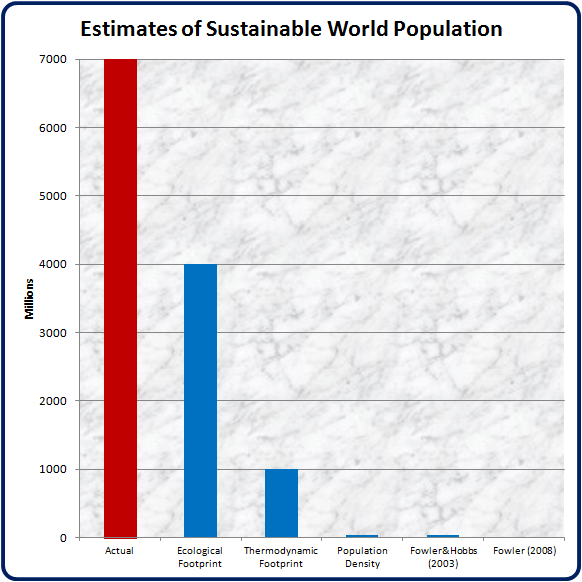
As you can see, the estimates for a sustainable human population vary widely – by a factor of 500 from the highest to the lowest.

The Ecological Footprint doesn’t really seem intended as a measure of sustainability.  Its main value is to give people with no exposure to ecology some sense that we are indeed over-exploiting our planet.  (It also has the psychological advantage of feeling achievable with just a little work.)  As a measure of sustainability, it is not helpful.

As I said above, the number suggested by the Thermodynamic Footprint or Fossil Fuel analysis isn’t very helpful either – even a population of one billion people without fossil fuels had already gone into overshoot.

That leaves us with four estimates: two at 35 million, one of 10 million, and one of 7 million.

The central number of 35 million people is confirmed by two analyses using different data and assumptions.  My conclusion is that this is probably the absolutely largest human population that could be considered sustainable.  The realistic but similarly unachievable number is probably more in line with the bottom two estimates, somewhere below 10 million.

I think the lowest two estimates (Fowler 2008, and Fowler 2009) are as unrealistically high as all the others in this case, primarily because human intelligence and problem-solving ability makes our destructive impact on biodiversity a foregone conclusion. After all, we drove other species to extinction 40,000 years ago, when our total population was estimated to be under 1 million.

So, what can we do with this information?  It’s obvious that we will not (and probably cannot) voluntarily reduce our population by 99.5% to 99.9%.  Even an involuntary reduction of this magnitude would involve enormous suffering and a very uncertain outcome.  It’s close enough to zero that if Mother Nature blinked, we’d be gone.

In fact, the analysis suggests that Homo sapiens is an inherently unsustainable species.  This outcome seems virtually guaranteed by our neocortex, by the very intelligence that has enabled our rise to unprecedented dominance over our planet’s biosphere.  Is intelligence an evolutionary blind alley?  From the singular perspective of our own species, it quite probably is. If we are to find some greater meaning or deeper future for intelligence in the universe, we may be forced to look beyond ourselves and adopt a cosmic, rather than a human, perspective.

By Ray Grigg: The Evolution of Denial

Ray Grigg writes an environmental column in my local newspaper and lives on an island near my home.

We’ve never met but he’s written the best review of Ajit Varki and Danny Brower’s book on denial that I have seen anywhere.

http://tidechange.ca/2013/07/17/the-evolution-of-denial-by-ray-grigg/

Consciousness can be costly. Philosophers and poets have long pondered this dilemma. But the idea has rarely entered the theories of evolutionary scientists until Dr. Danny Brower introduced it to Dr. Ajit Varki, an oncologist who is also an authority on cellular biology and an expert on anthropogeny (the origin of humans).Dr. Varki met Dr. Danny Brower for a brief but intense hour at a 2005 conference on the origins of human uniqueness. As a geneticist, Dr. Brower was fascinated with the evolution of human consciousness. But he was less curious about the human ability to be aware of their own minds and the minds of others as he was about the apparent inability of other animals to develop the same facility. Whales, elephants, apes, dolphins, and some birds such as magpies provide clear evidence of self-awareness. Even though they have existed in evolutionary history for much longer than humans, however, they have never developed the same degree of self-awareness, empathetic sensitivity, social sophistication and intellectual acumen as humans. Dr. Brower thought he had an answer.

His answer haunted Dr. Varki. So, when Dr. Brower died suddenly in 2007, leaving an incomplete manuscript, Denial: Self-Deception, False Beliefs, and the Origins of the Human Mind, Dr. Varki inherited the task of finishing it. The completed book explores the advantages, costs and implications of our human capacity to understand, empathize, organize and act, the attributes that define us as individuals, societies and civilizations.

Dr. Varki notes that some species of animals seem capable of recognizing themselves as individuals and of mourning the death of their fellows. Such animals may even recognize their own mortality, a traumatizing experience that could be psychologically crippling without the protection of an appropriate defence mechanism. And this mechanism, the theory proposes, is denial.

Humans may have succeeded where other species have failed because we have simultaneously developed the contradictory capacity for both self-awareness and denial. Thus we are capable of exercising all the intellectual, empathetic, social and cultural skills that are responsible for our amazing accomplishments but we are also capable of isolating ourselves from the inevitable death which shadows all our efforts. This capacity, the theory suggests, is the adroit device of evolution that allows us to function while avoiding the heavy psychological cost of knowing the inevitable consequence of being alive. The problem presented by self-awareness is solved simply by sidestepping the reality we do not want to confront.

As Dr. Varki outlines in his elaboration of Dr. Brower’s theory, this is a useful strategy for the individual. And it has advantages for society, too. So people undertake enterprises they would never begin if they actually confronted the reality of the challenges. Denial forms a partnership with optimism to remove the obstacles preventing us from attempting the unpredictable, difficult or impossible. Travelling to the moon, rowing across the Pacific, or working faithfully for 45 years to reach a retirement pension all require an erasing of very credible risks and obstacles. Such ordinary activities as having a baby, driving on a freeway, flying in an airplane or buying a lottery ticket all require acts of denial. Even falling in love is an act that doesn’t consider the possibility of heartbreak. So risk and failure are blindly overlooked for the prospect of benefit. Bravery could be one word to describe such behaviour — if we were fully aware. But a better word might be denial, a strategy which Dr. Varki refers to as “terror management”.

The shortcoming of denial, however, is that it tends to be indiscriminate — so we deny things we should confront. Denial is also a much better coping strategy for an individual than for a species. Indeed, the loss of a few individuals because of their refusal to confront reality is unlikely to endanger the viability of an entire society. But this constraint no longer applies in a globalized world. If denial is responsible for a nuclear holocaust, then this lurking Armageddon could obliterate much of civilization as we know it. What if denial results in the use of uncontrollable biological weapons, or the release of a virus which could initiate an unstoppable global pandemic? What if genetic tinkering inadvertently creates an organism which crashes the planet’s biological systems? The denial mechanism which once affected only local people in local places could potentially affect life on the entire planet.

This is the context in which Dr. Varki raises the subject of climate change. The mechanisms we use to avoid confronting this threat are extraordinary. It is a silence that pervades many conversation. It is a subject that elections commonly avoid. It is a science that politicians suppress — at least in Canada where those who raise it are deemed pessimists, heretics, cynics, enemies, radicals.

Of course, reality is remarkably insistent. So the trauma of extreme weather events force climate change into public awareness where it is too often heard but denied. The required remedial action is invariably postponed. The necessary government regulations become promises that never materialize. Excuses and rationalizations abound as the carbon dioxide levels rise and the planet’s weather becomes more unusual, threatening and destructive. Dr. Varki summarizes the stakes succinctly. “This is the one case,” he says of global warming, “where we cannot afford to get it wrong the first time.”

Dr. Varki concedes that his refinements to Dr. Brower’s theory need more scientific study and evaluation. But, he contends, the theory seems to fit the evidence. More sobering, however, is the way the theory seems to fit our history.

By Big Picture RT: Mass Extinction is Closer Than You Know

A very nice summary on the latest warnings from climate scientists.

Until the end when he concludes by saying we need a carbon tax to force us away from fossil energy. He has no clue what he is talking about.

We need a much smaller economy and many fewer people.

Why is my message so unpopular?

No one supports a planned contraction of our population and economy.

Yet everything gets better with fewer people.

Those that are on the fence with respect to having children will decide to have none. Those that want a family can still enjoy one child. If we are worried about inappropriate selection for males we can provide a tax incentive for having females.

Those that care about growth and having more stuff can be assured that as the population falls there will be more resources per capita available, especially if we can induce the population to fall faster than the depletion rate of non-renewable resources.

There will be much less chance of war. There will be less traffic. Housing will be more affordable. Forests and wildlife will bounce back. The air and waters will clear. We will have more land available to grow food the old way when fossil energy is depleted. We will have space to move when climate change forces relocation.

To be open and honest, there will be a large reduction in paper wealth and credit with a shrinking economy, but that’s going to happen soon regardless of what we do. Instead of waiting for a crash we can anticipate the contraction and implement policies to ensure some fairness between rich and poor.

There will also be a lot less advanced technology. But again, that’s going to happen soon regardless of what we do due to depletion of non-renewable energy and other resources.

Fewer iPhones and more forests and fish for our grandchildren is a very good trade-off.

What I’m really talking about is getting ahead of the curve in a planned, controlled, and civilized manner. Rather than letting nature take over in a chaotic painful collapse.

I think it’s a hopeful positive message. Something to fight for.

Why doesn’t every wise leader and concerned grandparent and environmental activist and climate scientist and biologist in the world scream this message every chance they get?

The limits to growth today are so obvious and in our face that the time is ripe to start a new narrative about how we might live in a finite world.

I suspect the majority of citizens would support the idea of a stable or falling population. But I also suspect the majority would oppose big government forcing population reduction and economic contraction policies.

Breaking through this opposition will require limits to growth awareness.

And limits to growth awareness will require us to find a way to override our evolved denial.

It would help if more people who understand what is going on would speak up.

Silence guarantees a despot rising to blame others, war, and chaos.

Overpopulation Denial

Most non-domesticated life on earth is in decline and about 200 species a day are going extinct due to a wide range of environmental problems. Many humans are at risk of being harmed or killed by related problems this century.

All of the many problems are caused by the same thing: humans have used non-renewable energy to explode their population from 1 billion to 7 billion in 100 years, and now consume so large a share of the earth’s resources that almost all non-domesticated species are in decline.

Note that I use the word “resources” here in a broad context meaning land, water, minerals, photosynthetic output, biomass, and the planet’s capacity to recycle waste products.

The total quantity of resources consumed by humans equals the human population times the average consumption per person.

About 75% of the world’s population are poor and do not consume much more than is required for subsistence, although they desire and are working hard to consume more. The privileged 25% are working hard to maintain and grow their level of resource consumption and the majority are unwilling to contemplate a voluntary reduction in consumption, in part because they know that if they reduce their consumption others will consume the freed resources.

This dynamic makes it difficult to reduce the total human footprint by reducing per capita consumption.

Therefore, any progress towards solving the problems caused by human overshoot must come from a reduction in human population.

Paraphrasing Albert Bartlett, “There is no problem on earth that does not improve with fewer people”.

Establishing an effective and fair global population reduction policy will be very difficult and may be impossible for many reasons, not least of which it conflicts with what our genes want to do.

It may also be too late for a reduction in birth rate to prevent the worst consequences of overshoot. We can however say with certainty that a rising population will make things worse and a falling population will make things better. Therefore we should try to get the population down regardless of the prognosis.

Given that population reduction is the only thing that might help our predicament, why do we not even discuss it?

More to the point, why do those individuals and organizations with the best understanding of the seriousness of our predicament not speak out for population reduction? I am talking about environmental organizations, climate scientists, biologists, ecologists, deep greens, peak oilers, doomers, you name it. Almost without exception they are silent on population reduction.

I see the same dynamic in activist friends and acquaintances who deeply care about the planet and who work hard on environmental and social issues but never mention population reduction, despite the fact that population reduction is the only thing that might improve long-term environmental and social issues.

I understand that it may be impossible to gather enough political support, and that we might conclude that unintended consequences of population reduction policies are worse than the problems we are trying to solve. But at least we would have had the conversation and made a deliberate decision to not change course.

As it stands today we are racing towards a cliff without even discussing if we should slow down or change direction.

I like to think that if citizens understood that the choice was between having one child with some chance of a happy life versus having several children with no chance of a happy life, I think most people would choose a small family. Especially if they had confidence that the rules would be applied to rich and poor alike, and that cheaters would be punished. But if we don’t discuss it we’ll never find out if I am right or wrong. We’ll just blindly go off the cliff.

The fact that we do not discuss the only thing that might actually improve the future is amazing. I concluded several years ago that denial must be genetic. I later found a theory for evolved denial by Ajit Varki and Danny Brower and it is the reason this site exists.

Today, Alice Friedemann of the Energy Skeptic blog published a paper addressing this issue by Roy Beck & Leon Kolankiewicz titled “The Environmental Movement’s Retreat from Advocating U. S. Population Stabilization (1970-1998): A First Draft of History“.

It’s a long rambling paper on an important topic so I thought it worthwhile to summarize its key points here. Note that the paper has a U.S. focus with little analysis of what happened in other areas of the world.

What changed from 1970 to 2000?

  • In 1970 the need for population control was broadly understood and accepted by political leaders, business leaders, environmental organizations, universities, and the public. Strong environmental laws were passed. Earth Day had population control as a priority.
  • Thirty years later in 2000 the problems caused by population growth were still discussed but there was no discussion of the underlying population growth problem. The US population had increased by 70 million (33%) since 1970 . There was more nitrogen oxide pollution, more CO2, more endangered species, and fewer wetlands. Environmental groups no longer had population control as a priority and did not oppose laws that increased immigration. Earth Day did not mention population control.

What caused these changes from 1970 to 2000?

  • In 1970 the fertility rate of the white population fell below replacement level. All population growth after 1970 came from immigration and higher birth rates of the non-white population.
  • Environmental groups backed away from population control as a priority for fear of membership and donation loss due to potential charges of racism and the increased demographic influence of immigrants. Environmental groups competing for members and donations focused on issues that could demonstrate short-term successes rather than issues like population control that take decades to show results. It is much harder to raise funds for preventing future problems than for fixing an existing problem. In summary, protection of environmental institutions took precedence over protection of the environment.
  • Business used donations (or the lack thereof) to influence environmental groups to drop population control as a priority because they wanted the economic growth created by immigration and reduced labor costs from an expanding labor pool.
  • Politicians did not want to touch the population issue because of the increased voting power of immigrants.
  • The Catholic Church aggressively opposed any group in favor of population control, especially after abortion was legalized. It appears the Catholic Church had a large influence on government population policies but historians need to research this to confirm.
  • Women’s issues emerged as a priority which shifted the narrative from racially sensitive population control to politically correct empowerment of women.
  • A view emerged within the left that most environmental problems were caused by unfair distribution of resources and capitalism rather than overpopulation. Priorities shifted from population control to changing the economic system.
  • A view emerged that it was wrong to block immigration and to conserve resources for future generations while poor people struggled in developing countries.

The paper concludes with the following statement:

Historians need to explain how an environmental issue as fundamental as U.S. population growth could have moved from center-stage within the American environmental movement to virtual obscurity in just twenty years. For the American environment itself, the ever-growing demographic pressures ignored by the environmental establishment showed no signs of abating on their own as the nation prepared to enter the twenty-first century.

I found the paper to be a disappointment. I think it did a good job of explaining why environmental groups dropped population control as a priority. In summary they chose to give higher priority to protecting themselves than the environment. That’s no surprise.

A much more important issue that was not addressed was why did the majority of the public drop population control as a priority? Given that public sentiment shifted it is no wonder that political leaders, business leaders, universities, and environmental groups followed suit.

What really happened? I have a theory.

In 1970 economic growth was strong. The middle class was healthy and not threatened. Most white families, for whatever reason, had already decided to have 2 or fewer children. Making population control a priority did not require lifestyle changes for most. There was surplus wealth to spend on environmental protection laws and enforcement. People who understood the threat of overpopulation could form organizations and raise funds to support themselves.

By 2000, economic growth had slowed. The middle class was in decline and feeling threatened. Recent immigrants with higher birthrates became a powerful political force and resisted changes to their lifestyles or immigration reductions. Environmental groups chose survival over principles. Government deficits had replaced surpluses. Economic growth was becoming harder to achieve due to depletion of low-cost non-renewable energy. Our monetary system requires growth or else it collapses, however it will not collapse if per capita economic activity decreases as long as total economic activity increases. Therefore continued growth of the population via immigration became necessary to maintain some overall economic growth despite falling real incomes for individuals.

Today, 15 years later, the middle class is under even more pressure because low-cost non-renewable energy continues to deplete and globalization has eroded their standard of living. They see that immigration has not benefited them, seek someone to blame, and many have decided to vote for Trump.

If I am right, it is ironic that economic growth slowed due to the overpopulation related depletion of non-renewable resources which then required a further population increase to maintain some economic growth to avoid collapse. It’s analogous to the positive feedback loop of rising temperatures causing ice loss and methane release.

We have only two paths. We can find a way to break through our evolved denial and proactively act. Or we can let nature act for us.
It’s Really a Shame

I’m almost finished The Vital Question by Nick Lane.

I may write a book review but the punchline is that bacterial life is probably common throughout the universe.

Complex eukaryotic life, on the other hand, is probably very rare.

And human-like intelligence will be even rarer if Varki is right.

We are wrecking a very special thing.

Enjoy it while it lasts.

By James Hansen: Ice Melt, Sea Level Rise and Superstorms

Here is an important update and warning from James Hansen, the world’s most respected climate scientist.

Unfortunately his proposed solution to shift from fossil to renewable energy while continuing to grow the economy will not work and will make the situation worse.

We must shrink the economy but no one has the courage to say this.

I’m ok cutting Hansen a little slack because without belief in a happy solution he probably could not stay motivated to continue his important work.


Denial is the Only Topic Less Popular than Overshoot

I observe most people close their minds when I discuss overshoot but they don’t get upset.

It’s easy and natural for us to deny unpleasant things, as Varki’s theory predicts.

When I discuss denial I find people not only close their minds but also become agitated.

Talking about denial seems to get too close to a nerve.

I’ve yet to find a single person that shares my fascination with denial, despite denial being the most powerful and destructive force at play in our society.

We are causing the 6th great extinction. About 200 species a day are going extinct. We don’t talk about it.

The resource that created advanced civilization and 6 of our 7 billion people will be depleted within 20 years. We don’t talk about it.

Climate change is accelerating faster than most predictions and the problems are already obvious if you care to look. We don’t talk about it.

Fisheries are collapsing and the coral reefs are dying. We don’t talk about it.

Trees are in decline worldwide. We don’t talk about it.

We’ve had 8 years of zero interest rates. We don’t ask why.

Debt is so high now that we avoid talking about its implications.

40,000 climate change experts and concerned citizens met in Paris and did not even discuss the only thing that might make the future less bad.

Weaker countries are starting to fail. We avoid connecting the dots.

Leaders pretend everything is OK. Citizens seek someone to blame. No one seeks a science based understanding of what is happening.

The state of the union speech by the most powerful person in the world did not even mention any of the most important issues we face.

Denial is amazing!

By John Weber: Solar Devices Industrial Infrastructure

John Weber presents here the industrial infrastructure required to manufacture a “green renewable” solar panel.

Solar energy collecting devices also have an industrial history. It is important to understand the industrial infrastructure and the environmental results for the components of the solar energy collecting devices so we don’t designate them with false labels such as green, renewable or sustainable.

This is an essay challenging ‘business as usual’. If we teach people that these solar devices are the future of energy without teaching the whole system, we mislead, misinform and create false hopes and beliefs.

http://sunweber.blogspot.ca/2015/04/solar-devices-industrial-infrastructure.html