Thank you to Gaia for contributing this essay on her experience with growing coffee in Australia, and my apologies for the delay in posting. I have been procrastinating everything in my life of late, I’m sorry.
When I think about end of growth implications, and the coming scarcity of things we now take for granted, coffee is at the top of my list of things I will miss. My favorite moment of every day is the first sip of the triple espresso Americano I make every morning.
Preptip:
We cannot grow coffee here in Canada and someday I will probably have to make do without. As a hedge against inflation, and as a buffer for the early days when supply will likely be intermittent or unaffordable, I stock a fair amount of coffee.
I have learned that unopened roasted beans taste fine well past their best-by date. I have not yet done enough tests to know how much past the best-by date is ok, but I currently assume at least 2 years.
I consume 50 g per day which is 1 Kg every 20 days. When scarcity arrives, I will reduce my consumption in half to double the duration, and then halve it again if necessary. I stock about 20 Kg of roasted beans, plus 10 Kg of canned ground coffee which has a longer shelf-life, plus 6 Kg of instant coffee which has an infinite shelf-life.
When my preferred source of caffeine is no longer available, I will switch to black tea, which I also stock in large quantities because it has an excellent shelf-life, and is still very inexpensive.
One of my projects this year at the farm I assist is to construct a shipping container size dehydrator which we plan to use initially for making tea from black current leaves. Apparently it’s a tasty healthy tea, but alas has no caffeine.
As the end of growth approaches we know there will be price inflation for necessities. The price of all food has increased a lot in Canada over the last few years, but coffee stands out as one of the worst. I buy the cheapest espresso beans available in my community and the price has almost doubled over the last 4 years from $14/Kg in 2021 to $22/Kg today.
Why are coffee prices increasing?
Grok: Coffee prices are increasing due to a combination of environmental, economic, and geopolitical factors affecting global supply and demand. Severe weather events, particularly in major coffee-producing countries like Brazil and Vietnam, have significantly reduced crop yields. Brazil, the world’s largest coffee producer, has faced droughts, frosts, and excessive rains, leading to lower arabica bean production. Similarly, Vietnam, a key supplier of robusta beans, has experienced droughts followed by flooding, cutting output. These disruptions have tightened global coffee supplies, with some estimates suggesting deficits for multiple consecutive years.
Rising global demand is also a factor, as coffee consumption grows in markets like China and India, alongside steady demand in traditional markets like the U.S. and Europe. This imbalance between shrinking supply and growing demand has driven wholesale prices up, with arabica beans surpassing $4 per pound in early 2025, a level not seen in decades.
I’m sure printing trillions of dollars to force a little more growth from lethargic energy supplies, while using an engineered virus as an excuse, probably also has something to do with the price increases.
Also, after reading Gaia’s essay, it’s clear there is a lot of human and fossil energy required to produce coffee, which no doubt has also contributed to the price increase.
Now over to Gaia…
Some days I am just so disheartened by what is happening on our planet on all fronts, but yet we must bear it and bear witness to the fullness of what we as a species have wrought. That is taking more courage than I ever believed I could have, but yet I must try and it certainly is a comfort to have friends on your site who are sharing similarly. I am finding great joy in communing with nature, especially through tending food plants and feeling so much gratitude for their sustenance for body and spirit. I have been wanting to share snapshots in picture and words of my experience on the land to add to the collective wonder and appreciation of so many others’ homesteading stories and images, including your fulfilling season at the farm. I think I can manage in bite-sized snippets, and if a picture can tell a thousand words, then I should be out of business sooner or later!
I think you Rob are the number one coffee addict that I know and definitely the most prepared for when the SHTF. I think you could open SHTF Cafe at the End of the World, it only needs one table and chair just for you! In honour of your habit, these are the very first photos I will share relating to our property and lifestyle. You may refer back to the post where I described in some detail (and you thought it was TMI until I clarified a very critical point!) how I successfully processed coffee from bush to bean–for possibly the first and last time as it took quite a bit of effort for not very many cups of the finished drink, which I don’t even imbibe! I do drink decaf but there is no feasible home method for that, unfortunately. I cannot say how my single estate grown coffee tastes, but it did smell as heavenly as anything when I was roasting the beans, so at least that is something.
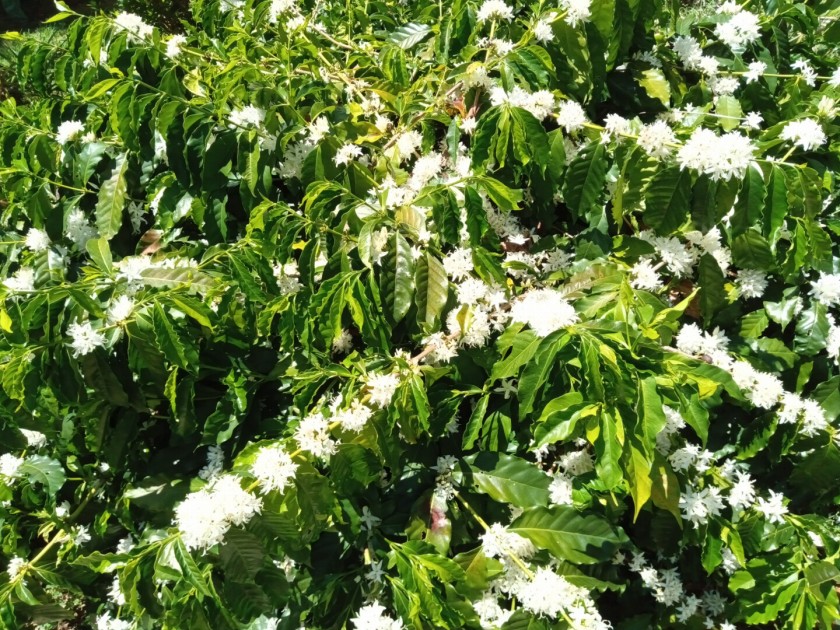
The photo does not depict the intoxicatingly sweet fragrance from these flowers, just divine! This particular plant is a prostrate form and the flowers are layered on long branches, very attractive.
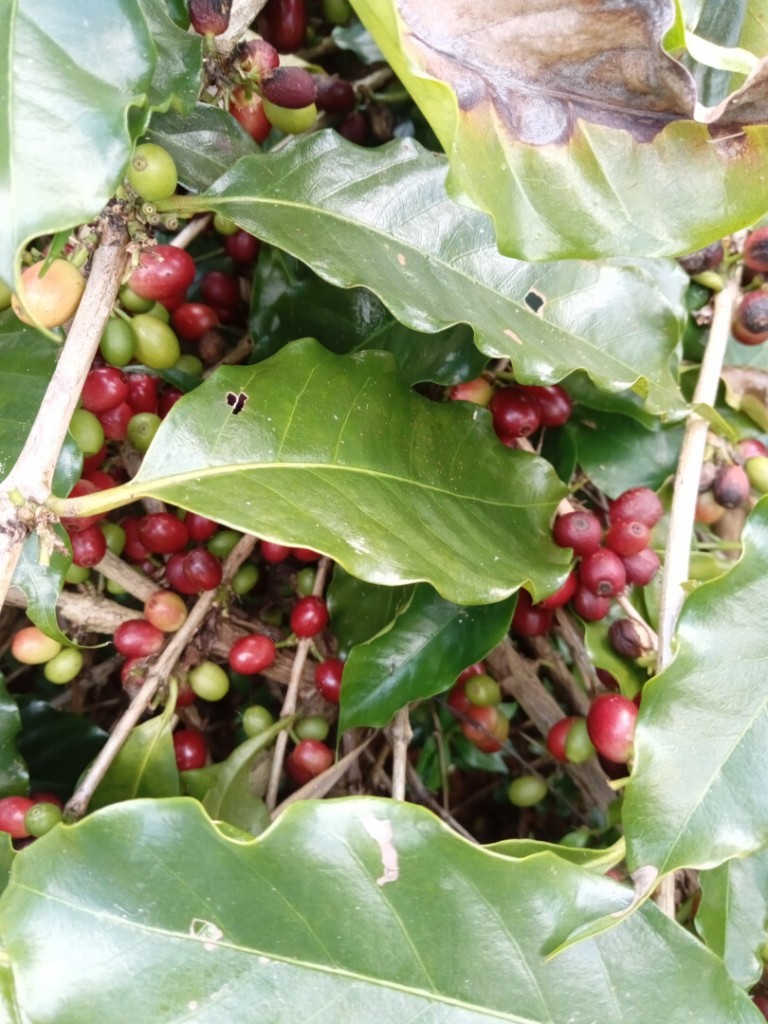
Here is the same plant about nine months later, with the berries finally ripe. Our property is located in highland tropics and the cooler climate which slows ripening of the fruit is supposed to produce a more complex flavour profile. I enjoy eating some of the red berries, the scant pulp has an appreciable sweetness, somewhat caramel-like, and the red skins which are loaded with antioxidants taste a bit like raw green beans, not unpleasant at all.
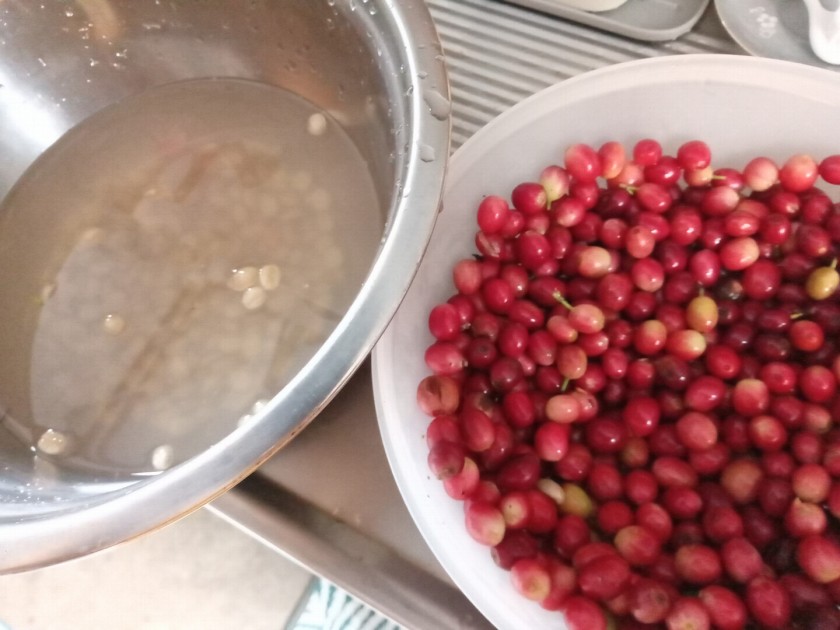
It took about 15 minutes to pick this bowl of berries, not too onerous as one just strips the branch from top to bottom. Squeezing the berries to pop out the beans, usually 2 per berry, sometimes 3, takes a bit more time and I found it best to do it underwater otherwise the beans have a tendency to fly everywhere. Then you have to soak the beans for 24-48 hours to ferment off the slimy pulp surrounding them (this is what makes them slippery suckers that shoot in every direction).
I didn’t take a photo of the drying and hulling process, which is the next step. I placed the beans in a mesh bag and sundried them for about a day. You know when it’s dried when the outer parchment-like husk starts to crack a bit along the middle of the bean. Removing this rather hard covering is the most time-consuming and tricky part of the operation. I looked online for advice and it seems like putting the beans in a food processor that has plastic blades (some models have plastic blades for stirring function, I happen to have this) which won’t pulverise the beans is the best solution if you don’t want to try to remove the parchment layer by hand. There will always be some beans to be hand hulled, usually they rub off in 2 halves. The plastic blades agitate the beans enough to slough off the dried parchment hull on most of the beans, but you have to do this in small batches. Then you still have to somehow separate the beans from the removed hulls and the best method is winnowing, tossing the beans and hulls up and down on a tray in a current of air (on a windy day) and the air blows the hulls away whilst the heavier beans drop back down into the tray.
Finally, you will have achieved getting green coffee beans that are ready for roasting. You can do this on the stovetop, constantly shaking and stirring the pot, or in an oven, also turning the beans, but I found the easiest way is to use my hand-crank popcorn maker which is basically a pot with a metal wire stirrer on the bottom that you can keep turning whilst on the burner (this is an essential device if popcorn is your thing, and a very useful one in any case because you can toast all manner of nuts and seeds–and now coffee beans!) This took about 8 minutes of cranking (and heating) but so worth it as the smell of roasting coffee is as heavenly as the smell of the flowers from whence they originated. I was really quite chuffed when I got to this stage just for that irresistible aroma which was actually emanating from my own beans!
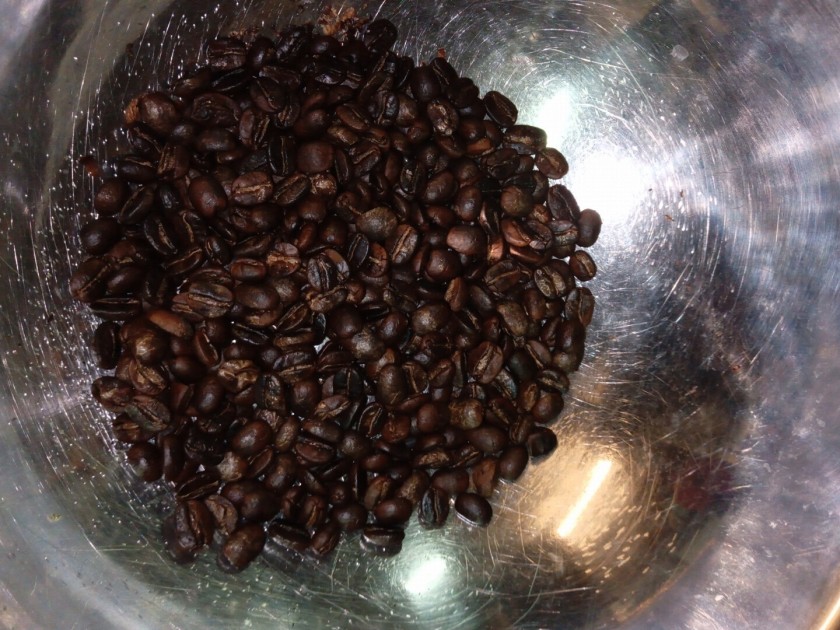
Viola! As you can see, I think I roasted them to an espresso strength. At long last, you have in your hand the pitifully meager result of all the work I have tried to describe in painstaking detail. In total, I think I processed in my first batch enough coffee for one person drinking one cup for about a week or less. But that’s not the point, which was really to experience all the labour involved if one had to do this by hand so we can appreciate all the more how mechanisation (and exploited labour) are the reason why we have so much for not much effort on our part other than probably the final grinding and boiling water. It highlighted for me the impossibility of being able to self produce (even if one lived in the right climate) even a fraction of the foodstuffs we take for granted daily if we were to use our own labour. In this example, I still had to use some modern devices, and certainly fossil fuels made possible the final brewing, which is the whole point of the whole endeavour. Very sobering indeed, rather than stimulating as from caffeine.
Well, it looks like it still takes Gaia 1000s of words to describe anything even when accompanied by pictures! I hope you all enjoyed this first pictorial installment of Gaia’s garden and kitchen. For all you coffee lovers out there, enjoy what you have whilst you can! This documentary has probably prompted Rob to invest in even more quantity of coffee, not a bad idea really. No doubt it will be a trading commodity in our near future.
Namaste everyone.
 un-Denial
I find it very troubling that our top sane experts see poor judgement and/or insanity in our leaders, have no idea why our leaders are behaving as they are, and are worried because they don’t understand what is going on.
It’s like a covid replay. Instead of insisting everyone transfect themselves with an untested mRNA gene therapy for no good reason, and blocking safe and effective responses to covid for no good reason, they are now escalating towards nuclear war for no good reason.
LikeLike
LikeLike
The Story of B | Do the Math
Tom Murphy’s fetish with Daniel Quinn continues. It’s a long one. I started typing up a witty reply using the Ishmael writing format involving the gorilla, Tom and Daniel Quinn. LOL, it was kind of hacky and too long, so I deleted it.
I guess all I want to say after reading Tom’s essay is this –
Quinn always went with three million years for how long humans have been roaming this planet living as harmlessly as a hyena or a shark or a rattlesnake. If you were to ask him; Could taker culture (agriculture) have started anytime in those three million years, from a human capability standpoint, but the only reason it didn’t was because the Holocene period hadn’t made it possible yet?
Quinn would’ve answered yes to that 😊… Being blind to fire and full consciousness will cause massive plot holes in your story.
LikeLiked by 2 people
We also don’t really know anything about how people lived further back than 100,000 years ago, because there have glacial maximums prior to that. If there was farming then the evidence would be gone.
LikeLiked by 1 person
Oh those damn glacial maximums. I hate that we can’t be 100% certain about anything from way back when… It blocks me from claiming what I think is so obvious – that there is no evidence of anything man-made until only recently because humans were not capable of this type of complexity until only recently.
And it also gives an opening to that annoying story about everything repeating itself. That there have been multiple agricultural & industrial revolutions (pure bullshit btw).
Monk, you love to remind me that I can’t be so cocky about this stuff.😊 You made me finally pop my cherry with AI. My very first question (Google AI Mode) – What human evidence can survive through glacial maximums?
So then I started trying to get the answer I wanted to hear, but this damn AI isn’t falling for it.
LikeLiked by 1 person
I have been crossing checking AI against Wikipedia and it has been getting a lot of stuff wrong. I am currently working on an overview of deep time that I think will be helpful. I have always loved the image below to inspire me of how much we don’t really know about the past. Some people look at modern day hunter/gathers and infer things from them about people in the past. But modern day people are modern day people, even if they live completely traditionally in the amazon or what have you.
https://www.flickr.com/photos/107849035@N05/13671164105/
LikeLiked by 1 person
Very cool pic! Sitting here staring at it for 15 minutes.
LikeLiked by 2 people
Hideaway, you might enjoy this episode on how China has successfully competed to become the dominant manufacturer of complex products in the world, and why Trump’s tariffs will probably fail to unseat this dominance.
P.S. I haven’t finished it yet but no mention of the role China’s cheap abundant coal played.
LikeLike
Good piece by George Tsakraklides on population although he offers no suggestions on how our numbers may be ethically reduced.
Why None of These People Will Ever Talk to You About Overpopulation – https://open.substack.com/pub/georgetsakraklides/p/why-none-of-these-people-will-ever?utm_source=share&utm_medium=android&r=yn9sg
*We can change our behaviour with a significant degree of failure, but what would have a real, tangible impact is managing our population size: Population management doesn’t just modify behaviour. It erases it. If we recognise the value in managing the population of camels in Australia, wild boar in Europe and the red-vented bulbul in Hawaii, then why can’t we do the same for the number one most invasive species on the planet?
We can stop eating meat, stop flying and take many other steps. It still won’t stop ecological devastation, pollution and many other elements of overshoot which are the results of our population volume and dependence on toxic materials. A civilisation that throws out 13 million smartphones a day cannot be described as a civilisation. It is a spreading infection on its way to becoming consumed by its own waste.
We need to have far fewer smartphones, because we will never be able to manufacture them sustainably. We need to use less energy, because the energy transition and renewables revolution have miserably failed. And for these things to happen we need to have fewer humans, because it is the only path which guarantees the reduction of our impact on the planet.”
LikeLiked by 2 people
Good essay. Found this in the comments:
This is exactly why I’m tough on Daniel Quinn. He seems to be the one most responsible for this kind of simplistic, delusional thinking. It’d be like me trying to figure out why everything started exploding upwards in the mid 20th century with the Great Acceleration… and then concluding that it was because of a few key decisions that were made in the 1930’s and 40’s.
Ridiculous right. Always have to go back further in order to get the more accurate story. You all know I’m down with the KISS principle (keep it simple stupid), but Quinn took it way too far.
I’ve been trying for a couple months to tie in the Great Acceleration with the Human Acceleration because I think it makes total sense and will get people to see it easier… but I’ve been struggling like hell with how to come at it. Some of my attempts have even made humans start looking like a Frankenstein experiment.😊
LikeLiked by 2 people
Something that doesn’t fit very well into the “it all started with agriculture/civilization” arguments is the fact that civilizations started independently over time in multiple locations. So not just the Nile/Indus/Mesopotamian/Chinese civilizations that everyone’s familiar with, but dozens more that came later and weren’t necessarily a direct offshoot (think Incans, Mayans, etc). On top of that, after these civilizations started and collapsed, new ones inevitably followed. You need to ask yourself why civilizations would “restart” after a collapse and reversion to hunter-gatherer/nomadic lifestyles. The answer is probably that the environment was already being degraded gradually around the world prior to civilizations starting, and was left highly degraded after the civilizations collapsed, making hunter-gatherer lifestyles impossible. Even if you had only hunter gatherers, you’re going to have an environmental impact. Agriculture was probably a last resort for a lot of communities after the wild plants and animals had been scavenged to the point of no longer being able to sustain people. In other words, just think of how much introducing invasive species harms local environments today. Now imagine humans being that invasive species.
LikeLiked by 3 people
“A key advantage of renewable energy is that it can power the energy needs of mining operations in remote areas, where the cost of building the infrastructure required to hook the mine up to the grid network or building a conventional power station would be significant. . . .
Similarly, BHP has recently agreed a five-year PPA with CleanCo (the Queensland government-owned renewable energy developer) under which it intends to purchase up to half of the power required for its Queensland coal mining operations from CleanCo’s wind and solar generators over the term of the PPA²⁵.” ?
https://www.wfw.com/articles/mining-renewable-energy-a-greener-way-forward/#:~:text=%22A%20key%20advantage%20of%20renewable,power%20station%20would%20be%20significant.%22
LikeLike
Good one today by Indi on the insanity of the US’s China policies.
It will be very interesting to see which does better in the collapse. The US because of its reserve currency, military, food self-sufficiency, and oil resources, or China because they make everything everyone needs with citizens that still remember hardship.
https://indi.ca/america-is-attacking-its-own-supply-lines/
LikeLiked by 3 people
LOL!
LikeLiked by 2 people
Yikes!!!
https://www.zerohedge.com/political/im-very-disappointed-elon-trump-responds-musk-opposition-big-beautiful-bill
LikeLike
When a person with an honors masters degree in electrical engineering has to turn to Alex Jones for news he can trust you know the world is fucked.
https://x.com/RealAlexJones/status/1930715762911567888
LikeLiked by 3 people
I never heard of this crazy hole before. It made me think of the early days of discovering fire where tribes would have to keep their fire going year-round because once it’s out, they don’t know how to restart it.😊
Turkmenistan reduces 50-year fire dubbed ‘Gateway to Hell’
This reply made me laugh – How much vodka you think was involved in that decision?
LikeLiked by 3 people
A blockbuster documentary The Agenda on the factors leading to technocratic control of people by AI assisted elites. Jacob Nordangard’s work show up largely here. Just came out this month.
It makes climate crisis out to be a fraud, artfully portrayed as life threatening to all humans on the planet. Just because climate destabilization/ecocide has been adopted as cause celebre/trigger event of the globalism/OWG movement set in motion decades ago, does not mean that climate is not an issue. It IS THE DEFINING ISSUE OF ALL TIME. We don’t have to rely on computer modeling to predict likely futures; we have physical data now that tells us or shows us that life on earth is under extinction pressures. Geoengineering is also a likely ill-conceived response by the power-elite to that giga-crisis. All said, ecology and physical laws governing energy will force an overshoot of the carrying capacity of this jewel of a planet. There is a survival bottleneck facing all life forms that is now clearly visible. I am utterly despondent and inconsolable that Humanity has failed, both the leadership and the masses.
LikeLiked by 2 people
I skimmed this and it seems to be a documentary produced by a dot connector that is unaware of (or in denial of) the most important dots: overshoot, resource depletion, and the imminent collapse of complexity and the economy.
A giveaway is anyone that criticizes the WEF’s plan for us to eat bugs, and in the same breath not acknowledging that 5 billion starving people without access to protein might be grateful for bugs.
Or criticizing a digital currency without in the same breath acknowledging we are going to need some mechanism to ration consumption and implement negative interest rates.
Or someone that worries about 5G radiation and does not mention sugar or transfecting 5 billion people with a novel untested mRNA technology.
Happy to revise this if I missed segments with awareness.
LikeLiked by 3 people
I tried it. Made it about 45 minutes. I don’t buy into the Great Reset… you’ll own nothing and be happy, implanted chips, and every point of sale being monitored and tracked.
Prior to becoming overshoot aware I was into this stuff. But I started noticing something. Seemed like everyone… my neighbors, the cashier at the grocery store, grandma & grandpa, they all knew about Klaus Schwab’s evil masterplan. That was enough of a red flag to make me get out. I’ve always gone with the golden rule – if the masses know about it, then that’s exactly what “they” want.
But I’m glad you posted it… for two reasons. First, because it takes some balls to try and please this snobbish crowd😊. Second, because after I gave up on it, I was still in the mood to be stimulated with this type of content. I came across Adam Curtis’s 2016 film HyperNormalisation. If you’re in the mood for dot connecting like The Agenda documentary… I think Adam’s is definitely the better one to go with. (although I’m not done watching it yet… and yes, its pre covid so might be a little dated)
LikeLiked by 1 person
I like Adam Curtis too. I have all 30 of his documentaries in case anyone is looking for something.
LikeLiked by 1 person
What happens when AI eventually runs into energy limits?
LikeLiked by 1 person
Just watched the latest peak oil chat, especially liked the early report from Roger and J Laherrere and the last one from Dan Gowin. Basically scary stuff. Do we have 5 years?
The Simon Michaux stuff basically says Hawaii is stuffed in my book for any type of modernity. It all relies upon materials coming into the state to build everything for any chance of a modernity sustainable future, so the rest of the world will have to operate in ‘normal’ mode (growth in population, energy and materials) to provide all the ongoing inputs to Hawaii..
https://youtu.be/cQ2jQwP0Sh0?t=14
Will have a more in depth look at the 1419 pages of Simon’s report, but might take a couple of minutes….
LikeLiked by 1 person
I’m still leaning to Lar Larsen’s 2027 for serious problems to begin because he’s the only guy that’s tried to integrate the combined effects of falling supply, EROI, and the export land model.
However as I predicted many years ago, our problems will be blamed on another tribe provoking a war, and peak oil will never be acknowledge as the cause of collapse.
Looking forward to your analysis of Simon’s report. 🙂
LikeLiked by 3 people
If Hideaway’s analysis is long enough, can it be a guest post?
LikeLiked by 2 people
You bet. We’re fortunate to have Hideaway as a contributor here. It’s rare to find important new ideas in the overshoot space.
LikeLiked by 1 person
If you see any signs of me losing my mind like Nate Hagens and other aware people as the consequences of extreme overshoot approach please let me know and I’ll shut this site down.
LikeLiked by 1 person
LOL.
I actually thought you might be heading down that road back when you posted the RFK piece. Not because of RFK, but I sensed too much hopium with Elon and Trump.
I don’t sense it at all anymore, but I’ll keep an eye on you. Not worried about Trump whatsoever, but an Elon relapse is not out of the question.😊
LikeLiked by 1 person
Can we refresh the comments pages? It’s a long time scrolling to the bottom! I remember the days when they’d be fewer than 30 comments🙂.
LikeLiked by 1 person
Rob (or WordPress) changed the settings so that all comments are now on one page. I like it better this way. But yes, it takes a while for the page to load on my computer. Need a new featured essay so we can start over with the comments.
LikeLike
Perran motivated me to write a short essay. It’ll be up shortly.
LikeLiked by 1 person