Thank you to Gaia for contributing this essay on her experience with growing coffee in Australia, and my apologies for the delay in posting. I have been procrastinating everything in my life of late, I’m sorry.
When I think about end of growth implications, and the coming scarcity of things we now take for granted, coffee is at the top of my list of things I will miss. My favorite moment of every day is the first sip of the triple espresso Americano I make every morning.
Preptip:
We cannot grow coffee here in Canada and someday I will probably have to make do without. As a hedge against inflation, and as a buffer for the early days when supply will likely be intermittent or unaffordable, I stock a fair amount of coffee.
I have learned that unopened roasted beans taste fine well past their best-by date. I have not yet done enough tests to know how much past the best-by date is ok, but I currently assume at least 2 years.
I consume 50 g per day which is 1 Kg every 20 days. When scarcity arrives, I will reduce my consumption in half to double the duration, and then halve it again if necessary. I stock about 20 Kg of roasted beans, plus 10 Kg of canned ground coffee which has a longer shelf-life, plus 6 Kg of instant coffee which has an infinite shelf-life.
When my preferred source of caffeine is no longer available, I will switch to black tea, which I also stock in large quantities because it has an excellent shelf-life, and is still very inexpensive.
One of my projects this year at the farm I assist is to construct a shipping container size dehydrator which we plan to use initially for making tea from black current leaves. Apparently it’s a tasty healthy tea, but alas has no caffeine.
As the end of growth approaches we know there will be price inflation for necessities. The price of all food has increased a lot in Canada over the last few years, but coffee stands out as one of the worst. I buy the cheapest espresso beans available in my community and the price has almost doubled over the last 4 years from $14/Kg in 2021 to $22/Kg today.
Why are coffee prices increasing?
Grok: Coffee prices are increasing due to a combination of environmental, economic, and geopolitical factors affecting global supply and demand. Severe weather events, particularly in major coffee-producing countries like Brazil and Vietnam, have significantly reduced crop yields. Brazil, the world’s largest coffee producer, has faced droughts, frosts, and excessive rains, leading to lower arabica bean production. Similarly, Vietnam, a key supplier of robusta beans, has experienced droughts followed by flooding, cutting output. These disruptions have tightened global coffee supplies, with some estimates suggesting deficits for multiple consecutive years.
Rising global demand is also a factor, as coffee consumption grows in markets like China and India, alongside steady demand in traditional markets like the U.S. and Europe. This imbalance between shrinking supply and growing demand has driven wholesale prices up, with arabica beans surpassing $4 per pound in early 2025, a level not seen in decades.
I’m sure printing trillions of dollars to force a little more growth from lethargic energy supplies, while using an engineered virus as an excuse, probably also has something to do with the price increases.
Also, after reading Gaia’s essay, it’s clear there is a lot of human and fossil energy required to produce coffee, which no doubt has also contributed to the price increase.
Now over to Gaia…
Some days I am just so disheartened by what is happening on our planet on all fronts, but yet we must bear it and bear witness to the fullness of what we as a species have wrought. That is taking more courage than I ever believed I could have, but yet I must try and it certainly is a comfort to have friends on your site who are sharing similarly. I am finding great joy in communing with nature, especially through tending food plants and feeling so much gratitude for their sustenance for body and spirit. I have been wanting to share snapshots in picture and words of my experience on the land to add to the collective wonder and appreciation of so many others’ homesteading stories and images, including your fulfilling season at the farm. I think I can manage in bite-sized snippets, and if a picture can tell a thousand words, then I should be out of business sooner or later!
I think you Rob are the number one coffee addict that I know and definitely the most prepared for when the SHTF. I think you could open SHTF Cafe at the End of the World, it only needs one table and chair just for you! In honour of your habit, these are the very first photos I will share relating to our property and lifestyle. You may refer back to the post where I described in some detail (and you thought it was TMI until I clarified a very critical point!) how I successfully processed coffee from bush to bean–for possibly the first and last time as it took quite a bit of effort for not very many cups of the finished drink, which I don’t even imbibe! I do drink decaf but there is no feasible home method for that, unfortunately. I cannot say how my single estate grown coffee tastes, but it did smell as heavenly as anything when I was roasting the beans, so at least that is something.
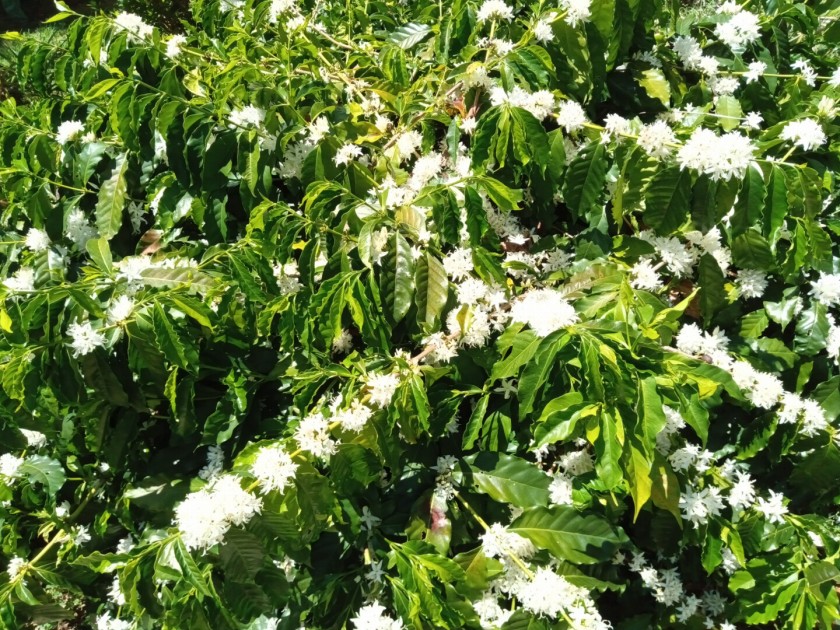
The photo does not depict the intoxicatingly sweet fragrance from these flowers, just divine! This particular plant is a prostrate form and the flowers are layered on long branches, very attractive.
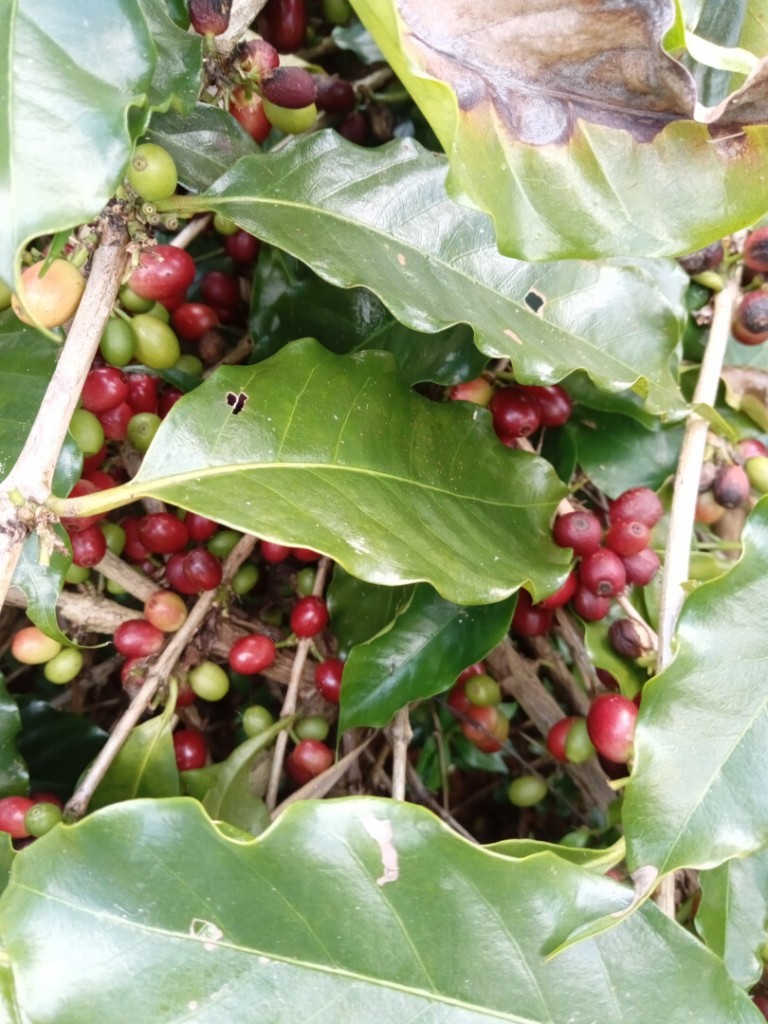
Here is the same plant about nine months later, with the berries finally ripe. Our property is located in highland tropics and the cooler climate which slows ripening of the fruit is supposed to produce a more complex flavour profile. I enjoy eating some of the red berries, the scant pulp has an appreciable sweetness, somewhat caramel-like, and the red skins which are loaded with antioxidants taste a bit like raw green beans, not unpleasant at all.
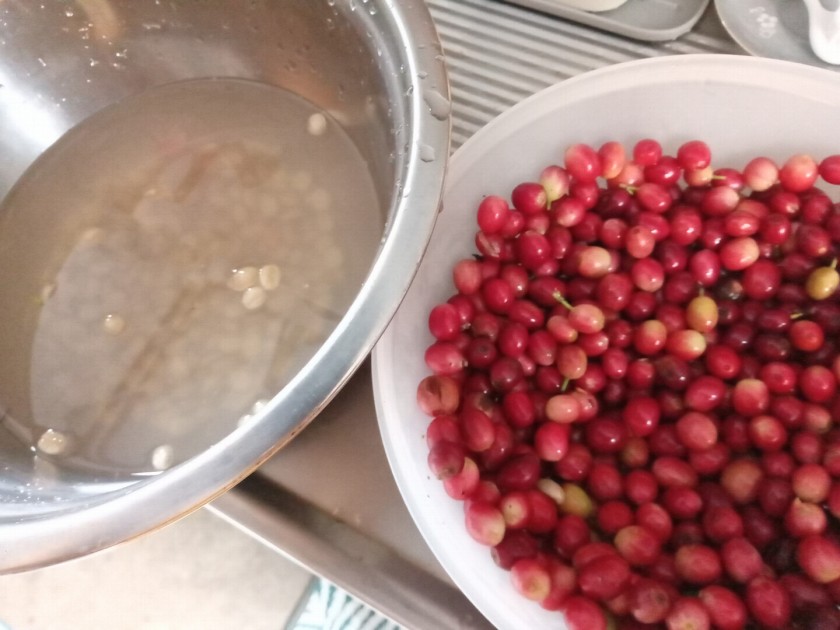
It took about 15 minutes to pick this bowl of berries, not too onerous as one just strips the branch from top to bottom. Squeezing the berries to pop out the beans, usually 2 per berry, sometimes 3, takes a bit more time and I found it best to do it underwater otherwise the beans have a tendency to fly everywhere. Then you have to soak the beans for 24-48 hours to ferment off the slimy pulp surrounding them (this is what makes them slippery suckers that shoot in every direction).
I didn’t take a photo of the drying and hulling process, which is the next step. I placed the beans in a mesh bag and sundried them for about a day. You know when it’s dried when the outer parchment-like husk starts to crack a bit along the middle of the bean. Removing this rather hard covering is the most time-consuming and tricky part of the operation. I looked online for advice and it seems like putting the beans in a food processor that has plastic blades (some models have plastic blades for stirring function, I happen to have this) which won’t pulverise the beans is the best solution if you don’t want to try to remove the parchment layer by hand. There will always be some beans to be hand hulled, usually they rub off in 2 halves. The plastic blades agitate the beans enough to slough off the dried parchment hull on most of the beans, but you have to do this in small batches. Then you still have to somehow separate the beans from the removed hulls and the best method is winnowing, tossing the beans and hulls up and down on a tray in a current of air (on a windy day) and the air blows the hulls away whilst the heavier beans drop back down into the tray.
Finally, you will have achieved getting green coffee beans that are ready for roasting. You can do this on the stovetop, constantly shaking and stirring the pot, or in an oven, also turning the beans, but I found the easiest way is to use my hand-crank popcorn maker which is basically a pot with a metal wire stirrer on the bottom that you can keep turning whilst on the burner (this is an essential device if popcorn is your thing, and a very useful one in any case because you can toast all manner of nuts and seeds–and now coffee beans!) This took about 8 minutes of cranking (and heating) but so worth it as the smell of roasting coffee is as heavenly as the smell of the flowers from whence they originated. I was really quite chuffed when I got to this stage just for that irresistible aroma which was actually emanating from my own beans!
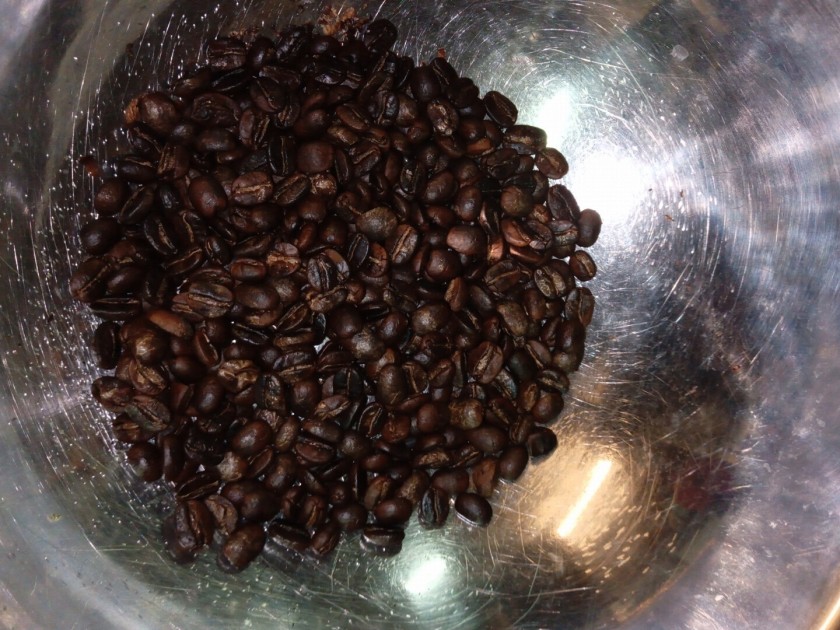
Viola! As you can see, I think I roasted them to an espresso strength. At long last, you have in your hand the pitifully meager result of all the work I have tried to describe in painstaking detail. In total, I think I processed in my first batch enough coffee for one person drinking one cup for about a week or less. But that’s not the point, which was really to experience all the labour involved if one had to do this by hand so we can appreciate all the more how mechanisation (and exploited labour) are the reason why we have so much for not much effort on our part other than probably the final grinding and boiling water. It highlighted for me the impossibility of being able to self produce (even if one lived in the right climate) even a fraction of the foodstuffs we take for granted daily if we were to use our own labour. In this example, I still had to use some modern devices, and certainly fossil fuels made possible the final brewing, which is the whole point of the whole endeavour. Very sobering indeed, rather than stimulating as from caffeine.
Well, it looks like it still takes Gaia 1000s of words to describe anything even when accompanied by pictures! I hope you all enjoyed this first pictorial installment of Gaia’s garden and kitchen. For all you coffee lovers out there, enjoy what you have whilst you can! This documentary has probably prompted Rob to invest in even more quantity of coffee, not a bad idea really. No doubt it will be a trading commodity in our near future.
Namaste everyone.
 un-Denial
Thank you to the anonymous donor at Panopticon’s Climate and Economy.
It was very kind of you to promote un-Denial.
For those who do not know, I have a history with Panopticon. I used to hang out with him and the late Gail Zawacki in a private group on Facebook. Together they encouraged me to start un-Denial which I probably would not have done without their motivation.
I started un-Denial with a pseudonym but they pressured me to stand up and use my real name.
Later, when Panopticon started his own blog, he used a pseudonym because he didn’t want to damage relationships with his neighbors.
Good thing I’m a loner. 🙂
LikeLiked by 2 people
In front of my home is a reef that is exposed at low tide. A few days ago we had an exceptionally low tide so I decided to walk out to the end of the reef to see how the marine life is doing.
I don’t go out to the reef very often anymore because I find it too depressing. As a child in the 60’s and 70’s I visited the reef many times and vividly remember the abundant diverse life including kelp beds, seaweed, seagrass, oysters, crabs, geoducks, clams, mussels, barnacles, starfish, snails, sand dollars, shrimp, bullheads, flatfish, etc. etc.
Now it is essentially a desert.
At the very end of the reef there is still a bit of life clinging on, but the diversity is very low.
Here is a view of my home from the reef:
Children growing up today will think this is normal.
I can assure you it is not normal.
LikeLiked by 2 people
Do you know the reason why life in this place has receded? There doesn’t seem to be much human activity, directly on the site…
LikeLike
Not sure, there are many candidates.
The most important factor probably was the loss of the kelp beds which was a keystone species that many other species depended on.
Why did the most of the kelp beds on the east coast of Vancouver Island disappear? Last I checked the experts weren’t sure but suspect something big like a change in ocean pH or temperature.
Whatever the cause it also took out most of the seagrasses and other seaweeds.
Other forces in play:
I participated in migratory seabird counts for a few years. They are way down too. I quit because it was too depressing looking at the historic numbers.
LikeLiked by 1 person
Thank you. Complex.
LikeLike
Why did kelp beds decline on the east coast of Vancouver Island?
LikeLike
I am currently experimenting with Honey Mesquite( Prosopis Glandulosa) which has overwintered in my garden. The beans have a high sugar content and a flavor somewhere between caramel, brown sugar, and molasses. Ground, they make a fairly good hot beverage. For caffeine, I am going to order Yaupon(Ilex Vomitoria), which is more similar to Yerba Mate, and so, more of a tea.
I have also stocked and frozen whole bean coffee, but someday, it will be gone.
LikeLiked by 1 person
Thanks for the idea. It looks like my region is too cool to grow Yaupon.
LikeLike
Hello Rob,
What a wake up call to see me headlined, very unexpected and somewhat unnerving! The jolt was better than from caffeine! Joking aside, thank you for sharing my one and only coffee experiment last year, hope it was informative as well as entertaining. As a follow-up conclusion to that energy intensive exercise, I found out that I had over-roasted the beans (not having any experience on how to process small batches) so the end result had a rather more burnt flavour profile than desired. Sigh, after all that work, you can just still ruin it by not knowing when enough is enough and it’s time to stop. Kinda like what we’re doing with everything on the planet.
It’s a very sobering account you shared pictorially of the once vibrant ecohaven now so degraded. There really are no words, just silent witnessing. Every where we turn and look, we are the attendees at the biosphere’s wake.
As for plants that can be grown for their caffeine content, I think in your hardiness zone the most likely successful candidate would be Camellia sinensis (here I give the scientific name so we’re all on the same page), the source of what we know as tea, be it black or green. It’s a lovely evergreen shrub with delightful dainty white flowers with a shock of yellow stamens. The shrub responds very well to heavy pruning to maximise the new tender leaf shoots that are prized for white tea. Look how mercenary my description is–proving the point I just tried to make with Charles. Everything we Homo sapiens look at is through the lens of “what’s in it for us?” Is there no other way?
I am a bit nervous about any plant with the codifier Vomitoria. Doesn’t sound like it would make it into the top 10 baby girl’s names, does it? I guess this is a good reason why to scientifically label things, it tells us something that could possibly prevent a good deal of discomfort, if not worse. In this case, I think the problem is result of consuming too many of the berries (it is a holly family), not so much making a tea from the roasted leaves.
It sounds like you have enough coffee beans to at least see you rather comfortably through a long caffeine withdrawal period, so if it does come to that, you probably won’t miss the physiological effects of your favourite drink. Many ground up nuts, seeds, roots, have been used as a blackish, brownish, herbally, nutty, earthy-tasting hot beverage that can be considered a coffee “substitute” if it’s the routine you think you’ll be missing as well. But if it’s truly full-on collapse, who knows what our routine will be other than dawn to dusk scratching to grow food, so just enjoy all the coffee you want now and we’ll all be happy knowing you do!
Namaste.
LikeLike
Very sad to see Rob. A few years ago Nikki took the kids to a beach with a group of other homeschoolers. She set up a few metre x metre transects and asked the kids to identify things that shouldn’t be there. Most of the kids just stared blankly at the square. She said “what about the old plastic peg, the cigarette butts, the length of nylon, the…..” The kids didn’t even see that stuff as abnormal. It’s all they’d ever known.
On the topic of keystone species you might appreciate this documentary about the group of ecologists who discovered / developed the concept.
Regards 🙏
LikeLiked by 2 people
Thanks. I don’t talk or think about it very often. I find it very troubling. All of my best childhood experiences were at this beach and my memories of the marine life are detailed and vivid.
I went on my annual garbage pickup walk a couple days ago and cleaned up everything I could find in the nearby trails.
LikeLiked by 1 person
It seems we all have some kind of cross to carry 🙂
This reality is simultaneously cruel and beautiful. I know now the flow of life will continue, only all that we have known wiped out and something else arisen. It’s delicately hurtful or lovingly painful. Intoxicating.
LikeLiked by 2 people
Instead of a Youtube video, I get the following error message:
LikeLike
Me too Stellar. Those damn New Zealanders are plotting against america already.
LikeLike
Works fine in Canada.
LikeLike
Not working in the U.S. The embed shows
I had to drag the mouse over the preceding and following words, then right-mouse and view-selection-source to get the title ; The Serengeti Rules (2019) | Full Documentary.
Search results within YouTube did not include the video.
For those that are curious, looks like the gist of the video (based on content of similar videos) is the realization that herbivores can also be a keystone species. When wolves were reintroduced (or maybe allowed to flourish) in Yellowstone, it was discovered that this allows willow trees near water to grow because grazing animals have to keep moving, this brought back beavers, then large riparian areas, then insects, then birds. In the Serengeti, wildebeest grazing allowed trees to return, which helped elephants, giraffes, and so on.
LikeLike
Here is the documentary’s home site:
https://www.bbc.co.uk/programmes/m000b8p4
I looked for another unblocked online version without success however it’s available to download as a torrent here:
https://thepiratebay10.xyz/torrent/35004757/BBC_Unlocking_Natures_Secrets_The_Serengeti_Rules_720p_x264_AAC
I can confirm this is a good quality rip however as is normal for MVGroup rips they waste disk space with an excessive bitrate so I transcoded to CQ25 to reduce the size by 50% with very little loss of quality.
I watched it in 2019 and rated it 7 out of 10 but remember nothing about it.
LikeLike
I am generally a bit hesitant to pirate things, but then again Meta pirated millions of books, so it could train its AI models on them.
https://arstechnica.com/tech-policy/2025/02/meta-defends-its-vast-book-torrenting-were-just-a-leech-no-proof-of-seeding/
LikeLike
In this case it’s a PBS documentary produced with your tax dollars so I personally wouldn’t feel any guilt.
LikeLike
Great job Gaia! And very cool pics. Love the way you emphasize the time and labor required just to produce a few cups of coffee.
I’m addicted to coffee. But only K-cups. Takes me approximately two minutes from when I wake up till I’m sipping it. And this Empire Baby even bitches about that. (c’mon! there’s gotta be a way to shave those two minutes down… what is this? Some primitive native american new world?… Hell no, I’m George Jetson, and all I should have to do is push a button and get instant gratification. In fact, I shouldn’t even have to go through the painstaking labor of pushing a button)
Ugh, fu#king technology. That Steel Mass Production Factory video from yesterday sent me down a mini rabbit hole where I ended up watching Koyaanisqatsi (1982). Saw the trilogy back in my Dowd days but completely forgot about it. I actually think every person in this audience would appreciate this film.
Best to not do any research and just start watching. You’ll be hooked within five minutes. Free on Tubi, but I think I saw a link on youtube also. And if you don’t trust my recommendation skills, watch this brief description from the creator and I bet he’ll pique your interest.
LikeLiked by 1 person
I think Sarah Connor wrote this one with help from her heart and not an AI.
The interesting thing she missed is there are roughly an equal number of people from the other political camp that feel as strongly about the leaders that were just voted out.
Both camps are certain their view of the world is good and correct, and the other is evil and wrong.
My reading of history says this a bad omen.
https://www.collapse2050.com/totally-insane/
LikeLiked by 2 people
I don’t understand her post at all.
Is she reacting to the tariffs? If so, aren’t tariffs a pretty sane decision, given the scale of overshoot? I recognize it’s difficult (impossible maybe) to deescalate the global system, without crashing it completely. I am grateful for the absence of nuclear exchanges or other triggers of mass-dieoffs. I am grateful to be alive, free and nourished. What the heck, I am still able to write these words and I know how much of a luxury that is.
I don’t understand her post at all.
LikeLike
A lot of people are REALLY upset about Trump.
It’s possible that’s at the core of the covid family problems I mentioned earlier because I said something inappropriate in anger that could have been interpreted as support for Trump. I don’t know.
LikeLiked by 1 person
I think I may have an interpretation (maybe invalid), at least bits of the puzzle. I’ll try to express it clearly:
Basically, Trump is the externalization of this conflict. It shows them who they (partly truly) are. Their hidden obscurity. Because, in a way, Trump doesn’t care being a “bad” person. He is the personification of business.
To blame it all on Trump, is the easy posture. But it won’t work, and I think it’s the last outburst of rage, before acceptance of the dark side. Before independence. Once light and obscurity are reunited, a new cycle starts.
Maybe, that’s why, I had the intuition that “material collapse will happen in synchronicity of a mass regulatory psychological event”. These as truly apocalyptic, revelatory times about the true nature of many things, the fall of the veil. I really like the fact that Trump is the current incarnation of the trickster (https://en.wikipedia.org/wiki/Trickster). Because he is making the impossible possible, by allowing/forcing many to travel into paths that they forgot/forbid to themselves.
Maybe I have it all wrong, but it’s entertaining to narrate it that way. Ah ah ah.
(note: I am not particularly supporting Trump. He is just doing his thing. Like all of us, aren’t we?)
LikeLiked by 3 people
Here’s another take, by Jem Bendell who asked ChatGBT which wrote this memo:
CONFIDENTIAL MEMO
From: Strategic Futures Group
To: National Policy Council
Subject: Strategic Ambiguity in Collapse-Contingency Policy Implementation
Date: April 1st, 2025
Summary:This memo outlines the rationale for maintaining strict narrative control over the United States’ long-range policy measures that align with systemic collapse-preparedness. The intention is not to deny the biophysical limits or geopolitical volatility threatening global stability, but to emphasize the existential need for public and international secrecy regarding the real purpose behind current U.S. policy directions.
https://jembendell.com/2025/04/11/is-trump-preparing-for-global-collapse-even-if-he-doesnt-realise-it/
The total biomass on planet Earth equates to around 545.8 gigatons. Of this total, plants make up 82.4% and surprisingly, bacteria make up 12.8%. Animals make up just 0.47%. Even more remarkably, humans make up only 0.01% of all biomass on Earth.
LikeLike
Interesting. Thanks for that.
Regarding the biomass… that one species that makes up only 0.01% of the weight… has created more stuff (by weight) than the total 546 gigatons of biomass.
I think I got this link from a comment here.
biocubes: an inventory of biomass and technomass
Biomass on that site is listed at 1100 Gt while the man-made shit is at 1300 Gt. These figures are toward the end of the slideshow.
It’s all pretty damn separate and superior if you ask me. LOL. There is no place in the universe where Full Consciousness fits in with the rest of life.
Harnessing fire seems like an absolute one-off freak accident. But, if given billions of years, will life pretty much always eventually find its way to fire? Or is life on Earth truly unique?
LikeLike
Hello Gaïa gardener,
Thank you for the post with great pictures. I enjoyed it very much.
Do you know which species of Coffea it is?
Since you seemed to enjoy them, here are the emojis, I found for the circumstance: 🫘 and then ☕ (from https://emojipedia.org)
Best.
LikeLike
Hello Charles,
So nice to “share a cuppa” with you and others here. I must say I was quite surprised when I woke up this morning to see that Rob slipped in my contribution just now, it was some months ago that I sent him those images and text and so much as happened since to “wake up” the world to smell the coffee so to speak! I always appreciate your contributions and keep a space in my heart that your affirmative and benevolent attitude for all the unfolding is still the possibility that will see us through with the most peace. I am grateful for and inspired by your faithfulness in upholding your truth and the gentle but steady manner in which you share it.
As for the Coffee species, here I must admit to my rather cavalier tendency to forget and dismiss names of cultivars, not very helpful when it comes time to share information. In trying not to focus on the scientific names of things (and once I was very much into that, having been educated with that mindset of logic and order), I guess it’s my way of wanting to just be with another life form without immediately categorising it and organising it into my world view. I know you would understand me when I say an organism has the right to exist just for what it is, not because we can label it and claim it for our purposes. I recall the Genesis creation myth when God allowed Man to name the animals, and thus began his dominion over them. But humans, having language, that’s what we do, describe what is in our world, and then claim it for ourselves and our purposes by being able to define to others what it is we call our own. In the act of labeling any object, we already perceive differently. If I could go into a forest and just immerse into the essence of it, I would be truly seeing it with original eyes.
That’s another Gaia diversion for you! The label for the plant in question has long disintegrated but I do believe it is an Arabica. The curious thing is the prostrate form that this particular cultivar takes, making it even more ornamental in my view with the layering look of the long branches. All the many seedlings that pop up are an upright bush form. I wish I could just think of every plant for it’s innate beauty but no, I cannot get over the underlying motivation for its utilisation value, and how I am going to maximise it so via pruning and such. If only the trees knew of my intentions to sever their limbs every time I walk past to admire and gauge their growth!
Thank you for the emojis. Our minds are conditioned to respond with a dopamine injection when we recognise and interpret correctly another’s friendly communication, and I think emojis fit that purpose well. I will continue to try using words to do the same whilst we have the ability to connect together here. All the best to you and your family.
Namaste.
LikeLike
Thank you.
Thank you. I have found my North and know where to navigate. A fine line between Scylla and Charybdis (https://en.wikipedia.org/wiki/Between_Scylla_and_Charybdis), the Middle Way (https://en.wikipedia.org/wiki/Middle_Way), in-between acceptance and steering. Towards peace and love, without entirely relinquishing the sword :
A crazy, funny, agitated, little man.
No problem about the name. I asked, because of this map:
Yes, there is a great danger in words. Still, the ability to learn wielding the sword has been bestowed upon us. That’s not by chance. Inter-penetration 🙂
Perceiving one way, does not preclude the other. There is no intrinsic wrong in separation nor non-dual perception. Both are possible.
Do you prefer images or words, then? 😉
To me, we are creatures in-between worlds. A link. And I am not afraid of neither worlds anymore. It’s great to be able to freely navigate and smile everywhere. The game of utter freedom.
Enjoy your property. If you want, show us more photographs anytime. At some point, I am pretty sure, some pupil will show up and learn your way of gardening with mother plants.
Best.
LikeLike
Just wanted to say something more.
I guess you are refering to https://en.wikipedia.org/wiki/Wu_wei?
Then why don’t you just do it? What prevents you from doing it? That’s always available. Not only in forests.
To me, the point is to stop living only through the mental process (and through the narration of the you), by seeing there is no “you”. It’s only a concept. By giving you the answer, I probably have ruined it for you. You will have to find your own way.
It will come, don’t worry. Just do what you have to do. Eyes wide open (https://fr.wikipedia.org/wiki/Adhyatma_yoga#L'%C3%A9rosion_des_d%C3%A9sirs, sorry not translated in english)
Best.
LikeLike
https://realgreenadaptation.blog/2025/02/22/a-chat-with-grok/#comments
The term “REAL” seems to stand for Realistic, Relative, and Accepting Localism—reflecting a pragmatic approach that works within the constraints of modern society (e.g., carbon dependency) rather than rejecting it outright. It’s aimed at individuals and small communities seeking meaning and preparedness in an uncertain future, without promising global solutions.
Saludos
el mar
LikeLike
Interesting site. He’s a very serious prepper with some good tips. He mentioned something I’d forgotten about: an old fashioned wash tub for cleaning clothes.
I haven’t formed any other opinions about him yet.
LikeLike
Of course, no one in my town stocks clothes washing tubs, nor does Amazon. Everyone assumes washing machines will be abundant and reliable forever.
LikeLike
Black Bag is the best movie I’ve seen in a while. It’s a dramatic spy thriller with great writing, great characters, and great acting.
https://www.imdb.com/title/tt30988739
https://www.rottentomatoes.com/m/black_bag
https://en.wikipedia.org/wiki/Black_Bag
LikeLike
you would probably like The Agency then with Fassbender in it.
LikeLike
Thanks for the tip, I put it at the top of the queue.
LikeLike
There is the Maximum Power Principle (https://un-denial.com/2023/09/28/by-preston-howard-the-maximum-power-principle-and-why-it-underscores-the-certainty-of-human-extinction-in-the-near-future/, https://en.wikipedia.org/wiki/Maximum_power_principle)
And there is robustness (https://www.youtube.com/watch?v=YR769MZl9sI) and suboptimality (https://www.anthropocene-curriculum.org/contribution/suboptimalism)
Do these notions contradict or complement?
LikeLiked by 1 person
Charles,
Preston MPP Howard offering a brief reply.
Olivier Hamant’s discussion of the performance trade-off between efficiency and efficacy complements the Maximum Power Principle rather than contradicts it. His examples contrast ‘then’ versus ‘now,’ showing how our successful survival perhaps depends on scaling back performance to increase robustness. He does not discuss energy as the hidden driver behind ‘then’ and ‘now.’
Overlay energy across his efficiency-efficacy trade-off and one sees his ‘then’ examples are from a time of greater energy availability, while his ‘now’ examples are from a time of constricting energy. If energy is abundant, one can be less efficient in collecting resources because there are plenty, in addition to the robustness he also references. As energy becomes limited, today’s more ‘efficient’ methods may become constrained by energy limitations, regardless of robustness.
However, to the extent Harnant embraces the fact that Nature likes diversity (to encourage robustness), I completely agree. As Donald Hoffman shows with Australia’s jewel beetle, Nature often embraces a non-optimal ‘satisficing’ solution. (Example: I don’t have to run faster than the bear to survive. I only have to run faster than you.)
So, do you see Harnant contradicting MPP or complementing MPP?
I’ll close quickly with a thank you to Charles and all the others Rob pulls into our un-denial discussions. I seldom visit without learning (cooperative learning, according to Harnant) something of value. Is un-denial great, or what?
LikeLiked by 1 person
Hi Preston.
Thank you for passing by.
I think there is a bit of truth in both. But at this point, I am just playing, throwing around ideas from persons of authority (scientists). Just to show that nobody knows. It is immensely complex.
MPP/Darwin survival of the fittest (interpreted as survival of the strongest) used to scare the hell out of me. The obligation to compete, to sever my links from the others, to shut down my feelings in order to crush them. Supposedly because, I was told and believed, this is how reality works. That’s now totally insane to me.
I know, I should have known better, as these are all models that are being improperly used outside of their initial domains of application.
My goal is to encourage people to stop building simplistic models of reality in their minds. And then get frightened, lament over, or find excuses for their behavior in them 🙂 (sorry 🙂
I think reality is supposed to be paradise. I made it hell with mental abstractions (maybe this can be generalized to pretty much the whole humanity since a fairly large amount of time). My recipe now is just to let happen what deeply feels right, irrelevant of how crazy it might seem. Total honesty, starting with oneself and complete trust in the outcome (free of expectations).
It certainly works a lot better for me, than any detour into mental models like I used to do. As soon as there is a model, and I plan to get somewhere (instead of just doing what feels right at each moment), it gets nightmarish. I think that’s because I am then trying to play God instead of playing my role.
Sorry for not being able to give you an answer at the level you might enjoy it (biology/thermodynamics). That’s just the answer which works for me.
Let me end with a little thought experiment, just a mental game. From Hamant, among other things, I liked the idea that we used to burn energy to save time (for instance, taking an airplane) and that it will increasingly make more sense instead to take time in order to save energy. As a fun mental experiment, I like to imagine there is a Zeno’s paradox with collapse: every time theoretical collapse nears somewhat, our activity is slowed down by the same factor (could be several things, like energy use reduction, population reduction, substitution…), so that collapse is somehow forever postponed until it becomes irrelevant 🙂
(I am pretty sure it won’t happen like, that, but Zeno’s paradoxes are fun: https://en.wikipedia.org/wiki/Zeno%27s_paradoxes)
LikeLike
Charles, thanks for sharing that video. Watching at the half hour mark where he shows a slide of a mountain, with abundance at the bottom and trees in competition for the plentiful resurces, vs. scarcity at the top and trees in co-operation mode to ensure their own survival, very much reminds me of the past 200 years and how capitalism has been lauded as the best way to organise our lives. Those 2 centuries of abundant fossil fuel energy are clearly coming to an end, and the empires that have been successful in that time (the Anglosphere) are clearly struggling economically, politically and socially right now…whereas those parts of the world where fossil fuel abundance has been less available to people (Asia, Africa, the global south) are currently reimagining a world order based on trade and integration, rather than war (as has been the approach of the Anglosphere, competition taken to its logical extreme)…I’ve been listening to Alex Krainer more recently, and he makes the point that the old world governments are pushing their populations towards revolutions by repeatedly ignoring their populations moves towards the right, whereas the BRICS block is much more about trade, integration and co-operation…seems to me the future belongs to this mode of thinking.
LikeLike
Yes 🙂 I liked that slide too.
And I agree with your analysis. Hopefully, I feel there is a major change ongoing in every aspects of society, even in the West, despite the governments and their multiple old guards (https://en.wikipedia.org/wiki/Old_Guard_(France)).
LikeLike
Interesting times.
If I lived in China and was told I could not buy anything made in the US I don’t think I’d care.
If I lived in the US and was told I could not buy anything made in China I’d be pretty worried.
LikeLike
What’s interesting is how the ‘trade war’ is thought to be such a big thing in the markets, yet from China’s perspective 14.9% of exports go to the USA. The imports from USA make up 2.8% of all imports to China.
If we assume that the current tariffs hold then making an assumption sales of non essentials (I hate that term, but not enough time in this post to explain), make up 33% of those, while the irreplaceable bits make up the other 66%, then the ‘hit’ to the Chinese economy is just 5% of exports.
What percentage do exports make up of the Chinese economy? Answer, 20%. So the hit to the China’s economy is 5% of 20%, or a grand total of 1%.
Assuming there is some type of stimulus package in China because the economy is not doing well, plus China offers more goods to other countries at cheaper prices, China is doing just fine…
So what are the markets and headlines so upset about? Inflation in the USA of many ‘essentials’ that come from China. What does the USA import a lot of from China?
” …..in Sep 2024 alone, United States imported 36 Drill Pipes shipments from China. This marks a year-on-year growth of 140% compared to Sep 2023, and a 6% sequential increase from Aug 2024.
United States imports most of its Drill Pipes from China.”
https://www.volza.com/p/drill-pipes/import/import-in-united-states/coo-china/
Costs of drilling the fracked oil wells just went up as the price of oil is going down; based on perception of a recession.
Donny and his ‘advisors’ have not thought about the effect on the USA of his tariffs, so now he must do something to save face.
LikeLike
I was thinking that pretty much every item in Walmart and appliance and tool stores is made in China.
But drill pipe is much more important.
LikeLike
Met up for dinner tonight with some friends. Some of them gave a 50% tip for their meal. LOL. I tried to whip up some discovery questions about this bizarre behavior. Is it white guilt? Class guilt? The closest answer I could come up with was they do it so that they’ll be liked by the waiter who they’ll probably never see again in their lifetime, LOL.
When I went out of town a couple months ago I saw this tipping frenzy constantly. My friends and I would take turns buying drinks. The four of us were all drinking $6 bottled beer. So each round was $24. They’d always give the bartender/waitress at least $30, but most of the time $35 and sometimes $40. Every single round! When it was my turn, I always gave $24.
All three had a problem with my lack of tipping. They said you get much better service when you tip (always love getting genius advice like that… “Well you see, if you give a big tip, they’ll treat you better than if you give no tip”…. Holy shit, why didn’t I think of that? Thank you captain obvious). And here we were in this dive bar with 14 people total and my clueless friends are actually serious with this ridiculous advice… and getting embarrassed when it was my turn to pay.
Tipping for overpriced drinks is absurd, especially doing it for every round. Back in my clubbing party days, where you kind of had to tip so that the bartender would notice you because it was so damn crowded… even then I still only gave $5 tip on every fourth or fifth drink.
Mr Pink in the classic clip below influenced my tipping philosophy 30 years ago. But the best thing to do is buy your liquor at the store and go drink at home. Going out used to be fun and easily affordable with penny beer nights or $1 shots for reverse happy hour. Heck, $2 draft beer was a regular thing when I was 21. Eating dinner for free during happy hour was an art form. Buffalo wings, mini taco’s, sliders… all you can eat for just a two-drink minimum. Ah the good old days.
Most places nowadays have a tip jar (no matter what the business is). At the dispensaries, the budtenders expect a tip on every transaction. Each one has a full tip jar to make it look like everyone tips. Obviously these assholes just stuff their own money in the jar at the beginning of their shift in order to take advantage of social pressure. But the tip jar at my water & ice store cracks me up the most. Let me get this straight, I’m gonna bring my water bottles from home, fill them up, and then haul them to my car… with no help whatsoever… and then I’m supposed to tip you for it?
The latest trend has the cashier for Taco Bell or wherever asking you if you want to round up your change to the dollar to give to some bullshit charity. It works, otherwise it wouldn’t become a trend. And the more aggressive they are, the better it works. It’s the same thing as the stereotype cliche of the sleazy used car salesman handing out 100 business cards to women at the bar. One or two fish are always bound to get hooked.
LikeLiked by 1 person
Here are a couple tips for never having to tip that work well for me:
LikeLiked by 2 people
I have a 40 year old flat fiberglass roof that I need to refinish with a new layer of gelcoat.
I need one 20L pail and it costs $580 !
I traced the supply chain. My local distributor rebrands a product wholesaled in Vancouver who sources it from a factory in South Korea.
There are no other suitable products available in my town, and only one (maybe) available online for a higher price.
A leaking roof with no materials to fix it will be a big deal someday.
LikeLiked by 2 people
A couple posts by HHH…
https://peakoilbarrel.com/december-non-opec-and-world-oil-production-rose/#comment-787809
https://peakoilbarrel.com/open-thread-non-petroleum-april-10-2025/#comment-787794
LikeLike
A fascinating deep dive into the technology and design of plastic soda bottles.
The next time you see plastic waste in your environment you can marvel at the ingenuity of the engineers that created it.
LikeLike
Alexis Zeigler on living using less energy than we use today. I think he has useful advice for people who want to collapse now and avoid the rush.
I am pretty sure Hideaway will find a way to show that Alexis Zeigler’s lifestyle won’t scale or some other Achilles’s heel.
LikeLike
I couldn’t watch it all, as this is the ‘dream’ that we can all live sustainably with a mostly modern lifestyle, provided we just fix a whole lot of simple motors and use solar panels etc. All the ‘stuff’ he uses comes from the modern world, and relies upon the modern world for all the parts.
His seed business doesn’t exist without some transport to those that buy them. He can’t pay his taxes without that transport business existing. All his machines will become non repairable at some stage, it’s just entropy.
All of us can only live like he does in a modern world, providing the rest of the modern world continues to exist. Could he move to Sub Saharan Africa, 400km from the nearest town of over 5,000 and do exactly the same thing? If the answer is no, then what he’s doing is not close to sustainable, it’s just a little delay of the inevitable.
Like most of Nat’s ‘followers’ they are in denial of what’s coming, so prefer the fairytale of modernity light…
LikeLiked by 3 people
I was in a waiting room on Friday and had too much time to look around at what people were doing. Most on their phones..
A very large in girth couple entered with the 6-8 year old son running amok, until dad (I presume) gave the kid a some type of sugar sweet and his phone to ‘play’ on.
Looking at this scenario, a thought came to me about how unfit genetically us western humans have become. We’ve had generations of softness bred into us, with each succeeding generation more dependent upon the modern world than the previous ones.
We now have many generations that have never had to worry about predators, except other humans. Is it possible we are now genetically unfit to survive a natural world and hence will go extinct relatively quickly in the future? Is this the fate that befalls every species that gains the hubris (language, fire, agriculture) to think they are above and beyond the natural laws of the planet?
LikeLiked by 5 people
The peasants in poor countries will probably do much better than us.
I think it’s going to be a gong show in the west when scarcity arrives.
LikeLiked by 3 people
Nah; Genes take a awhile to diverge to that extent. What will change rather quickly is the epigenetics and the current culture. Cultures are transmissible, and can be persistent/successful as long as the environment they have evolved in is stable within bounds.
https://en.wikipedia.org/wiki/Transgenerational_epigenetic_inheritance
We are well on our way into a radially altered environment, so the current “Western” culture will end, but humans will continue to breed, connive, fight, and sometimes even develop cooperative groups that provide a bit of space for artistic expression and contemplative appreciation for being alive. That’s as positive was I can get about the upcoming bottleneck.
No question there will be a great culling in the mean time.
LikeLiked by 1 person
Hi Scarr0w, I meant we overcame predation hundreds perhaps even thousands of generations ago, so there hasn’t been anything culling the weakest of our species for a long time except for parasites and diseases.
Given this very long time, it’s possible we have weakened our genetic pool by a great degree, to be unfit for a natural world that might come once we have past the bottleneck of collapse and the environment is no longer suitable for any form of agriculture.
Looking further into the future, we’ll find that the Holocene period was a unique period of climate stability, yet all the plans of doomers seems to involve agriculture of some type because humanity has been doing that much longer than modern farming, yet always ignores the reality it probably wont be possible..
LikeLiked by 2 people
I agree about agriculture eventually being dead (within 200 years easy). But ya, this one’s hard to map out. There’s something tricky about it. Kinda like the King Kong meeting of Old world vs New world, there’s a time travel aspect going on… regarding the mental state of humans.
No doubt one hell of a struggle, but I’m sure modern brains can adapt to life without fossil energy… a lifestyle similar to Tales from the Green Valley (400 yrs ago). The old memories of life on easy street will probably only conjure up scorn and disdain. But I could still see people sitting around the dinner table telling stories about a time when their ancestors played with magic.
But there’s zero chance of the modern brain adapting to life without agriculture. It’s a death sentence mixed with torture, misery, and insanity. The modern brain will have to die off in order for humans to even have a chance. Whatever the mental state of humans was prior to the Holocene is where it will have to get back to mentally. This type of logic or whatever is always missing from the people who think we can revert back to our old ways of living in harmony with nature.
And back pre-Holocene we’re talking about an environment so rich in resources, that Elon Musk’s idiotic phrase “sustainable abundance for all” is actually a pretty good description. Not so much anymore.😊
I’m staying with my bet… full extinction by 2250.
LikeLiked by 1 person
Genetic weakness- Yeah, there is a lot of that. Myself included. I’ve been wearing glasses since the age of ten. In a hunter gatherer environment, I’d have died long ago. Once a large culling happens, as long as the remainders hang on to cooperative group behavior and ability to craft weapons from natural materials, I think some would make it through, just like the first time.
We’re talking first worlders that will have severe losses. Still a few remote “primitive” groups that are more or less genetically fit, and not far removed from hunter gatherer modes. One wonders whether after a few centuries/millennia, they might begin another world wide diaspora.
I garden, but also plant all manner of food trees. I like to think that this area will be nice stopping point and gathering place for someone a few centuries from now.
LikeLiked by 3 people
Myopia is one of the diseases of civilization. (I wear glasses too)
LikeLike
Release the tigers into the waiting room. Mmmm sugar coated fat filled meat treats. What more could a cat want?
LikeLiked by 3 people
Yeah, I’ve been much more wary lately. I have a surveillance system installed outside my home. A couple of the past nights there has been a large mountain lion walking/investigating on my porch late at night. Of course it’s not looking for humans 😉 . We have lots of deer, elk and turkeys wandering around too.
AJ
LikeLiked by 1 person
My security cameras disclosed that deer visit my yard many evenings.
LikeLiked by 1 person
Surprisingly enough, Tigers and other felines can’t taste sweetness.
https://pmc.ncbi.nlm.nih.gov/articles/PMC2063449/
LikeLiked by 1 person
August 2019 – BlackRock released the “Dealing with the next downturn” report.
“Unprecedented policies will be needed to respond to the next economic downturn. Monetary policy is almost exhausted as global interest rates plunge towards zero or below.”
“An unprecedented response is needed when monetary policy is exhausted and fiscal space is limited. That response will likely involve “going direct”: Going direct means the central bank finding ways to get central bank money directly in the hands of public and private sector spenders. Going direct, which can be organised in a variety of different ways, works by: 1) bypassing the interest rate channel when this traditional central bank toolkit is exhausted, and; 2) enforcing policy coordination so that the fiscal expansion does not lead to an offsetting increase in interest rates.
An extreme form of “going direct” would be an explicit and permanent monetary financing of a fiscal expansion, or so-called helicopter money.”
September 2019 – Repo Crisis
It’s like “See? What I’ve just told you?”
October 2019 – Pandemic simulation
December 2019 -Killahvirus in China!
It’s so f*cking dangerous, even the flu virus was affected. We need to print money! We need to print money! It’s safe and effective! Helicopter money!
Regards, Comrade
LikeLiked by 1 person
Timeline of fun facts in case you missed my prior comment on this:
LikeLike
Why Bug Out States Are Not a Good Idea to Move Into
https://thehonestsorcerer.substack.com/p/why-bug-out-states-are-not-a-goo
Given Norway’s low population density, I thought that their Biophysical situation would be better than that.
LikeLiked by 2 people
Its varies like most countries. The midle of Norway could support 200 000, but its live 450 000 her.
LikeLike
https://www.vizionapi.com/blog/tariff-shockwave-us-import-bookings-collapse-after-q1-surge
Saludos
el mar
LikeLike
Wet Bulb Dead Zones could make Parts of Middle East, Pakistan, Uninhabitable — Even at Night
https://www.juancole.com/2025/04/middle-pakistan-uninhabitable.html
LikeLike
Food peak production yet 3 billion more babies by 2050
https://energyskeptic.com/2025/have-we-reached-peak-food-sustainability-challenged-as-many-renewable-resources-max-out/
Despite this, Elon Musk thinks we need more babies.
LikeLiked by 1 person
Even though I think I understand what is causing the insanity (end of growth), and why it is occurring (overshoot + MORT), I still often struggle to accept it, and sometimes question my own sanity since everyone around me seems blind.
Tim Watkins makes me feel like I am not alone. He is able to articulate the big picture better than most. Now if he would only integrate MORT into his story…
In today’s essay Watkins foreshadows the end of democracy.
https://consciousnessofsheep.co.uk/2025/04/16/who-will-be-our-mussolini/
LikeLiked by 2 people
I can really relate. EVERYONE (except here at un-denial and a few other sites) that I interact with (family, neighbors, people in general) seem to believe that the world around them will continue as it is in perpetuity. No overshoot awareness, little political awareness (usually in one camp or the other), no health awareness (still getting “shots”.
I sometimes question my sanity. My wife accused me today of changing my behaviors in light of new evidence! Wow, now I have quit being a vegetarian and eat a low carb (still beans and lots of green veg) highly keto/healthy fat diet. And that’s only diet. Only one daughter is somewhat aware of overshoot but is firmly “blue” DEI democrat woke.
It’s depressing knowing what’s coming . . . tomorrow or next month or in a few years (if Trump doesn’t start WW3 in the Middle East or Asia).
AJ
LikeLiked by 2 people
I blew up a lot of relationships over covid. Not too many left.
When I think about it, covid isn’t really the core issue. I’d think I’d rather be alone than hang around with people that treat scientific issues as if they are political issues, and who refuse to adjust beliefs based on evidence.
LikeLiked by 1 person
lol AJ at your wife. actually updating your view of reality in light of actual evidence, what were you thinking?? my partner has done the same slightly with me, but she does get around to following the plan after some grumbling (i learnt not so long ago that soaking all grains and legumes overnight makes them much easier to digest, for example; she’ll still grumble but does actually mostly do it).
Rob, i think the core issue above all else is tribal identity. to not go with the crowd meant almost certain death for our ancestors, so that instinct to follow the herd is deep within us. couple that with a preference for letting someone else do the thinking for you, and social proof becomes an almost immovable post. i think that developing your own mind, rather than following groupthink, is reflective of a person’s level of spiritual evolution, but we may well differ on that point. regardless, as so often, Voltaire said it best: “Many are destined to reason wrongly; others, not to reason at all; and others, to persecute those who do reason.”
LikeLike
Very good points. Tribal identity is a better description of what I called “political”.
I remember watching people in social situations during covid. They would do a dance of ping and response to confirm they were in the same tribe. But NEVER any discussion of the latest science confirming or contradicting their beliefs.
LikeLiked by 1 person
Even though Tim Watkins seems to get most of the complexity of our problems relating back to energy and materials, I often find little snippets of his denial, like in the following…
“despite the huge potential for self-sufficiency in North America,”
Then at the end …. “ What is required is a root and branch rebuilding of the UK’s critical infrastructure – within which I include the reshoring of as much food production as possible. This, in turn, requires us to bin the neoliberal order as no longer fit for purpose, and to return to a mixed economy – with critical infrastructure in some form of public ownership or administration – so that an inevitably smaller economy begins to work for the people rather than the other way around…“
Unless that bit at the end is to just give hope to readers..
North America cannot be self sufficient with today’s complexity, the market is not large enough. They could not make all the modern ‘widgets’ that goes in all the massive variety of machinery to keep their economy going.
Without the complexity of the products coming in from all over the world, they would lose the ability to do the mining of materials and energy plus the efficiency of their farming operations.
It is the relationship between complexity and market size that seems to be missing from every conversation, when ‘experts’ contemplate self sufficiency. People tend to link human ingenuity with being able to produce the modern technology we use for everything in the modern world, while totally forgetting that to produce this technology requires a large market for all the ‘new’ tech.
We can’t afford, in terms of capital, materials and energy to produce every aspect of modernity on a small scale. The world simply doesn’t and can’t work that way.
We all intuitively know and understand that a civilization like the people on North Sentinel island with a population estimated at around 50-200 people, will ever build a nuclear reactor, or a solar panel for themselves, by themselves, on their island. They do not have the size to reach the required complexity of metal fabrication, instrument precision, design concepts etc, even if the rest of us dropped all the basic minerals required to do the job on the island.
They don’t lack intelligence, they are most likely have just as high an IQ as the rest of us. They can’t ever reach modernity’s level of complexity, simply because there are not enough people to do all the required specialist operations/tasks required to produce something complex.
In our modern world, we have a ‘market’/population of 8.2 billion people to become highly specialised in a huge variety of tasks, starting from providing food so that others can concentrate on their speciality. We use money, whether it’s sea shells, copper coins, gold coins, bits of paper, or bytes on computer screens to allow every specialty to communicate it’s importance to other areas of civilization across the world. Only the huge market that finds uses for every minor component of modernity allows our civilization to keep growing/developing.
If/when we unravel either the market size, the complexity, the energy inputs, the material inputs or the growth, it all falls to pieces. New modern products all rely upon the market growing to pay for the capital of building the factories, it’s the interest on the borrowed funds and the capital cost itself.
So many commentators on everything ‘economic’ seem to mostly understand the complexity of the modern world, but never relate any of it back to market size that allows it to occur. An Apple I-phone ‘factory’ is not just one factory, it’s a complex array of hundreds of factories making individual parts, which are based on other factories making specialized machines that shape the parts, with it all based on a myriad of processing plants purifying all the different materials required by every separate part. This of course is related back to a range of mines producing all the separate metals and minerals required, plus refineries producing the range of plastics and polymers etc.
Think of modern world complexity as a series of post-it notes spread out on a football field with a bits of string showing the links from one to another. Each post-it note relates to a factory, or a mine or a farm or an engineering firm or a designer or, or, or….
With the whole football field covered in paper and strings, we would still leave out many aspects of interconnections of our modern global world. We have to keep adding new post-it notes all the time to fill in gaps we’ve missed, solving problems of ‘shortages’ in one area or another. Old mines of metals and minerals deplete (likewise coal, oil and gas), we always need new ones, mostly of lower grade, deeper, more remote, which require new technologies to gain access to them in the most efficient ways. Hence a never ending increase of post-it notes and links between them..
This is growth in our system size, complexity and market, all requiring more energy and materials, ie more growth..
Now the modern thinking is we can just take a quarter of the post-it notes, and build it up on another small field while ignoring all the links that existed. Re-localising as it’s called is a recipe for collapsing our modern world a lot more quickly than it otherwise would have happened. Our 8.2 billion people totally rely upon the complexity of the modern world.
Even the rural farmers in Sub Saharan Africa have used an average of over 10kg of modern fertilizer per hectare since 1972, with the most recent decades the highest.
https://data.worldbank.org/indicator/AG.CON.FERT.ZS?locations=ZG
“AI is already making a significant impact across Sub-Saharan Africa with innovative applications tailored to local needs. The World Bank Group has contributed by supporting various projects.
One such initiative is “Hello Tractor”, a platform that connects smallholder farmers with tractor owners and uses AI to streamline operations. In this project, machine learning is used to monitor tractor usage, forecast weather patterns, and enable communication via text messages in areas with limited internet access. Since 2014, Hello Tractor has digitized about 3.5 million acres, increasing food production by 5 million metric tons and creating over 6,000 jobs.”
https://blogs.worldbank.org/en/agfood/artificial-interlligence-in-the-future-of-sub-saharan-africa-far
Nowhere is safe or unaffected by modernity (except maybe the North Sentinel Island people).
Imagine all the post-it note links on the large football field, once a quarter have been taken out, leaving 3/4 left, with all the broken fully dependent chains. Likewise for the new field of only a quarter of the large field, both will quickly collapse as collection of materials, energy and food in a world of 8.2 billion relies upon complexity, and the complexity relied upon the large global markets.
BTW it also means that it’s guaranteed we collapse complexity as population falls, as we lose the ability to gain metals, minerals, energy and food more rapidly than the falling population. Even the thinking of ‘we’ll recycle everything, misses that to do so means building more collection, separation and recycling facilities, which is an increase in complexity, so not possible in a world of falling population, markets, energy etc…
LikeLiked by 4 people
I noticed those defects in Watkins essay too. Seems hard for most overshoot aware people to prevent some hope creeping in from time to time.
I think this is your best ever discussion of complexity and its dependence on market size. You really should get a full essay up on the topic someday. You’ve got so many good comments here it would be mostly a cut and paste exercise.
I wonder if some of our intellectual and political leaders intuit what you are saying?
For example, many western leaders, which some call globalists, have been pushing for more integration of all countries. I assumed their main motivation was climate change because if you believe in the net zero fantasy it cannot be achieved without global coordination. Maybe instead they have some intuitive understanding of the complexity dependencies you explain?
Maybe Elon Musk and others like Tucker Carlson who are worried about falling population also have some intuitive understanding of complexity’s dependence on scale?
Maybe the aware people like Nate Hagens and Chris Martenson that resist pushing population reduction do so not because they’re worried about losing followers, but rather because they intuit the implications on complexity?
Where does this leave people like Jack Alpert and myself that have argued population reduction is the only good path because it will minimize the suffering and maybe create a better destination for those that remain?
It seems we’re screwed without population reduction, and we’re screwed with population reduction.
LikeLiked by 2 people
Excellent. More bedtime stories from uncle Hideaway. And I agree with Rob, one of your best recaps.
Have you ever seen that film I recommended the other day, Koyaanisqatsi? If not, I think you’d enjoy the hell out of it. My main takeaway was how clearly obvious it is that humans don’t fit in with the web of life… but your takeaway might be more complexity related or whatever. Here’s a cool scene from it.
LikeLike
Hello bro,
I liked Koyaanisqatsi so much that I’ve ordered the trilogy DVDs, thank you so much for that recommendation. I’ve seen Baraka which drew that same sense of bewildered wonderment, and the Qatsi movies were clearly the precedent. I sure have missed a lot in the cinema world but no better time than now in the twilight of modern civ to catch up on the classics before the lights go out. This immersive sensorial masterpiece was a blast from the past and at times I felt poignantly nostalgic for what once was, as the era depicted was my formative years, 40 some years ago. Already the symptoms of our end-stage disease were grossly evident and yet we have managed to keep the terminal patient alive another half century, there will be no swift and painless ending for us. I think the film is even more powerful viewed in hindsight from our most modern perspective, we can see how the cancer had its insidious growth to the stage where we have now become completely smothered by the tumour’s tentacles. Watching these mesmerizing images paired totally in sync with the extraordinary music by Philip Glass was like life flashing before one’s eyes just at the moment of death (or so we have been conditioned to imagine), with otherworldly repetitive music almost imitating the synapses of our brain cells sparking to give us consciousness for the last moments. That probably sounds weird enough (even for Gaia) to work into some kind of thesis, haha!
Thank you again for sharing these visual and musical gems as you often and generously do.
Namaste, friend.
LikeLiked by 2 people
Great review Gaia! You made me want to watch it again😊. Good idea to get the dvd trilogy. These types of films damn near get ruined when they cut to commercials.
Imagine if they made this today. Would be pretty easy. Especially with drones and time lapse video technology. Most of the artistic shots would involve people playing on computers. I could see a ten-minute segment just viewing waiting rooms of doctor/dentist offices… showing a social creature no longer interested in socializing and prefer instead to bury their heads into their phones.
But that’s why it’s so impressive that they created this masterpiece with footage from 1975-82. That timeframe always feels like a simpler and more innocent “good old days”. And like you said so eloquently, “I think the film is even more powerful viewed in hindsight from our most modern perspective, we can see how the cancer had its insidious growth to the stage where we have now become completely smothered by the tumour’s tentacles.”
LikeLike
I missed your recommendation. Koyaanisqatsi looks good, I’ll get it. Thanks for the tip.
LikeLiked by 2 people
Excellent post. I’m not as articulate as you are at describing this on a macro-level, but I do have some insight on this from my own professional experience. People don’t understand that the addressable market in manufacturing is absolutely critical the economic viability of not only new production facilities, but existing plants as well. I’ve worked on projects with large pharmaceutical companies to assess the viability of opening new plants to manufacture their products. It simply doesn’t make economic sense for them to spend the huge amount of money and time necessary to not only build a new plant, but hire and train workers, set up all of the supply chains, hire marketing teams, and do the legal/regulatory work necessary to bring their products to market unless the scale of that market is (nearly) global.
This same logic applies to existing plants. Take even one significant region out of the demand side of the equation, and the economics of even continuing to produce the product(s) made in a plant becomes a lot more tenuous. People don’t realize that a lot of the capital projects in place these days were constructed when interest rates globally were at or near 0%, which means that the return on investment that needed to be shown to get a project approved was relatively low. Take away a key segment of the market, and many of these projects are no longer viable. I don’t mean “running at reduced capacity”, I mean “closed”. People with a simplistic view of how companies really work don’t understand that “reducing production” significantly simply isn’t viable in most cases. Management will choose to close a factory rather than run it at reduced capacity because even if production is cut, there’s a huge amount of fixed costs that will not vary proportionally with the reduced output.
This was well known in the late 1800s and early 1900s, when companies were terrified of “overproduction” and looked for overseas markets to purchase excess production. That was a significant impetus behind European and American Imperialism. It wasn’t just looking for raw materials and resources, it was also an attempt to find untapped markets for manufactured goods.
Luckily it won’t come to that, Trump’s already walking back his tariffs. I think that eventually resource scarcity and economic contraction will inevitably erode the modern way of life, but this push for re-localization won’t be imposed by democratically elected governments, it’s just too unpopular since manufacturing workers don’t represent as significant of a voting block as those who would be drastically harmed by the wave of consumer inflation or economic depression that would result from any attempt to “re-localize” through tariffs. All of the people who are in the fantasyland that tariff-induced economic contraction is some sort of bitter pill that needs to be swallowed so we can return to the “golden age” of the 1950s (when 1/3 of houses still didn’t have indoor plumbing, oh boy!) don’t understand that the other side of this looks more like the Grapes of Wrath than The Andy Griffith Show, but their tunes will change when they’re hit with either 15% inflation or a job loss.
LikeLiked by 2 people
Thankyou Felix, excellent points. It’s obvious to me from what you’ve written that you have been deeply involved in manufacturing, which is possibly what’s required to understand all the points you mentioned.
My wife and I were 50% owners in a small manufacturing business a couple of decades ago and I became well aware of all the choke points of the business and what would happen if some supply lines were cut off or some of the market collapsed for whatever reason.
That experience is one aspect of how I’ve come to the conclusion that the situation due to complexity and market size/scale is why so many people do not understand the full situation and why it’s so hard to find people aware, basically because most people have no understanding of important aspects of our reality through lack of experience in the necessary fields, which are very diverse..
LikeLike
Hi Hideaway. Yes, I absolutely agree that part of what we’re seeing is the result of a knowledge gap on the part of a majority of the population. What I find surprising is that even people who are “supposed” to know how manufacturing or economic policy work don’t seem to realize that re-localization doesn’t make a lot of sense if the aim is to somehow maintain or enhance material well-being at current levels of technology.
My friend is a great example of someone who “should know better”. He’s an engineer at an aerospace company and works mostly on setting up & improving their manufacturing processes. Just the other day we talked about how he thought Trump’s re-shoring could work. He cited the fact that manufacturing processes have improved an enormous amount since the 1940s, when he claimed the US was largely self-sufficient (this is another myth but this post will already be too long for me to address it). In his mind it follows that the US could re-shore much of its production now because increased efficiency and a larger population means that the US could basically do everything in-house. Now before getting into my critique of his view, I want to start by saying he’s a really intelligent person, and a lot of the people who advance these arguments aren’t necessarily dumb or anything, although he’s the first to admit Trump’s implementation of the tariffs was, in his words, “indicative of someone with low competency”.
The first reason that he and many other people who work in manufacturing in the US might be misled about tariffs is that many of the remaining large companies that actually manufacture goods in the US are those that largely contract with the government or some other captive market. As a result many of those who work in manufacturing in the US have their experience limited to “special” companies with guaranteed demand at a good margin by either the government or some other customer that for whatever reason requires or prefers the manufacturing to be done in the US. Considering the high cost of manufacturing in the US relative to other countries, it’s no small wonder why much of the manufacturing left in the US is heavily subsidized by the government through either direct financial support, legal requirements, or guaranteed procurement (think about all the cost-overruns in the F-35 program, now imagine you ordered a phone that ended up being years late and twice as expensive. This is a huge subsidy). Firms that have to compete in the ”free market” usually care more about stimulating demand than manufacturing costs. Just look at the budgets for advertising and marketing vis-à-vis capital investment for large firms like Procter & Gamble or Apple to see where their priorities really lie. As a side note, ask yourself if you’d rather work in advertising at Apple, or in one of their factories. Which facility has anti-suicide nets? A company like Northrup Grumman only has to worry about buying off a few congressmen, Apple has to somehow convince every teenager in America that spending $1000 on a phone each year is “cool” or else they’ll lose market share. That’s arguably a lot harder to do than making a phone marginally cheaper.
Apple could potentially move Iphone production to the US because their gross margins on Iphones are like 100% (although it seems they already balked at this idea and Trump made an exception for them). However intermediate suppliers that sell to Apple don’t have “brand loyalty” with padded margins like the end-product companies do. They compete on price, which means they usually have pretty thin margins that they can only make up for with volume, which means selling to the whole world.
Another point my friend & others miss is just how much more stuff people have now than they did in [insert mythical before-times]. The increased complexity can be seen everywhere. In 1945 someone might have a black and white TV with an antenna that showed maybe 4 channels if they were lucky. Now people have a “smart TV” with a computer inside, a modem, a router, a cable box, an HDMI cable, fiber optics and all the supporting infrastructure to keep it running that delivers 40 different streaming services, cable, 4k etc etc. All this is to essentially do the same activity of trying to distract yourself. There’s thousands of components that are all manufactured at thousands of facilities around the world, who themselves source from thousands of other factories and on and on.
This same process of complexity goes for anything in modernity. Take any experience you have, from traveling to going to the doctor to going for a run. Odds are everything you use, from airplanes, to MRI machines, to sneakers, are far more complex to manufacture than anything that existed 80 years ago, and all that stuff can only exist in a world with globalized trade.
The last point is likely a red herring, but I’ll mention it anyway. Factories take years to set up are very expensive. Even if companies were to assume that the Republicans wouldn’t just get voted out in 4 years (a near certainty in the event of an economic contraction) and these plants could magically produce everything in the country, it’d take years to get those new plants online. During that time people would have to reduce consumption, which is a polite way of saying “get poorer”. This argument’s a red herring because, as we discussed above, these plants wouldn’t even be viable in a smaller market, so companies would just never build them in the first place. The argument does however, allow Americans to live in the fantasyland where the US could go back to being a dominant manufacturing powerhouse, but just not with this policy. It’s the rhetorical equivalent of a 10-year-old shouting “You’re lucky my dad’s here or I’d beat you up”.
I failed to convince my friend of anything, he’s a techno-optimist (which drives me nuts) so he’s convinced that we’re just a few robots away from re-shoring everything. I didn’t even get into resource depletion, that’s a whole can of worms I don’t think he’s ready to open yet.
Trump’s 90 day “pause” on tariffs was almost certainly the result of him getting phone calls from all of his major donors who had to explain to him that putting easy-to-circumvent tariffs on China for political points is one thing, but putting high tariffs on the entire world will cause their companies to go blow up.
LikeLiked by 1 person
Very nice Felix. I agree.
I don’t think it’s possible to predict if we will collapse with worthless money (hyperinflation) or no money (deflation), but I do think we can predict that many things we take for granted will not be available at any price.
There will be a period when life is hard but not impossible. In preparation for that early hard stage each of us should decide what’s so important that you don’t want to live without it, and stock up now.
I have a list. One item is spare computer parts so I can enjoy pleasant distractions like movies and music when the weather is bad. Another is hiking boots so I can enjoy nature when the weather is good.
https://un-denial.com/2020/12/26/preptip-save-your-sole/
LikeLiked by 1 person
Hi Rob, yes you raise a great point. As you pointed out in your other comment as things start to break down, things will become unavailable seemingly at random due to the complex web of production chains. Covid was a “trial run” of what this may look like, but I’d expect it to become more commonplace in the next 10-20 years as we hit limits in certain material inputs and/or regions that produce certain goods become less stable. If, for example, some rare earth element becomes very scarce, rationing that material or increases in its price (which is really just another form of rationing) will cause a lot of products downstream to become no longer viable.
Covid was an example of this happening abruptly, however we see it day to day in the form of substitution and the deterioration of product quality. A great example is candy companies taking cocoa butter out of their ingredients and replacing it with chemical concoctions. As cocoa prices continue to rise long term due to the same factors impacting coffee that you point out in the article above, I’d expect this to continue. Fun fact- the legal limit to call something “chocolate” in the US is 10%, and a Hershey’s bar is only 11% chocolate here. The reason US Hershey’s bars tastes like puke to some (including me) is that one of its ingredients is butyric acid, which causes puke to taste like, well, puke.
I think this process will not really be perceptible to most people for a time, since it will just seem like certain features in will become rare due to scarcity. Touch screens will become more expensive due to Indium shortages, which will make companies reduce its use over time. I can only imagine the Iphone sales pitches of the future, telling you that you don’t “need” a touchscreen, and that an AI chatbot or a camera that follows your eye movement or something is a hip new feature that “liberates you” from your need for such dated technology.
LikeLiked by 1 person
Hello Felix,
Thank you for sharing your perspectives based on real-life experience of what works and doesn’t in our hyper complex globalised world. The insightful comments and ideas arising from your and Hideaway’s discussion can and should replace most macroeconomic texts!
I do understand all your points on how we can’t just magically re-localise production by clicking our red-shoed (made in China, of course) heels together three times. But the one glaring elephant (lion, tiger, and bear) in the room is how are we to replace the cheap human labour that we have depended upon like water on endless tap? That’s the whole reason manufacturing was outsourced in the first place, and if we cannot admit or address this, there’s no chance at all that any coming home enterprise will succeed.
This gets back to my deep-seated remorse that I have confessed to many times here–the reason we have gotten rich and spoiled in the West is because we have plundered others’ resources and human capital with abandon. Why is it that for many the first thought about China, Mexico, India, Vietnam is not of their great histories and culture but merely as our source of cheap labour, as if that is the main reason for their existence in our view? How can an entire country and civilisation be reduced to just dollar signs, of course at the exchange rate most favourable to us? We really need to stare gobsmacked (or even better face-slapped) at the figures to bring this point home. For example, the average garment worker’s wage ranges from $26 USD (in Ethiopia, rock bottom price) to about $340 USD (in China, highest cost but most bang for buck) PER MONTH. Needless to say, the working conditions and hours are often atrocious, one can even make a case for them being inhumane. Yes, we can own a slave that we don’t even have to house or feed for under a dollar to 10 a day. The average manufacturing salary in the US is $35,000/year. You can pay one worker in the States or have nearly 9 doing the same job in China or 112 Ethiopian workers. China officially reports 125 million people in the manufacturing industry but the numbers are most likely much higher with forced and unpaid workers. That number is 75% of the entire employed population of the US. Currently the US has 12.5 million workers throughout all manufacturing sectors, although there would be many undocumented migrant workers especially in the lowest paying of these, such as the garment industry. From these bare-faced facts, even with our dumbed down, sugar and fat coated brains, we can deduce that it would be impossible to compete in the world market unless we replicate the slavery system en masse at home. Maybe the policy of mass deportation will reverse and instead we will reinstate a modern day slave trade. And this is assuming that the infrastructure and supply chains to support a localised industry all magically pop up like mushrooms after a spring rain.
The likelihood of America or any other first world nation being able to reproduce the industry of China in any future scenario is zero to nil and only the most naive would believe it. Already the markets are crashing over the possibility of tariffs, much less a complete global restructuring of physical and human capital. Perhaps the real agenda was never to really get back manufacturing but only pretend it so (much like the Green deal) to appease the common citizens that we are doing something to make ourselves great again (and save the planet at the same time). In the meantime, we can now blame China for everything, further building up an enemy in preparation for conflict in every arena with that undisputed superpower. We have certainly picked the wrong adversary, China is more than ready to resist on every platform and now the rhetoric coming from the Middle Kingdom is very direct and openly critical. This is on all levels, from reprimanding government officials to young citizens on YouTube calling out the West as spoiled, lazy and fat. The tide has completely turned and we are only waking up to that brief lull before the wave roars back with tsunami force and overcomes us. China, being a civilisation for over 5000 years, has bide its time with infinite tolerance and patience and now the dragon is in full flight. The Eastern sensibility tends not to be so crass as to gloat over unmitigated revenge, but you can sense that the Chinese are so ready to savour this moment when America and all it stands for meets its comeuppance. The fact that the West is poised to fall on and by its own sword must be even more satisfying.
This not even 100 day administration has ripped off the lid to a new can of worms, but one that we would have had to swallow sooner or later. We here all know the truth that any nation’s triumph will be short lived as nothing will deflect the calamities of our overshoot predicament. But to be present and accounted for at this singular time! It’s like hitting the cosmic jackpot to have the consciousness to actively witness this vivid unfolding. Alas, we also must submit to cosmic law and order, and our every action has caused this planet to respond with equal and opposite force that is now becoming only too apparent. It is far too late to change course but still we can humble ourselves for the reckoning–to everything there is a season, and this is the season to reap what we sow.
Namaste, friends.
LikeLiked by 2 people
We deserve some payback for the things we did to humiliate China.
Also, just a reminder that cheap abundant coal was as important as hard working inexpensive labor to China’s manufacturing success.
LikeLike
Yes, thank you for taming my runaway diatribe. Always the common denominator is erstwhile cheap and abundant energy, without which any one of us may not have even been born. I owe all my ranting and raving to fossil fuels!
LikeLiked by 1 person
Hey sis,
Stop bashing Merica… Love it or leave it!! Oh that’s right, you left a long time ago. Smart girl😊.
Great comment.
LikeLike
I think you’ve pointed out the most important thing, which is that labor costs in the US are too high to compete with slave-like conditions overseas. That said, even if the US decided to immiserate factory workers to the point where their wages are somehow competitive, or there were breakthroughs in robotics and automation that obviate the need to even hire factory workers in the first place, then you’d have to deal with the much greater issue of infrastructure. That’s how you can tell that the Trump administration isn’t actually serious about re-shoring, they’re not asking for trillions of dollars to upgrade the infrastructure that would be needed to “re-industrialize”.
Never forget the only real success Trump ever had was as a reality TV personality. He may come off like an idiot, but he understands on a very fundamental level how the media works in a soundbite era. He was never serious about re-shoring manufacturing, or if he was he or his team must have had some inkling that it isn’t possible for him to actually do it in a few years. What’s important to him is the soundbite that he’s taking a symbolic stand against those nasty foreigners who are actually to blame for America’s woes. Never mind that the offshoring was done by American corporations, no, they’ll get a tax cut.
To your point though, I think you’re making a pretty solid case as to why re-shoring wouldn’t even be desirable. Americans have a rosy idea of what working in a factory is like. It’s probably because the closest most of them have ever actually been to a factory is when they watched Charlie and the Chocolate Factory as kids. The discussion of job stability and high wages is framed by the conditions of another era. Seriously, think about the global conditions during America’s “golden age” of manufacturing in the 50s and 60s. Basically the US had just gotten done bombing its two main industrial rivals back to the stone age, the other industrial nations of the world were either completely destroyed, up to their eyeballs in debt from financing the war, or broken off from global trade by Communism. It was a world where the US was the only major industrial power that could service the entire world’s market. Europe had to rebuild its industrial base, and the former colonies of European powers were opening their markets for the first time to American goods after being released from mercantalist trade relationships with their colonial masters. This meant demand for American goods was so high that high wages could be offered to workers. That world no longer exists, no matter how much Americans may wish it.
LikeLiked by 1 person
Watch the moment elephants formed ‘alert circle’ during 5.2 magnitude quake
Very cool video of intelligent life. Love these clips. But my doomer supremacy cringes when I hear Clueless Fucking Morons talking about it. Like the link below. (the only human worth a damn was Mindy from San Diego Zoo). And how about the narrator’s voice from Inside Edition. WTF? How do people listen to that.
Elephants Form Circle to Protect Young During Earthquake
Ughh… It’s so nasty to hear such novice views of reality rooted completely in human supremacy. Reminds me of an old funny Chris Rock bit about white people finally supporting a black presidential candidate. The joke is that they only like him because they’re surprisingly impressed that he “speaks so well, he’s so well spoken!”
LOL, that’s the same level of ignorance I hear when CFM’s talk about animals or when they wonder if there is any other intelligent life in the universe, besides humans.
ps. I’ve been pretty much out of the doomasphere for the last few days. Was dealing with my cat, Mr Zeus. He got really sick but knock on wood, he seems to be slowly getting better. It’s been exhausting. And expensive. I panicked and took him to the vet. His blood/urine lab work, xrays all came back showing no issues and I was back to being on my own with trying to fix my cat.
The highs and lows of life have been on full display. Suffering from watching my baby not be able to eat or drink (squirting liquid in his mouth with a syringe was not very effective). On the fifth day (when things were looking like rock bottom), Zeus surprised the hell out of me and his little tongue came alive and started slurping the gravy water from the wet food, so much that I had to give him two refills. The tears of joy were overflowing.
There is no drug in the world that’ll give you that extreme of a high. I just wish there was a way to get there without suffering through the lows.
pss. To the other cat owners out there, I don’t recommend taking your cat to the vet when he/she has bathroom problems or eating/drinking issues… I’ve done it three times now and every time it’s been well over a $1000 just to find out that there’s nothing wrong showing in their test results and I’m back to square one… The vets know this is a moneymaking bonanza. As soon as you mention pee or drinking issues, you get moved to the front of the line. Not because they are worried that your cat is in immediate danger, but because they know they’ve got a big money ticket. And they know that the CFM customer (me) will be desperate enough to go along with anything they say.
LikeLiked by 1 person
Happy ending stories with loved pets are nice. Glad it all turned out well.
LikeLiked by 1 person
Yesterday morning we noticed an increase in activity by mosquitos, mice, and snakes at our place, yet there was only minor showers of rain forecast over Easter and none for yesterday. Sure enough I thought in the morning how all the increased insect and animal activity always seems accurate, and sure enough we had a totally un-forecast thunderstorm yesterday afternoon, dumping 15mm of rain in about 15 minutes. Considering how dry it’s been here, that was very welcome.
The animals knew it was coming well before all the modern human gizmos of satellite imaging and forecasting did.
LikeLiked by 3 people
Hi Chris,
Once again, I made an earlier reply that was much more lighthearted before reading your experience with Mr Zeus. I join Rob and others here who are very glad that your kitty has proven yet again that they do have at least nine lives. If only they knew the pain and suffering their human companions go through (then again, they probably do and as a cat, expects nothing less!) Many of us know how desperate it feels when a pet is poorly and you just don’t know what is wrong or how serious it might be. It’s difficult but sometimes the best thing (after you’ve taken them to the vet and parted with your thousands of dollars) is to trust that nature knows what to do and time and natural healing will sort things out, animals are often more resilient and robust than we think. Sometimes they just have a bad hairball day and feel out of sorts, like we do, and just need some peace and space to work through whatever imbalance they’re having, whether it be from a viral thing or digestion issue.
My mother has a 14 year old Ragdoll cat who is the best companion for an elderly person that we could ever hope for (and already we are dreading the fateful day when he finally uses up his last life). Over the years he has gotten in and out of many scrapes and scenarios (one of which was costly to the tune of many thousands in emergency bowel surgery for an impacted walnut shell of all things!). Other than an obvious life-threatening situation, we can tell he’s feeling out of sorts (for whatever reason) when he stops talking, as usually he is very vocal (demanding) and after a few false alarm visits to the vet, now we just wait it out with him and he turns good in a day or so. My mother being quite religious will tell him “Jesus will save you”, prays for his quick recovery, and plays hymns to him on the piano, comfort and encouragement for them both. It seems to work so far!
Give your kitty a extra cuddle or scratch (whatever he prefers) from me!
Namaste.
LikeLiked by 2 people
Ready for nice weather with a new air filter, coolant changed, chain cleaned, and body waxed.
25K Km recommended valve clearance check is coming up. It’s a tricky job and touch and go whether I try it DIY. Waiting for quote from shop but I’m expecting a big number. I’m reading that Honda engines are so well built that most of the time the valve clearances are fine and no adjustments are required. I’m leaning to taking the risk and skipping it.
LikeLiked by 1 person
Rob …. “Ready for nice weather with a new air filter, coolant changed, chain cleaned, and body waxed.”
Your’s or the bikes?? LOL…
LikeLiked by 1 person
😂😂 I knew Rob had a kinky side that he was hiding from us.
LikeLike
😂😂
It’s my favorite time of the year. Hummingbirds are back at my feeder, the grass is green, and it’s warm enough to ride my motorcycle. In another week or two I’ll be tilling my bed at the farm.
LikeLiked by 1 person
American Concentration Camps
Once a regime starts to send people to concentration camps — including those in El Salvador — it creates a system of detention that eschews due process and disappears citizens into black holes.
https://chrishedges.substack.com/p/american-concentration-camps
We can’t let this be normalized.
LikeLike
So what else do you suppose they do with all the people that have illegally entered the US. Just keep giving them money for nothing.
Resources are depleting getting rid of undesirable non citizens seems logical to me. There is nothing to suggest that they will be locking up citizens.
If it worries you move to another country but being a non citizen there you might be detained.
LikeLiked by 1 person
https://www.nbcnews.com/news/latino/trump-farmworkers-hotel-workers-undocumented-legal-rcna200722
Seems to be that the gist is, if you are illegal leave and come back legally. You are more than welcome if you come back legally and we vet that you are not a person of criminal intent such as MS 13 gang members.
LikeLike
If “undesirable” non citizens are using excess resources, why not just deport them to their home countries?
This is not about conserving resources, it’s about creating a spectacle of cruelty.
LikeLike
I just found this
LikeLiked by 1 person
Hi Stellar,
Hope things are going well for you and your family. By now the weather may be settling a bit in that famous Windy City? This is exactly the kind of news that sealed my decision to not come back to the States at this time (and Chicagoland was my destination so we could have even met up!), just too many unknowns for what might happen.
I am a Chinese-looking person traveling on an Australian passport but with an American accent. My story (and true!) is to visit my 94 year old father-in-law but my passport will show that I’ve only entered the States two other times in the past 25 years (also for family reasons). My Australian passport still states the place of birth which is the US, and on a previous entry I was told by a rather belligerent border official that I should be traveling on a US passport as I am still a US citizen (they never let you go, unless you renounce and that costs $2350 USD and several visits to the nearest US embassy, which is far from convenient). I had let my US passport lapse years ago after I became an Australian citizen and saw no need to renew it as for all practical purposes I had cut ties with that country, short of paying to renounce. By the way, to renew a lapsed US passport whilst in a foreign country also requires a visit to the US embassy, so of course I still didn’t do so prior to this planned trip as I was to be traveling as an Australian citizen. However, I prepared to bring an certified copy of my birth certificate, my expired US passport, copy of marriage certificate (to prove that I was married to the son of the man I was to visit) and also considered getting proof that my father-in-law served in the Korean war, thinking that should give me brownie points.
I had already expected some trouble when I fronted up to the counter at LAX, but as weeks went by and more and more stories of confiscated phones and laptops, detainments, deportations, and worse of all, detentions, started surfacing with disturbing regularity (in the Guardian, it seems that every other day there was an article of this atrocity) that my husband pulled the plug on my trip at nearly the last minute. Also, the tariff fiasco had just started, especially ramping up with China, and the US/Iran negotiations were far from stablised to avert military armageddon. It just wasn’t worth the risk and besides, there would have been the added constant worry of knowing when would be the right time to come back to Australia where the balance of my family live, if I could even get back, should the world situation disintegrate further. Despite it all, I had steeled myself to go with this mindset that chances were it would have been alright and taking care of family meant more than any risk, but now I realise that there are other family members involved in this and their peace of mind is also my responsibility.
So it was like a reprieve at the last minute, and I must admit that it certainly feels like the right decision as things seem to continue unravelling. I am not the only one by far to abort travel to the States, there was a record decrease in travelers from Australia to the US last month, and I am certain that’s true for most countries. China has issued a travel advice warning for travelers to the States and I would think that by now it would be considered a national duty to avoid giving their nemesis country any patronage.
But personal story aside, Stellar, I think there is a very good reason why there is an uptick in these detentions whether it be at the border or rounding up people already in the country, especially as ICE has now been given pretty much carte blanche to do whatever it wants. All one needs to do, as usual, is follow the money. As with jails in the US, many detention centers are now privatized with lucrative government contracts and guess what organisations are behind these? Yes, Blackrock, Vanguard, Wolf Hill, and the usual suspects as major stockholders of the GEO group that own many of these prisons and detention facilities. It’s just another clear case of using tax payer funds to line the pockets of the oligarchy class that is now running the dying Empire with the mad king at the helm. It’s a last ditch effort to further consolidate power and wealth whilst trying to accomplish the stated agenda, and at this point who can tell what that is anymore, or does it even matter as long as the power of and for the people is undermined?
Boy, if Gaia was revealed in name if I tried to enter the States, I would be damned for sure and summarily detained in one of these hospitable facilities! The days of freedom of speech for us of Empire are waning, perhaps some just desserts for the usurption of liberties that our predecessors have wrought on countless others. Let’s make use of our privilege as we still can.
Namaste, friends.
LikeLiked by 4 people
I think our days of global travel are closing so best choose where you wish to live and stay there.
I really don’t have a problem with that. Things are just going to get more restricted as time moves on. I think the best skill one can have is to live under the radar and not interface much with the system.
LikeLiked by 3 people
Good one today by Dr. Malcolm Kendrick on my favorite topic: Why?
This time the why of covid.
Here are a couple extracts I liked but the whole essay is worth a read. Especially the bit on how the flock shifted overnight from knowing a new vaccine takes a decade to properly test to knowing it can be done in months without cutting corners.
https://drmalcolmkendrick.org/2025/04/17/29896/
LikeLiked by 1 person
Hello Rob,
Thank you for sharing that. I do appreciate very much the metaphor of the masses acting as a murmuration, very apt description of how the majority have responded in lock-step in the whole Covid disaster, each at their own level of influence. Thousands of behavioural studies have concluded that for the majority, being tribal oriented, following the rules of the leaders, and going with the dominant group is the best evolutionary tactic for our survival. However, this is not definitive proof to me that there is no “higher up” agenda by some entity or entities unrevealed, as they could well be using and counting on this known fact on how the majority will react in times of uncertainty and threat. All it would take is a few key decisions in several spheres of control that would set off the predicted chain reaction, that once started becomes a ever more self-fulfilling and feeding phenomena.
When I first began posting here (and that seems to have been a point of re-birth for me, a fuller awakening to this reality), Covid was still unfolding and I was passionate about this topic of why and how it could have happened. I wrote at length about the culture of the medical profession from my experience training as a student and junior doctor of how such manipulation happens, it’s built into the ethos and there is no dissent possible lest you leave the system, in which case you no longer have any agency at all. I see the same thing happening in the academic world of my husband, and surely the corporate world operates even more hierarchically.
There may absolutely be no-one or no-thing driving this bus. But as sure as we know that complexity always starts from a simplified form, and from that foundational basis things evolve, change and grow, how can we be sure that there is no guiding underlying form and structure to the the workings of our known modernity?
As an example, we can agree that the self-annointed “science” of economics as heralded by demigods in financial centres like London and NYC set the parameters of our very ability to carve out an existence in this monetary based society. Economic theory had a beginning, and far from being a natural law as only the hubris of man could assume, it is more and more clear that this construct has been man-made, and more so, made for the utmost benefit of a select few to exploit all others to varying degrees. However, there is no other way for us to live now, other than owing and paying by the rules. We are so inculcated in this system that we don’t even ask questions so fundamental such as “why should one country’s dollar should be only worth so little of another’s?” That was such a question that kept me awake and uneasy ever since I was young and simple minded enough to think that if a human being worked 8-10 hours a day doing the same thing as another human being in another location, they should get the same material benefit for their labours. What a farce when the mad king despicably spews that we have been robbed by China all these years! I can barely contain my own disgust and guilt knowing that the easy life I have is because of the economic slavery of billions. Who dictated that this is the only way to do so, it must have had an origin, and a deliberate continuation of that policy because it suited the ones that benefit most. There is nothing to prove that the power that perpetuates has been forgotten, made redundant or lost primacy, in fact, it behooves us to understand that such a force is still possible, and so interwoven now into our fabric to be invisible in its omnipresence. Those who know how to wield this power have gross and subtle control and dominion indeed. I know this is sounding more and more like something out of LOTR, but the analogy of one ring to rule them all is quite fitting here!
I am hopeful that you were able to take your motorcycle out for a spin today and enjoy that exhilaration of being one with machine. I can imagine you cruising the straights and taking the turns with the joy of freely choosing your own route, it suits your maverick spirit, no following the masses for you!
Namaste, friend.
LikeLike
Lovely words Gaia, thank you.
Yes, I do love riding my motorcycle very much. It’s dangerous but brings great joy, and my bike is super economical to operate so I don’t feel quite so bad for burning scarce resources.
I think a murmuration probably explains the behavior of family and friends and most citizens, however I’m with you that something else was going on with some powerful people behind the curtain.
There are many lines of evidence for this (in no particular order and incomplete because I’m doing a fast recall from failing memory):
LikeLike
Charles Eisenstein was a big help early on in my reality journey. But just like most of my original teachers… when it comes to accepting reality… I’ve lapped him (simply because my denial control is more advanced than his).
His short clip here is a good example of the nightmare of full consciousness forcing us to create meaning out of nothing to avoid the meaninglessness of it all… sapiens just grasping at straws, it really is tragic.
Are humans a curse on the planet?
LikeLiked by 1 person
John Michael Greer posted something collapse related after a while,-
https://www.ecosophia.net/lords-of-the-fall/
I haven’t read his blog in over a year, but the message is the same as his earlier works. I think he’s a very entertaining writer and used to find his “catabolic collapse” thesis appealing. Maybe I’ve just lost what little denial I had left, but I just can’t imagine the usual course of history is going to repeat this time around, where there’s a decline and fall of one civilization, an interregnum period, and then the rise of a new civilization in its place.
I just don’t think he adequately acknowledges how different the planet is from the way it was even 300 years ago. Like sure, civilizations have declined and fallen in the past, and I agree that we’re on that same trajectory now. What’s different though is that prior civilizations that “declined and fell” were all nearly entirely agrarian. This meant that there was much more widespread knowledge of agriculture at a less sophisticated level of technology. The change in infrastructure and practical knowledge of most of the population (read farmers) between “roman period” for example, and dark age Europe, was much less than such a change would be today. It was a lot easier for a roman farmer to teach his son to be a peasant after the empire crumbled than it would be for a technical product manager to teach his son the same set of skills.
Couple that with global warming rendering parts of the planet effectively uninhabitable in the next 50-100 years, as well as nuclear/plastic/chemical pollution, which is in many cases persistent for tens of thousands of years, and I don’t see how organized human activity will be possible at any scale. The already very high childhood mortality rates of pre-industrial societies would be much, much greater in such a world.
None of this is even taking into consideration a nuclear weapons exchange, which is increasingly likely in a resource-constrained world, in which case it’ll be almost immediate lights-out.
I guess what I’m getting at is that this time it really is different. The romans may have depleted the soil, but they didn’t create massive tailing ponds or radioactive waste that will render large parts of the planet uninhabitable for tens of thousands of years. I think life will go on, but it will need to adapt to the new world that humanity has created, and I don’t think that non-technological man is a part of that world.
LikeLiked by 3 people
Welcome Felix, most of the people here probably agree with you. This time really is different.
LikeLike
If you hang out here at un-denial, then I guarantee there’s no maybe about it😊.
Hello Felix, good post. I totally agree with you. I stopped paying attention to JMG a while back. Guess I got sick of reading about hobbits, magic and sorcerers. But I skimmed that article and ya, you’re right… same old Greer with his three-century collapse mentality.
Most impressive thing about his blog to me is how he responds to every comment (in one big comment). Even if he’s got 2,000 of em… he’ll address every single one. (hint hint Rob… just kidding😊)
LikeLiked by 1 person
If I don’t respond it usually means I have nothing useful to say, or sometimes I disagree and am keeping my mouth shut to not stifle different views.
I stopped reading JMG about 10 years ago because he takes 1000 words to communicate a 10 word idea.
LikeLiked by 1 person
Oh dear, I fear I fall smack into that description.
(Hey, that’s probably the first 10 word sentence I wrote!)
That makes two now, I’m getting better at it!
LikeLiked by 3 people
I like your prose. As does everyone else here.
LikeLike
I certainly do. In fact most commentators here write extremely well.
LikeLike
Why, thank you Rob and niko for your kind endorsements. I feel very privileged to be able to comment amongst this select group, having been at once humbled and elevated by all the wit and wisdom shared freely and generously here.
You’ve just given me free rein and I’m chomping at the bit to contribute something that could certainly be considered prose in the verb sense (to talk tediously) and debatable if you mean written language structured in paragraph form!
See my response to Felix above for the latest example.
LikeLiked by 1 person
Again thanks Felix for pointing to the new article from JMG. I think you’ve summed it up perfectly again…
” Like sure, civilizations have declined and fallen in the past, and I agree that we’re on that same trajectory now. What’s different though is that prior civilizations that “declined and fell” were all nearly entirely agrarian. This meant that there was much more widespread knowledge of agriculture at a less sophisticated level of technology.“
Our civilization goes way deeper than most people consider, as even the rural poor in Africa and Asia for the most part use modern seeds and fertilizers, plus often rudimentary fossil fuel powered machines to grab their harvests in some way, allowing for an increased productivity compared to no use of these things.
In the heart of the Congo, the rural poor can buy petrol by the litre in old used plastic bottles or jerrycans from someone that turns up at the village on a pushbike, the bike being used to mostly carry the heavy load, not a rider. The pushbike operator then buys a lot of cheap produce from the locals to take back to the larger towns and cities for sale at markets.
Of course there is also all the work done by those ‘helping the poor’ in rural Africa and Asia by helping to modernise their lives….
https://reliefweb.int/report/democratic-republic-congo/funding-international-development-association-helps-revitalize-cash
My point being that even what we’d consider to be the poorest of poor rural inhabitants on earth, are still involved in a lot more modernity than any prior civilization, as in prior to 300 years ago, let alone our modern western agriculture, that falls to pieces rapidly with either a lack of fuel, fertilizer, parts, trucks, tractors, or electricity. All rely on a hugely complex chain of modernity to exist.
JMG doesn’t understand the cascade of failures that will happen when any one part of modernity starts to fail, and all the feedback loops that will accelerate the failure of the initial part of failure.
Pick any one of energy, materials, climate, market/population size/scale, to fall and the result is the same, with a cascade of feedback loops affecting every other aspect in a chaotic manner, including accelerating the decline of the one part that started the decline, which then just accelerates the decline of every other aspect.
A simple possible chain of events/failures. Let’s say Donny decides to ban all Chinese imports to the US. This stops the majority of drill pipe and casings from entering the US, which increases prices drastically for shale drillers (and makes pipe unavailable for some). Quickly the shale drilling falls, leading to increases in oil prices, which raises inflation, which makes the Fed raise interest rates, which collapses the stock market, all of which makes funding of any new business highly unlikely. Copper prices also rise due to increased costs of oil, interest rates and lack of new investment. Costs of solar and wind rise, due to higher interest rates, copper shortages. Discretionary spending everywhere declines rapidly, which raises unemployment levels, which feeds back into lower prices of discretionaries like gaming computers, which stops development of a new chip plant, which was required for making the new sensors needed on directional drill rigs, and new GPS guided grain harvesters, which lowers new oil drilling, then reduces yields on grain farms and on and on……
I guarantee the downturn will not happen/start like I’ve mapped out above, it’s just one of millions if not billions of chaotic scenarios that will eventually happen, even if everyone cooperated to try and maintain civilization, which is certainly not happening.
The chain and effects just go on with the results of 8.2 billion people, having their standard of living and food availability rapidly falling. This is a recipe for an accelerated collapse all due to modernity that totally relies upon modernity elsewhere, so the whole lot has to collapse in fairly short order..
My preference is to use stars as the physical example of how self organising and adapting systems work. Small stars that are only just large enough to reach fusion of hydrogen into helium, Red Dwarfs, are able to exist for trillions of years. They are akin to the earliest, simplest human civilizations of around or under the Dunbar number (150 individuals), who couldn’t reach any level of complexity greater than gathering their own food using the simplest of tools..
At the other end of the spectrum, the largest stars are blue giants and hypergiants. Due to their extreme mass and luminosity, blue supergiants and hypergiants have very short lifespans, lasting only a few million to tens of millions of years. They eventually collapse into supernovae, leaving behind neutron stars or black holes. They have the highest levels of complexity or reactions. They have a dynamic interplay of pressure and gravity, resulting in complex evolutionary pathways. Blue giants have multiple layers of fusion occurring simultaneously, with each layer producing a different element. The outermost layers fuse hydrogen to helium, while deeper layers fuse helium to heavier elements. As they age the reactions and interplay of a greater variety of elements become more complex.
The Blue giants are akin to our civilization, with far greater complexity than smaller versions. The end result for a blue giant that starts to fuse iron, that takes energy to do, instead of releasing extra energy, is that the force of gravity rapidly ‘wins’ (not quite the right word), compared to the heat being expelled up through the layers, which had allowed the whole star to remain stable, leading to a collapse inwards of the whole star, creating a supernova. It’s a rapid decomplexification of the whole process, blowing the lot apart except for the dense centre that remains, usually a black hole.
Our civilization, far larger by orders of magnitude from any prior civilization, also has orders of magnitude greater complexity, so when any one main part of our complexity starts to fall, it will lead to an accelerating cascade of events that decomplexify the whole system of civilization, which clearly is a fast collapse. As there are 8.2 billion of us humans, also orders of magnitude above the sustainable number we had pre agriculture, human population also has to rapidly collapse..
If it had ever been human ingenuity and not the size/scale of our civilization that led to complex modernity, then the isolated hunter gatherer societies we’ve included in our civilization over the last few hundred years would have all developed their own advanced civilizations, independently of us. Their brain size is the same as ours, so their ingenuity is as good as ours, yet they all remained ‘simplified’ compared to, or relative to, our modern civilization.
LikeLiked by 5 people
I remember this surprising chain reaction of consequences that happened during covid:
LikeLiked by 3 people
Hideaway, I am offering you a challenge: Post this comment on Ecosophia.
LikeLike
LOL. I’m definitely in favor of injecting a high dosage of reality into that audience and then watching some of their heads explode… but Stellar, you forgot to leave a very important disclaimer: JMG knows witchcraft. He might turn our beloved Hideaway into a frog or something.
LikeLiked by 1 person
I just noticed you’re building your brand with fire icon. I like it. Have you chosen a name yet?
LikeLike
Dang it, you caught me red-handed. 😊
Just playing around in wordpress. Only took me an hour to figure out how to upload a pic. Such a luddite.
No name yet. And I know at this point I’m the boy who cried wolf… but that damn youtube channel is gonna happen eventually. I shit you not. 😊
LikeLiked by 2 people
Thank you for your reply, Hideaway. I think the metaphor is apt. Honestly with something so complex I think the only way to think about it is using metaphors because our brains are just not equipped to process/model the sheer amount of complexity involved in such a huge system.
I agree with part of JMG’s central thesis, that industrial societies are already in decline and have been for quite some time now, and that this process is likely to continue for some time into the future. I don’t agree with him, however, that the long term trajectory of collapse will be gradual as collapse accelerates, and where humanity ends up after the collapse.
If I were inclined to be generous to JMG’s argument and assume that there’s no nuclear exchanges and some small bands of humans survive the ensuing collapse in small pockets of habitable land, his timeline of decline still doesn’t make much sense. There’s a ton of processes in modern industrial civilization that are necessary to maintaining both high population densities and high agricultural outputs that can’t be scaled down, and the removal of which would lead to a very rapid contraction in the human population (polite way of saying mass die-off). Two key examples are pesticides and antibiotics, which have to be constantly improved using ever more complex methods. There is no “steady state” with them. If the infrastructure that provides the environment for technological development is no longer possible and the technology does not improve, then these two essential goods will rapidly lose their effectiveness.
This won’t cause a slow, gradual decline. It will cause mass starvation and 50% childhood mortality rates very quickly. It means that a significant percent of women will not survive their childbearing years. Most women now are choosing not to have children for a host reasons. Imagine how much less appealing it sounds when you factor in a high risk of death from infection for both her and the baby. Imagine a world where surgery is no longer possible because malpractice won’t cover the risk of infection. Crops are genetically engineered for higher yield and are planted in monoculture fields. The high yields from this form of agriculture is only possible in the context of pesticide use. If you’ve ever even had a garden you know how highly susceptible modern varieties of fruits and vegetables are to pests. And before anyone brings up the idea of using more sustainable methods of agriculture, I’d like to remind you that pesticides are essential in all large scale modern agriculture, even “organic” or “eco-friendly” methods. Pesticide failure would cause mass starvation, which will have all sorts of knock-on effects that will be rapid and devastating. I think the world ends up looking a lot more like Syria in the next 50 years than medieval France or something. Syria is even generous, since it’s still receiving food aid is capable of trading with the rest of the developed world. Imagine what happens when the whole world turns into Syria. That doesn’t sound like a gradual decline, it sounds like a collapse.
That’s just pesticides and antibiotics, there’s dozens of other examples I could think of off the top of my head. The world that exists after industrial civilization won’t have stable bordering countries to trade with. It won’t have soil loss that is naturally remediated in a few generations. It’s going to have a lot more environmental toxicity for tens of thousands of years. I’m sure there’s a lot I’m missing here, a comprehensive list of how it’s “different this time” would require an enormous amount of research to understand, if it’s even possible for a human mind to comprehend.
With that in mind I still think JMG is an excellent writer, and even if I don’t agree with him I still enjoy reading what he has to say (when it’s about current events or “the arc of history”). I like his perspective because he is just so out there, which he freely admits to. In the case of collapse I just think he’s looking at the same vastly complex issue as the rest of us and coming to a different conclusion.
LikeLiked by 1 person
That cool new word “murmuration” is stuck in my brain and I see them everywhere now…
https://www.coffeeandcovid.com/p/clustered-friday-april-18-2025-c
LikeLiked by 1 person
Yes Jeff made some interesting observations of pre 2019 clusters and their reportings vs now. Everyway we look the vaxx are bad is being re enforced.
The cat also has this to say about the fight beginning in the white house against covid conspirators.
https://boriquagato.substack.com/p/breaking-news-here-it-comes
LikeLike
Fingers crossed but most of the hope I had for the new administration is draining away.
On a related topic, I watch a lot of different podcasts. A majority of people are sick with the flu or a cold. It’s spring. That’s not normal.
Anyone else seeing this?
LikeLike
I watched Nate Hagens’ latest Frankly. He had a flu or the cold.
LikeLike
Yes I noticed that too. Nate remains silent on mRNA transfections.
LikeLike
not right now, thankfully, but I’ve seen lots of people sick lots of the time over the past 6 months, particularly. 2 things I’ve found that seem to have helped are chlorine dioxide and vitamin C:
https://rumble.com/vdey7t-the-universal-antidote.html
(both vids banned by youtube, always a good sign 😉
Simon
LikeLike
https://player.vimeo.com/video/113144579 was the other vid i intended to link to.
LikeLike
I had a closer look at the White House lab leak site.
It’s very good at calling out the US funded gain of function research that caused the pandemic, and some of the unscientific harmful responses like lockdowns and social distancing.
I noticed however there is not a word about the people killed and harmed by mRNA transfections.
Nor anything about the people that were killed by withholding effective treatments.
Nor anything about the people that were killed with inappropriate treatments like ventilators and remdesivir.
Is this a strategy to disrupt the murmuration with easier to accept facts like “your business was unnecessarily harmed by lockdowns” and avoiding tightening the murmuration by not saying “people you trusted damaged you and your children with mRNA transfections” ?
RFK seems to be taking a similar careful strategy on autism saying the cause will prove to be “avoidable environmental factors and not genetics”.
LikeLike
one step at a time.
LikeLiked by 1 person
LOL, telling 2.4 million mothers they caused their child’s autism for no good reason is risky.
Could be a mega-MORT trigger, or a mega-RAGE trigger.
They’ll have to ease into it.
LikeLike
Dr. John Campbell today with an update on the appalling autism epidemic.
He thinks the cause will be revealed later this year.
LikeLike
I am probably responsible for my child being mildly autistic having got him vaccinated as an infant. High functioning but I would prefer if it wasn’t so for him. We thought they were safe we were very wrong.
LikeLiked by 2 people
I actually mailed Campbell early during the covid mania asking him to look at the data Suzanne Humphries shows in dissolving illusions….loads of comments on his youtube vids similarly suggested he actually looked at the data regarding vaccines, rather than repeating what corporations had told him to be true. better late than never, I guess.
Simon
LikeLike
Yes, and Dr. Campbell has acknowledged and apologized for his early wrong advice. He’s very angry that he was misled by the authorities.
I respect someone that changes their covid beliefs based on evidence. There are not very many people able to do this.
LikeLiked by 2 people
A few days ago, RFK Jr. said that people with autism would never pay taxes or hold a job or live unassisted lives in general, and he has gotten a lot of heat for those remarks. He seemed to be talking about a wide spectrum of conditions based on some of the more severe cases.
https://www.thedailybeast.com/rfk-jr-scrambles-to-defuse-outrage-over-his-autism-claims-as-elizabeth-warren-calls-for-resignation/
LikeLike
Yes, I think RFK meant severe autism. I understand that many people function normally with mild autism.
Elizabeth Warren has been silent on the epidemic until now so she should STF up.
LikeLike
The mental retarded democrats will continue to call for everyone to resign who does do their bidding. They have no shame but at least it seems their hypocrisy is being revealed rapidly.
LikeLike
The Trump administration is doing real harm to the Biosphere right nowhttps://www.npr.org/2025/04/17/nx-s1-5366814/endangered-species-act-change-harm-trump-rule
When/if Trump tries to loosen regulations on the wide array of chemicals harming our health, will MAHA speak out against it? If the answer to this question is no, this will show that MAHA has made a Faustian Bargain.
LikeLike
I agree this will be a big issue regarding industry and health. But let us not deny that as we collapse or try to avoid collapse we will burn this planet to the ground to keep the party going. We are just like that. Our hard task is to enjoy what exists now knowing that it is most likely going to be wiped out at some point. That is what extinction events do and this one coming will be a big one I suspect.
LikeLike
https://twitter.com/i/status/1912985376010223822
crickets from the news media at the time
LikeLike
Nice rant directed at Americans by a young Chinese man.
LikeLiked by 1 person
Hi Rob, wanted to thank you for bringing together an informed, articulate group of realists helping normalize some of us nerodivergent idealists/nihilists, depending upon our stage of acceptance!
Am also a bit of a tree hugger, 20 years into environmental restoration of my old family farm in the Texas Dustbowl, which shares many attributes and challenges with our Down Under friends.
My thanks to all your network contributing to this worthy denial therapy!
LikeLike
Welcome and thank you for the kind words. I hope you become a regular here.
LikeLike
I’m still figuring out alt-news guy Maxojir, but if you’re sick of the pro-BRICS anti-West crowd then you might want to check out his channel.
He seems to be agnostic and assumes every country lies.
I like that he often discusses important bio-physical data relevant to conflicts.
He also does regular energy supply updates so may be overshoot aware.
All I know about him is he’s a 32 year old male Christian trying to make a living from photography and YouTube, used to live in Alaska, and now lives somewhere in the US.
LikeLike
An 8000% increase in deaths from your favorite transfection:
https://x.com/toobaffled/status/1912985376010223822
LikeLiked by 1 person
it may not be safe but it sure is effective
LikeLike
I’ve always had a thing for Sandra Bullock. Not current Sandra but early in her career. Around 1993-98. Demolition Man, Speed, While You Were Sleeping, The Net, Two If by Sea, A Time to Kill, Hope Floats, Practical Magic… I can watch these anytime, anywhere. Heck, I even like Speed 2. She hypnotizes me in these movies.
I was watching ‘The Net’ recently for the first time in a couple years. This and ‘Hackers’ had quite an impression on me back in 1995. Fantasizing about living a double life like them. Juggling the online world vs the real world. Having these mysterious, imaginary online friends and all that stuff. (the movie WarGames 1983 also had a hand in this)
Well, I never became a hacker and never found a website where I felt like I had imaginary friends. The closest I ever came was back when IMDB allowed comments. Other than the doomasphere, IMDB is the only other place where I have ever posted comments regularly. A few people knew my name and would ask me movie related questions, but it was never a tight group or anything.
Funny that I had to become a doomer and find un-Denial to finally experience some of this true double life experience with juggling the online world with the real world. But unlike back in 1995, I no longer have much of a real-world life. My small inner circle communication is done pretty much through text and email. I might meet up a couple times a year with some of them for dinner or something, but that’s about it.
Sorry, that was a lot of babbling just to get to my point… That excellent rant Rob posted yesterday of the young Chinese dude tellin it like it is… I sent that clip to my circle. Partly to give them some good info, but partly because I knew it would push some people’s buttons. But I didn’t think it would be this effective.
I had two people reply back with a nasty email with ugly racist language about China, and ugly pride in USA… I knew one of them was capable of going there, but the other one surprised me. MORT goes into hyperdrive when you’re told you’ve been bamboozled about everything, especially when your being told by the supposed enemy. LOL.
The one that surprised me also made sure that I understand he wants no more contact from me. And that’s ok by me. In fact, my doomer supremacism prefers it that way… weed out the weak ones. But if un-denial or the internet ever goes down for good, I’m gonna be one hurting unit.😊
This scene captures beautiful Sandra at her best… and also the fantasy feelings I had about mingling with the online world back then. LOL, it’s always sexier and more exciting in the movies than real life.
LikeLiked by 1 person
Thanks for movie tips. I’ll check out the Bullock movies.
Hackers is one of my favorites. I’ll bet I’ve watched it a dozen times.
Your friend’s response to the rant shows why it is so easy for our leaders to take us to war.
LikeLiked by 1 person
https://indi.ca/what-if-theyre-just-stupid/
Saludos
el mar
LikeLike
New interview of Dr. Simon Michaux by the Canadian Prepper.
Michaux discusses how he thinks the world really works behind the scenes, and says some things I’ve not heard from him before.
I’d say Michaux’s very smart and aware, with a big dash of crazy, and a bigger dash of denial.
For example, the entire global economic system is going to crash, oil is depleting fast, but small scale thorium molten salt reactors in shipping containers will save us.
And if thorium doesn’t work, we’ll use zero point energy powered by quantum fluctuations.
And if that doesn’t work we’ll figure out the UAP’s anti-gravity technology.
Nobody wants to simply say that modernity will vaporize and billions will die.
P.S. Monk was right, Canadian Prepper is overshoot aware, but he sure hides it most days, I assume to not lose subscribers, friends, and family.
LikeLike
This recent video does a good job of explaining why small scale nuclear is overhyped, and why nuclear in general is struggling.
You can skip the ending which says there’s no need to worry because wind and solar will save us.
LikeLike
Rob ….. “And if thorium doesn’t work, we’ll use zero point energy powered by quantum fluctuations.
And if that doesn’t work we’ll figure out the UAP’s anti-gravity technology.
Nobody wants to simply say that modernity will vaporize and billions will die.”
Even Simon’s job, income, stature relies upon offering some type of hope.. There is no money coming for those who state “we’re fucked”. Everyone already mostly knows that instinctively, so they wont pay to hear it it from someone else, they want and will pay for ‘There’s a chance if we do this…..’
People just don’t want to hear that Hansel and Gretel were eaten by the wicked witch, or that Prince Charming never found Cinderella, or that Snow White was poisoned and died from eating the apple…
If Thoriumm reactors were as good as Simon Michaux keeps harping on about, then plenty of countries in Africa, South Asia and South America could have built them over the last few decades for cheap power, without breaking nuclear weapons guidelines, yet they didn’t. It’s most likely because they didn’t have the complex technology available to build and operate them, and/or the returns of energy just are not there..
LikeLiked by 1 person
These guys are nuclear advocates and are not worried about peak oil, however I thought this discussion on the very difficult challenges of molten salt reactors was pretty good.
LikeLike
I watched part of the podcast. They started talking about AI, but they didn’t mention that AI is heavily dependent on cheap energy and global supply chains.
LikeLiked by 1 person
Extended heatwave in India, Pakistan to test survivability limits, with temperatures reaching Death Valley levels
https://www.cnn.com/2025/04/15/asia/india-pakistan-heatwave-climate-crisis-intl-hnk/index.html
LikeLiked by 1 person
I don’t think B used an AI to write today’s good essay.
https://thehonestsorcerer.substack.com/p/being-certain-about-uncertainty
LikeLiked by 2 people
HHH explains why the WEF Great Reset plan says “you will own nothing and be happy”.
https://peakoilbarrel.com/open-thread-non-petroleum-april-18-2025/#comment-788038
LikeLiked by 2 people
Detachment doesn’t mean that you will own nothing.
It means that nothing will own you.
LikeLike
Hideaway on the implications of the Great Simplification…
To which Dr. Tim Morgan replied…
I wonder if human labor can indeed provide the necessities for 8B without the complex technologies we rely on to optimize the production of necessities?
LikeLiked by 3 people
This implies that at some point, all mining and drilling will come to a halt. Not a “gentle” Hubbert decline, but a steep Seneca cliff.
@Hideaway
Can we do more to recycle more of the already extracted minerals? I know that recycling will not allow modernity to continue indefinitely, but can it least allow the mineral supply to last a bit longer, or is the situation completely hopeless?
LikeLiked by 1 person
I’m not trying to pick on you Stellarwind72, as it’s an argument often heard about recycling more..
Now instead of using the word ‘recycle’, run through the exact processes that need to happen, how we collect all the used stuff, separate it all, then process it back into a raw material good enough to use in industry, then include all the heat sources used and chemicals used and sources, plus then transport it back to original industry users. Include all the new machines, buildings, processes and people involved, including all the energy and materials and from what source…
That list above is what every exponent of ‘recycle’ leaves out. We already recycle whatever is economic to recycle, which often leads to stolen copper cables as it’s a valuable recyclable, yet recycled copper is only around 15%-20% of all ‘new’ copper.
Lets recycle is nothing more than a hand wave explanation of the future, with usually no understanding of what it would entail..
Plus there is the not so minor detail of entropy back into the environment of a portion of everything we mine, so after a certain number of generations it’s all gone anyway.
Every single answer or solution, requires a lot more mining and energy, growth in complexity and population size to make happen, even recycling ‘more’.
LikeLiked by 4 people
Modernity is screwed no matter what we do. Whether through abrupt climate change, biosphere collapse, fossil fuel and mineral depletion, or the various forms of pollution, modernity will end in the not-so-distant future.
LikeLike
LikeLiked by 3 people
Well, that’s a big (partial) relief.
Rintrah explains why peak oil is a nothingburger and covid remains a serious threat.
He seems to be arguing (without knowing it) that if the genes we evolved to deny mortality are defective then we actually seek out death. This doesn’t smell right to me.
https://www.rintrah.nl/nothing-ever-happens/
LikeLike
A sign of the times?
The retaining wall on the road leading into the little community I live in needs to be replaced. It’s a big project.
For about 2 months they have been assembling the machines and materials needed for the project which includes 3 big excavators, a pile driver, a jumbo dump truck, generators, lighting, huge steel I-beam piles, etc. etc..
Today they announced the project has been delayed until next year because of unspecified supply chain delivery challenges.
Yesterday my power went out 3 times. The weather was fine. That’s never happened before without a major storm.
LikeLiked by 1 person
2030 Doomsday Scenario: The Great Nuclear Collapse
Sarah Connor pumped out another one of these prediction essays. A little too heavy on chemicals and stuff for my liking, but overall, a fun read.
Note to other bloggers. Yes, these predictions are kind of getting old… but doomers still love this shit. Her essay had 20 comments in the first hour. This was mine:
Ahh, some nice doomer porn. Thanks Sarah. Appreciate it.
Just want to nitpick three lines that stood out to me:
1. “What was roughly 8 billion people in 2020 falls by at least hundreds of millions by 2040.”
Too conservative. At the very minimum I’d say two billion.
2. “and by 2050 it may be heading toward 2.5 °C despite the collapse in human emissions.”
I’ve seen enough Paul Beckwith videos and James Hansen reports to make me think this is too conservative also.
3. “One such international effort in 2048 finally encases the remains of a major U.S. reactor that melted down 15 years prior, using robotic builders to minimize human exposure.”
Boy, that’s a big, complex operation. That level of complexity will not be available. (of my three nitpicks…. this is the one I’m most confident about)
LikeLiked by 4 people
Chris… Yes the article is a complete misunderstanding of complexity once again by another doomer.
This bit really annoyed me…. “ By 2045, marine biologists report increased contamination“.
What marine biologists?? What instruments? Where did they come from?? What ‘powers’ them??
If the entirety of our system has unraveled enough for the prior circumstances to happen, then thinking anything ‘normal’ like people being able to be marine biologists is just nonsense.
If we’ve fallen as far as mentioned very quickly, then everything we find normal also fails, people are out trying to survive, to obtain food, shelter and heat in cold places. People will try and grow or hunt for food where ever they can and not even know about the contamination, despite getting progressively less well when in those zones..
Sarah makes the classic mistake of most cornucopians, of assuming 1 or 2 aspects fail but everything else works nearly normally.
I’m increasingly finding the lack of understanding of complexity and it’s exact roll in our civilization as a major impediment in the understanding of our predicament..
LikeLiked by 4 people
LOL. That “marine biologists” bit annoyed me too. You can tell Sarah doesn’t lurk here. If she did, she’d be able to somewhat wrap her head around complexity/scale by now (like the rest of us…. thanks to you).
She thinks that after civilization crashes that there will still be “international effort in 2048”. Obviously, “international effort” does not exist at that point.
Another pet peeve is the phrase “future historians”. Sarah didn’t use that phrase, but the mighty B made that mistake in his otherwise fine essay today.
LikeLiked by 1 person
This only one of the reasons why nuclear cannot and will not solve climate change (or any of the other symptoms of overshoot).
LikeLike
As a follow on from the above post about Sarah Connor’s latest, and Simon Michaux’s latest, I came across the following from Luke Kemp…
In this video Luke makes what I think is the classic mistake about our modern civilization’s increasing complexity, when he comes up with something decreasing in complexity, number of languages around the world.
Our complexity is all about making the collection of food, water, energy and materials more efficient, while less languages is also about the entirety of the system becoming more efficient. Less languages are not a simplification of civilization, it’s an efficiency gain because of the complexity of technology and transport that enables us to go everywhere or communicate with the rest of the world so quickly.
Not only do we have less languages, we also have less buggy whip manufacturers today than 200 years ago, with the variety of buggy whips being a lot less. That’s an outcome of more efficient economies of scale in the declining industry of buggy whip manufacturing, plus I’ll bet the largest buggy whip manufacturers of today (if any), use a lot more technology than 200 years ago to make those whips.
Economies of scale, in both manufacturing and market size is what allows for greater technology/complexity to be used in modern farming, metal processing, mining, energy extraction, water extraction, plus delivery of the lot to consumers of all types. It’s all done in the most economic way possible, which is the most efficient way, as the inefficient businesses eventually go bust as they can’t compete economically with the most efficient businesses in the same field.
The scale of the market is an integral component of the entirety of the system. The silicon chip market requires huge complexity to make the most modern technological chips, but also requires a massive market to be able to absorb the costs of the many intricate processes to make these chips on a large efficient scale. Silicon chips are sold to a huge variety of customers, including many discretionary activities like gaming machines, or poker machines, plus to computer makers that supply huge bureaucracies that seem like totally wasted forms of energy and materials.
However they are an integral part of complex civilization, by spreading out the use of materials and energy, while providing the markets to do so. Without the markets growing, the chip manufacturers couldn’t continue to improve the chips and keep them cheap for all purposes.
All the efficiency gains are in the collection, shaping and distribution of energy and materials, while the growing civilization suffers from man made complexities of our own making in an effort to all get along with each other in a larger scale of community.
We didn’t need complex laws and rules in a small hunter gatherer/minor slash and burn agriculture village where everyone knew everyone, with mostly an equal effort to stay alive. We didn’t need, nor could energetically afford police or soldiers, nor bureaucrats, nor teachers, nor lawyers, nor accountants. The village itself just made sure by mutual consent that everyone performed all these tasks, or they were expelled from the village to survive on there own, where they couldn’t survive and thrive because of predators.
On any given 100 acres of land, a lot more food can be produced for the nearest city, by using the most efficient agricultural methods, which means the least number of people, with the best tech, seeds, fertilizers, pesticides and herbicides available. Change any of these to reduce the monoculture and the calories available for the city declines. The best long lasting calories of greatest efficiency, grown on marginal distant lands, that most lead themselves to bulk transport are grains.
The simple reality is that our existing civilization based on highly complex efficient food, water, material and energy gathering capabilities, relies upon huge markets for businesses to survive and produce enough modern gadgetry or wizardry to enough customers, including lots of inefficient users of energy and materials, to allow the efficient modern process to continue.
Growth is also an important aspect of complex civilization as we rely upon ever decreasing ore grades requiring increasing energy use to obtain the same quantity of minerals, metals and energy itself. Growth is not just about the interest rate charged on loans as most think, it’s mostly about lower grade resources, which require a lot more machinery, processing and energy to obtain the same quantity as previously. But if we need more of anything to gain access to the same quantity we had before, we need to mine more now to make the extra machines and provide the energy to run those extra machines.
Over the last 100 plus years we’ve had a lot of efficiency gains provided by the increasing complexity, of which most was not required until the late 60’s early 70’s when it became obvious that growing surplus oil energy was starting to reverse. We’ve had both substitution and increased efficiency gains ever since. Efficiency gains and substitution both suffer from the laws of diminishing returns providing fairly hard limits on their usefulness in keeping complex civilization going. At some point substitution become less efficient, while efficiency itself can only approach 100% but never get their, with many uses of energy having much lower limits determined by many different physical laws.
So many people in the ‘future’ business, even those who are well aware of a poor future, still don’t understand the roll of complexity and market size, while often mentioning complexity or discussing it, yet have not put together the reality of the whole, by thinking we can leave out parts of what makes our complex civilization function.
One aspect I haven’t mentioned, but is also important, is inequality, which comes from growth in complexity and specialization. We didn’t have inequality in primitive early villages/groups at or below the Dunbar number, we only get as we grow our size and complexity, with a more inequality being a more efficient use of materials and energy. It’s no coincidence that the peak in equality with the least differences between the elite and the general public in the developed world came at the time of peak oil use per person, in a world of cheap energy availability in the ’60’s.
LikeLiked by 5 people
Very good, thanks.
There’s another dimension to the complexity story that I think a lot about.
As our complexity grows, so does our fragility.
When something complex breaks, it’s very hard to repair, or to substitute.
My home town just north of here used to have a gravity fed water system that was capable of sustaining 30,000 people with very little energy or complexity. They rebuilt the system a few years ago with a more complex filtration and chlorination system and pumps are now required. If electricity and backup generator diesel is unavailable for any reason, the city will have no water and there’s no patch you can make to return it to a gravity fed system.
We’re also using unsustainable debt to grow our technology, materials and logistics complexity. That debt is another form a fragility in that it will cause great collateral damage when growth stops.
It feels more and more to me that there will be no gentle or even bumpy decline. We’ll probably collapse with a bang.
LikeLiked by 2 people
Hello Hideaway,
Hope all is going well for you and your family and you’re having a relaxing Easter Monday. When we first migrated to Australia 26 years ago and learned of the extra day off in Easter Monday and even more incredulous in having Easter Tuesday as well (a Tasmanian privilege), we just couldn’t believe our luck. No matter what happens from this time forward, we really did have the most charmed lives this side of the collapse.
I just wanted to say thank you again for your contributions here. I rely on them, as all other comments here, as a source of comfort for the validation they provide of our predicament. The collective wisdom and understanding shared is a guidestone to keep me on the path of accepting what cannot be changed. But there is a silver lining, somehow the acceptance of it makes ever clearer the choices I still have. Sometimes it is a struggle for me to balance all that is before us, but when I get my daily dose of un-denial, I feel emboldened again to press on.
I have a suggestion for how to collate your illuminating posts, something that Rob has been banging on about and rightly so, for some time now. How about curating them into a Book of Days format so the faithful reader can delve into one discourse per day of the year? Surely you have more than 365 entries already, each of them worthy and worthwhile. For the devout doomer, it could be used like a morning devotional, setting the tone for the day with an inspired topic to reflect upon. If this all seems too sanctimonious, we could always reformat it as Uncle Hideaway’s Bedtime Stories. Either way, I’m sure your diehard fans here will be clamouring for a sequel!
Namaste.
LikeLiked by 4 people
Thanks Gaia, I am having a very lazy Easter Monday, and sometimes I just get a bee in my bonnet and have to write something down. I intend to put it all together, but keep finding parts of the picture, mostly from others misunderstanding of complexity that cements a point for me.
Every time I figure I have it mostly figured out, another piece of the puzzle falls into place, and I’m sure there are more bits to go, but we have it mostly figured out now.
Rob, you are correct in that the more complex everything is, the more brittle or fragile complex civilization becomes. There are those that think the complexity creates resilience and can point to minor wins for resilience, however they miss the breakdowns that will happen when something important to the system breaks and it could be something no-one sees coming.
Rob …. “It feels more and more to me that there will be no gentle or even bumpy decline. We’ll probably collapse with a bang.“
I can’t see it any other way myself either, though we can possibly muddle along for a lot longer until the big fall happens, especially while the oil energy is still flowing freely. I suspect the ‘royal we’ will keep trying to figure out if every hiccup is the big one, and eventually will find a ‘what happened moment’ after a lot of false starts down, but they all weaken the overall system anyway. To stick my head out, I think the latest tariff kerfuffle is just another temporary glitch, not the big one, but it will weaken the overall system a bit more…
LikeLiked by 2 people
Based on our history, the trigger will probably be war.
What happens when US leaders wake up and realize that reshoring manufacturing, steel production, mineral processing, ship building, semiconductors, pharmaceuticals, chemicals, etc., etc. is not possible due to energy and material limits, plus the global market is not large enough to support complex plants in both China and the US?
Will the US permit China to control almost all of the world’s manufactured goods? I think not.
Imagine if the US blockades oil into China in an attempt to reduce China’s strength. Do you think China will simply roll over and collapse? I think not.
A lot of key infrastructure required for complexity could be destroyed in a very short period. For example, the Taiwan chip factories or the US grid with an EMP.
Overnight our world could change.
LikeLiked by 2 people
I’m on standby to be Hideaway’s compiler and editor if he ever decides to create a Complexity Manifesto.
It would fill a big hole missed by my Energy and Denial Manifesto.
Add paqnation’s Fire Manifesto and we’ve covered everything important required to explain our species’ unique existence, capabilities, behaviors, and overshoot predicament.
LikeLiked by 2 people
Congratulations to all of us here at un-Denial. We solved the puzzle. Now it’s time for our prizes and rewards… oh wait, Dave Pollard already touched on that:
LikeLiked by 1 person
LOL. I can’t shut today. Ok, one more thing and then I’ll be done for the night.
It was a very pleasant surprise to wake up today and see this post. I know Rob has some of that Hideaway modesty in him where he doesn’t like to be praised… but too bad.😊
This post is exactly why he’s such a great teacher and worth following. There’s a lot of ego shit in the doomasphere. Everyone thinks they’ve got it all figured out and most aren’t willing to alter their story. But Rob continues to be completely open to changing or tweaking it whenever it makes sense.
This is one of my biggest complaints with these lifers who are still on the same story from 30 plus years ago. All of Michael Dowds teachers were like this. Thomas Berry, William Ophuls, Teddy Goldsmith, E.O. Wilson, Daniel Quinn… how many of these guys would have allowed me to tweak their story even just a tiny bit?
John Michael Greer, Jem Bendell, Guy McPherson… these types give me the same vibe. I’m sure I’m wrong on some of them, but you get the point.
So once again, thank you Rob for creating and maintaining this wonderful site and being open to anyone who comes along with an interesting idea.
LikeLiked by 1 person
Thanks for the kind words Chris.
LikeLiked by 1 person
To think that we can just leave out parts of what makes our complex civilization function, is like thinking we can just take out our liver and kidneys, and then keep playing basketball as if everything’s okay.
LikeLiked by 4 people
Klin, exactly. We can lose a finger or toe, or a lot of skin, but take something important out and it’s game over. If money is the heart and oil the blood, with coal or coal/iron being the oxygen, then any of these removed or even greatly reduced creates huge problems for the whole.
LikeLike
As a linguistics nerd, I think the loss of linguistic diversity is quite tragic.
LikeLiked by 1 person
Think of the ‘efficiency’ we’d reach if what all the ‘we need to become more efficient’ brigade won, and we had enough time, resources, energy etc…
The world would be speaking one language, and we’d all belong to one nation. There would be only one type of car, smart phone, refrigerator etc all being built by one company, that everyone had shares in.
We would have hardly any schools, just enough education for only the smart ones that would fill all the required jobs.
We would have almost no medical care except for those with ‘important’ roles in keeping the essentials of society going.
There would be no sport, recreation, holidays or tourism as these are all inefficient uses of energy and materials. No libraries except for the few schools, with the books all coming from the same publisher, and all factual non fiction. No cinemas, no choices in clothing except for the different uniforms of the different required workers for the company.
It’s a stupid, nonsense world which will never happen, well have collapsed well before we reach this point as over 90% of people would be destitute and unemployed. In general that’s the way of increased efficiency in everything.
I agree losing ancient languages is sad, yet how many languages will humans be speaking in a few thousands of years if we go extinct? Who will care about old languages in a few thousand years if humans survive the collapse?
LikeLiked by 2 people
“What are you afraid of losing, when nothing in the world actually belongs to you?”
–Marcus Aurelius
LikeLike
🙂
LikeLike
Woo-hoo, more woo-woo from the oh-so-wise peak oil oracle Art Berman.
This should be interpreted as a warning to all who frequent un-Denial.
Awareness can lead to insanity.
Or more accurately, extreme awareness can revive dormant denial genes.
https://www.artberman.com/blog/toward-a-conscious-myth-meaning-and-the-sacred-in-a-digital-age/
LikeLiked by 1 person
I’ve said a couple times now that I should take advantage of peoples hopium (for monetary purposes). Start preaching about consequences of biblical proportions and how you can be saved if you just do this or that.
I think Art is taking my que. I don’t believe that he’s gone this far wacko, this quickly. He’s searching for the money. I expect him to be hawking magic crystals very soon.😊
LikeLiked by 1 person
Nice rant by Indrajit Samarajiva on the insanity of the US trade war.
https://indi.ca/the-dog-who-caught-the-trade-car/
LikeLiked by 1 person
No sure how many people here have ever watched the TV series The West Wing, but I’d envisage it would be a far better series made with today’s president instead of the calm rational, sensible one portrayed by Martin Sheen in the series…
I also wonder how many people also think, like I do that the Penguins were a very deliberate placement on that spread sheet, as a distraction, to make people think they didn’t have it all planned..
LikeLike
I really liked the West Wing. It brings back nostalgic memories of when I thought our leaders were wise and at least tried to do the right thing.
I have no idea anymore what is a deliberate plan and what is a shallow whim.
LikeLike
LOL. I hadn’t even thought about that penguin angle. Your theory makes sense to me.
Yes, big fan of West Wing. President Bartlet is the greatest fictional president we’ve ever had. And since I’m filled with useless trivia… the creator, Aaron Sorkin, got the idea for this show while he was working on his 1995 movie ‘The American President’ starring Michael Douglas. Martin Sheen’s character in that movie (white house chief of staff AJ) damn near steals every scene he’s in. Sorkin said he instantly knew during filming that Sheen would make a better president than Douglas and that’s when he started the concept for The West Wing. Much of the first season was actually taken from material he edited out of The American President’s script.
I have trouble watching the show nowadays. Too much of a fairy tale compared to reality.
ps. By far, my two favorite movies from Sorkin are A Few Good Men (1992) and The Trial of the Chicago 7 (2020).
LikeLiked by 1 person
Hideaway and everyone else’s great comments got me thinking… Sorry if this is even more than usual with my low IQ, dumbed down logic.😊
For all of life’s existence, participation “on the farm” has been 100% required. And then 12,000 years ago the Holocene epoch came along and opened up doors for the one and only species that could do something with these opened doors (nothing special about them, they just happen to be the only ones who ever played with fire). And even though things would start changing drastically over the next few thousand years for this species, one thing always stayed somewhat constant: this “100% on the farm” universal rule of life. Roughly 500 years ago we were still at 90%.
And then fossil energy comes along and turns this “on the farm” concept completely upside down. USA is 2%. LOL, all hail my fellow Empire Babies. Was looking for global but couldn’t find anything. I know I’ve seen figures that say 5-10% worldwide. So 500 years ago, 90/10 ratio (population 500 million). Today, 10/90 ratio (population 8 billion). That is one hell of a flip. Creating an infinity amount of dangerous “free time”. Poor full consciousness never stood a chance.
That ratio flip is gonna be similar everywhere in the universe that gets to fossil energy. Feels like something different and good can happen if you play your cards right during the 500-year flip … But once again, it’s just an illusion. The MPP won’t allow it. Maybe if the collective group understood the MPP, then they could act in ways that defy it… Good idea in theory, but that’s what MORT’s there for. To make sure the collective never understands what’s going on in the first place.
So back to those phrases we were picking on yesterday… marine biologist, future historian, international effort… in an age of post collapse, actually let’s just say being in the middle of an involuntary degrowth era… those phrases are ludicrous.
People are forgetting about Tainter’s “just getting by” part. Back to a 90/10 ratio in a world that is much more beaten up than it was 500 years ago… and the beating it took is from the very same thing that created the ratio flip in the first place. You gotta love it. Grab the popcorn. The consequences are en route.
This classic song feels appropriate for this post:
LikeLiked by 1 person
Chris, every prior civilization that came and went from Tainter’s and everyone’s else’s work, was during the Holocene when ‘farming’ was possible. It’s human hubris to think the stable clime can continue for much longer, whether we humans had burnt fossil fuels or not.
We humans unconsciously have altered the atmosphere, then when conscious about it accelerated the process.
I fear for all large mammalian life currently left as when we collapse it’s the last food source for 8 billion ravenous humans. The Earth will recover, and different life forms will develop over the next few millions of years, until the Earth can no longer sustain life at all due to the sun’s expansion..
You’re correct consequences are on the way, but not back to a simpler agrarian lifestyle that many hope for..
LikeLiked by 2 people
One of the most common large mammals on the planet is humans. In cities, they are in fact the only abundant large mammal. Make of that what you will.
This is from the soundtrack of one of my favorite TV shows, BTW.
LikeLiked by 2 people
Thanks Stellar for the tip on Beastars. I’ll check it out. I’ve never watched anime before.
LikeLike
Thanks Hideaway.
I probably should’ve spelled that out better. I just mean that ever since the beginning of life, every species and every individual within those species have always been required to devote the majority of their time to producing energy, primarily in the form of food… in order to survive.
Getting “off the farm” seems like the biggest life cheat code imaginable. With dire repercussions attached.
LikeLiked by 1 person
Could be some places? Rural Norway? long away from anything? Some years?
LikeLike
Regarding gold, “nereus” in “das gelbe Forum” (Germany):
https://www.dasgelbeforum.net/index.php?id=672011
“As much as I applaud the rise, one should be all the more concerned about the state of the global financial system.
This rapid “return” to gold is fear-driven, because it now reveals the quagmire into which the system has consciously and deliberately immersed itself for decades.
Now, people are desperately searching for the ropes to salvage what can still be saved.
The fact that the US dollar is weakening against the euro is likely one of the mirages looming on the horizon for those dying of thirst.
Presumably, hedge fund investments in underlying trading are being forcibly liquidated, hence the price losses and the rise in interest rates, and a temporary flight to the euro.
But if the euro is used as a safe haven—just look at the miserable EU empire of the unholy maggot queen Ursula—then goodnight.
I’m more inclined to believe that the US dollar will appreciate again and push the euro below parity, because the dollar—especially the eurodollar—is still the world’s trading currency and will likely remain so for a while, while the euro will be systematically devalued.
Therefore, the gold price in euros still has plenty of room to rise.
I had expected the big flight into gold around 2027/2028 and was hoping for a linear upward trend until then.![[[zwinker]]](https://www.dasgelbeforum.net/images/smilies/zwinker.gif)
But now it’s starting to smell a bit hyperbolic.
At the beginning of February, some US bank raised its price target for the end of 2025 from $3,200 to $3,500. We’re just $5 away from that point, and we still have April.”
Saludos
el mar
LikeLike
I think gold is the best indicator of global stress and possible trouble.
Notice that the mainstream news never discusses gold’s price relative to other assets, nor what it implies.
LikeLiked by 2 people
The moment is approaching where they will no longer be able to paper over our biophysical deficits. What happens next, I don’t know.
LikeLike
Some 15 – 20 years ago as I became collapse aware I started investing a small amount of money (compared to my earnings) in gold. I understand gold to be only valuable when civilization, of some kind, is still ongoing. If there is a complete collapse only Kcals and energy will be valuable (and the force (guns/people) necessary to protect them).
Gold is only a hedge if fiat currency becomes worthless or is replaced, and some form of government continues (have to have something to pay taxes). Otherwise since I can’t eat it, it’s kinda worthless. It makes me think that it was a smart investment that it is now increasing so rapidly in value – means fear is really starting to rise; but it really is a double edged sword – collapse is starting?.
AJ
LikeLiked by 3 people
LikeLiked by 2 people
Edge.org
Got that link from the comments of your Manifesto. It made me laugh because I remember when I was just starting to attempt to accept the MPP and this thermodynamic stuff… I remember feeling like “ok, time for me to learn that the purpose of the universe is to use up all its energy”.
And because full consciousness requires me to attach meaning to everything… I envisioned this creator type (god) having all of these lackeys that he had to deal with. Like other Universes or something. God walks into a room full of these Mr Universe types and gives them all a box that’s filled with energy. God then says “ok, when your box is empty, your job is complete, and you can join me and the other gods for the after party.”
So then all of the Mr Universes start getting busy working independently on how to empty their own box of energy as quickly as possible. Our Mr Universe came up with the idea of thermodynamics and the MPP. Other Universes may have come up with different plans.
LOL, I used to be embarrassed to admit these things… but I now understand doomers better. We all have wacky, crazy ideas swirling through our heads because of the insanity of our awareness level.
That quote at the top was dangerous, dark, and depressing for me at one time… but not anymore. Makes perfect sense. Helps to explain the chaos. Gives me calm.
And for Life’s sake, I can’t wait until our Mr Universe gets to join the after party. Only got a few hundred trillion years to go.😂
This song used to be my vibe regarding these “dangerous” ideas: Stormy Weather
But after soaking up some knowledge, the vibe changes more to this: This Is the Day
LikeLiked by 1 person
I experienced “the The” on September 7, 1989 in Düsseldorf. One of the best concerts I’ve ever seen.
Now they are coming to the Elbphilharmonie in Hamburg in May. I have tickets again!
Saludos
el mar
LikeLiked by 1 person
My awareness of fossil energy use goes up this time of the year because I stop buying gas at the pump and instead use up my winter stores of gasoline to turn it over, and to reduce the quantity before the weather gets too hot to safely store it.
Every 150km I dump a 20L can of gas into my van.
150km is not that far, and despite trying to drive as little as possible, it doesn’t take long to accumulate 150km.
20L is a substantial quantity of liquid that weighs about 15Kg.
This process makes me think about the miracle of a planet that accumulated enough dead biomass to permit a fire ape to burn 16 BILLION liters of oil PER DAY.
LikeLiked by 1 person