Thanks to Sam Hopkins for bringing my attention to the work of Chris Clugston.
I’m pretty well read in the overshoot space and I thought I knew all the important contributors. Somehow I missed Chris Clugston.
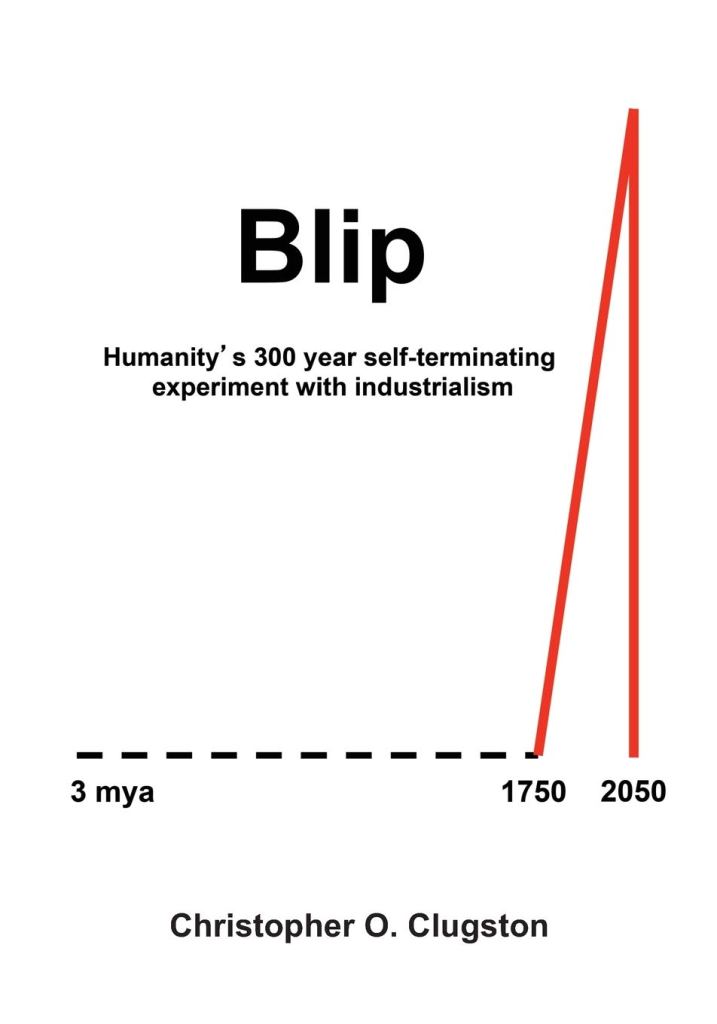
Clugston has written two books: Scarcity in 2012, and Blip in 2019.
His unique contribution is to research our consumption of depleting non-renewable resources. All 100+ of them, not just fossil energy.
For many people, fossil energy depletion is a fuzzy threat because it’s complicated and there are so many cheerleaders of false beliefs. Ditto for the climate change threat with its promoters of green growth and carbon capture machines.
Clugston presents so many tangible non-negotiable threats to modern civilization that after absorbing his work there is no room for doubt and no where to hide.
His conclusion is bleak. Clugston calculates modern civilization will be done by 2050, with or without climate change, with or without peak oil, and with or without any green new deal idea.
Harsh yes, but real, and honest, and helpful for those still trying to make the future less bad, because his work shows that the best path is democratically supported rapid population reduction policies.
Clugston’s visibility on the internet is low. I don’t know it that’s by choice, or because of the unpleasantness of his message. I’d like to see that fixed so the people working to make the future less bad can use his work as ammunition.
What we do to enable our existence simultaneously undermines our existence…
Our enormous and ever-increasing utilization of NNRs (nonrenewable natural resources) – the finite and non-replenishing fossil fuels, metals, and nonmetallic minerals that enable our industrial existence – is causing:
– Increasingly pervasive global NNR scarcity, which is causing
– Faltering global human prosperity, which is causing
– Increasing global political instability, economic fragility, and societal unrest.
This scenario will intensify during the coming decades and culminate in humanity’s permanent global societal collapse, almost certainly by the year 2050.
Since 2005, Chris Clugston has conducted extensive research into human “sustainability”, with a focus on non-renewable natural resources (NNR) scarcity. His goal has been to articulate and quantify the causes, implications, and consequences associated with industrial humanity’s “predicament” – our self-inflicted, self-terminating human/Earth relationship.
Here is the companion video to his book Blip:
Here is a 2012 presentation by Clugston in support of his book Scarcity:
Here is a summary of Clugston’s 2012 book Scarcity:
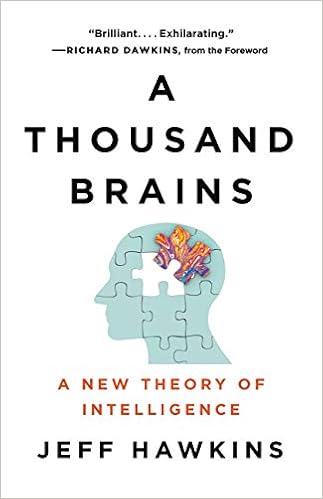
A bestselling author, neuroscientist, and computer engineer unveils a theory of intelligence that will revolutionize our understanding of the brain and the future of AI.
For all of neuroscience’s advances, we’ve made little progress on its biggest question: How do simple cells in the brain create intelligence?
Jeff Hawkins and his team discovered that the brain uses maplike structures to build a model of the world-not just one model, but hundreds of thousands of models of everything we know. This discovery allows Hawkins to answer important questions about how we perceive the world, why we have a sense of self, and the origin of high-level thought.
A Thousand Brains heralds a revolution in the understanding of intelligence. It is a big-think book, in every sense of the word.
I’ve followed Hawkins for many years and he’s one of my favorite neuroscience researchers. He started as an electrical engineer and created in 1996 the groundbreaking handheld PalmPilot (which I owned 🙂 ), and then switched careers to his passion of figuring out how the brain works.
In his book he proposes a new theoretical framework for how intelligence works. I think he’s on to something important. So does Richard Dawkins who wrote the forward and compares the book to Charles Darwin’s On the Origin of Species.
I see an opportunity to build on Hawkins’ intelligence framework to push Varki’s MORT theory forward by refining why and what we deny, and how denial is implemented in the brain. Some of my still rough ideas are presented at the end of this essay.
There’s a second aspect of Hawkins’ book that is also interesting.
After presenting his new theory on intelligence, Hawkins spends the last half of the book explaining how our old brain behaviors and false beliefs (aka denial) threaten the survival of our species, and he proposes several ways we might avoid these threats.
He’s clearly worried and knows we are in trouble.
Yet when discussing the threats to our species he is blind to the biggest, imminent, and certain threat we face: fossil energy depletion. Hawkins, like most polymaths, can’t see that the technology he loves, was created by, and totally depends on, rapidly depleting non-renewable resources.
So we have a world expert on how and why our brain creates false beliefs, that can’t see his own false beliefs.
We could ask for no better evidence that MORT is true!
But wait, there’s more.
In the last chapters Hawkins obsesses over inventing a lasting means for our species to signal to other life in the universe that human intelligence once existed. As I was reading this I kept thinking, what the hell are you going on about? The odds are extremely low that other intelligent life will ever see our signaling satellites, and who the hell cares if they do? Then a light went on. His signal is a high tech version of an Egyptian pyramid, and is his brain’s mechanism for denying death.
So how could it get any better?
a well written enjoyable book
with an important new theory
on the most interesting aspect of a unique species
that may push forward Varki’s MORT theory on why we exist
by a brilliant polymath
that is blinded by the same denial that created his species
Following is a brief recapitulation of Hawkins’ cortical column framework for intelligence integrated with my musings on how it might be used to clarify and focus Varki’s MORT theory.
This hypothesis will be revised, possibly substantially, after I complete a 2nd more careful reading of Hawkins’ book and published papers, which I’ve just started. I’m also hoping to incorporate criticism from Dr. Varki which may improve or kill my ideas.
Downvoting the Cortical Column Death Model to Breach the Extended Theory of Mind Barrier
Version 1.2, April 17, 2021
Note: For the sake of brevity, every occurrence of “not die” should be read as “not die until viable offspring are produced”.
Genes evolve and collaborate to create bodies.
Bodies exist to replicate genes.
A body must not die to achieve its purpose of replicating genes.
The brain exists to help the body by choosing the best action to not die for a given set of sensory inputs.
The old brain uses simple static models to directly cause actions to not die.
The neocortex uses more complex learned models to indirectly cause actions to not die by requesting the old brain to execute actions.
Learning is moving: the neocortex learns by moving senses around the subject to create (up to about 1000) reference frame models.
Thinking is moving: concepts without physical form, like mathematics, are learned by moving between models to create new reference frame models.
Models have redundancy which makes knowledge more resilient and repurposable.
Models are stored in cortical columns.
The neocortex is composed of many nearly identical cortical columns.
Senses (and outputs from other models) are evaluated for matches by models.
Models collaborate by voting to decide our conscious reality.
The agreed reality is used by other models to select the best action to not die.
Evolution increases the number of cortical columns in species that benefit from more intelligence to not die.
Social species have the most cortical columns because modeling social relationships is hard.
The human neocortex has about 150,000 cortical columns.
There are two important thresholds on the continuum of increasing social intelligence.
“Theory of mind” is the threshold where a brain learns a model of another brain, and that model includes an understanding that the other brain can die.
“Extended theory of mind” is the threshold where a brain learns that its model of another brain also models itself, and that it can also die.
The extended theory of mind threshold may be difficult for evolution to cross, because it has happened only once on this planet.
A model that predicts possible death from injury and certain death from old age results in fewer actions to not die.
Fewer actions to not die is called depression.
Genes for an extended theory of mind thus do not persist.
To break through the barrier, evolution requires a mechanism to prevent the learned death model from evaluating true.
A mechanism consistent with the archeological record was to learn a model for life after death (aka God) which downvotes the death model thus continuing the actions to not die.
Modern Implications of the Death Model
Climate change acceptance combined with the common false belief that renewable energy can replace depleting non-renewable fossil energy, and the common false belief that technology can remove sufficient CO2 from the atmosphere, does not trigger the death model, and the false beliefs cause our species to take actions that worsen our overshoot predicament.
Awareness of human overshoot and its implications are present in less than 0.01% of humans, including most highly educated polymaths, because it triggers the death model. Most people deny overshoot with false beliefs that non-renewable resources are abundant.
I salute Martenson’s honesty for explaining how difficult it has been to make a living from overshoot education.
As an aside, I don’t think he’s aware of it, but the reason it’s so hard to teach overshoot is explained by Varki’s MORT theory.
It seems there were 3 key problems at Peak Prosperity:
insufficient revenue from selling overshoot education;
one partner who wanted to focus on science based journalism, and one partner who wanted to focus on how to profit from the coming economic collapse;
a threat to revenue from YouTube’s censorship of Martenson’s excellent science based COVID-19 journalism.
Martenson shared something that troubles me (even more than I already was) about out future:
I created the Crash Course in 2008 because it didn’t exist. I’m proud of all that the Crash Course has accomplished – without it Peak Prosperity would never have come into being – and while it represents some of the best work of my life (so far), if it didn’t already exist I would not invest the time to create the Crash Course today.
Why not? Because the world has changed and I don’t think it would be even slightly receptive to that material now. The Crash Course had a huge impact in 2008. My assessment is that today it would fall flat and gain little traction. The programming against critical thinking and independent thought is too pervasive and successful. In brief, from my perspective,the world has gone a bit mad. It’s lost its grip on reality.
In case you aren’t aware of it, Martenson’s Crash Course is the best introduction to our overshoot predicament available anywhere. It was instrumental on my personal journey to awareness, and I thank Martenson for his excellent work.
There are two dimensions to his statement that trouble me.
First, Martenson is saying that citizens today are less interested in understanding reality than they were 10 years ago. It’s a concern because to reduce future suffering we need the overshoot awareness trend to be increasing rather than decreasing. The more we grow our population, deplete critical resources, degrade ecosystems, and inflate our debt bubble, the greater the eventual suffering we will experience. By denying an unpleasant reality we are making the eventual reality more unpleasant.
Although I think I understand the underlying reason for this trend, which is that our genetic tendency to deny reality is proportional to the unpleasantness of the reality, and our predicament today is much much worse than it was 10 years ago, it still deeply troubles me.
Second, Martenson is saying that if he were to start Peak Prosperity today he would not invest the time to create the Crash Course because insufficient people would pay for it.
Martenson is one of only two individuals out of eight billion (the other being Nate Hagens) that has taken the time to create a high quality video course on everything every citizen should understand to be a good citizen.
And he says he wouldn’t do it again because no one would watch it.



 un-Denial